Ponte Vecchio: Florence's Ancient Bridge of Gold
Ponte Vecchio is Florence's oldest and most photographed bridge, spanning the Arno River since 1345. Free to cross at any hour, it carries a corridor of jewellers' shops above three low medieval arches, with the secret Vasari Corridor running overhead. Here is everything you need to know before you go.
Quick Facts
- Location
- Ponte Vecchio, 50125 Firenze FI — connecting Centro Storico to Oltrarno across the Arno
- Getting There
- 15-min walk from Santa Maria Novella station; 10 min from the Duomo; 3 min from Piazza della Signoria
- Time Needed
- 20–45 minutes to cross and browse; longer if you plan to buy jewellery
- Cost
- Free — the bridge is a public pedestrian crossing open 24 hours, every day of the year
- Best for
- Early morning walkers, architecture enthusiasts, photography, and anyone crossing between the historic centre and Oltrarno
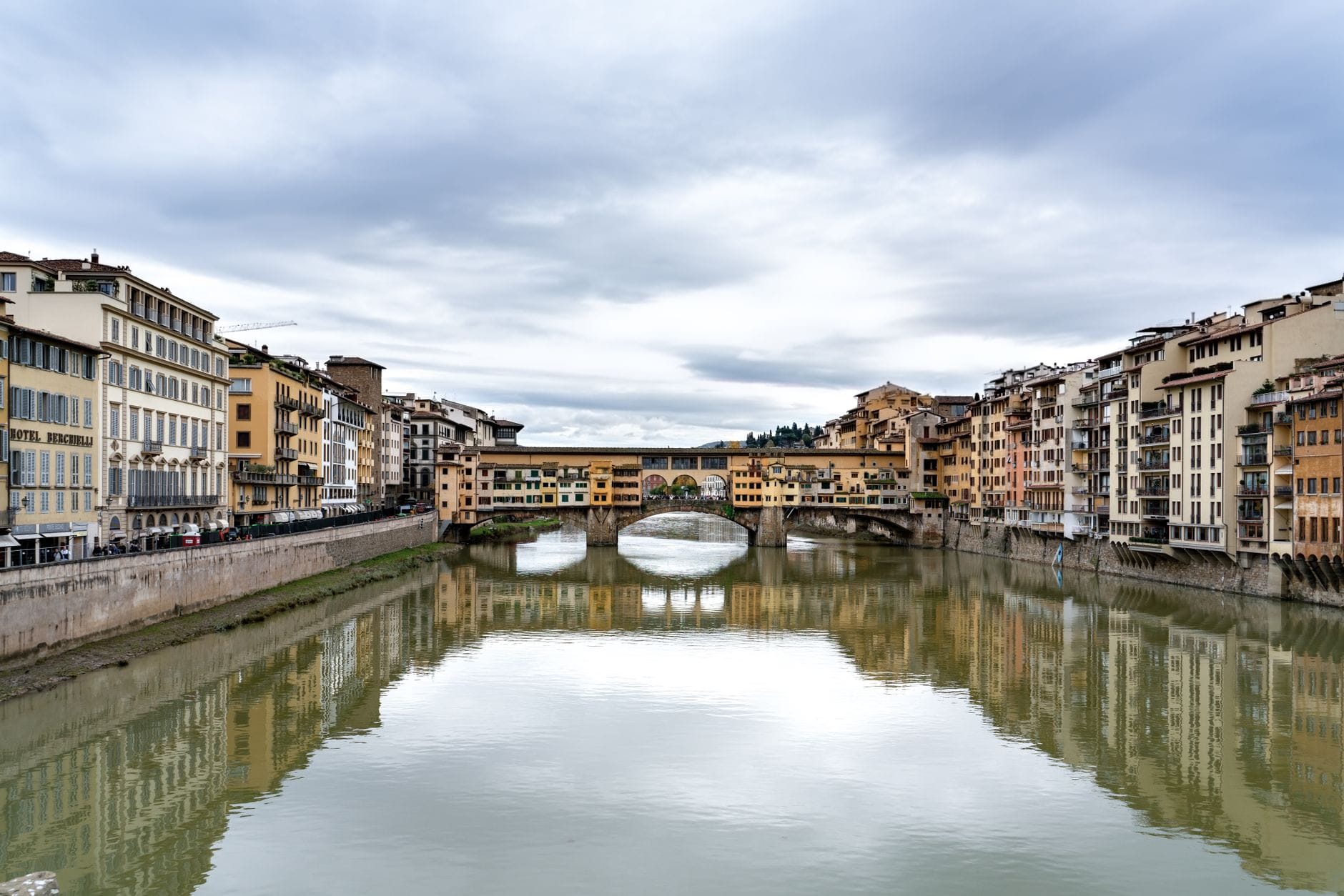
What Ponte Vecchio Actually Is
Ponte Vecchio, literally 'Old Bridge' in Italian, is a medieval stone bridge crossing the Arno River at its narrowest urban point. It is not a museum, not a ticketed attraction, and not a pedestrian mall. It is a functioning public bridge that happens to carry a continuous row of small jewellery and goldsmith workshops along both its sides, with a secret elevated corridor running above them. That combination of ordinary infrastructure and layered history is precisely what makes it unlike any other bridge in the world.
A bridge has stood at this location since Roman times, but the current stone structure was rebuilt after a catastrophic flood in 1333 and completed around 1345. Architecturally, it is classified as a closed-spandrel segmental arch bridge with three wide, low spans, and it is recognised as one of the earliest prominent segmental arch bridges in the Western world. The arches are unusually flat and broad for their era, which gave the bridge a visual horizontality that still looks modern against the river.
ℹ️ Good to know
Ponte Vecchio is free to cross at any time of day or night, 365 days a year. No ticket, no reservation, no entry system. Just walk.
The Shops: From Butchers to Goldsmiths
The bridge originally housed a variety of tradespeople, most notoriously butchers, who used the bridge's proximity to the river to dispose of waste. In 1593, Cosimo I de' Medici issued a decree restricting the shops to goldsmiths and jewellers, a regulation that still defines the bridge today. Step inside one of the narrow workshops and you will see rings, necklaces, and pendants displayed in glass cases barely wider than a kitchen countertop, the sales staff close enough to make small talk unavoidable.
The quality and price ranges vary considerably from shop to shop. Some workshops produce their own pieces; others stock mass-market items aimed at tourists. If you are seriously considering a purchase, take time to look at multiple vendors and ask whether pieces are made in-house or imported. The better goldsmiths will typically show you hallmarks and origin details without being asked.
Gold jewellery here is sold by weight as much as by design, so comparing prices requires understanding the gram price for the karat you are buying. For context on Florence's broader artisan and craft scene, theLeather School of Florencenear Santa Croce offers a similar workshop-to-retail experience in a different craft tradition.
Tickets & tours
Live prices and dates from our booking partner. If you book, we may earn a commission at no extra cost to you.
Florence walking tour at sunset with wine tasting
From 55 €Instant confirmationFree cancellationPalazzo Vecchio secret passages tour with lunch or gelato tasting
From 47 €Instant confirmationFree cancellationPalazzo Vecchio and Salone dei Cinquecento guided tour
From 65 €Instant confirmationFree cancellationBest of Renaissance and Medieval Florence walking tour
From 20 €Instant confirmationFree cancellation
The Vasari Corridor: The Secret Passage Above Your Head
Running directly above the shops on the bridge's eastern side is the Vasari Corridor, an elevated enclosed passageway commissioned by Cosimo I de' Medici in 1565 and designed by Giorgio Vasari. It was built to allow the Medici family to move privately between their political seat at Palazzo Vecchio and their residence at Palazzo Pitti, crossing the Arno without mixing with the public. The corridor stretches over one kilometre and passes through multiple buildings and above the rooftops of the Oltrarno.
From the bridge itself you can see the corridor's distinctive row of small square windows running along the upper storey above the shops. Access to the corridor has historically been restricted, but it has reopened to the public in recent years as part of theUffizi Gallerycomplex. Check current Uffizi booking information before your visit, as access arrangements and availability change.
How the Experience Changes by Time of Day
At dawn, Ponte Vecchio belongs almost entirely to joggers and photographers. The pale stone glows warm against the grey-green Arno, the shutters on the shops are still rolled down, and the only sounds are water and distant church bells. The Arno's surface reflects the bridge in near-perfect symmetry from the viewing points on either bank, particularly from the Lungarno degli Archibusieri to the north. This is unambiguously the best time for photography and for simply experiencing the bridge as a piece of architecture rather than a commercial corridor.
By mid-morning the shops open and foot traffic builds rapidly. By late morning on a summer day, the bridge can feel genuinely compressed: two streams of people moving in opposite directions through a passage narrowed further by shop displays and onlookers pausing at the central gap in the buildings, the only open-air section in the middle of the bridge where you can look directly up and down the Arno. Conversation at normal volume becomes difficult. The scent of warm stone mixes with coffee drifting from a nearby bar.
Late afternoon, especially in spring and autumn, brings softer light and slightly thinner crowds than midday. Sunset from the Arno riverbanks, with the bridge silhouetted against an orange sky, draws its own audience of photographers and couples. In midsummer the bridge at dusk remains warm and busy well into the evening. On winter weekday mornings, you may find it almost quiet.
💡 Local tip
The best unobstructed view of Ponte Vecchio from the riverbank is from the Lungarno degli Archibusieri on the north side, or from the Ponte Santa Trinita a few hundred metres upstream. Arrive before 8am in summer for photography without crowds.
World War II and the Bridge's Survival
In August 1944, retreating German forces destroyed every bridge in Florence to slow the Allied advance except for Ponte Vecchio. The reasons for this exception are not definitively documented; one widely cited account suggests Hitler personally ordered it spared, though this claim is difficult to verify from primary sources. What is documented is that the medieval bridge survived while the bridges immediately around it were demolished. The buildings on both Arno banks near the bridge were destroyed by the Germans to block access approaches, and the scars of that reconstruction are visible in the buildings flanking the bridge ends today, notably more uniform and 1950s in character than the medieval fabric surrounding them.
The bridge also survived the catastrophic 1966 Arno flood, though shops on the bridge suffered significant damage. It is a structure that has outlasted wars, floods, and centuries of use without losing its fundamental medieval form.
Getting There and Navigating the Area
Ponte Vecchio sits at the southern edge of theCentro Storico, roughly three minutes on foot from Piazza della Signoria and about ten minutes from the Duomo. From Santa Maria Novella railway station, the walk takes approximately fifteen minutes through the historic centre. There is no direct public transport stop at the bridge itself; the nearest tram and bus connections are at Santa Maria Novella or along the Lungarno.
The bridge is the main pedestrian link between the historic centre and theOltrarnodistrict on the south bank. Cross it heading south and within a few minutes you reach thePitti Palaceand the Boboli Gardens. The bridge is a natural midpoint on any walking route connecting these two halves of the city.
The bridge itself has no steps and a gently sloping stone roadway, making it broadly accessible for wheelchair users and those with mobility aids. The main practical challenge is crowd density at peak hours, which can make slow or careful movement difficult. The shop interiors are small and may have threshold steps; accessibility varies by individual premises.
⚠️ What to skip
Avoid the bridge between 10am and 5pm in July and August if you are sensitive to crowds. The central section becomes genuinely compressed, and navigating with luggage, a pushchair, or mobility aids is frustrating. Early morning or after 7pm are significantly more comfortable in summer.
Photography and Practical Tips
The most reproduced view of Ponte Vecchio is from the riverbank rather than from the bridge itself. Position yourself on the Lungarno degli Archibusieri on the north bank, or walk to the Ponte Santa Trinita for a slightly elevated angle looking east. Both positions are public and free. The light is best in the hour after sunrise when it catches the south-facing facades of the shops, and in the thirty minutes before sunset when the entire structure goes warm amber.
From on the bridge, the open section in the centre, where the shops pause and the side barriers drop, gives a direct view up and down the Arno. This is also the most photographed spot on the bridge itself and tends to attract a small cluster of people at almost any hour. Patience and willingness to wait thirty seconds is usually enough to get a clean shot.
If you are building a broader itinerary around the city's most celebrated viewpoints, the guide tobest views in Florencecovers the full range of vantage points, including Piazzale Michelangelo and the Duomo terrace.
Insider Tips
- The padlock railings that once covered the bridge's lamp posts were removed by the city to prevent structural damage. Attaching a padlock anywhere on the bridge is now prohibited and subject to fines.
- If you are buying jewellery, visit the bridge early in the day when shopkeepers are less busy and more willing to explain their pieces and negotiate on higher-value items.
- The open gap in the centre of the bridge is easy to miss if you are navigating through a crowd. Pause here: it is the only point on the bridge with an unobstructed view directly down to the river surface below.
- The buildings at both ends of the bridge, particularly on the north bank, are noticeably more uniform than their surroundings. These date from postwar reconstruction after German forces destroyed the adjacent buildings in 1944 to block access routes to the bridge.
- To see the Vasari Corridor's exterior clearly, look at the upper storey of the eastern side of the bridge. The row of small square windows is directly above the shop rooflines. The contrast between the medieval arches below and the Renaissance gallery above is most visible from the Ponte alle Grazie looking west.
Who Is Ponte Vecchio For?
- Architecture and history enthusiasts who want to understand how a medieval bridge functioned as a commercial and political object simultaneously
- Photographers: the bridge and its reflections in the Arno are among the most compositionally satisfying subjects in Florence at any time of day
- Walkers using it as a route between the historic centre and the Oltrarno, Pitti Palace, and Boboli Gardens
- Jewellery buyers looking for gold pieces made by Florentine goldsmiths, though careful comparison shopping is advisable
- Early risers who want a significant Florentine landmark almost to themselves before the crowds arrive
Nearby Attractions
Other things to see while in Centro Storico (Historic Center):
- Arno River Walk (Lungarni)
The Lungarni are the named embankment streets running along both banks of the Arno River through central Florence. Free to walk at any hour, they offer the city's best unmediated views of the Ponte Vecchio, the surrounding hills, and the slow rhythm of Florentine daily life. No ticket, no queue, no reservation required.
- Brunelleschi's Dome Climb
The climb inside Brunelleschi's Dome is one of the most physically rewarding experiences in Florence. 463 steps through narrow brick passages deliver you to a panoramic terrace above the city's rooftops, with views that no other vantage point in the historic centre can match. Here is everything a traveler needs to plan it well.
- Florence Baptistery
The Florence Baptistery, officially the Battistero di San Giovanni, is one of the oldest and most significant religious buildings in Italy. Standing directly in front of Florence Cathedral, it is famous for Ghiberti's gilded bronze 'Gates of Paradise' and a breathtaking interior ceiling covered in Byzantine mosaics. This guide covers what to expect, when to visit, and how to make the most of your time here.
- Florence Cathedral (Duomo di Firenze)
The Cattedrale Metropolitana di Santa Maria del Fiore is the geographic and spiritual heart of Florence. Free to enter, extraordinary to stand inside, and far more layered than its famous exterior suggests. Here is everything you need to plan a worthwhile visit.
Planning a trip? Discover personalized activities with the Nomado app.