Pitti Palace: Inside Florence's Most Ambitious Royal Complex
Built for a Florentine banker and expanded by the Medici into a dynastic seat, Palazzo Pitti is the largest museum complex in Florence. Spread across a series of interconnected galleries and terraced gardens, it rewards visitors who come prepared and leave the crowds behind.
Quick Facts
- Location
- Piazza de' Pitti 1, Oltrarno, Florence
- Getting There
- Walk from Ponte Vecchio (10 min); city buses C4 and 11 stop nearby
- Time Needed
- 2–4 hours for galleries; add 1–2 hours for Boboli Gardens
- Cost
- Cumulative ticket (Pitti + Boboli + Bardini Gardens) available; check current prices at uffizi.it
- Best for
- Art and history lovers, garden explorers, travellers with a full day in the Oltrarno
- Official website
- www.uffizi.it/en/pitti-palace
What Pitti Palace Actually Is
Palazzo Pitti is not a single museum. It is a sprawling palace complex that contains multiple separate museums, a treasury, a costume gallery, a porcelain collection, a carriage museum, and the Boboli Gardens stretching up the hillside behind it. Most visitors who come expecting one coherent experience are surprised by the scale. A single combined ticket covers all of it, but no one visits everything in a day.
The palace sits on the south side of the Arno in the Oltrarno district, a neighbourhood with a noticeably different pace from the historic centre across the river. The piazza in front of the palace is wide and sun-exposed, paved in large sloping stone blocks that funnel you toward the facade. On busy mornings the square fills with tour groups and school trips. By early afternoon it often empties considerably, especially in spring and autumn.
If you are planning a full day in this part of the city, Pitti Palace combines well with theCappella Brancacci and the Boboli Gardensjust behind the palace itself. The wholeOltrarno neighbourhoodrewards a slow exploration.
💡 Local tip
Book tickets in advance through the Uffizi Galleries official website (uffizi.it). The palace is part of the Uffizi Galleries complex and walk-up queues at the door can be unpredictable, especially from April through October.
The History Behind the Scale
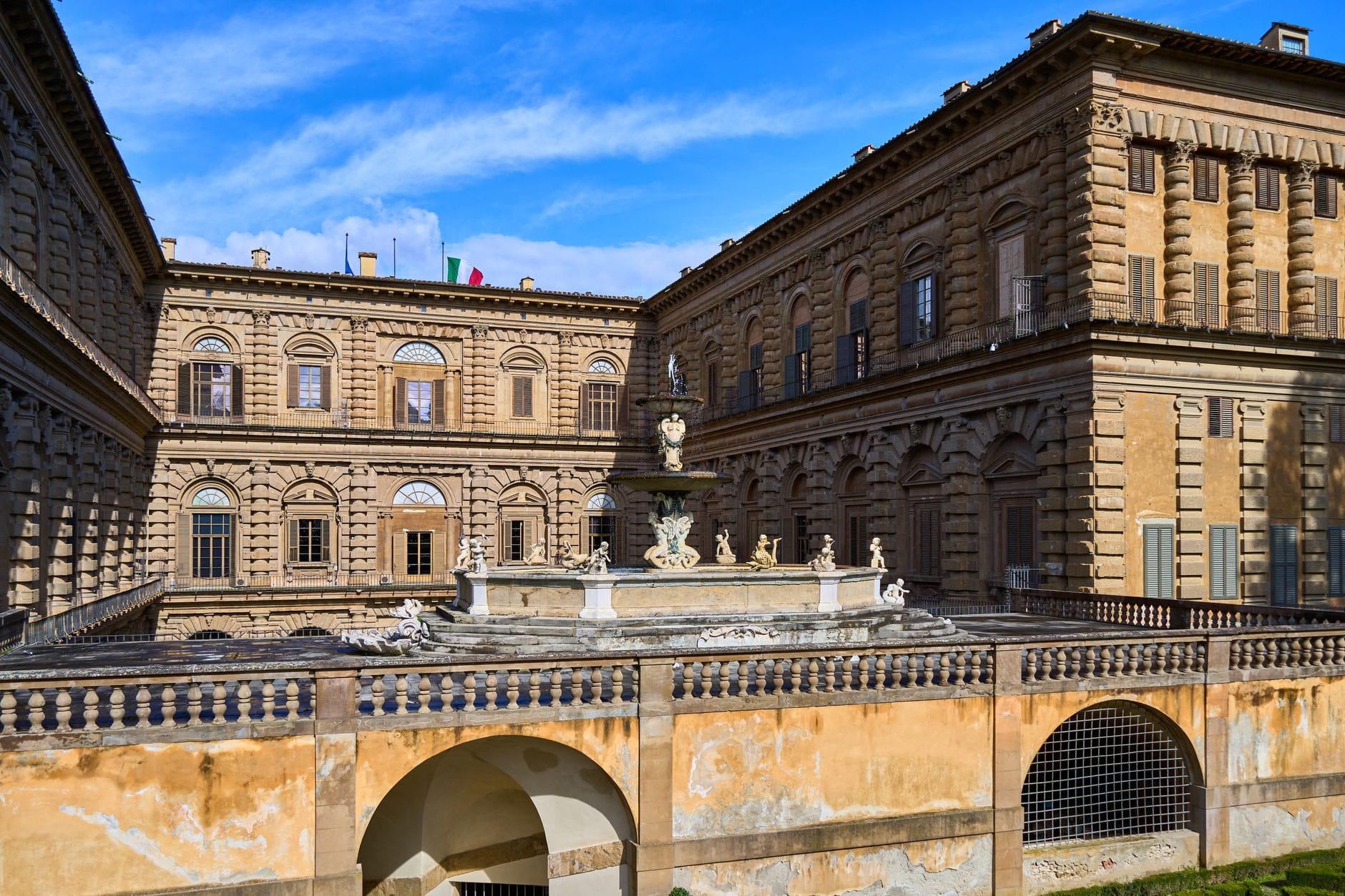
The palace's origins trace back to 1458, when the Florentine banker Luca Pitti commissioned a residence intended to outshine the Medici palaces across the river. The ambition was explicit, the competition personal. Pitti died before seeing the project complete, and the building passed to the Medici in 1549 when Eleonora di Toledo, wife of Cosimo I de' Medici, purchased it. That transfer reshaped the trajectory of the structure entirely.
Under the Medici, the original modest block was expanded dramatically over the following two centuries. The long lateral wings that now frame the courtyard were added in stages, pushing the footprint of the building to its current monumental proportions. After the Medici line ended, the Habsburg-Lorraine dynasty inherited and continued using it as their principal Florentine seat. When Florence briefly served as the capital of the newly unified Kingdom of Italy in the 1860s and early 1870s, the Savoy royal family lived here. In 1919, the complex was donated to the Italian state and opened to the public.
For a deeper read on how the Medici shaped the physical landscape of Florence, theMichelangelo in Florence guideoffers useful context on the family's patronage strategy.
Tickets & tours
Live prices and dates from our booking partner. If you book, we may earn a commission at no extra cost to you.
The Galleries Inside: What to Prioritise
The Palatine Gallery is the centrepiece for most visitors and the section that justifies the trip on its own. It occupies the piano nobile, the main floor of the palace, and contains a collection of Renaissance and Baroque paintings assembled by the Medici and subsequent dynasties. Unlike the Uffizi, where works are displayed in roughly chronological order with curatorial labels, the Palatine Gallery is arranged as the Medici actually hung the paintings: dense, floor-to-ceiling, with large canvases competing for attention. Raphael, Titian, Caravaggio, Rubens and Andrea del Sarto are all represented. The lighting in the frescoed reception rooms changes depending on cloud cover outside, and on overcast mornings the gilded ceilings and heavy velvet draping can make the rooms feel almost oppressive in their richness.
The Royal Apartments, accessible from the Palatine Gallery, show the palace as it was furnished for actual residential use in the nineteenth century. The contrast is instructive: the Medici gallery rooms are about display and collecting, while the Savoy living quarters feel almost domestic by comparison, with layered carpets, family portraits, and wardrobes still in place. Guided tours often skip these rooms, which means they are reliably quieter.
The Gallery of Modern Art occupies the upper floor and covers Italian painting from the late eighteenth to early twentieth centuries. It is regularly undervisited relative to its quality. The Macchiaioli painters, a Tuscan movement that pre-dated French Impressionism in its emphasis on outdoor light and loose brushwork, have a strong presence here. If you have any interest in nineteenth-century European art, this floor is worth the stairs.
The Treasury of the Grand Dukes (Museo degli Argenti) occupies the ground floor summer apartments. It houses the Medici collection of goldsmithing, hardstone vessels, jewellery, and decorative objects, some made by craftsmen the family patronised directly. The rooms themselves are frescoed with elaborate illusionistic architecture from the seventeenth century.
ℹ️ Good to know
The palace is open Tuesday through Sunday, 08:15–18:30, with last entry approximately 60 minutes before closing (currently 17:30). It is closed on Mondays, 1 January, and 25 December. Always confirm hours on the official Uffizi Galleries website before your visit, as they adjust seasonally and for public holidays.
The Boboli Gardens: A Different Kind of Visit
The Boboli Gardens rise steeply behind the palace on a hillside that the Medici terraced and planted over more than four centuries. The gardens are formal in structure but large enough that they never feel manicured to the point of sterility. Cypress alleys lead to open amphitheatres, fountains, grottos with embedded shells and fossils, and clearings with long views across the city. The smell shifts as you move through: cut grass and cypress near the lower terraces, dusty stone and box hedging higher up, occasional wafts of rose or citrus from the parterres.
In summer, the gardens are genuinely cooling after the palace interiors. The upper sections, reached by a long central axis that runs from the palace toward the Forte di Belvedere, are less visited and considerably quieter. The Isolotto, a garden island set in a large oval pond in the lower western section, is one of the more arresting spaces: a walled enclosure surrounded by water, dense with citrus trees and baroque stonework. It looks best in late morning light.
The gardens connect at the upper edge to theForte di Belvedere, which offers some of the best panoramic views over Florence. TheBardini Gardenis a short walk away and is included on the same cumulative ticket.
When to Come and What to Expect at Different Times
The palace opens at 08:15, and the first hour or so is consistently the calmest. By 10:00, tour groups begin arriving in volume, and the Palatine Gallery in particular can feel congested in the rooms with the most famous works. If you arrive close to opening, you can move through the main gallery floors before the groups, then descend to the Treasury or the gardens as crowds build upstairs.
Midday in summer is the hardest time to visit the gardens. The exposed upper terraces have limited shade, and the stone pathways reflect heat significantly. In spring or autumn, midday in the gardens is fine. Winter visits have a particular quality: the gardens are nearly empty, the bare trees reveal the formal geometry of the layout more clearly, and the palace interiors are all the more imposing with thin grey light coming through the tall windows.
Photography inside the galleries is generally permitted without flash for personal use, but tripods and monopods are typically prohibited. The painted ceilings in the Palatine Gallery are difficult to capture without distortion. The Isolotto in the Boboli Gardens and the long cypress avenue are the most photographically satisfying spaces in reasonable light.
⚠️ What to skip
The palace complex involves considerable walking, including stairs and uneven stone surfaces throughout the gardens. Visitors with limited mobility should check the Uffizi Galleries website or contact them in advance to understand which sections are accessible and whether lift access is available for specific galleries.
Getting There and Practical Logistics
Palazzo Pitti is a ten to fifteen minute walk from the Ponte Vecchio, crossing into the Oltrarno and heading south along Via Guicciardini. The route is flat until the final approach to the piazza. City buses C4 and 11 stop in the vicinity if you prefer not to walk. The palace is not directly on a tram line, so most visitors arrive on foot from the centre or by bus.
The main entrance faces the piazza. There is no significant bag storage inside the palace, so leave large luggage at your accommodation. A security bag check is standard at entry. Dress comfortably for a long visit with considerable walking. In summer, bring water. The palace does not have a large cafe on site, though there are options in the piazza and along Via Guicciardini.
If this is your first time in the Oltrarno, theguide to getting around Florencecovers bus routes, walking distances, and transport options across the city in detail.
Who Might Want to Skip It
If you have only a single day in Florence and are focused on Renaissance art, the Uffizi Gallery offers a more curated, chronologically organised experience for that specific purpose. Pitti Palace rewards visitors who have time to move slowly through multiple collections and the gardens. Travellers on tight itineraries who want a single, concentrated masterpiece experience may find the scale more frustrating than rewarding. The palace also has less signage in English than the Uffizi in some sections, so visitors who rely heavily on labels and interpretive text may want to download the official Uffizi app or hire a guide.
First-time visitors deciding between the two should read theUffizi Gallery guideto understand what each offers before committing time to either.
Insider Tips
- The Gallery of Modern Art on the upper floor is almost always quiet, even when the Palatine Gallery below is packed. It contains serious work and takes around 45 minutes at a reasonable pace.
- The Boboli Gardens close at a different time than the palace interiors and the closing time changes monthly. Check the specific garden hours separately on the Uffizi website when planning your visit.
- The Royal Apartments are included in the standard ticket but are often overlooked by visitors who rush through the Palatine Gallery. They take about 30 minutes and show the palace as an inhabited home rather than a collection space.
- If you are visiting in summer, enter the palace first when it opens and save the gardens for mid-morning, when the low terraces are shaded and the upper sections have had time to lose their overnight coolness.
- Disabled visitors and one accompanying companion receive free admission under the Uffizi Galleries policy for Pitti Palace and related museums. Confirm current eligibility and documentation requirements directly with the museum before your visit.
Who Is Pitti Palace For?
- Art and history enthusiasts with at least half a day to spare
- Garden and landscape lovers, particularly in spring and early autumn
- Travellers interested in the decorative arts, royal interiors, and Italian design history
- Visitors who want to explore the Oltrarno and combine the palace with the surrounding neighbourhood
- Repeat Florence visitors who have already covered the Uffizi and Accademia
Nearby Attractions
Other things to see while in Oltrarno:
- Bardini Garden
Tucked into the hillside above the Oltrarno neighborhood, the Giardino Bardini is a 4-hectare historic garden offering panoramic views over Florence, a famous wisteria pergola, and a far more intimate atmosphere than its famous neighbor, the Boboli Gardens. Open daily (except the first and last Monday of each month) from April 1 through September 30, it rewards visitors who time their arrival carefully.
- Basilica di Santo Spirito
On the south side of the Arno, away from the crowds of the Duomo district, the Basilica di Santo Spirito stands as one of Florence's most complete Renaissance interiors. Designed by Filippo Brunelleschi in the late 1430s, it offers serene architecture, a Michelangelo crucifix, and a surrounding piazza that feels more Florentine than touristic.
- Boboli Gardens
Spread across 30 hectares behind Palazzo Pitti in the Oltrarno, the Boboli Gardens are one of Italy's finest examples of Italian Renaissance and Baroque garden design. Laid out from the mid-16th century as a private Medici retreat, the grounds combine terraced lawns, shaded groves, monumental fountains, and open-air sculpture across a hillside with sweeping views over Florence.
- Cappella Brancacci
The Brancacci Chapel inside Santa Maria del Carmine holds one of the most significant fresco cycles in Western art. Painted by Masolino, Masaccio, and Filippino Lippi between 1424 and 1481, these images of St Peter's life transformed how painters understood light, space, and the human figure. Visits are intimate by design, capped at 30 people for 30 minutes, making advance booking essential.
Planning a trip? Discover personalized activities with the Nomado app.