Forte di Belvedere: Florence's Best Panorama Above the Oltrarno
Perched on the Boboli hill above Palazzo Pitti, Forte di Belvedere is a 16th-century Medici fortress offering some of the most expansive views over Florence's rooftops and hills. Open seasonally for outdoor exhibitions and panoramic walks, it rewards the uphill effort with a perspective on the city that few tourists bother to find.
Quick Facts
- Location
- Via di San Leonardo 1, Oltrarno (above Boboli Gardens), Florence
- Getting There
- Walk uphill from Palazzo Pitti via Costa San Giorgio or Via di Belvedere; no direct bus to the gate
- Time Needed
- 1 to 2 hours
- Cost
- €5 full price / €3 reduced; free for Metropolitan City of Florence residents
- Best for
- Panoramic views, outdoor contemporary art, architecture lovers, and anyone who wants a quieter alternative to crowded city squares
- Official website
- musefirenze.it/musei/forte-di-belvedere
What Is Forte di Belvedere?
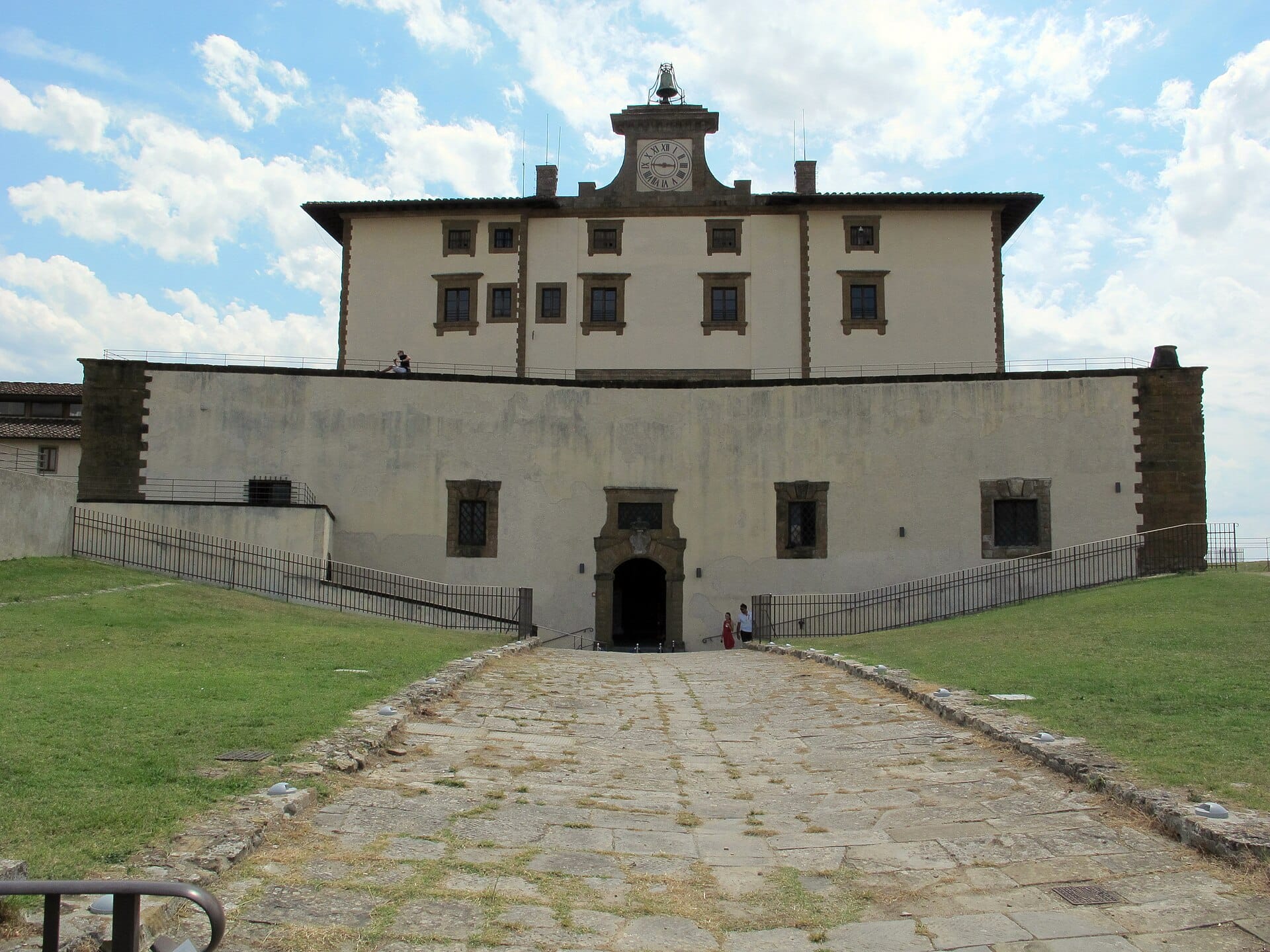
Forte di Belvedere, officially the Fortezza di Santa Maria in San Giorgio del Belvedere, is a late-Renaissance military fortress built between 1590 and 1595 on the orders of Grand Duke Ferdinando I de' Medici. The architect was Bernardo Buontalenti, one of the most technically gifted designers of the Florentine Mannerist period, and the result is a structure that blends defensive rigour with an almost theatrical sense of theatre. The fort sits on the high ridge of the Boboli hill on Florence's south bank, in the Oltrarno quarter, and from its bastions the city spreads below in almost every direction.
The fortress served two purposes simultaneously: it was a military stronghold capable of defending the Medici from external threats and, if necessary, from Florentine rebellion, and it was a private retreat connected to the Palazzo Pitti complex by a garden path and to the wider Medici network via the final leg of the Vasari Corridor. That combination of political power and domestic luxury is very much the Medici signature, and it is legible in the architecture today.
Today the fort functions as a seasonal civic cultural space managed by the Musei Civici Fiorentini (MusE Firenze), hosting rotating open-air exhibitions from June through October. The interiors are generally not open to the public; the draw is the outdoor terraces, the fortification walls, and the views. If you are building a broader itinerary around Oltrarno's cultural weight, consider combining this with a visit to theBoboli Gardens and Palazzo Pitti, both of which sit directly below the fortress.
ℹ️ Good to know
Opening season 2026: Tuesday to Sunday, 10:00–20:00 (last admission 19:00), from 24 June to 26 October. Closed on Mondays. Admission: €5 full price, €3 reduced. Free for residents of the Metropolitan City of Florence and for various other categories including under-18s and ICOM cardholders. Verify current prices and hours at musefirenze.it before your visit, as seasonal schedules can change.
The Climb Up: Getting There and What to Expect on the Way
There is no shortcut. Every approach to Forte di Belvedere involves a sustained uphill walk on narrow streets that were laid out for Medici-era feet and mule carts, not modern tourism. The most common route begins at Palazzo Pitti, cuts through the edge of the Oltrarno and climbs via Costa San Giorgio or Via di Belvedere. The cobblestones are uneven and in places the gradient is steep enough that you will want flat, grippy shoes. Allow 15 to 20 minutes of walking from Piazza de' Pitti.
The walk itself is worth taking slowly. Costa San Giorgio passes between ochre-coloured palazzo walls, with views beginning to open up over terracotta rooftops before you even reach the fortress. You may hear birdsong, the occasional scooter labouring up the hill, and very little else. In the summer months the shade of the high walls provides some relief from midday heat, but the exposed terraces at the top can feel intense between noon and 3pm.
Visitors with mobility impairments or motor disabilities can reach the fortress by car and leave it in a dedicated parking area just close to a pedestrian access leading to the entrance; the outer spaces are partially accessible, though the irregular surfaces of a 16th-century fortress mean some areas are easier to navigate than others. Contact the venue in advance if accessibility is a concern.
💡 Local tip
Wear proper walking shoes. The stone surfaces are worn smooth in places and get slippery after rain. A light layer is useful in the morning even in summer, as the hilltop catches the wind before the city heats up.
Tickets & tours
Live prices and dates from our booking partner. If you book, we may earn a commission at no extra cost to you.
Perfume masterclass: a sensory experience in Florence
From 70 €Instant confirmationFree cancellationFlorence cathedral complex and Brunelleschi's dome tickets
From 59 €Instant confirmationMedici series tour in Palazzo Medici Riccardi
From 90 €Instant confirmationFree cancellationPalazzo Vecchio secret passages tour with lunch or gelato tasting
From 47 €Instant confirmationFree cancellation
The Views: What You Actually See From the Bastions
The panoramic quality at Forte di Belvedere is genuinely different from what you get at Florence's other famous viewpoints. From Piazzale Michelangelo, the view is composed and photogenic but it is shared with dozens of tour buses and hundreds of people at almost any hour. From the Forte, the view is wider, higher, and far less crowded. On a clear morning, the arc from the Duomo across to the Arno bridges, then up to Fiesole and the Apennine foothills, feels almost private.
The fortress looks north over the city's historic centre, and on cloudless days the sight of Brunelleschi's dome rising above the terracotta field is precisely as arresting as every photograph suggests, without the photograph's compression. To the south and west, the Tuscan hills roll in pale greens and greys. The tower of the Palazzo Vecchio is visible, and if you know where to look, you can trace the roofline of theVasari Corridorrunning from Palazzo Vecchio to the south side of the Arno.
The best light for photography is in the morning, when the sun is behind you as you face north over the city. By late afternoon the angle reverses and the Duomo and tower are partially backlit, which creates a different quality of image but makes detail work harder. Sunset can be spectacular from the western bastions, though the fortress closes at 20:00 and Italian summer sunsets tend to fall close to that hour, so the timing is tight.
💡 Local tip
Photography tip: Arrive between 9:00 and 11:00 for soft directional light across the city. A standard 24–70mm equivalent lens covers most compositions; the view is wide enough that ultra-wide lenses tend to miniaturise the Duomo. A UV filter or lens hood helps with morning haze.
The Fortress Itself: Architecture and Medici History
Buontalenti designed the Forte di Belvedere as a star-shaped fortification with four angular bastions, a form that was the state of the art in late-16th-century military architecture, intended to eliminate the dead angles that medieval towers left vulnerable to cannon fire. The central palazzina, a small two-storey residence within the walls, was built for Ferdinando I as a private retreat. It is compact and elegant rather than grand, which makes the contrast with the muscular outer defences all the more interesting.
The walls are built from pietra forte, the same warm grey-brown sandstone used throughout Florentine civic architecture. Up close the surface has a rough, almost grainy texture, and sections of the wall show the weathering of four centuries. The geometrical precision of the bastions is most apparent when viewed from the terraces above, where the star-fort plan becomes readable as a whole.
Historically, the fort represented the final defensive link in a network that ran from the Palazzo Vecchio, through the Uffizi, across the Ponte Vecchio, and up to Palazzo Pitti and the Boboli Gardens. The Vasari Corridor formed the secure passage through this chain, allowing the Medici to move between their public and private palaces without entering the streets. For a full sense of how that system functioned and what it looked like at street level, theMedici Florencehistorical context is worth understanding before your visit.
Seasonal Exhibitions and Cultural Programming
Since the late 20th century, Forte di Belvedere has functioned primarily as a venue for temporary outdoor art exhibitions rather than as a permanent museum. The programming rotates each season and has historically included large-scale sculpture installations and contemporary art shows that use the terraces, bastions and open-air spaces as a setting. The outdoor context is integral to how the work is presented; you are as much looking at the fortress as at the art, and vice versa.
The quality and scale of exhibitions varies from season to season. In some years the programming has been genuinely ambitious, with internationally recognised artists. In others it is more modest. Before you make the fortress a priority, it is worth checking what is currently showing at the MusE Firenze website. If there is no exhibition, the site still opens to the public for the views and the architecture.
⚠️ What to skip
The fortress is a seasonal venue, typically open from early June to late October only. Outside these months it is closed entirely to the public. If you are visiting Florence in spring or winter, plan your itinerary around other viewpoints such as Piazzale Michelangelo or the Brunelleschi Dome.
Practical Walkthrough: How to Plan Your Visit
A straightforward visit to Forte di Belvedere takes about an hour if you walk the perimeter, study the architecture and spend time with the views. If there is a substantial exhibition showing, add another 30 to 45 minutes. Most visitors will not need more than 90 minutes total, which makes it easy to combine with the Boboli Gardens or a walk down through the Oltrarno.
The most logical pairing is a morning at the fortress followed by lunch in the Oltrarno neighbourhood below. The area around Santo Spirito has a range of trattorie and wine bars that draw locals as much as tourists. From the fortress you can descend through Costa San Giorgio and be on the south bank of the Arno within 20 minutes. TheOltrarno neighbourhoodrewards slow exploration; the streets between Palazzo Pitti and the river are where the artisan Florence that tourists tend to look for still actually exists.
There is no restaurant inside the fortress and there are no major vendor stalls near the entrance, though a café operates on the terraces; bring water, especially in July and August when the exposed hilltop terraces can be genuinely hot by mid-morning. The nearest reliable coffee is back down the hill in the Oltrarno.
If you are deciding between several high viewpoints on the same trip, the Forte offers the widest and least crowded panorama, the Brunelleschi Dome climb offers the most intimate understanding of the cathedral complex from within, and Piazzale Michelangelo is the most accessible for families or groups with mixed mobility. All three reward the effort in different ways. For a ranked comparison and logistics, thebest views in Florence guidecovers each option in detail.
Who Should Skip This Attraction
Forte di Belvedere is not the right choice for everyone. Visitors with significant mobility limitations will find the approach steep and the interior surfaces uneven; while car access and partial accessibility are available, the site was built in the 1590s and that fact is apparent underfoot. Families with very young children or pushchairs may find the cobbled climb and the lack of facilities inside frustrating.
If you have only one day in Florence and need to prioritise, the fortress is probably not the top-line choice over the Uffizi, the Accademia or the Duomo complex. It earns its place in a two- or three-day itinerary where there is room for a slower morning on the Oltrarno hill. Visitors who want air-conditioned interiors, permanent collections, or a café on site should manage their expectations accordingly. Outside the seasonal opening window, it is closed, full stop.
Insider Tips
- Arrive soon after opening on a Tuesday or Wednesday. Weekends draw more visitors and the terraces, though large, feel different with a crowd. The early-week, early-day window offers something genuinely close to solitude at a major Florentine landmark.
- The northern bastion gives the clearest head-on view of Brunelleschi's dome. Walk the full perimeter of the walls before settling anywhere; the southern and western terraces offer a completely different perspective over the Tuscan hills that most visitors miss by stopping at the first good view.
- Free entry for residents of the Metropolitan City of Florence means the fortress draws a local crowd on some evenings that feels quite different from the standard tourist mix. If you time a late-afternoon visit well, the ambience is closer to a Florentine passeggiata than a museum visit.
- Check the MusE Firenze website for the current exhibition before visiting. The admission price does not change based on what is showing, so knowing what you will encounter helps set expectations and prioritise how long to spend inside versus on the terraces.
- The descent via Via di Belvedere towards San Miniato al Monte is a quieter alternative route back to the city. It takes slightly longer but passes the Giardino delle Rose and the hillside gardens below, and avoids retracing your steps entirely.
Who Is Forte di Belvedere For?
- Photographers wanting an uncrowded northern panorama of Florence with the Duomo as the centrepiece
- Architecture enthusiasts interested in late-Renaissance military design and Medici urban strategy
- Travellers on a two- or three-day Florence trip who want a slower morning away from the main museum circuit
- Visitors combining the fortress with the Boboli Gardens and Palazzo Pitti for a full Oltrarno hill day
- Contemporary art followers who want to see what outdoor exhibition the current season is hosting in an extraordinary setting
Nearby Attractions
Other things to see while in Oltrarno:
- Bardini Garden
Tucked into the hillside above the Oltrarno neighborhood, the Giardino Bardini is a 4-hectare historic garden offering panoramic views over Florence, a famous wisteria pergola, and a far more intimate atmosphere than its famous neighbor, the Boboli Gardens. Open daily (except the first and last Monday of each month) from April 1 through September 30, it rewards visitors who time their arrival carefully.
- Basilica di Santo Spirito
On the south side of the Arno, away from the crowds of the Duomo district, the Basilica di Santo Spirito stands as one of Florence's most complete Renaissance interiors. Designed by Filippo Brunelleschi in the late 1430s, it offers serene architecture, a Michelangelo crucifix, and a surrounding piazza that feels more Florentine than touristic.
- Boboli Gardens
Spread across 30 hectares behind Palazzo Pitti in the Oltrarno, the Boboli Gardens are one of Italy's finest examples of Italian Renaissance and Baroque garden design. Laid out from the mid-16th century as a private Medici retreat, the grounds combine terraced lawns, shaded groves, monumental fountains, and open-air sculpture across a hillside with sweeping views over Florence.
- Cappella Brancacci
The Brancacci Chapel inside Santa Maria del Carmine holds one of the most significant fresco cycles in Western art. Painted by Masolino, Masaccio, and Filippino Lippi between 1424 and 1481, these images of St Peter's life transformed how painters understood light, space, and the human figure. Visits are intimate by design, capped at 30 people for 30 minutes, making advance booking essential.
Planning a trip? Discover personalized activities with the Nomado app.