Bardini Garden: Florence's Quieter Hillside Escape with Remarkable Views
Tucked into the hillside above the Oltrarno neighborhood, the Giardino Bardini is a 4-hectare historic garden offering panoramic views over Florence, a famous wisteria pergola, and a far more intimate atmosphere than its famous neighbor, the Boboli Gardens. Open daily (except the first and last Monday of each month) from April 1 through September 30, it rewards visitors who time their arrival carefully.
Quick Facts
- Location
- Via de' Bardi 1, Oltrarno, Florence — entrances also at Costa San Giorgio 2, near Ponte alle Grazie and Forte Belvedere
- Getting There
- No direct tram stop; walk 10-15 minutes south from Ponte Vecchio across the Arno into Oltrarno. Taxi or ride-hailing to Via de' Bardi is practical with luggage.
- Time Needed
- 1.5 to 2.5 hours at an easy pace; allow longer if you stop at the villa cafe or linger at the upper terrace viewpoint
- Cost
- €10 standard adult admission; reduced and combined tickets available. Ticket office closes one hour before the garden closes.
- Best for
- Garden lovers, photographers after city panoramas, couples, and anyone wanting a slower alternative to Florence's major museum queues
- Official website
- www.villabardini.it
What the Bardini Garden Actually Is
The Giardino Bardini is a historic terraced garden covering circa 4 hectares on the hillside above the Oltrarno, Florence's south-bank neighborhood. It sits between the more famous Boboli Gardens and the hilltop Forte di Belvedere, sharing the same ridge but attracting a fraction of the visitors. The garden was acquired in the early 20th century by antiquarian Stefano Bardini, who restructured it into its current form: a layered landscape that combines formal Italian garden design, wilder wooded sections, and an English-style landscape area in the upper reaches.
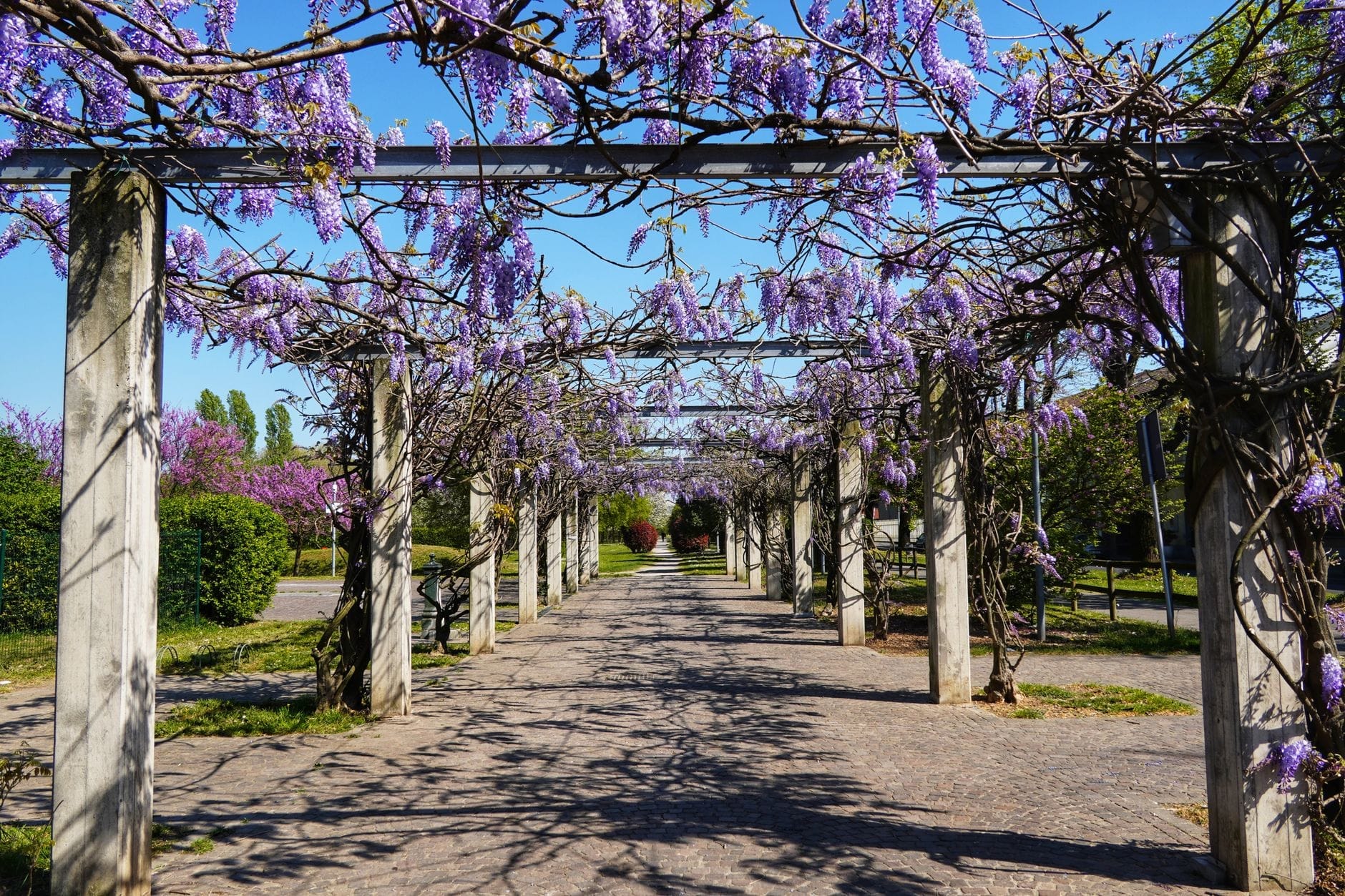
For most travelers, the garden's appeal comes down to two things: the famous wisteria pergola that erupts in purple in late April and early May, and the panoramic terrace overlooking the red-tiled rooftops of Florence, the Arno, and the dome of the cathedral. If you are planning a broader Oltrarno day, the garden pairs naturally with a walk along theArno river walkand a visit to theOltrarno neighborhooditself, which has a genuinely different texture from the tourist-heavy centro storico.
ℹ️ Good to know
Opening hours (April 1 – September 30): daily 10:00–19:30, with the ticket office closing one hour before closing time. The garden is CLOSED on the first and last Monday of each month. Always check the official website before visiting, as seasonal hours outside this window may differ.
The Experience: Moving Through the Garden
You enter from Via de' Bardi 1/r at the lower level, or from Costa San Giorgio 2 higher up the hill. The lower entrance places you at the foot of the garden's grand baroque staircase, a wide stone ramp flanked by stone balustrades and potted lemon trees. The climb is gradual but real — this is a hillside garden, and the path gains meaningful elevation as you move upward. Wear shoes with grip, especially if you visit after rain.
The lower sections are more formal: geometric box hedges, gravel paths, and the pergola structure that becomes the garden's centerpiece in spring. As you ascend, the garden loosens into wilder woodland, with stone benches tucked beneath cypress trees and areas of long grass that feel genuinely untended compared to the clipped precision below. The acoustic shift is noticeable too: the city sounds — the distant hum of scooters, the occasional church bell — filter in and then fade as the tree canopy thickens.
At the upper terrace, the view opens completely. You are looking north over the rooftops of Florence in a wide arc: Brunelleschi's dome to the left, the tower of Palazzo Vecchio cutting the skyline, and the hills of Fiesole on the far horizon. This is a legitimate rival to the view from Piazzale Michelangelo — closer to the city, slightly lower in elevation, and without the tour buses and souvenir sellers that crowd the more famous viewpoint.
Tickets & tours
Live prices and dates from our booking partner. If you book, we may earn a commission at no extra cost to you.
Pitti Palace, Palatine Gallery and Boboli Gardens guided tour for small groups
From 98 €Instant confirmationFree cancellationPitti Palace and Boboli Garden Guided Tour
From 0 €Instant confirmationFree cancellationPitti Palace private tour and Boboli Gardens tickets
From 0 €Instant confirmationPitti Palace private tour and Boboli Gardens tickets
From 0 €Instant confirmation
Timing Your Visit: How the Garden Changes by Hour and Season
Morning visits, arriving close to the 10:00 opening, offer the best light for photography on the upper terrace. The sun rises over the hills to the east, and between 10:00 and 12:00 it catches the dome at a flattering angle. By early afternoon the terrace falls into partial shadow from the trees behind, which is actually pleasant for sitting but less ideal for wide panorama shots.
Late afternoon, particularly in the hour before closing, is the other sweet spot. The lower garden fills with golden light, the lemon scent is stronger in warm air, and visitor numbers thin considerably after 17:00. The garden never reaches the crush levels of the Uffizi or Accademia, but midday in peak summer brings enough visitors to make the narrow upper paths feel congested.
💡 Local tip
Wisteria season runs roughly from late April to mid-May. The pergola — a long barrel-vaulted tunnel of interlocked branches — becomes completely draped in hanging purple flowers during this window. It is the single most photographed element of the garden and worth planning around if you are visiting Florence in spring.
Outside the wisteria window, the garden is at its most colorful in late spring (roses, iris) and least visually dramatic in high summer, when the heat dries the grass and the formal sections look somewhat parched. Autumn brings cooler air and changing leaf color in the woodland section, which has its own appeal.
History and Context: Who Was Stefano Bardini?
Stefano Bardini (1836–1922) was one of the most significant antique dealers and art collectors in 19th-century Italy. He assembled an extraordinary collection of medieval and Renaissance art, sculpture, and decorative objects, much of which he eventually left to the city of Florence. The Museo Bardini, located nearby on Piazza de' Mozzi, houses that collection. The garden came under his ownership in the early 1900s and was restructured to complement Villa Bardini, the residential structure that still stands at the center of the property.
The garden passed through several hands over the 20th century and fell into significant neglect before a major restoration effort returned it to something close to its original state. It reopened to the public in 2007. The restoration preserved the bones of Bardini's layout while clearing decades of overgrowth from the woodland sections. It sits within the broader cultural orbit of Florentine hill gardens — a tradition that also includes theBoboli Gardensand the lesser-knownGiardino delle Rosefurther along the hillside toward Piazzale Michelangelo.
Practical Walkthrough: Getting There and Getting Around
The garden sits in the Oltrarno, Florence's south bank, and is most easily reached on foot from the city centre. Cross the Arno via Ponte alle Grazie (the bridge immediately east of Ponte Vecchio) and walk south along Via de' Bardi for a few minutes — the lower entrance at number 1 appears on your right.
The upper entrance on Costa San Giorgio is useful if you are coming from the direction of Forte di Belvedere or descending from the San Miniato hill. Using this entrance reverses the typical visitor flow and puts the panoramic terrace first, followed by the descent through the formal garden — a sensible approach if you have limited energy or time.
Accessibility is partial. The garden's terrain is inherently uneven, with stone steps, gravel paths, and significant gradient changes. The official listing notes the garden is "limitata" in accessibility and can be visited with an accompanying person for those with mobility limitations, but visitors using wheelchairs or pushchairs should expect genuine difficulty on most of the upper paths.
⚠️ What to skip
The garden is CLOSED on the first and last Monday of each month. This is an easy detail to miss. If your Florence itinerary falls on one of those Mondays, adjust accordingly — the nearby Boboli Gardens or Giardino delle Rose may be alternatives.
Photography Tips and What to Bring
The upper terrace is the priority for city panoramas, but the framing works best with a moderate wide-angle lens rather than a telephoto — the view is about breadth, not isolating individual landmarks. The wisteria pergola is most effective shot from inside the tunnel looking toward the light source, with the hanging flower clusters creating a natural frame. Midday light flattens the texture; early morning or late afternoon are noticeably better.
Bring water, particularly in summer — there is no reliable water fountain along the route once you leave the lower entrance area. Comfortable walking shoes are strongly advised given the stone steps and uneven gravel. If you are building a full Oltrarno afternoon, consider pairing the garden with a stop at thePitti Palace(a 10-minute walk west) or a look inside theCappella Brancaccibefore or after. For those interested in Florence's broader array of viewpoints, thebest views in Florenceguide covers how the Bardini terrace compares to other vantage points around the city.
An Honest Assessment: Is It Worth It?
At €10, the Bardini Garden is priced at a level where expectations should be managed. It is not a grand botanical garden with rare species or elaborate installations. The plant collection is attractive but not exceptional outside the wisteria season, and the villa building itself is not open for general interior visits. What you are paying for is access to a well-maintained historic landscape with a genuinely excellent city view, in a setting that feels calm and unhurried compared to most of Florence's major sites.
Visitors who find the Boboli Gardens too crowded or too sprawling will likely prefer the Bardini. Visitors expecting a world-class botanical experience with labeled species and interpretive signage will be underwhelmed. Those with limited mobility should carefully consider the terrain before committing. For everyone else, on a clear morning in late April with the wisteria in full bloom and the city laid out below the terrace, it is one of the more genuinely satisfying hours you can spend in Florence.
Insider Tips
- The upper terrace view is best between 10:00 and 11:30 on clear days, when the morning sun catches the dome from the east. Arrive at opening to have the terrace almost entirely to yourself.
- The Costa San Giorgio entrance (upper) is significantly less well-known than the Via de' Bardi entrance. Entering from above and descending through the garden reverses the crowd flow and lets you reach the panoramic terrace before most visitors have climbed to it.
- Late April to early May is wisteria season. Book Florence accommodation with this window in mind if the pergola is your primary reason to visit — the display lasts only two to three weeks and varies year to year depending on spring temperatures.
- The Villa Bardini cafe on the property offers a covered outdoor terrace with city views. It is a good option for a coffee or light lunch without leaving the garden — and the view from the cafe terrace is nearly as good as the main upper viewpoint.
- Check the municipal calendar carefully before visiting: the garden is closed on both the first AND last Monday of each month.
Who Is Bardini Garden For?
- Photographers and travelers chasing Florence panoramas without the Piazzale Michelangelo crowds
- Couples looking for a slower, more atmospheric afternoon in the city
- Spring visitors who want to see the wisteria pergola at peak bloom
- Garden history enthusiasts interested in historic Florentine landscape design
- Anyone building a full Oltrarno day combining art, food, and outdoor spaces
Nearby Attractions
Other things to see while in Oltrarno:
- Basilica di Santo Spirito
On the south side of the Arno, away from the crowds of the Duomo district, the Basilica di Santo Spirito stands as one of Florence's most complete Renaissance interiors. Designed by Filippo Brunelleschi in the late 1430s, it offers serene architecture, a Michelangelo crucifix, and a surrounding piazza that feels more Florentine than touristic.
- Boboli Gardens
Spread across 30 hectares behind Palazzo Pitti in the Oltrarno, the Boboli Gardens are one of Italy's finest examples of Italian Renaissance and Baroque garden design. Laid out from the mid-16th century as a private Medici retreat, the grounds combine terraced lawns, shaded groves, monumental fountains, and open-air sculpture across a hillside with sweeping views over Florence.
- Cappella Brancacci
The Brancacci Chapel inside Santa Maria del Carmine holds one of the most significant fresco cycles in Western art. Painted by Masolino, Masaccio, and Filippino Lippi between 1424 and 1481, these images of St Peter's life transformed how painters understood light, space, and the human figure. Visits are intimate by design, capped at 30 people for 30 minutes, making advance booking essential.
- Forte di Belvedere
Perched on the Boboli hill above Palazzo Pitti, Forte di Belvedere is a 16th-century Medici fortress offering some of the most expansive views over Florence's rooftops and hills. Open seasonally for outdoor exhibitions and panoramic walks, it rewards the uphill effort with a perspective on the city that few tourists bother to find.
Planning a trip? Discover personalized activities with the Nomado app.