Giardino delle Rose: Florence's Overlooked Hilltop Garden
Perched on the hillside below Piazzale Michelangelo in the Oltrarno district, the Giardino delle Rose is a free, terraced public garden designed by Giuseppe Poggi in the 1860s. It combines sweeping views over Florence's rooftops with seasonal rose displays, shaded paths, and a noticeably calmer atmosphere than the crowded viewpoint above.
Quick Facts
- Location
- Viale Giuseppe Poggi 2, 50125 Florence
- Getting There
- Walk up from Ponte alle Grazie or the Arno embankment via Viale Giuseppe Poggi; also accessible from the path below Piazzale Michelangelo
- Time Needed
- 45–90 minutes
- Cost
- Free entry
- Best for
- Views over Florence, rose season walks, quiet afternoon breaks
- Official website
- http://verdeonweb.comune.fi.it
What the Giardino delle Rose Actually Is
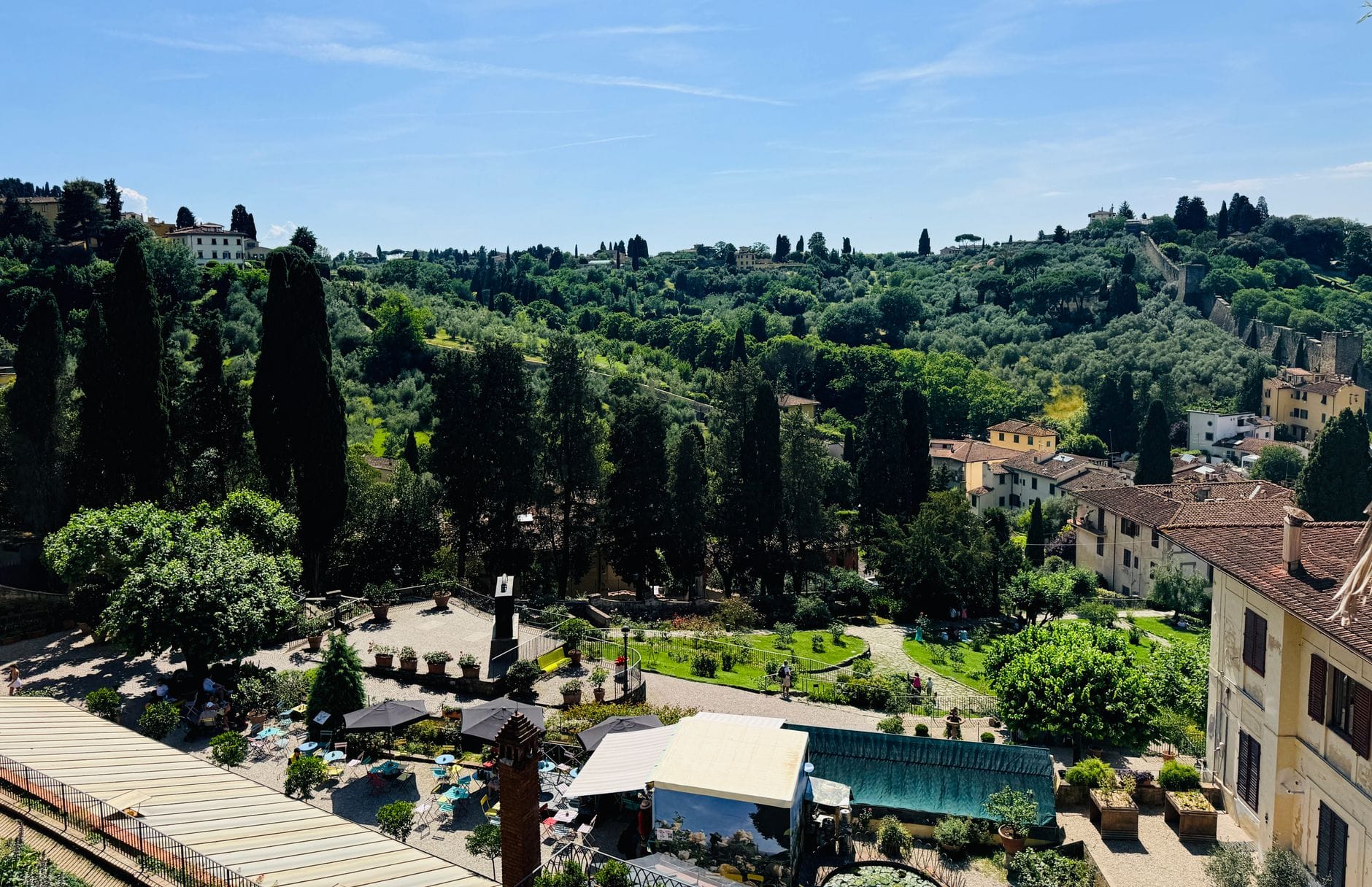
The Giardino delle Rose is a terraced public garden on the southern slope of the hill that also carries Piazzale Michelangelo. Designed by the urban planner Giuseppe Poggi in the 1860s, the garden offers sweeping views over Florence. Where Piazzale Michelangelo offers a wide panorama from a paved esplanade surrounded by tour buses and selfie crowds, the Rose Garden offers essentially the same view in sections, from a sequence of lower terraces, almost entirely without the noise.
Admission is free, making it one of the few genuinely worthwhile zero-cost experiences in a city where entrance fees add up quickly. The address is Viale Giuseppe Poggi 2, 50125 Florence, and the garden is open year-round. Seasonal closing times vary: 20:00 from May through September, 19:00 in April, 18:00 in March and October, and 17:00 from November through February. The garden is closed on Christmas Day and New Year's Day.
💡 Local tip
The garden is partially accessible for visitors with mobility limitations, but the terraced layout means some sections require steps. If accessibility matters, arrive from the main Viale Giuseppe Poggi entrance rather than the upper path from Piazzale Michelangelo.
The View: What You See and When
From the garden's upper terrace, the classic Florentine skyline spreads across the northern horizon: Brunelleschi's dome over Santa Maria del Fiore, Giotto's Campanile, the tower of Palazzo Vecchio, and the green hills of Fiesole in the distance. The composition is nearly identical to the one sold on every postcard in the city, but here you are looking at it through a canopy of rose canes and cypress rather than over a concrete balustrade.
The light shifts considerably across the day. Morning visits, particularly in spring and early autumn, produce soft, direct illumination on the dome and a relative absence of haze. By mid-afternoon in summer, the hill behind the garden creates partial shade on the lower terraces while the view can become slightly washed out in the heat. The most photographically interesting window is roughly the hour before sunset, when the city takes on a warm amber tone and the swifts that spend summers over Florence begin their evening circuits at eye level.
On busy summer days, Piazzale Michelangelo directly above is genuinely overcrowded from mid-morning onward. The Rose Garden, despite sharing the same hillside, rarely reaches the same density. Visitors who arrive at the main Viale Giuseppe Poggi entrance in the early morning will often find themselves nearly alone on the upper terrace, which is remarkable given how close it sits to one of the most visited viewpoints in Italy.
For a broader comparison of panoramic spots across the city, the guide tobest views in Florenceputs this garden in context alongside San Miniato, Piazzale Michelangelo, and the Bardini Garden.
Tickets & tours
Live prices and dates from our booking partner. If you book, we may earn a commission at no extra cost to you.
Ticket entrance to Galleria dell'Accademia and open bus Florence tour
From 57 €Instant confirmationFree cancellationPerfume masterclass: a sensory experience in Florence
From 70 €Instant confirmationFree cancellationFlorence cathedral complex and Brunelleschi's dome tickets
From 59 €Instant confirmationMedici series tour in Palazzo Medici Riccardi
From 90 €Instant confirmationFree cancellation
Rose Season: When the Garden Earns Its Name
The garden's primary horticultural identity is its rose collection, which includes many varieties. Peak bloom typically falls in late April through May, though the exact timing shifts by a week or two depending on the year's temperatures. During this window the terraces are dense with color and the scent is noticeable from the lower paths on still mornings. Varieties range from heritage climbing roses on the stone walls to modern hybrid teas on the central beds, and labels identify most of them, which is useful if you are trying to note a specific cultivar.
Outside of rose season, the garden is still a pleasant place to walk, but its primary attraction becomes the view and the relative quiet rather than the planting itself. The cypress trees along the upper path give structure in winter, and the terraced stone walls and gravel paths retain a Mediterranean coherence even when the beds are bare. If you are visiting specifically for the roses, late April or early May is the reliable target window.
ℹ️ Good to know
A smaller secondary bloom sometimes occurs in September on repeat-flowering varieties, though it is less dramatic than the spring display.
Getting There: The Walk From the Arno
The most straightforward approach on foot begins near Ponte alle Grazie on the Oltrarno bank of the Arno. From there, Viale Giuseppe Poggi curves uphill in a broad arc, following the retaining walls Poggi built as part of the same 1860s urban redevelopment. The walk from the riverbank to the garden entrance takes roughly 10 to 15 minutes at a moderate pace and is largely unshaded in summer, so the morning or late afternoon timing recommended for the garden itself applies to the approach as well.
Alternatively, visitors already at Piazzale Michelangelo can descend to the garden by a path that runs along its southern edge. This is a shorter connection but requires some attention to the terrain, particularly on the irregular stone steps. The garden can also be incorporated into a longer hillside itinerary that continues up to San Miniato al Monte, a Romanesque church with an extraordinary facade that sits about 15 minutes further up the hill.
The broader Oltrarno neighborhoodrewards slow walking. The streets between the Arno and the hillside are lined with artisan workshops, wine windows, and smaller churches that most visitors never find.
Practical Walkthrough: How to Navigate the Garden
The garden is organized on three main terrace levels connected by gravel paths and stone steps. The upper terrace carries the best unobstructed views and is where most visitors spend the majority of their time. The middle and lower terraces are denser with planting, more shaded in the afternoon, and considerably quieter. There are benches throughout, and on weekday mornings the lower terraces attract locals using them as a rest point on their commute up or down the hill.
There is no cafe or food service inside the garden. Water fountains may be present seasonally, but carrying water is advisable, particularly in summer. The terrain is uneven in places and some of the stone paths become slippery after rain, so footwear with grip is sensible if the weather has been unstable. Photography is unrestricted, and tripods are manageable on the wider upper terrace, though the narrow paths on lower levels limit setup options.
⚠️ What to skip
The garden closes earlier than most visitors expect during winter months, at 17:00 from November through February. Arriving after 16:00 in that period risks finding the entrance already shut.
Fitting It Into Your Florence Itinerary
The Rose Garden works well as a standalone 60-minute detour, but it makes more sense as part of a half-day Oltrarno itinerary. A logical sequence might start at the Pitti Palace in the morning, move through the San Niccolò quarter, climb to the garden for the view and a rest, and then continue up to San Miniato before returning to the river via the stepped alleys behind the hill. This route covers the main reasons to spend time on the south side of the Arno without requiring any transport.
If you have not yet explored the Oltrarno side of the city, thethings to do in Florenceguide includes context on how the neighborhoods south of the Arno differ from the tourist-heavy centro storico to the north.
Visitors with children will find the open terrace space manageable, though the uneven paths require attention with strollers. For a broader look at what suits families on the south side of the river, theFlorence with kidsguide covers the most practical options.
Honest Assessment: Who Will Enjoy This and Who Might Not
The Rose Garden is worth the short walk from the Arno for almost anyone who wants a view of Florence without the Piazzale Michelangelo crowd. It is particularly well-suited to visitors who are spending a morning in the Oltrarno and want a quiet place to sit before or after the Pitti Palace and Boboli Gardens circuit.
It is not a destination worth building a day around unless you are visiting specifically during rose season. Outside of that May window, the planting is pleasant but unremarkable by the standards of major Italian formal gardens. Visitors who have already seen the Bardini Garden, which sits nearby and offers a more formally curated landscape, may find the Rose Garden comparatively simple. And anyone expecting the polish of a botanical garden with extensive labeling and interpretation will be underwhelmed. What it offers is atmosphere, access, and a view: three things that remain reliably good at almost no cost.
The Bardini Gardenis a few minutes' walk west and has a ticketed entrance, a more structured layout, and its own elevated terrace overlooking the city, making the two a natural pair on the same afternoon.
Insider Tips
- The upper terrace on the western edge of the garden gets the clearest view of Brunelleschi's dome without foreground obstruction. Walk past the first benches and continue along the wall toward the cypress trees to find it.
- During rose season in late April and early May, visit on a weekday morning before 10:00 to have the terraces largely to yourself. The scent is strongest before midday heat begins to thin the air.
- The path connecting the garden to San Miniato al Monte continues uphill from the top of the garden and takes about 15 minutes. Combining both into a single late-afternoon walk, ending at San Miniato for the view at golden hour, is one of the better free experiences in Florence.
- If you are coming from central Florence, the Ponte alle Grazie crossing adds almost nothing to the walk time compared to Ponte Vecchio, but drops you directly onto Viale Giuseppe Poggi rather than into the San Niccolò crowds.
- The lower terraces are almost entirely unused by tourists and are a good option if you want to sit and read or eat a packed lunch without company. There is shade there from mid-afternoon in summer.
Who Is Giardino delle Rose For?
- Travelers who want Florence's iconic skyline view without the Piazzale Michelangelo crowds
- Visitors in late April or May who want to see the rose collection at peak bloom
- Anyone planning a half-day Oltrarno walk combining the hillside, Pitti Palace, and San Miniato
- Budget-conscious travelers looking for free, genuinely worthwhile experiences in Florence
- Photographers who want soft morning or pre-sunset light over the Florentine rooftops
Nearby Attractions
Other things to see while in Oltrarno:
- Bardini Garden
Tucked into the hillside above the Oltrarno neighborhood, the Giardino Bardini is a 4-hectare historic garden offering panoramic views over Florence, a famous wisteria pergola, and a far more intimate atmosphere than its famous neighbor, the Boboli Gardens. Open daily (except the first and last Monday of each month) from April 1 through September 30, it rewards visitors who time their arrival carefully.
- Basilica di Santo Spirito
On the south side of the Arno, away from the crowds of the Duomo district, the Basilica di Santo Spirito stands as one of Florence's most complete Renaissance interiors. Designed by Filippo Brunelleschi in the late 1430s, it offers serene architecture, a Michelangelo crucifix, and a surrounding piazza that feels more Florentine than touristic.
- Boboli Gardens
Spread across 30 hectares behind Palazzo Pitti in the Oltrarno, the Boboli Gardens are one of Italy's finest examples of Italian Renaissance and Baroque garden design. Laid out from the mid-16th century as a private Medici retreat, the grounds combine terraced lawns, shaded groves, monumental fountains, and open-air sculpture across a hillside with sweeping views over Florence.
- Cappella Brancacci
The Brancacci Chapel inside Santa Maria del Carmine holds one of the most significant fresco cycles in Western art. Painted by Masolino, Masaccio, and Filippino Lippi between 1424 and 1481, these images of St Peter's life transformed how painters understood light, space, and the human figure. Visits are intimate by design, capped at 30 people for 30 minutes, making advance booking essential.
Planning a trip? Discover personalized activities with the Nomado app.