Basilica di Santa Maria Novella: Florence's Gothic Masterpiece at the City Gates
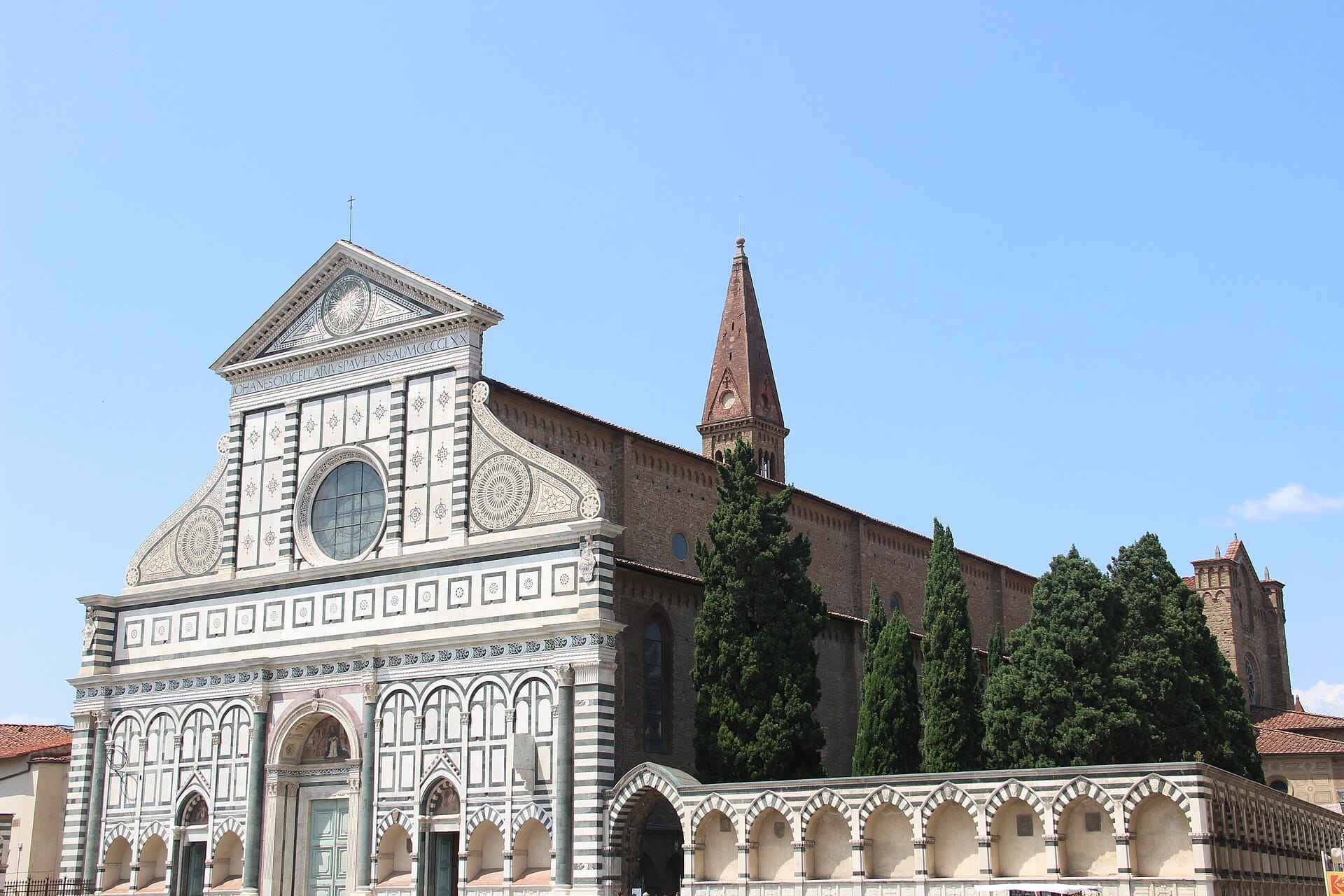
Standing directly opposite Florence's main railway station, the Basilica di Santa Maria Novella is one of the most important Gothic churches in Italy. Its marble façade, designed by Leon Battista Alberti, and its interior packed with frescoes by Ghirlandaio and Masaccio make it a genuine rival to the more famous churches further into the historic centre.
Quick Facts
- Location
- Piazza Santa Maria Novella 18, 50123 Florence — northwest edge of the historic centre, directly opposite Firenze Santa Maria Novella railway station
- Getting There
- About a 2-minute walk from Firenze Santa Maria Novella (SMN) railway station. The T1 and T2 tram lines also stop nearby at the station. On foot from the Duomo: roughly 10 minutes west along Via dei Cerretani.
- Time Needed
- 1.5 to 2.5 hours for church, cloisters, and museum complex
- Cost
- Ticketed entry; current prices include €7.50 full, €5 reduced, and free admission for eligible visitors. Check current prices at the official site: smn.it
- Best for
- Art history lovers, architecture enthusiasts, Renaissance fresco hunters, and anyone arriving by train who wants to start exploring immediately
- Official website
- www.smn.it/it/visita
Why This Church Deserves More Than a Passing Glance
Most visitors to Florence walk past the Basilica di Santa Maria Novella the moment they step off a train, rolling luggage in hand, already thinking about the Uffizi or the Duomo. That is a significant mistake. This Dominican church, construction of which began around 1290 and continued for nearly two hundred years, contains some of the most important artwork in Florence. Masaccio's Trinity fresco, painted around 1427, is the first known painting in Western art to use mathematically correct linear perspective. Domenico Ghirlandaio's cycle of frescoes in the Tornabuoni Chapel is a masterclass in late 15th-century narrative painting. Neither of these things is a minor footnote.
The church was consecrated in 1420, though its famous marble façade came later, commissioned by the Rucellai family and designed by the humanist architect Leon Battista Alberti. The complex also includes a substantial museum occupying the old Dominican convent, built between 1279 and 1357 on the site of a 7th-century church. What you get here is not a single attraction but several layered on top of each other: a Gothic basilica, a Renaissance façade, frescoed cloisters, and a municipal museum, all within one ticket.
💡 Local tip
Opening hours as of 2026: Monday to Thursday 09:00–17:30, Friday 11:00–17:30, Saturday 09:00–17:00, Sunday 13:00–17:00. The ticket office closes one hour before the building closes. Hours may differ on religious holidays — check smn.it before you go.
The Façade: Alberti's Geometric Gamble
Before you go inside, stop in Piazza Santa Maria Novella and look at the façade properly. The lower half, in white and dark green marble, dates from the 14th century and shows Gothic tendencies in its blind arcading and pointed arches. The upper half is entirely different: Alberti's 15th-century addition imposes a strict geometric logic on the composition, using circles, squares, and classical proportions to create something that feels almost mathematical. The two large scroll-shaped volutes at the sides were invented specifically to mask the sloping roof of the nave and solve a visual problem no architect had tackled before in that way. Every architecture student knows this façade. Seeing it in person, particularly in the low morning light when the marble reads in sharp relief, makes the textbook images feel like a pale substitute.
The square itself is long and relatively calm by Florentine standards, partly because tourist traffic here tends to be purposeful rather than drifting. The obelisks at either end of the piazza, supported by bronze tortoises, were placed there by Cosimo I de' Medici to mark the turning posts of chariot races that were held here. That detail tends to surprise people.
Tickets & tours
Live prices and dates from our booking partner. If you book, we may earn a commission at no extra cost to you.
Inside the Basilica: What to Focus On
The interior is a broad Gothic nave with stone columns and the distinctive upward pull of the pointed arches. It is dimmer than you expect after the bright marble of the exterior, and the air carries a faint coolness even in summer. Your eyes adjust slowly. The scale is generous but not overwhelming in the way the Duomo is.
Masaccio's Trinity is on the left wall of the nave, roughly at mid-point. It is not large, but stand in front of it long enough and the illusionistic depth becomes genuinely vertiginous: the barrel-vaulted ceiling Masaccio painted recedes convincingly into the wall, and the skeleton below the painted tomb ledge carries the inscription 'I was once what you are, and what I am you will also be.' It is one of the most quietly powerful works in any church in Italy.
The Tornabuoni Chapel at the high altar, frescoed by Ghirlandaio between 1485 and 1490, is a different experience entirely. Where Masaccio's fresco is compressed and austere, Ghirlandaio's cycle is expansive and socially observant, with contemporary Florentine figures dressed in the fashions of the 1480s inserted into scenes from the lives of the Virgin and St John the Baptist. Note that this chapel is not accessible for mobility-impaired visitors. The Strozzi di Mantova Chapel, which contains Filippino Lippi's later frescoes from the 1490s, is also currently excluded from the accessible route.
⚠️ What to skip
The Tornabuoni Chapel, Rucellai Chapel, and Strozzi di Mantova Chapel are currently not accessible to visitors with mobility impairments. Accessible entry is from the left side of the façade — ring the red button bell. The museum section (convent) has a separate entrance at Piazza Stazione 4.
The Cloisters and Museum: The Undervisited Half
A large proportion of visitors who buy a ticket for the basilica never make it to the museum section in the old Dominican convent, possibly because the entrance is on a different square (Piazza Stazione 4, not Piazza Santa Maria Novella 18). This is worth correcting. The Chiostro Verde, or Green Cloister, takes its name from the greenish terracotta pigment used in the 14th and 15th-century frescoes that line its walls. Paolo Uccello painted scenes from Genesis here around the 1430s, including a remarkable Flood fresco that shows overlapping figures in a state of panic. The logic of space in these frescoes anticipates Renaissance perspective experiments in a way that feels almost restless. For a broader overview of Florence's church art beyond this complex, theguide to the best churches in Florenceputs Santa Maria Novella in useful context alongside its peers.
The Cappellone degli Spagnoli, or Spanish Chapel, is the most spectacular room in the museum: a large Gothic chapter house whose walls are entirely covered in 14th-century frescoes by Andrea da Firenze, depicting the Dominican order's role in Christian society with extraordinary allegorical ambition. The ceiling alone, showing the Triumph of Catholic Doctrine, takes several minutes to fully absorb. The room is cool, quiet, and almost never crowded at the same time as the basilica itself.
Timing Your Visit: How the Experience Changes by Hour
Arriving at opening on a weekday morning (09:00 Monday through Thursday) gives you the interior largely to yourself for the first thirty to forty-five minutes. The light entering from the high windows of the nave is soft and directional at that hour, which is particularly good for observing the tonal range in the Ghirlandaio frescoes. By late morning, especially in peak summer months, school groups and tour buses have typically arrived and the noise level in the nave rises considerably.
Sunday afternoon (the church opens to visitors from 13:00) can work well if you are combining it with the piazza area, but morning Mass runs until early afternoon and the tone of the visit feels slightly different when the building has just been in liturgical use. Friday mornings are a reasonable middle-ground option: the 11:00 opening is later, but tourist volume in the first hour after opening is usually lower than weekday mornings earlier in the week.
The piazza outside is pleasant in the early evening even when the church is closed, particularly around aperitivo hour when the outdoor seating at the cafes on the western side fills up. The white and green marble of the façade catches the warm late-afternoon light well, and the crowds thin perceptibly after 18:00 in spring and autumn.
ℹ️ Good to know
Dress code is enforced: shoulders and knees must be covered. Scarves or disposable coverings are sometimes available at the entrance, but do not rely on this. Wear or carry appropriate clothing, especially in summer.
Practical Walkthrough: Getting There, Getting In, Getting Around
The basilica's location on Piazza Santa Maria Novella, directly opposite the main train station (Firenze Santa Maria Novella, or SMN), is both its greatest practical advantage and, in some ways, its curse. Arriving by train, you can walk to the entrance in under two minutes: exit the station, cross Piazza della Stazione, and you are standing in front of the church. It is the most accessible major monument in Florence from a transport perspective. For those coming from further afield, the T2 tram line connects the airport with the SMN station, meaning this is technically the first major art destination you can reach from Florence Airport without changing transport. For more onnavigating Florence's transport network, including tram and bus options, that guide covers current options in detail.
The main visitor entrance to the basilica is at Piazza Santa Maria Novella 18. Accessible entry is via the left side of the façade — ring the red button. After visiting the church, to continue into the museum and cloisters, exit back onto the piazza, turn right, and walk to Piazza Stazione 4, where the museum entrance is located. Your ticket covers both sections, but the two entrances trip up a notable number of visitors who assume they are connected internally.
Photography inside is generally permitted without flash and without tripods. The cloisters allow more flexibility than the main church nave, where tour group volume sometimes makes careful composition difficult. For photographers interested in architectural subjects across Florence, theoverview of Florence's best viewpointsincludes exterior angles on several major monuments that reward early-morning visits.
An Honest Assessment: Is It Worth It?
Santa Maria Novella is not overhyped. If anything, it benefits from the attention vacuum created by the Uffizi and the Duomo complex absorbing the majority of Florence's tourist energy. The result is that you can stand in front of Masaccio's Trinity, one of the pivotal works in the history of Western painting, without a crowd pressing against your back. That is not something you can say about the Botticellis in the Uffizi.
Visitors with very limited time in Florence who must choose between this and the Uffizi should prioritise the Uffizi. But anyone spending more than one day in the city, or following the footsteps of the major artistic developments of the 15th century, should include Santa Maria Novella without hesitation. It fits naturally into a broaderthree-day Florence itineraryand is especially rewarding if you read even a basic introduction to Masaccio and Ghirlandaio before you arrive.
Who might find it less rewarding: visitors who are not engaged by religious art or architectural history, and those travelling with very young children who need a faster pace and more interactive experiences. The interiors are dim, the artwork requires close looking, and the museum section involves a fair amount of standing in contemplative silence. That is a feature for the right visitor and a drawback for the wrong one.
Insider Tips
- The museum entrance at Piazza Stazione 4 is separate from the church entrance at Piazza Santa Maria Novella 18. Buy one ticket, but plan for two separate entry points. Many visitors miss the cloisters entirely because they do not realise this.
- Masaccio's Trinity is on the left wall of the nave, not near the high altar. It is easy to walk past if you are heading straight for the Tornabuoni Chapel. Go left immediately after entering.
- The Spanish Chapel (Cappellone degli Spagnoli) in the museum section is one of the most completely frescoed Gothic spaces in Tuscany and is almost always quieter than the church itself. Allow at least 20 minutes there.
- Friday mornings have a slightly later opening at 11:00, but the post-opening crowd is typically lighter than the Monday-Thursday rush. Combine it with a walk along the nearby streets of the Santa Maria Novella neighbourhood before the ticket office opens.
- The obelisks in the piazza outside, supported by bronze tortoises, were placed by Cosimo I de' Medici as turning markers for chariot races. It is a small detail that gives the square a different dimension if you know it.
Who Is Basilica di Santa Maria Novella For?
- Art history travellers following the development of Renaissance perspective and fresco technique
- Architecture enthusiasts interested in Alberti's humanist approach to façade design
- Train arrivals wanting to begin their Florence visit with a serious monument rather than heading straight to the hotel
- Repeat visitors who have already covered the Uffizi and Accademia and want to go deeper
- Anyone who prefers contemplative, lower-crowd environments over the city's most trafficked museums
Nearby Attractions
Other things to see while in Santa Maria Novella:
- Officina Profumo-Farmaceutica di Santa Maria Novella
Founded by Dominican friars in 1221 and open to the public since 1612, the Officina Profumo-Farmaceutica di Santa Maria Novella is one of the oldest operating pharmacies in the world. Today it functions as both a boutique museum and a working perfumery, set inside a sequence of frescoed historic rooms steps from Florence's main railway station.
Planning a trip? Discover personalized activities with the Nomado app.