Museo Galileo, Florence: The Science Museum That Belongs on Every Itinerary
Housed in a medieval palazzo a short walk from the Uffizi, Museo Galileo holds one of the world's finest collections of historic scientific instruments, including two of Galileo Galilei's original telescopes. It is consistently overlooked in favour of Florence's art museums, which makes the experience quieter and more immersive than almost anything else in the historic centre.
Quick Facts
- Location
- Piazza dei Giudici 1, Palazzo Castellani, Florence (Centro Storico)
- Getting There
- 10-minute walk from Santa Maria Novella station; 5 minutes on foot from Piazza della Signoria and the Uffizi Gallery
- Time Needed
- 1.5 to 2.5 hours for a thorough visit
- Cost
- Full price €13; ages 6–18 €7; under 6 free; family ticket (2 adults + up to 2 children) €28
- Best for
- History lovers, science enthusiasts, families with older children, and anyone wanting a respite from the crowds at Florence's major art museums
- Official website
- www.museogalileo.it/en/index.html
What Museo Galileo Actually Is
Museo Galileo is Florence's museum of the history of science, and it is one of the most significant collections of its kind anywhere in the world. The full official name is Museo Galileo: Istituto e Museo di Storia della Scienza. Spread across two floors of Palazzo Castellani, a building whose origins date to the Middle Ages, the collection spans roughly a thousand years of scientific inquiry: astronomical instruments, navigational tools, globes, clocks, surgical equipment, early chemistry apparatus, and two original telescopes made by Galileo Galilei himself.
The institution was founded in 1927 by the University of Florence under the name Istituto e Museo di Storia della Scienza. It was rebranded as Museo Galileo in 2010, a name that better signals its centrepiece draw while also honouring the deep connection between Florence, the Medici court, and the scientific revolution that Galileo helped define. The building, once known as Castello d'Altafronte, sits directly on the north bank of the Arno, its facade visible from the river.
💡 Local tip
Opening hours: daily 09:30–18:00, except Tuesday 09:30–13:00. The museum shuts on 1 January and 25 December. Last admission is 30 minutes before closing. Online booking adds a €1 per ticket service fee but is worthwhile in high season.
The Collection: What You Will See
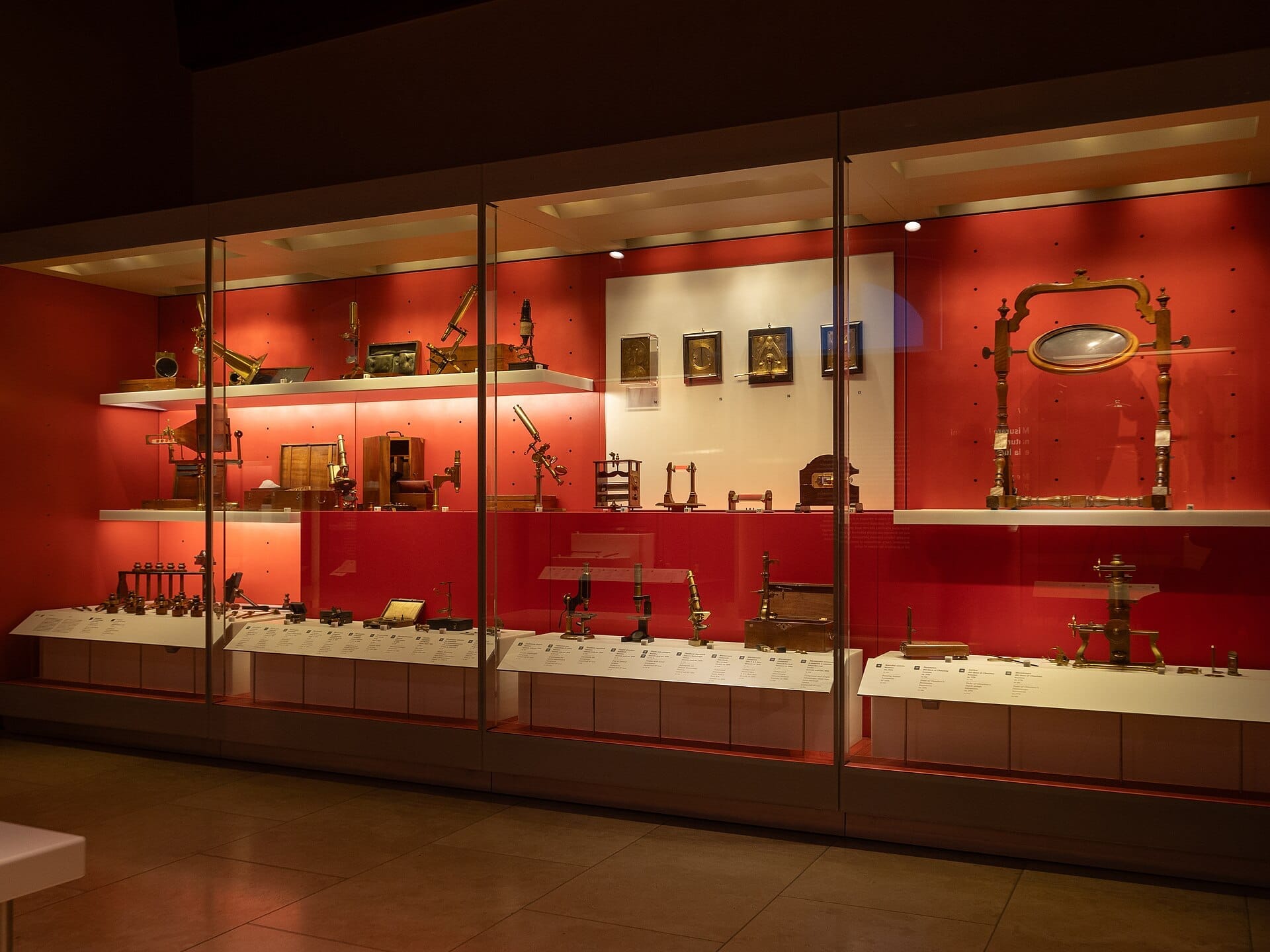
The ground floor and first rooms introduce the Medici scientific instruments, a collection assembled by the Grand Dukes of Tuscany between the 16th and 18th centuries. The Medici were not merely art patrons; they were committed collectors of precision instruments, and what survives includes some of the finest armillary spheres, astrolabes, and compasses ever made. The craftsmanship is extraordinary even to a non-specialist eye: gilded brass, engraved ivory, and mechanisms so precise they still move smoothly after four centuries.
The undisputed highlight is in Room IV: two of Galileo's original telescopes, displayed alongside the objective lens he used to observe Jupiter's moons in 1610, and a small reliquary containing the middle finger of his right hand. That last detail tends to stop visitors cold. It reads like something between a scientific trophy and a religious relic, which is precisely the point: Galileo was venerated in Florence with something close to sainthood after his death in 1642, despite his conflict with the Church.
The upper floor expands into later centuries: Lorraine-era instruments brought to Florence after the Medici line ended, early electrical equipment, thermometers and barometers from the Accademia del Cimento (among Europe's earliest scientific academies, founded in Florence in 1657), and a suite of large mechanical globes and orreries that model planetary motion with gears and brass rings. There is also a working reconstruction of Galileo's experiment on accelerating bodies along an inclined plane, which children tend to gravitate toward.
Tickets & tours
Live prices and dates from our booking partner. If you book, we may earn a commission at no extra cost to you.
Galileo Museum private tour
From 0 €Instant confirmationFree cancellationGalileo Museum private tour
From 0 €Instant confirmationFree cancellationGalileo Museum private tour
From 0 €Instant confirmationFree cancellationGalileo Museum private tour
From 0 €Instant confirmationFree cancellation
The Building and Its Setting
Palazzo Castellani occupies a narrow strip between the Lungarno Anna Maria Luisa de' Medici and the Via dei Castellani, roughly 200 metres east of the Uffizi along the river. The exterior is austere medieval stonework, easy to walk past without noticing. The entrance is on Piazza dei Giudici, a small square named for the magistrates' court that once occupied the area.
The location places Museo Galileo in immediate proximity to some of Florence's most visited sites. TheUffizi Galleryis a five-minute walk west along the river. ThePiazza della Signoriais barely further. This makes the museum a natural addition to a morning that begins with the Uffizi, or a standalone afternoon stop if the Uffizi queue has already defeated you.
From the upper-floor windows on the river side, there are clean views across the Arno toward the Oltrarno hillside. It is a small pleasure, but in a museum context the daylight and the river view provide a welcome pause between display cases.
How the Experience Changes Through the Day
Morning visits, from around 09:30 to 11:00, are noticeably quieter. Tour groups that pour out of coaches near the Uffizi rarely make Museo Galileo their first stop, which means the early hours belong mostly to independent travellers and the occasional school group. The light in the ground-floor rooms is controlled and consistent throughout the day since the collection relies on artificial lighting to protect the instruments, so time of day does not affect what you see inside.
Midday brings a moderate increase in visitors, particularly on weekdays when schools and guided tours overlap. The museum never reaches the claustrophobic density of the Accademia or the Uffizi, but the narrower display corridors can feel tight when two groups converge. If you are visiting with children or want to linger at the telescopes without someone at your shoulder, aim for the first hour of opening or the final 90 minutes before closing.
Tuesday is worth flagging separately: the museum closes at 13:00. If you arrive at 11:30 on a Tuesday expecting a full afternoon, you will be disappointed. Check the day before you travel.
⚠️ What to skip
Tuesday closing: the museum shuts at 13:00 on Tuesdays, not 18:00. This catches visitors off guard more than any other practical detail.
Practical Walkthrough: Getting In and Around
The main entrance is at Piazza dei Giudici 1. Visitors with mobility disabilities should use the entrance on Lungarno Anna Maria Luisa de' Medici 2, accessible via intercom. The museum states it is fully equipped for visitors with disabilities. Queues at the ticket desk are generally short compared to the major Florentine museums, though booking online saves time and guarantees entry on peak-season days. The online booking service charges a €1 per ticket surcharge.
The collection is spread across two floors with clear room numbering and bilingual labels in Italian and English throughout. The English translations are competent and informative rather than purely functional, meaning non-specialist visitors genuinely understand what they are looking at without needing a guide. An audio guide is available for hire if you want more depth on specific instruments. The museum shop near the exit carries well-produced books on the history of science and some reproduction instrument prints.
Getting to the museum on foot from the rest of the historic centre is straightforward. FromPonte Vecchio, follow the north bank of the Arno east for about five minutes and the palazzo appears on your left. Fromthe Baptisterynear the Duomo, it is around a 10-minute walk south through the historic centre.
Cultural and Historical Context
Florence's connection to the scientific revolution is less celebrated than its contribution to Renaissance painting and sculpture, but it is equally significant. The Medici court under Cosimo II provided Galileo with patronage and protection, and it was in Florence that Galileo wrote some of his most important works. The Accademia del Cimento, among the world's first dedicated scientific societies, operated in Florence from 1657 to 1667, producing systematic experimental results on topics from the nature of heat to air pressure. The instruments from those experiments are in this museum.
Understanding Museo Galileo in this context transforms a visit from a tour of old objects into something more coherent: this is the physical record of a city that simultaneously produced Michelangelo's David and the first telescopic observations of the solar system. For visitors exploring that broader intellectual history, the museum connects directly to nearby sites.Basilica di Santa Croce, a 15-minute walk east, is where Galileo is buried, and the contrast between his austere tomb and the elaborate monuments around it tells its own story about how Florence chose to remember him.
For a fuller picture of Florence's intellectual heritage across disciplines, thebest museums in Florenceguide covers how Museo Galileo fits alongside the Bargello, the Accademia, and the Uffizi in a multi-day itinerary.
Photography and Sensory Notes
Photography without flash is permitted in most areas. The instrument cases are lit from within against dark backgrounds, which makes close-up photography surprisingly effective with a smartphone. The telescopes in Room IV are in a glass case that can produce reflections in certain light conditions; positioning yourself slightly to the side rather than directly in front reduces glare.
The atmosphere inside is cool and quiet, with the particular hush of a building that takes its contents seriously. Unlike the more theatrical presentation of some science museums, Museo Galileo lets the objects carry the room. The smell is the faintly mineral scent of old stone floors and climate-controlled air, not unpleasant. Display case lighting keeps individual instruments warm-toned against their dark velvet mounts. The effect is closer to a jewellery exhibition than a conventional science museum.
Who Might Want to Skip This
Visitors primarily interested in painting and sculpture will find little here that overlaps with the rest of Florence's art museum circuit. The collection rewards curiosity about the instruments themselves and about the history of scientific practice, but it does not offer spectacle in the way the Uffizi or the Accademia do. If you have one day in Florence and your priority is canonical Renaissance art, Museo Galileo will likely not make the cut.
Young children under about eight may find the display-case format slow. There is interactive content, including the Galileo inclined-plane reconstruction, but the museum is primarily contemplative rather than hands-on. Families with very young children should factor this in.
Insider Tips
- Book online even for off-peak visits: the €1 surcharge is negligible and the ticket desk occasionally has unexpected queues when a guided group arrives simultaneously.
- Room IV, which contains Galileo's telescopes, is on the ground floor early in the circuit. If the museum is busy, visit this room first before the group tours arrive at it.
- The accessibility entrance on Lungarno Anna Maria Luisa de' Medici 2 requires pressing an intercom. Give a few minutes for staff to respond rather than assuming it is unstaffed.
- Combine the visit with Basilica di Santa Croce, where Galileo is buried, to give both sites more meaning. The walk between them takes around 10 minutes through the historic centre.
- The museum shop stocks the Museo Galileo catalogue, a genuinely authoritative reference on the collection, at a price that undercuts most online listings. If you are interested in the history of scientific instruments, it is worth picking up on the way out.
Who Is Museo Galileo For?
- History and science enthusiasts who want context for Florence beyond its art
- Families with children aged 8 and older, particularly those interested in astronomy or physics
- Travellers on a second or third visit to Florence who have already covered the main art museums
- Anyone seeking a quieter, less crowded museum experience in the heart of the historic centre
- Visitors combining the Uffizi with a shorter secondary attraction on the same morning
Nearby Attractions
Other things to see while in Centro Storico (Historic Center):
- Arno River Walk (Lungarni)
The Lungarni are the named embankment streets running along both banks of the Arno River through central Florence. Free to walk at any hour, they offer the city's best unmediated views of the Ponte Vecchio, the surrounding hills, and the slow rhythm of Florentine daily life. No ticket, no queue, no reservation required.
- Brunelleschi's Dome Climb
The climb inside Brunelleschi's Dome is one of the most physically rewarding experiences in Florence. 463 steps through narrow brick passages deliver you to a panoramic terrace above the city's rooftops, with views that no other vantage point in the historic centre can match. Here is everything a traveler needs to plan it well.
- Florence Baptistery
The Florence Baptistery, officially the Battistero di San Giovanni, is one of the oldest and most significant religious buildings in Italy. Standing directly in front of Florence Cathedral, it is famous for Ghiberti's gilded bronze 'Gates of Paradise' and a breathtaking interior ceiling covered in Byzantine mosaics. This guide covers what to expect, when to visit, and how to make the most of your time here.
- Florence Cathedral (Duomo di Firenze)
The Cattedrale Metropolitana di Santa Maria del Fiore is the geographic and spiritual heart of Florence. Free to enter, extraordinary to stand inside, and far more layered than its famous exterior suggests. Here is everything you need to plan a worthwhile visit.
Planning a trip? Discover personalized activities with the Nomado app.