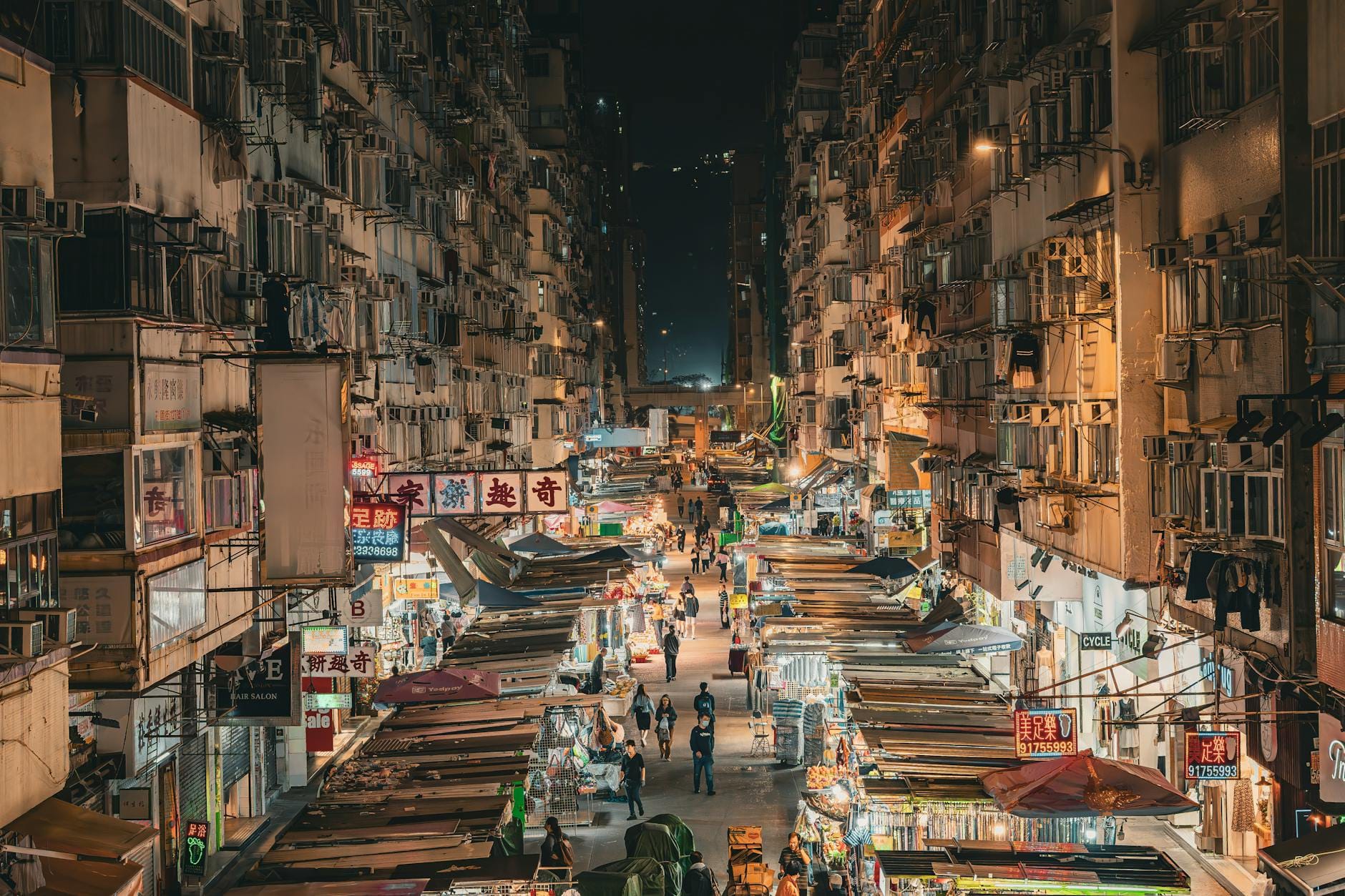
Yau Ma Tei is one of Kowloon's oldest and most atmospheric neighborhoods, where jade markets, neon-lit night markets, and Tin Hau temples sit alongside crumbling tenements and independent theatres. It occupies that rare space between genuine working-class Hong Kong and a neighborhood interesting enough to reward serious exploration.
Yau Ma Tei sits in the middle of Kowloon like a page from an older Hong Kong, one that hasn't been smoothed out for visitors. Jade traders crouch over velvet-lined cases at dawn, opera singers warm up near the typhoon shelter, and the Temple Street Night Market unfolds every evening with a reliability that has outlasted decades of change. It isn't a polished destination, and that's exactly why it earns its place on any serious itinerary.
Orientation
Yau Ma Tei occupies a compact slice of the Kowloon Peninsula between Jordan to the south and Mong Kok to the north. Its western edge runs close to the reclaimed waterfront along the West Kowloon Cultural District, while to the east it blends into the denser residential blocks approaching Prince Edward Road. The neighborhood is small enough to walk end to end in twenty minutes, but dense enough that those twenty minutes will take much longer than expected.
The MTR's Tsuen Wan Line stops directly at Yau Ma Tei station, and Jordan station marks the southern boundary. Between these two stops, the neighborhood unfolds around a grid of streets that include the famous Temple Street running north to south, and Kansu Street cutting east to west through the jade market zone. Reclamation Street and Shanghai Street are the main north-south arteries for daily life, lined with traditional hardware shops, paper goods merchants, and herbal tea stalls.
Understanding how Yau Ma Tei connects to the wider city matters for planning. To the south, a short walk brings you into Tsim Sha Tsui, where the hotel corridor and waterfront promenade serve a very different crowd. To the north, Yau Ma Tei bleeds almost imperceptibly into Mong Kok, whose commercial intensity picks up sharply past the Mong Kok MTR station. Yau Ma Tei sits between these two poles, quieter than both and more layered than either.
Character & Atmosphere
The neighborhood shifts personality several times across the course of a day. At around six in the morning, the streets around the Yau Ma Tei Wholesale Fruit Market on Waterloo Road are at their most chaotic: wooden crates stack sideways, motorbike carts idle in doorways, and vendors argue prices in Cantonese over the smell of ripe mangoes and durian that drifts two blocks in every direction. This is Hong Kong commerce at its oldest and least photogenic.
By mid-morning, the jade market on Kansu Street and Battery Street is fully operational. It runs under a series of green canvas awnings and draws a mix of professionals, collectors, tourists, and elderly locals who treat the stalls as a social club as much as a marketplace. Light filters unevenly through the awnings, making the jade glow in some stalls and look almost dusty in others. The bargaining happens quietly, in Cantonese or Mandarin, and watching the transactions is itself an education in a trade that runs on trust and long relationships.
Afternoons slow down considerably. Residents pull plastic stools onto the pavement outside ground-floor flats, old men play chess near the banyan trees at the Public Square Street gardens, and the traditional shops on Shanghai Street keep their metal shutters half-raised against the afternoon heat. There is a stillness to Yau Ma Tei at three in the afternoon that feels hard to find anywhere else in central Kowloon.
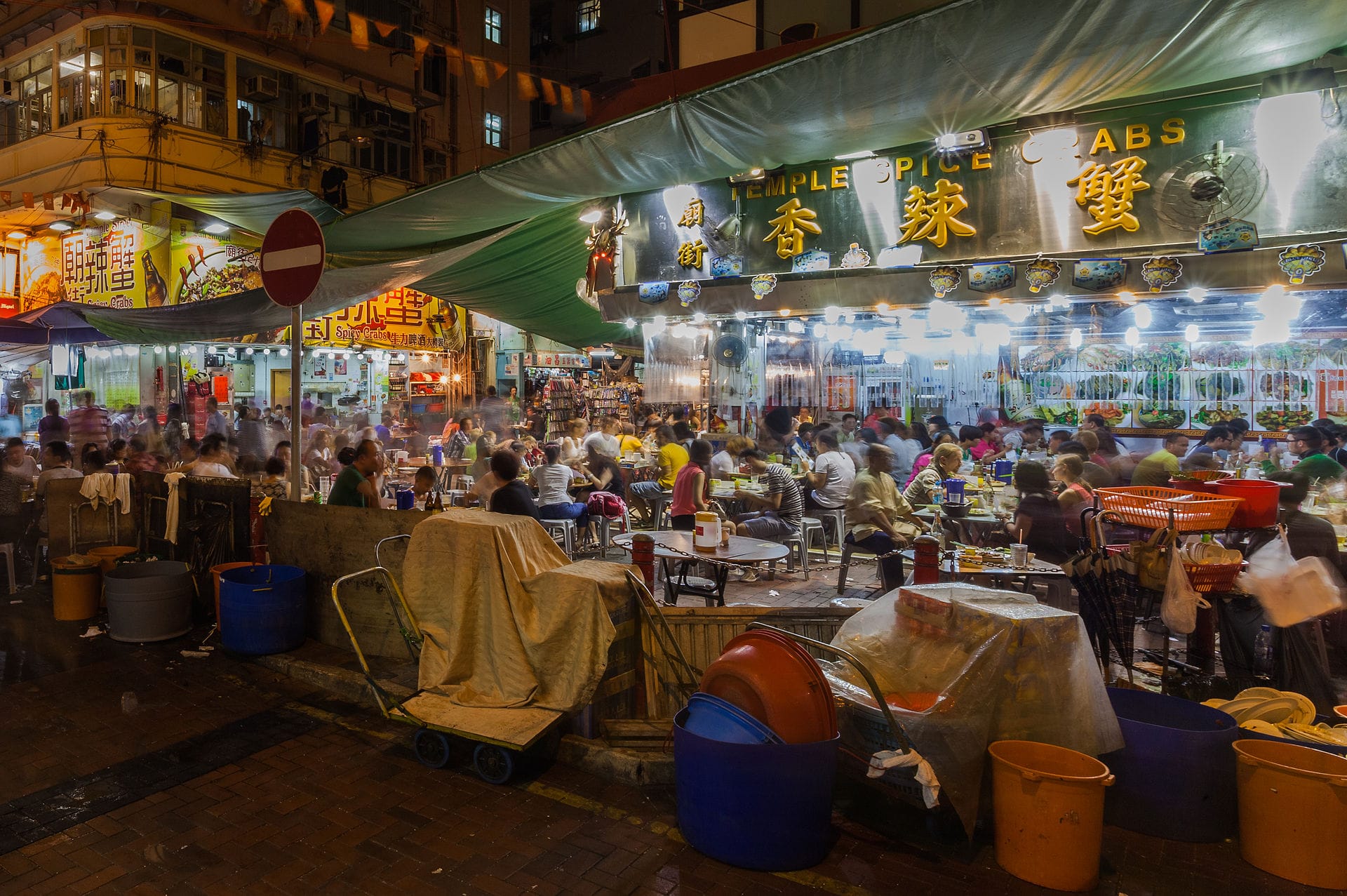
After seven, the street transforms again. Temple Street lights up with plastic lanterns, the fortune tellers set up their folding tables near the Tin Hau Temple, and the dai pai dong stalls begin sending columns of wok smoke up into the orange haze. The night market runs until midnight or later, and its crowd is genuinely mixed: local families eating crab at plastic-covered tables, mainland tourists navigating stalls of replica watches, and a persistent older contingent who come for the Cantonese opera performances near the temple square.
ℹ️ Good to know
The informal Cantonese opera performances near the Tin Hau Temple on Temple Street typically happen on evenings between around 8pm and 10pm. They aren't scheduled events — small groups of amateur performers gather and sing. Arrive without expectations and you may get something extraordinary.
What to See & Do
The Temple Street Night Market is the anchor attraction and one of Hong Kong's most enduring street spectacles. It runs from Jordan Road in the south to Kansu Street in the north, splitting around the Tin Hau Temple compound in its midsection. The stalls sell the usual assortment of phone cases, tourist trinkets, and cheap clothing, but the real point is the atmosphere: the food stalls that set up alongside, the fortune tellers at the temple end, and the general theatre of a Hong Kong night that has changed remarkably little in forty years.
The Tin Hau Temple at the heart of Temple Street is one of the most atmospheric in Kowloon. Tin Hau is the goddess of the sea, and this temple (And many others, like the one in Causeway Bay) predates the surrounding urban development by centuries, back to when this area was still coastal. The temple complex includes smaller shrines to other deities, and the incense smoke inside is thick enough on festival days to blur the gold paint on the altar figures. Outside, the forecourt doubles as a gathering point for chess players and opera enthusiasts after dark.
The jade market is worth visiting even if you have no intention of buying. Under the awnings on Kansu Street, vendors display everything from carved pendants to rough stones to antique pieces of uncertain provenance. If you do want to purchase, learn enough to ask questions: reputable dealers expect it, and the act of handling pieces and asking about origin is part of how trust is established. Go in the morning when the full range of stock is on display.
The Yau Ma Tei Theatre on Shanghai Street is a heritage building that has been restored as a venue for Cantonese opera and other performing arts. It dates to the 1930s and its tiled facade is one of the most recognizable on the street. Even if you don't catch a performance, the building itself is worth a look. Nearby, the cluster of traditional shops on Shanghai Street, some selling professional kitchen equipment, others dealing in incense, paper offerings, and ceremonial goods, gives a clear picture of the area's commercial continuity.
Kansu Street Jade Market: best visited 10am to noon when selection and activity peak
Temple Street Night Market: come after 7pm; the southern end near Jordan MTR has the densest food stalls
Tin Hau Temple complex: quieter in the morning, most atmospheric on weekend evenings
Yau Ma Tei Theatre on Shanghai Street: check the Leisure and Cultural Services Department schedule for opera performances
Wholesale Fruit Market on Waterloo Road: only worth visiting if you're up before 7am
Public Square Street gardens: a genuine local spot for afternoon chess and shade
Eating & Drinking
Yau Ma Tei is serious eating territory, and most of it has nothing to do with the night market stalls. The neighborhood is one of the better places in Kowloon to find traditional Cantonese congee and noodle shops open from early morning, the kind that have operated from the same address for decades and where the menu is hand-written on a board above the counter.
The Temple Street food stalls that set up in the evening specialize in seafood, particularly crab, clams, and shrimp cooked in garlicky broth at tables that overflow onto the pavement. Ordering works best by pointing, and prices are generally posted. These aren't fine dining options, but eating crab at a plastic table under string lights with the night market noise around you is an experience that holds up regardless of the quality of the chopstick technique.
Shanghai Street and the streets branching off it have a number of traditional cha chaan teng, the Hong Kong-style diners that serve milk tea, pineapple buns, toast with butter and condensed milk, and a rotating menu of rice and noodle dishes. These places are busy at breakfast and lunch, quieter in the afternoon, and worth the slight awkwardness of squeezing onto a shared table. Prices are low, well under HKD 50 for a full breakfast set in most cases.
Bars are sparse in Yau Ma Tei compared to the strip around Knutsford Terrace in Tsim Sha Tsui, but there are a handful of unpretentious local spots near the Jordan Road end of Temple Street. The neighborhood isn't a nightlife destination, and visitors looking for cocktail bars or rooftop venues should head south into Tsim Sha Tsui.
💡 Local tip
For late-night eating, the block immediately south of the Tin Hau Temple on Temple Street has seafood stalls that stay open past midnight on weekends. Arrive after 10pm when the tourist crowd has thinned and the local regulars take their seats.
Getting There & Around
Yau Ma Tei MTR station on the Tsuen Wan Line (red line) is the most direct entry point. Exits C and D put you closest to Temple Street and the jade market. Jordan MTR station, one stop south on the same line, is equally useful for arriving at the southern end of Temple Street near the busiest food stall concentration. Both stations are two to three stops from Tsim Sha Tsui, making the journey quick by any standard.
Within the neighborhood, walking is the only sensible option. The streets are narrow, traffic moves slowly, and the grid is simple enough that getting lost is unlikely. Temple Street runs north to south as a spine, with Kansu Street, Public Square Street, and Reclamation Street as useful east-west references. The entire zone between Jordan and Yau Ma Tei MTR stations is roughly 800 metres on foot, a ten to twelve minute walk without stops.
From Yau Ma Tei, the Star Ferry piers in Tsim Sha Tsui are reachable in around twenty minutes on foot heading south, or five minutes by MTR via Jordan and Tsim Sha Tsui stations. For those extending their day to the waterfront, the Tsim Sha Tsui Promenade and the Avenue of Stars are both a short ride or a pleasant evening walk south along Nathan Road.
⚠️ What to skip
Nathan Road through Yau Ma Tei carries heavy bus and taxi traffic at all hours. Crossing it on foot takes patience. Use the pedestrian crossings and avoid jaywalking during peak hours — the traffic flows faster than it looks.
Where to Stay
Yau Ma Tei is not a primary hotel district, but it has a reasonable selection of mid-range and budget accommodation, particularly along Nathan Road and the streets just off it. Staying here suits travelers who want central Kowloon access without paying Tsim Sha Tsui prices. For a full comparison of where to base yourself across Hong Kong, the where to stay in Hong Kong guide covers the tradeoffs in detail.
The advantage of staying in Yau Ma Tei is immediate access to the MTR Tsuen Wan Line, which connects north to Mong Kok and south through Jordan to Tsim Sha Tsui and then under the harbor to Central in around fifteen minutes total. It's a really useful base. The disadvantage is that some streets are noisy well past midnight, particularly those adjacent to Temple Street and Nathan Road. Rooms facing internal courtyards or upper floors tend to be significantly quieter.
Guesthouses occupy the upper floors of older tenement blocks throughout the neighborhood, some offering very basic rooms at low nightly rates, others recently renovated into boutique-style properties. The quality varies sharply even within a single building. Reading recent reviews carefully before booking matters more here than in more standardized hotel zones.
Practical Assessment: Who Yau Ma Tei is For
Yau Ma Tei rewards travelers who are comfortable with some friction: narrow footpaths, limited English on menus, streets that smell of fish and incense alternately, and an atmosphere that doesn't perform itself for an outside audience. It is one of the few areas in central Kowloon where the tourist layer sits on top of a neighborhood that clearly has its own life and would continue to function exactly as it does without any visitors at all.
It is also highly accessible. The MTR connections are excellent, the night market is well-established and easy to navigate, and the jade market requires no specialist knowledge to enjoy as a spectacle. Anyone building a first visit to Hong Kong should include at least an evening here alongside the more polished attractions further south in Central.
The area isn't ideal for travelers who need quiet evenings, those averse to strong smells in the street, or anyone looking for a sleek, air-conditioned retail experience. But for anyone curious about how Hong Kong lives when it isn't putting on a show, Yau Ma Tei delivers without reservation.
TL;DR
Yau Ma Tei is one of Kowloon's most authentic urban neighborhoods, centered on Temple Street, the Tin Hau Temple, and the Kansu Street jade market.
Best visited across multiple times of day: the jade market in the morning, the temples in the afternoon, and the night market after 7pm.
Excellent MTR connections via Yau Ma Tei and Jordan stations put the rest of Kowloon and Hong Kong Island within easy reach.
Food ranges from early-morning congee shops and cha chaan teng diners to seafood stalls on Temple Street running past midnight.
Best suited to curious, independent travelers; less ideal for those seeking quiet streets, polished hotels, or a curated visitor experience.
The definitive guide to choosing where to stay in Hong Kong: from harbor views in Tsim Sha Tsui to local life in Sham Shui Po, and why the MTR line matters more than the view.