Wat Suthat: Bangkok's Overlooked Royal Masterpiece
Wat Suthat Thepwararam is a first-class royal temple, one of ten such temples in Bangkok (and twenty-three in Thailand), housing the country's largest bronze seated Buddha and some of the most intricate mural paintings in Bangkok. It sits in the heart of the old city, directly across from the Giant Swing, and rewards visitors who take their time with an atmosphere that is quieter and more contemplative than the more famous temple complexes nearby.
Quick Facts
- Location
- 146 Bamrung Mueang Rd, Rattanakosin, Bangkok
- Getting There
- MRT Sam Yot (15-min walk) or Saen Saep Canal Boat to Phan Fa Pier
- Time Needed
- 1 to 1.5 hours
- Cost
- 100 THB entrance fee for foreign visitors
- Best for
- Mural enthusiasts, architecture lovers, travelers seeking temple depth without tour-group crowds
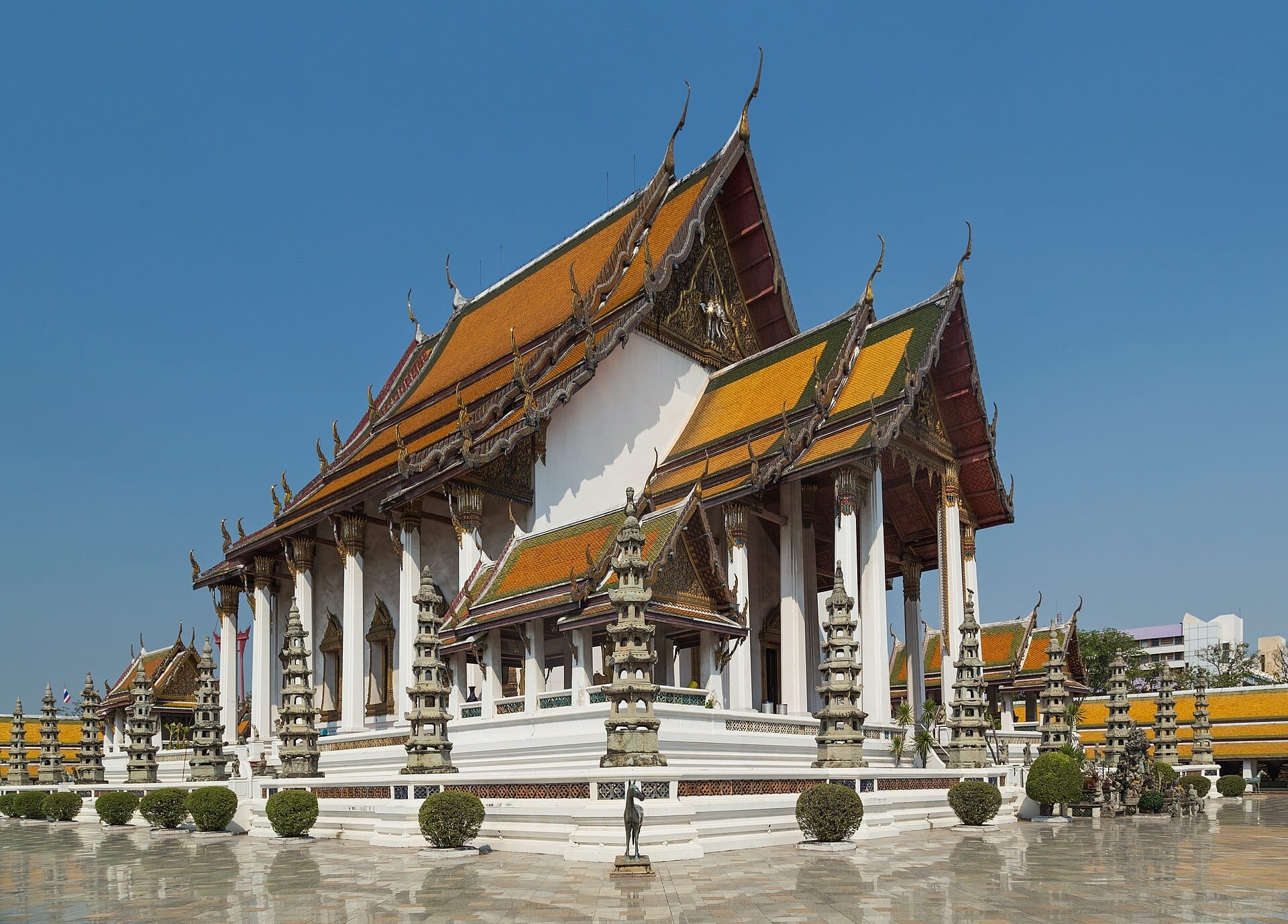
What Wat Suthat Actually Is
Wat Suthat Thepwararam is a first-class royal temple of the highest grade in Thailand. Construction began under Rama I around 1807 and was completed across three reigns, with Rama III adding the famous surrounding galleries and Rama IV completing the ordination hall's consecration. That 60-plus-year build is visible in the temple's layered architecture, where different eras of Thai craftsmanship converge in a single compound.
The temple is best known for two things: the Phra Sri Sakyamuni, a 25-foot tall bronze Buddha image brought by raft all the way from Sukhothai in the early 19th century, and the painted galleries that wrap around the inner courtyard with floor-to-ceiling murals depicting Buddhist cosmology and the Jataka tales. Neither gets the attention they deserve compared to what lies a short walk away near the Grand Palace.
Wat Suthat stands directly opposite the Giant Swing, the towering red teak structure that was once the site of a Brahmin ceremony abolished in 1935. The two landmarks frame each other visually across Bamrung Mueang Road and are best appreciated together as a single stop.
The Main Wihan and the Bronze Buddha
The principal building, the Wihan Luang (Grand Vihara), is regarded as the longest worship hall in Thailand. Walking through its doors, the immediate impression is scale: the ceiling climbs high above you, the air inside is noticeably cooler and carries a faint trace of incense, and the Phra Sri Sakyamuni sits at the far end in a posture of subdued calm. The statue's size is hard to convey in photographs. Seated, it measures roughly 8 meters in height, and it occupies the hall in a way that makes the surrounding floor feel like a moat.
Behind the main Buddha image, a second large image is positioned back-to-back, facing the rear entrance. This is less commonly photographed but worth circling around to see. The surrounding walls are also painted, though these interior murals are harder to read in the low light. Bring your eyes some time to adjust before rushing to photograph.
💡 Local tip
Visit on a weekday morning between 8:30 and 10:00 AM for the quietest experience. The hall is almost empty at this hour, and the light through the front doors creates a direct beam toward the Buddha image that is worth waiting for.
Tickets & tours
Hand-picked options from our booking partner. Prices are indicative; availability and final rates are confirmed when you complete your booking.
Temples of Bangkok and Grand Palace half-day guided tour
From 18 €Instant confirmationFree cancellationDamnoen Saduak floating market and Maeklong railway guided tour
From 36 €Instant confirmationFree cancellationBangkok tuk-tuk night tour with Chinatown street food meal
From 28 €Instant confirmationFree cancellationAfternoon Tea at Hyatt Regency Hotel Bangkok
From 900 €Instant confirmationFree cancellation
The Galleries and Their Murals
The cloister galleries encircling the inner courtyard are the element that serious visitors underestimate. These long, covered corridors are lined on the inner wall with 156 Buddha images of varying styles, and on the outer wall with dense narrative murals painted during the reign of Rama III. The paintings cover the Jataka tales, stories of the Buddha's past lives, rendered in the Thai style of the early 19th century: flat perspective, rich earth tones, packed with figures and background detail.
The murals have faded in places and show their age honestly. This is not a cleaned-up, restored display. The imperfection makes them more compelling. Some panels are still vivid, others have cracked or peeled at the edges, and the occasional shaft of daylight through the gallery windows catches the gold leaf detail in unexpected ways. Plan to spend at least 20 minutes walking the full loop, not rushing.
Photographers should note that the galleries are lit primarily by natural light from courtyard-facing windows. Midday sun bleaches the colors; late afternoon light (around 3:30 to 5:00 PM) is significantly warmer and more flattering for the murals. The galleries also remain open until close, so an afternoon visit specifically for mural photography is a reasonable strategy.
The Ordination Hall and the Courtyard
Beyond the main wihan lies the Bot (ordination hall). Its roof structure and decorative gables are particularly refined, and the boundary stones (bai sema) around it are unusual: they rest on lotus pedestals inside stone shelters, a feature associated with first-class royal temples. Monks use the Bot for official ceremonies, and it is sometimes closed to visitors without notice.
The courtyard between the buildings is planted with low shrubbery and a handful of mature trees. In the morning, monks in saffron robes move quietly between structures, and the birdsong is surprisingly prominent given the proximity to the road. By midday the courtyard gets direct sun and can feel exposed; wear light clothing and bring water. There are no shops or stalls inside the compound.
⚠️ What to skip
Dress code is strictly enforced. Shoulders and knees must be covered. Sarongs are not available for loan here as they are at the Grand Palace, so come appropriately dressed or carry a scarf large enough to wrap around your lower body.
Getting There and Navigating the Area
Wat Suthat sits on Bamrung Mueang Road in the Rattanakosin district, a street historically associated with Buddhist religious goods, where shops selling monk robes, amulets, Buddha images, and ceremonial items line both sides for several blocks. The walk from MRT Sam Yot takes around 15 minutes and passes through the Democracy Monument area.
An alternative approach is to take the Saen Saep canal boat to Phan Fa Bridge pier, which deposits you within a 10-minute walk and offers a different view of the Rattanakosin old city. From Phan Fa you pass the Democracy Monument and the Brahmin temples on Dinso Road before arriving at Wat Suthat, which makes a logical walking sequence.
Most visitors combine Wat Suthat with Wat Ratchanatdaram (Loha Prasat) and Wat Saket (Golden Mount), all of which are within a 15-minute walk of each other and together make a coherent half-day temple circuit without retracing steps.
How This Temple Compares to Others Nearby
Travelers who have visited Wat Pho or Wat Phra Kaew will find Wat Suthat significantly quieter and less choreographed. There are no ticket queues, no tour groups corralled through specific routes, and no shuttle trams. The trade-off is less interpretive infrastructure: signage in English is limited, and without some background knowledge or a guidebook, parts of the compound may not make immediate sense.
This is not an attraction designed around visitor convenience. The temple is an active place of worship, and that is its defining quality. You are welcome but not catered to, which is exactly what makes it different from the more touristically polished sites in the same neighborhood.
Who should skip it: travelers with very limited time who need only one signature Bangkok temple experience should prioritize Wat Pho or the Grand Palace complex instead. Wat Suthat rewards patience and a genuine interest in Buddhist art. If you are mainly ticking boxes or only have two hours in the area, the temple's subtler qualities may not land the way they deserve to.
Practical Notes
- Opening hours: 8:30 AM to 8:00 PM (ticket office closes earlier; confirm before a late visit)
- Entrance fee: 100 THB for foreign visitors; Thai nationals enter free
- Photography is permitted throughout the compound, including inside the wihan
- No tripods or professional video equipment without prior permission
- Accessible entry is available at the main gate on Bamrung Mueang Road; interior paths are mostly flat
- The nearest toilets are just inside the main entrance on the left
Insider Tips
- The amulet and religious goods market along Bamrung Mueang Road is one of the most concentrated in Bangkok. Even if you have no interest in buying, walking the block east of the temple entrance takes five minutes and gives a clear picture of how monks and devotees actually supply temple practice.
- Arrive on a Buddhist holy day (Wan Phra, which follows the lunar calendar) to see the temple functioning at full devotional intensity: flowers, incense, merit-making queues at the main image, and monks chanting in the galleries.
- The rear entrance on the south side of the compound, accessed through a quieter street, is usually less busy than the main gate and gives a different spatial entry into the courtyard that experienced temple visitors may prefer.
- Look for the small Chinese-influenced decorative details worked into the architecture around the galleries, including ceramic tile figures on the roofline. These reflect Rama III's aesthetic preference and are different from the more overtly Thai style of earlier reigns.
- If you visit in the late afternoon, the light on the exterior of the wihan's front facade is at its best between 4:00 and 5:30 PM, when the setting sun hits the gold and lacquer details on the doors directly.
Who Is Wat Suthat For?
- Travelers with a serious interest in Thai Buddhist art and mural painting
- Anyone following a Rattanakosin old-city temple circuit who wants depth beyond the Grand Palace
- Architecture enthusiasts interested in the Rama III period and Chinese-Thai hybrid decorative style
- Photographers willing to plan their visit around morning or late-afternoon light
- Repeat visitors to Bangkok looking for a significant site they may have bypassed on earlier trips
Nearby Attractions
Other things to see while in Rattanakosin:
- Bangkok National Museum
The Bangkok National Museum is the largest museum in Southeast Asia and the definitive starting point for understanding Thai history. Spread across a former palace compound near the Grand Palace, it houses royal regalia, pre-Siamese sculpture, intricate funeral chariots, and centuries of Buddhist art under one roof.
- Democracy Monument
Standing at the heart of Ratchadamnoen Avenue in the Rattanakosin district, the Democracy Monument is Bangkok's most charged political symbol. Built in 1939 to commemorate Thailand's transition from absolute monarchy to constitutional rule, it remains a living stage for the city's public life and a striking piece of art deco civic architecture.
- The Giant Swing
The Giant Swing (Sao Ching Cha) stands 27 metres tall in the heart of Bangkok's historic Rattanakosin district, just steps from Wat Suthat. Once the centrepiece of a daring Brahmin ceremony, this centuries-old teak structure is one of Bangkok's most recognisable landmarks — and one of its least-understood.
- Grand Palace Bangkok
The Grand Palace is Bangkok's most recognizable landmark and the ceremonial heart of Thailand. This guide covers what to see, when to go, how to dress, and how to make the most of a visit without the frustration.