Bangkok National Museum: Thailand's Finest Collection of History and Art
The Bangkok National Museum is the largest museum in Southeast Asia and the definitive starting point for understanding Thai history. Spread across a former palace compound near the Grand Palace, it houses royal regalia, pre-Siamese sculpture, intricate funeral chariots, and centuries of Buddhist art under one roof.
Quick Facts
- Location
- Na Phra That Road, Rattanakosin, Bangkok
- Getting There
- Take the Chao Phraya Express Boat to Tha Chang Pier (N3), then a 10-minute walk north
- Time Needed
- 2 to 4 hours, depending on depth of interest
- Cost
- 200 THB (foreigners), 30 THB (Thai citizens) with free guided tours in English and French on Wednesdays and English, French and German on Thursdays
- Best for
- History enthusiasts, art lovers, and anyone wanting context before visiting Bangkok's temples
What the Bangkok National Museum Actually Is
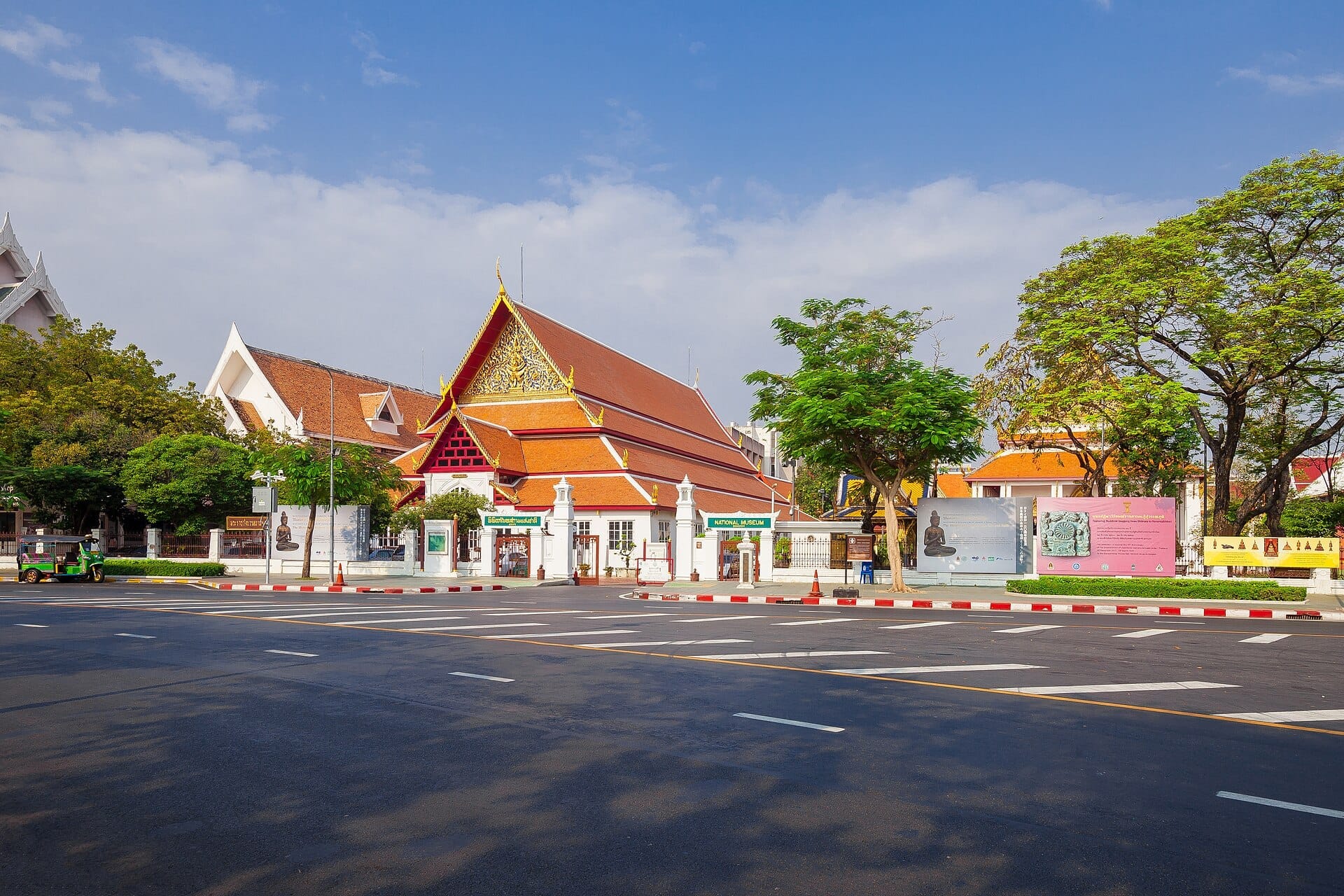
The Bangkok National Museum is not a single building. It is a compound of more than 20 structures spread across land that once formed part of the Wang Na Palace, the residence of the Deputy King (Uparaja) under the Chakri dynasty. After that institution was abolished, King Rama V established the museum in 1874, which formally opened to the public in 1926. Today it contains the single most comprehensive collection of Thai artifacts anywhere in the world, organized roughly by historical period and object type.
The compound sits immediately northwest of Sanam Luang, the large ceremonial field in the heart of Rattanakosin Island, and is flanked by Thammasat University to the east. From the street, the entrance is understated: a white gate in a long wall, easy to walk past if you are not looking for it. Inside, the mood shifts completely. The grounds are quiet even on weekday mornings, with shaded paths connecting the separate gallery buildings. The scale of the place only becomes clear once you are past the ticket desk.
💡 Local tip
Free volunteer-guided English tours depart from the ticket hall on Wednesdays and Thursdays at 9:30 AM. These are widely considered the best introduction to the collection, and they run for approximately two hours. Arrive a few minutes early to register.
The Main Galleries: What You Will Actually See
The permanent collection is organized across three principal wings. The Prehistoric and History Gallery in the Siwamokhaphiman Hall traces human habitation of the region from prehistoric Ban Chiang pottery (some pieces dated to 2000 BCE) through the Sukhothai, Ayutthaya, and early Bangkok periods. The gallery is methodical rather than spectacular, but the quality of individual objects is exceptional: stone inscriptions, bronze ceremonial weapons, and elaborately worked gold jewelry that survived the Burmese sack of Ayutthaya in 1767.
The Buddhaisawan Chapel, built in 1787, stands apart from the main gallery buildings as the spiritual center of the compound. Inside is the Phra Phuttha Sihing, one of Thailand's most revered Buddha images, surrounded by some of the finest surviving examples of early Rattanakosin mural painting. The chapel is still used for religious ceremonies, and you will often find fresh offerings at the base of the image. Remove shoes before entering, and speak quietly: this is a working sacred space, not merely a gallery exhibit.
The Red House (Wang Daeng), a teak residence originally built for Queen Sri Sudarak, a consort of King Rama I, is one of the compound's architectural highlights. Its dark red lacquered exterior and interior furnishings give the clearest picture anywhere in Bangkok of how royal domestic life looked in the early 19th century. The building is small and visits are brief, but the craftsmanship in the carved wooden panels and mother-of-pearl inlay work is worth examining slowly.
Tickets & tours
Hand-picked options from our booking partner. Prices are indicative; availability and final rates are confirmed when you complete your booking.
Temples of Bangkok and Grand Palace half-day guided tour
From 18 €Instant confirmationFree cancellationBangkok tuk-tuk night tour with Chinatown street food meal
From 28 €Instant confirmationFree cancellationAfternoon Tea at Hyatt Regency Hotel Bangkok
From 900 €Instant confirmationFree cancellationBangkok Wat Arun Temple of Dawn self-guided walking tour
From 13 €Instant confirmationFree cancellation
The Funeral Chariot Hall: The Unmissable Room
Most visitors remember the Chariot Hall longer than anything else in the museum. The Royal Funeral Chariots on display here are enormous, gilded wooden structures used to transport royal remains during state cremation ceremonies. The largest, the Vejayanta Rajarot, stands over 11 meters tall and weighs approximately 40 tonnes. These chariots were last used in 2017 for the royal cremation of King Bhumibol Adulyadej (Rama IX), which means you are looking at objects that remain in active ceremonial use.
The hall is dim and air-conditioned, and the scale of the chariots generates a particular atmosphere: a combination of architectural awe and the weight of recent history. Photography is permitted here, but the sheer size of the structures makes standard smartphone shots inadequate. A wide-angle lens or panorama mode will serve better. Go slowly and read the information panels, which explain the ritual function of each chariot and the meaning of the mythological figures carved into the lacquered wood.
How the Experience Changes by Time of Day
The museum opens at 9:00 AM Wednesday through Sunday, closing at 4:00 PM (last ticket 3:30 PM) and on most public holidays, and is closed Monday, Tuesday, and new year’s and Songkran festival day. Early mornings, particularly Wednesdays and Thursdays when the guided tours run, tend to attract a small but engaged crowd of visitors who treat the museum seriously. By 11:00 AM, school groups begin arriving and the main halls become noisier. The gallery buildings have uneven air-conditioning: the Chariot Hall is reliably cool, but some of the smaller outlying buildings can be warm and stuffy by midday.
The outdoor courtyards between the buildings are pleasant in the early morning, when the light is soft and the compound is nearly empty. By early afternoon, the tropical sun makes the connecting paths uncomfortable without a hat or umbrella. There is a small café near the entrance that opens during museum hours. It is functional rather than impressive, but useful on a hot day.
⚠️ What to skip
The museum is closed on Mondays and Tuesdays, as well new year’s and the Songkran period. Always verify the current schedule before visiting, as closures for royal ceremonies can occur without extended advance notice.
Cultural and Historical Context
Understanding what you are looking at requires knowing something about the civilizations that preceded Bangkok. The collection includes major holdings from the Dvaravati period (roughly 6th to 11th century CE), when Mon Buddhist kingdoms occupied central Thailand; from the Khmer-influenced culture that followed in the northeast and southeast; and from the Sukhothai period (13th to 15th century), widely regarded as the classical peak of Thai Buddhist sculpture. The famous Sukhothai walking Buddha figures, with their fluid flame-like limbs, are represented here in several strong examples.
Visitors who read about Thai temple architecture before arriving will find the museum collection much more legible. The reclining Buddha at Wat Pho and the Emerald Buddha at Wat Phra Kaew both become more meaningful once you have seen the National Museum's timeline of Buddhist iconography and understand how stylistic conventions evolved across different kingdoms and periods.
The museum sits at the geographic and symbolic center of Rattanakosin Island, Bangkok's historic core. A visit here pairs naturally with Sanam Luang and the surrounding temple complex for a full day in the old city. Travelers interested in the broader context of Bangkok's historic districts can consult a guide to Bangkok's best temples to plan a logical walking sequence.
Practical Walkthrough and What to Prioritize
The compound is large enough that attempting to see everything in a single visit leaves most people exhausted and remembering nothing clearly. A realistic two-hour visit should prioritize three stops: the Buddhaisawan Chapel for its murals and the Phra Phuttha Sihing image, the Chariot Hall for the funeral carriages, and the Siwamokhaphiman Hall for the prehistoric and Sukhothai collections. If you have a full morning, add the Red House and the decorative arts galleries covering royal regalia, costumes, and ceramics.
Comfortable walking shoes are important. The uneven ground between buildings, the shallow steps into each pavilion, and the polished floors inside the chapel all require some care. Dress covering shoulders and knees is required for the Buddhaisawan Chapel and is simply respectful throughout the compound. A small daypack with water is useful; the entrance area has drinking water available.
Photography policies vary by building. The chapel and some of the more sacred gallery spaces ask that you refrain from flash photography. The main historical galleries and the Chariot Hall generally permit photography. If in doubt, ask at the entrance of each building.
Who Should Skip This Attraction
The Bangkok National Museum rewards curiosity and patience. Visitors who find traditional museum formats tedious, or who are primarily interested in contemporary Bangkok rather than historical context, will likely find the experience dry. Young children may struggle with the length and the seriousness of the galleries. The museum's labeling, while improved, is still uneven: some objects have detailed English descriptions, others have minimal information, which can be frustrating without a guide. If your Bangkok trip is short and focused on food, nightlife, or shopping, this is a lower priority.
For visitors more interested in living culture than historical artifacts, the Jim Thompson House offers a more intimate and visually cohesive experience with Thai art and architecture, while Bangkok Art and Culture Centre (BACC) is a better destination for those interested in contemporary Thai artistic practice.
Insider Tips
- The Wednesday and Thursday morning English-language guided tours are free with museum admission and consistently described by serious travelers as the best way to engage with the collection. The volunteer guides are often retired academics or long-term Bangkok residents with deep subject knowledge.
- The Buddhaisawan Chapel sometimes closes for private religious ceremonies with no advance notice on the museum's main website. If you arrive and find it closed, ask at the ticket desk whether it will reopen later that morning.
- The museum's decorative arts galleries, particularly the room dedicated to royal insignia and regalia, contain objects of extraordinary workmanship that receive far less visitor attention than the main halls. Budget extra time if you have an interest in goldsmithing or gem-setting traditions.
- The compound connects historically and physically to the Grand Palace complex nearby. Visiting the National Museum first, particularly the Sukhothai and Ayutthaya period galleries, makes the iconography and ritual objects inside the palace compound significantly more legible.
- Arrive before 9:30 AM on a Wednesday or Thursday to guarantee a place on the free guided tour. The groups occasionally fill up quickly during peak travel months (November through February).
Who Is Bangkok National Museum For?
- History and archaeology enthusiasts wanting a comprehensive foundation in Thai civilizations
- Art lovers with an interest in Buddhist sculpture and Southeast Asian decorative arts
- Repeat Bangkok visitors ready to go deeper than the major temples
- Travelers spending a full day in Rattanakosin Island and wanting a logical morning starting point
- Anyone preparing to visit the Grand Palace or major Rattanakosin temples who wants interpretive context first
Nearby Attractions
Other things to see while in Rattanakosin:
- Democracy Monument
Standing at the heart of Ratchadamnoen Avenue in the Rattanakosin district, the Democracy Monument is Bangkok's most charged political symbol. Built in 1939 to commemorate Thailand's transition from absolute monarchy to constitutional rule, it remains a living stage for the city's public life and a striking piece of art deco civic architecture.
- The Giant Swing
The Giant Swing (Sao Ching Cha) stands 27 metres tall in the heart of Bangkok's historic Rattanakosin district, just steps from Wat Suthat. Once the centrepiece of a daring Brahmin ceremony, this centuries-old teak structure is one of Bangkok's most recognisable landmarks — and one of its least-understood.
- Grand Palace Bangkok
The Grand Palace is Bangkok's most recognizable landmark and the ceremonial heart of Thailand. This guide covers what to see, when to go, how to dress, and how to make the most of a visit without the frustration.
- Khao San Road
Khao San Road is one of Bangkok's most recognizable streets, drawing budget travelers, partygoers, and curious visitors from around the world. It delivers cheap cocktails, street food, and a carnival atmosphere after dark, but it polarizes visitors sharply. Here's what you actually need to know before you go.