The Giant Swing, Bangkok: A Towering Relic at the Heart of Rattanakosin
The Giant Swing (Sao Ching Cha) stands 27 metres tall in the heart of Bangkok's historic Rattanakosin district, just steps from Wat Suthat. Once the centrepiece of a daring Brahmin ceremony, this centuries-old teak structure is one of Bangkok's most recognisable landmarks — and one of its least-understood.
Quick Facts
- Location
- Bamrung Mueang Road, Rattanakosin, Bangkok (opposite the entrance to Wat Suthat)
- Getting There
- MRT Sam Yot (~15 min walk) or Sanam Luang (~20 min walk); tuk-tuk or taxi recommended from most BTS stations
- Time Needed
- 15–30 minutes to view and photograph; pair with Wat Suthat for a 1.5–2 hour stop
- Cost
- Free to view from the street; Wat Suthat entry is 20 THB for Thai visitors, 100 THB for foreigners
- Best for
- History enthusiasts, photographers, and anyone doing a walking tour of Old Bangkok
What Is the Giant Swing?
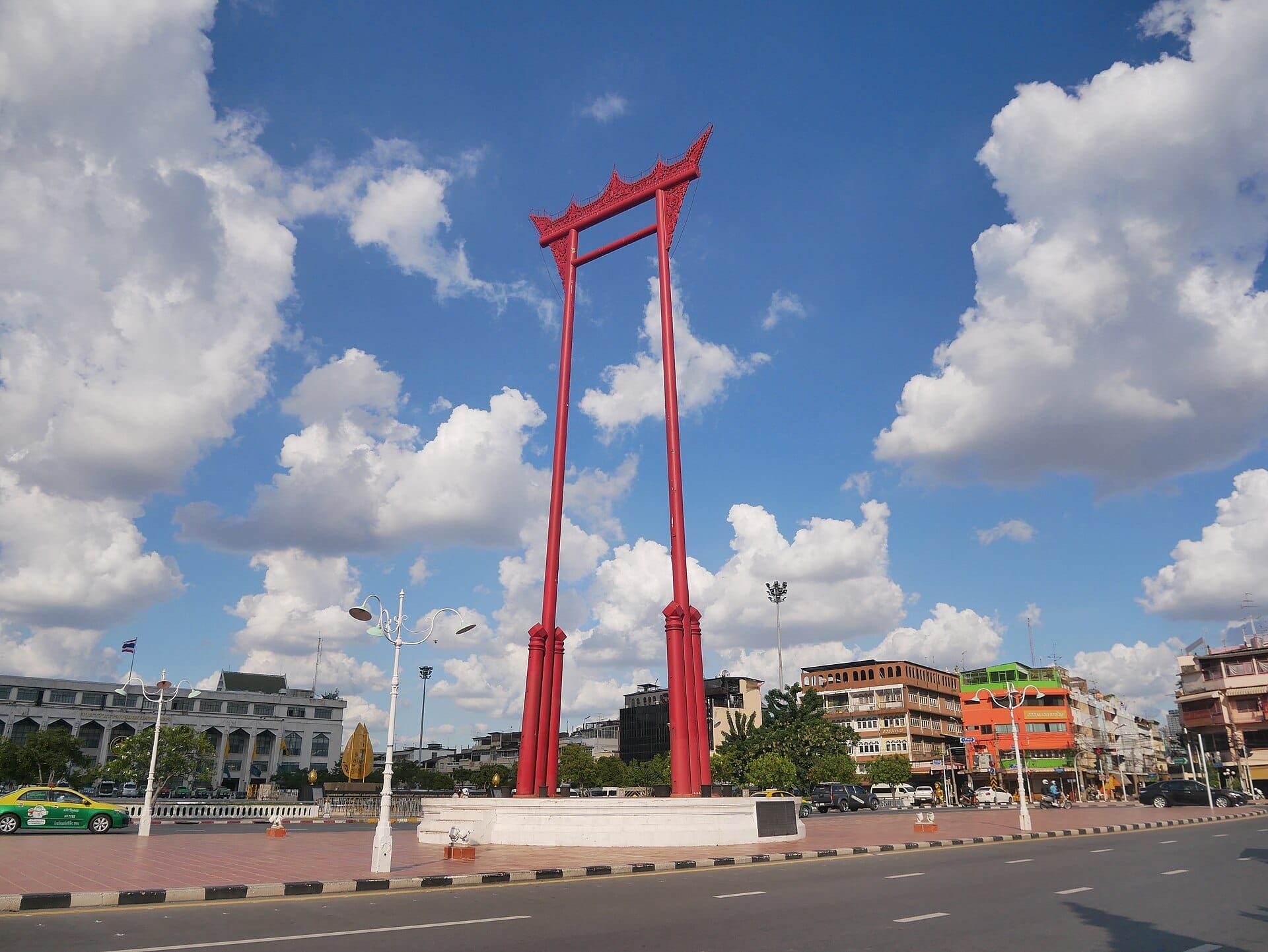
The Giant Swing, known in Thai as Sao Ching Cha, is a ceremonial structure that has stood on Bamrung Mueang Road since 1784, when it was commissioned by King Rama I as part of the founding of Bangkok as the new Siamese capital. The current posts are actually a restoration completed in 2007, when the original deteriorating teak columns were replaced with 16 golden teak logs sourced from Chiang Mai. The frame you see today is structurally faithful to the original but was purpose-built to last another century.
At 27 metres tall, the swing dominates the open plaza in front of Wat Suthat, one of Bangkok's most important temples. The two tall red columns are connected at the top by an elaborately carved crossbeam, and the whole structure is painted in a deep ox-blood red that catches the late afternoon light in a way that makes it almost glow. There is no actual swing rope attached today — it is a monument, not an interactive structure.
💡 Local tip
The best light for photography is late afternoon, roughly 3:00–5:00 PM, when the sun hits the red columns from the west and the background sky often turns a rich blue or orange. Mornings work well too for cooler temperatures and fewer pedestrians on the road.
The Ceremony It Was Built For
The Giant Swing was the centrepiece of a royal Brahmin ceremony called Triyampawai, held annually to worship the Hindu god Shiva. During this ritual, teams of men would sit on a platform attached to long ropes and swing in increasingly wide arcs, eventually reaching a height where they could grab a bag of gold coins hung from a tall bamboo pole using only their teeth. The ceremony was simultaneously an athletic feat, a religious rite, and a public spectacle.
It was a dangerous event by any measure. Historical records indicate that participants occasionally fell during the ceremony, and fatalities were not unheard of. King Rama VII suspended the ceremony in 1935, citing safety concerns, and it has never been formally revived. What remains is the structure itself, stripped of its function but not of its presence. Understanding this context changes how you look at it: this is not decorative architecture. It is the remnant of an event that once drew enormous crowds to this very square.
Tickets & tours
Hand-picked options from our booking partner. Prices are indicative; availability and final rates are confirmed when you complete your booking.
Golden Mount with Metal Castle and Giant Swing Tour in Bangkok
From 79 €Instant confirmationFree cancellationTemples of Bangkok and Grand Palace half-day guided tour
From 18 €Instant confirmationFree cancellationBangkok tuk-tuk night tour with Chinatown street food meal
From 28 €Instant confirmationFree cancellationAfternoon Tea at Hyatt Regency Hotel Bangkok
From 900 €Instant confirmationFree cancellation
What the Visit Actually Looks Like
The Giant Swing sits on a raised circular platform at the end of Bamrung Mueang Road, one of Bangkok's most interesting streets for religious goods and Buddhist paraphernalia. The platform itself is modest, ringed by a low fence, and there is a small plaque with historical information in both Thai and English. Most visitors spend five to ten minutes here before moving into Wat Suthat across the road.
The surrounding plaza is genuinely open and airy compared to the dense commercial blocks of central Bangkok. In the mornings, vendors sell flowers and offerings on the temple side. The smell of jasmine garlands and incense drifts across the square from early morning onwards. Traffic on Bamrung Mueang Road is intermittent, and you can usually cross to photograph the swing from the temple steps without too much difficulty.
Bamrung Mueang Road itself is worth a slow walk. The street is lined with shops selling Buddhist monk robes, gilded Buddha images, ceremonial umbrellas, and spirit house accessories. It is one of the few streets in Bangkok where the retail stock has remained essentially the same for generations. The textures here are distinct: polished bronze figures, rough saffron fabric folded in piles, lacquered wood in shades of gold and red. If you walk west from the swing, you will reach the area around Wat Ratchabophit in under ten minutes.
How the Atmosphere Shifts by Time of Day
Early mornings before 8:00 AM are quiet and photogenic. Monks from Wat Suthat occasionally cross the plaza. The square feels calm, and the red columns stand out sharply against the pale sky. By 9:00–10:00 AM, tour groups begin arriving, often combining the swing with the Grand Palace circuit. Midday is the hottest and least pleasant time to visit: the square has minimal shade, and the concrete radiates heat aggressively in Bangkok's dry season months.
Late afternoon brings a noticeable shift. The light turns warm and directional, the crowds thin out slightly, and the activity on Bamrung Mueang Road picks up as vendors prepare to close. If you are combining this stop with the nearby Wat Saket Golden Mount, scheduling Sao Ching Cha in the late afternoon and Wat Saket at sunset makes for a well-paced afternoon in old Bangkok.
⚠️ What to skip
There is almost no shade on the plaza platform itself. If you visit between April and June, bring water, wear a hat, and move quickly between shaded spots. This is a short stop, not a sit-and-linger location.
Getting There and Getting Around
The Giant Swing is not on a BTS Skytrain line, which catches many first-time visitors off guard. The closest MRT station is Sam Yot, roughly a 15-minute walk through Rattanakosin's old streets. From the Grand Palace area, it is an easy 20-minute walk east along Sanam Luang and then down Bamrung Mueang Road. A tuk-tuk or Grab taxi from Siam or Silom will typically cost 60–100 THB depending on traffic.
Rattanakosin as a whole is best explored on foot. The streets between the Grand Palace, Wat Pho, Wat Suthat, and the Democracy Monument form a logical walking loop that takes three to four hours at a relaxed pace. The Giant Swing sits almost exactly in the middle of that loop, making it a natural waypoint rather than a standalone destination.
Is It Worth a Dedicated Trip?
The honest answer is: probably not on its own. The Giant Swing is not an interactive site, there is no entry fee or interior to explore, and most people have seen enough after ten to fifteen minutes. Its value is almost entirely contextual. Placed alongside Wat Suthat, which is genuinely one of Bangkok's most underrated temples, and the atmospheric stretch of Bamrung Mueang Road, it becomes part of a rewarding half-day in old Bangkok.
Travellers who approach it expecting something on the scale of the nearby temple complexes will find it underwhelming. But travellers interested in Bangkok's layered history — its Brahmin ceremonial traditions, its Ayutthaya-era urban planning, its survival through multiple periods of reconstruction — will find the swing genuinely thought-provoking. It is also one of the few major landmarks in the city that remains uncrowded and completely free, which counts for something. For context on what else the Rattanakosin district offers, the best temples in Bangkok guide covers the full historic core in detail.
ℹ️ Good to know
Accessibility note: The circular platform around the Giant Swing has low steps. The plaza and surrounding pavement are generally flat, but Bamrung Mueang Road can be uneven in places. The area is manageable for most mobility levels but may present minor challenges for wheelchair users.
Insider Tips
- Walk the full length of Bamrung Mueang Road east to west — the shops selling ceremonial Buddhist goods are genuinely fascinating and almost entirely untouristy. Prices are also significantly lower than at market stalls near the Grand Palace.
- For the cleanest photograph of the swing with no vehicles in frame, shoot from the steps of Wat Suthat directly opposite. The elevated angle and stone gateway provide natural framing that blocks the road noise and crowds.
- Combine the Giant Swing with Wat Suthat on the same visit. Wat Suthat is one of Bangkok's six first-class royal temples and is far less visited than Wat Pho or Wat Arun, despite containing some of the finest murals in the city.
- The 2007 restoration used golden teak from trees over 200 years old. This detail is mentioned on the English-language plaque at the base — worth reading before you move on.
- If you are visiting during a weekday morning, local schoolchildren occasionally visit as part of cultural education trips. Their presence adds life to the plaza and provides candid photographic opportunities that are different from the usual tourist shots.
Who Is The Giant Swing For?
- History and culture enthusiasts building a deeper picture of Bangkok's pre-modern ceremonial life
- Photographers looking for iconic Old Bangkok shots with manageable crowds
- Visitors doing a self-guided walking tour of the Rattanakosin historic district
- Travellers pairing the stop with Wat Suthat for a combined temple-and-landmark visit
- Anyone with a specific interest in Thai-Brahmin religious traditions and their influence on the early Bangkok period
Nearby Attractions
Other things to see while in Rattanakosin:
- Bangkok National Museum
The Bangkok National Museum is the largest museum in Southeast Asia and the definitive starting point for understanding Thai history. Spread across a former palace compound near the Grand Palace, it houses royal regalia, pre-Siamese sculpture, intricate funeral chariots, and centuries of Buddhist art under one roof.
- Democracy Monument
Standing at the heart of Ratchadamnoen Avenue in the Rattanakosin district, the Democracy Monument is Bangkok's most charged political symbol. Built in 1939 to commemorate Thailand's transition from absolute monarchy to constitutional rule, it remains a living stage for the city's public life and a striking piece of art deco civic architecture.
- Grand Palace Bangkok
The Grand Palace is Bangkok's most recognizable landmark and the ceremonial heart of Thailand. This guide covers what to see, when to go, how to dress, and how to make the most of a visit without the frustration.
- Khao San Road
Khao San Road is one of Bangkok's most recognizable streets, drawing budget travelers, partygoers, and curious visitors from around the world. It delivers cheap cocktails, street food, and a carnival atmosphere after dark, but it polarizes visitors sharply. Here's what you actually need to know before you go.