Wat Saket (Golden Mount): Bangkok's Most Rewarding Temple Climb
Wat Saket and its famous artificial hill, known as the Golden Mount, offer one of the most satisfying short climbs in Bangkok. The 318-step spiral path winds past bells, shaded trees, and historical plaques before delivering a 360-degree view over the old city's rooftops and canals. It rewards effort without demanding a full day.
Quick Facts
- Location
- Wat Saket Rd, Pom Prap Sattru Phai, Bangkok (Rattanakosin district)
- Getting There
- Sam Yot MRT station / Phan Fa boat pier (Chao Phraya Express Boat)
- Time Needed
- 45 minutes to 1.5 hours
- Cost
- Approximately 100 THB entry fee for the Golden Mount area
- Best for
- Views over old Bangkok, early-morning temple atmosphere, photography
What Is Wat Saket and Why Does It Stand Out?
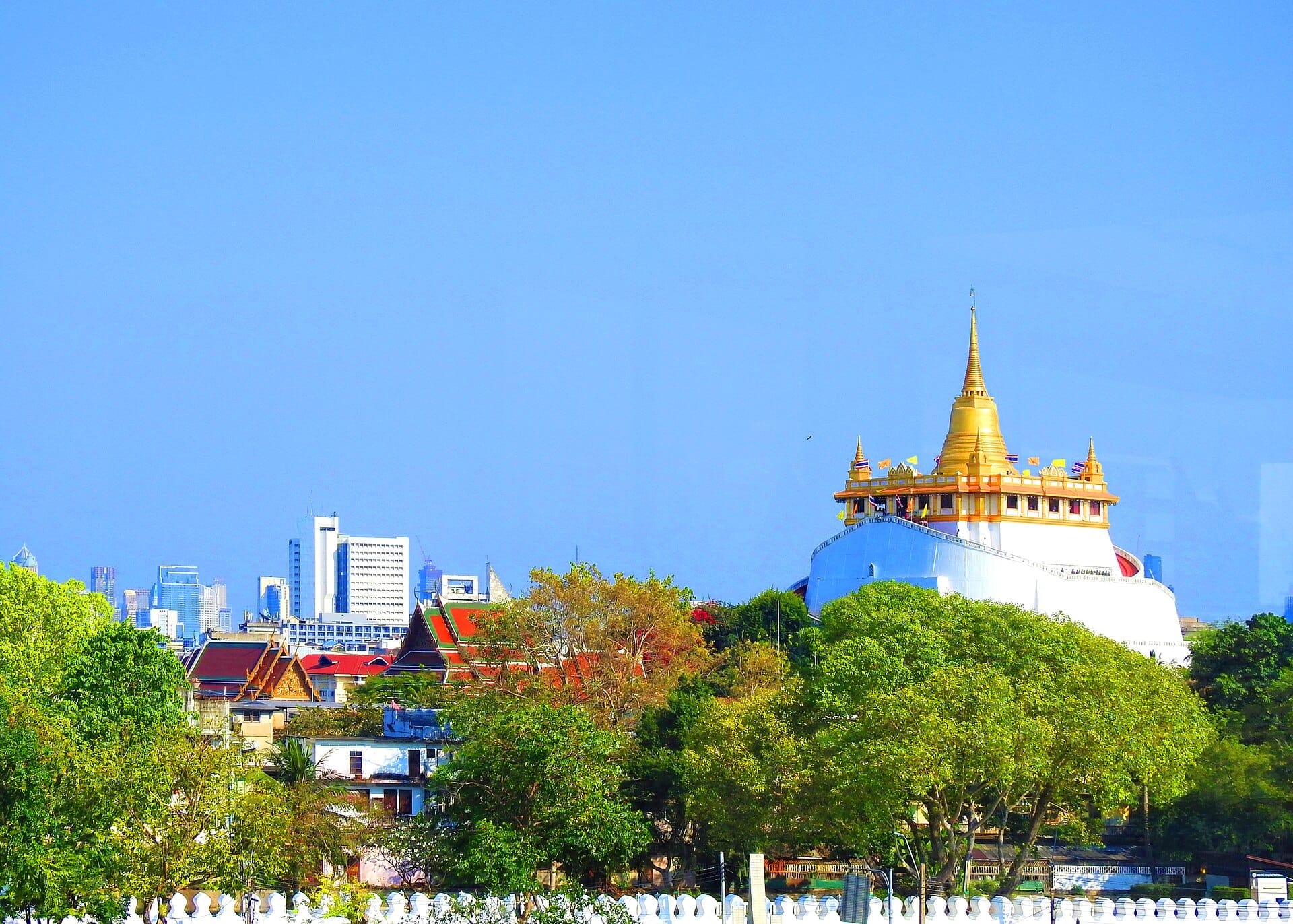
Wat Saket is one of Bangkok's oldest and most historically layered temple complexes, but its defining feature is the Golden Mount: an artificial hill topped with a gilded chedi that rises about 80 metres above the flat surrounding cityscape. The structure is immediately recognisable from across Rattanakosin, catching sunlight from a distance and orienting visitors who are navigating the old city on foot.
Unlike the grand ceremonial compounds of the Grand Palace or the riverside drama of Wat Arun, Wat Saket operates quietly. There are no enormous tour groups blocking doorways, no ticket queues stretching down the street. It functions as a genuine working monastery while simultaneously being open to visitors, which gives it an atmosphere that many of Bangkok's more promoted temples have lost.
💡 Local tip
Arrive before 9am to experience the temple in near-silence. A handful of monks complete their morning routines, incense smoke drifts across the lower courtyard, and the climb to the summit feels meditative rather than athletic. The light at this hour is also ideal for photography of the gilded chedi.
The History Behind the Hill
The site predates Bangkok itself. It was established during the Ayutthaya period and was later renovated and expanded by King Rama I when he founded the capital in 1782. The artificial hill was begun under Rama III but took decades to complete due to its scale and the soft Bangkok soil, which caused repeated collapses during construction. It was finally completed during the reign of Rama IV in the mid to late 19th century.
The chedi at the summit contains a relic of the Buddha, reportedly brought from India. This gives Wat Saket genuine religious significance beyond its visual prominence. The compound also has a sobering historical footnote: during the early Rattanakosin period, bodies of plague and smallpox victims were brought here to be cremated or left for vultures, since the temple stood outside the city walls. That history adds an unexpected gravity to what otherwise feels like a peaceful garden walk.
Every November, the temple hosts one of Bangkok's largest and oldest temple fairs, wrapping the hill in coloured lights and filling the surrounding streets with food stalls and traditional performances for about ten days. If you happen to be in the city during this period, the atmosphere is worth experiencing specifically.
Tickets & tours
Hand-picked options from our booking partner. Prices are indicative; availability and final rates are confirmed when you complete your booking.
Golden Mount with Metal Castle and Giant Swing Tour in Bangkok
From 79 €Instant confirmationFree cancellationChinatown and Golden Buddha Temple self-guided walking tour
From 13 €Instant confirmationFree cancellationTemples of Bangkok and Grand Palace half-day guided tour
From 18 €Instant confirmationFree cancellationDamnoen Saduak floating market and Maeklong railway guided tour
From 36 €Instant confirmationFree cancellation
The Climb: What to Expect Step by Step
The ascent begins at ground level through the lower temple compound, which contains ordination halls, monk quarters, and a small museum. The path then transitions to a covered stairway that spirals up the hillside. The route is partially shaded by mature trees growing from the slopes, and the walls are lined with hanging bells in various sizes. Ringing them as you pass is encouraged and produces a gentle metallic ripple of sound that carries down the staircase.
At intervals along the climb, there are small shrines and plaques explaining the history of the structure and its religious significance. The path is uneven in places and the steps vary in height, so solid footwear is more practical than sandals. The gradient is moderate. Most healthy adults complete the climb in under 15 minutes without stopping, though the heat and humidity of Bangkok make it feel more demanding than the step count suggests.
⚠️ What to skip
Visitors must dress modestly to enter. Shoulders and knees should be covered. Lightweight scarves or a long-sleeved shirt are sufficient. Unlike some Bangkok temples, there is no sarong lending service here, so come prepared.
The terrace at the summit is relatively compact, circling the chedi with a low railing. On clear mornings, the view extends across the Chao Phraya river, over the rooftops of Rattanakosin, and south toward the skyscrapers of the modern city centre. On hazy afternoons, the view compresses but the atmosphere changes: the golden chedi glows differently in flat light, and the crowds are thinner. Sunset visits are popular but the terrace gets crowded and the western sky tends to be obscured by atmospheric haze for much of the year.
How Crowds and Timing Affect the Experience
Wat Saket is open daily from approximately 7am to 7pm, with the Golden Mount area accessible during those hours for the entry fee. Mid-morning to early afternoon (10am to 2pm) brings the largest concentration of visitors, coinciding with group tours routed through the Rattanakosin area. The climb becomes noisier, the terrace more congested, and the mood shifts from contemplative to photographic queue.
If your Bangkok itinerary includes nearby sites like Wat Suthat or the Giant Swing, consider visiting Wat Saket first thing in the morning and the others later. The walking distances between these sites are short, and grouping them into a single Rattanakosin morning is efficient and rewarding.
Rain affects the experience significantly. The stairway surface becomes slippery when wet, and the summit terrace offers no overhead shelter. A light rain jacket or compact umbrella is worth carrying during the May through October monsoon months. On the other hand, the post-rain hour often brings exceptional clarity to the views as dust settles and the city briefly sharpens.
Getting There and Around the Area
Wat Saket sits on the eastern edge of Rattanakosin, just inside the old city canal. The most direct public transit approach is the Chao Phraya Express Boat to Phan Fa Pier (N3), which places you roughly a 10-minute walk from the temple entrance. From Hua Lamphong MRT station, the walk takes around 20 to 25 minutes through the edges of Chinatown, which itself makes for an interesting approach through a different texture of the city.
Taxis and tuk-tuks can drop you directly at the entrance on Wat Saket Road. Rideshare apps work reliably in this area. If you are combining a broader exploration of the old city, the Rattanakosin neighbourhood is compact enough to cover largely on foot, with Wat Saket serving as a natural eastern anchor point for a walking route.
Photography and Accessibility Notes
The summit terrace offers a 360-degree shooting angle, but the chedi itself dominates much of the close-range frame. Wide-angle lenses or smartphone ultra-wide modes work better than telephoto here. Morning light hits the eastern face of the chedi directly and creates cleaner reflections off the gold mosaic tiles. The city view to the west is better captured in late afternoon when the light angles improve, but haze is the variable that matters most.
Accessibility is limited. The spiral staircase has no lift alternative, and the uneven steps make the climb difficult for visitors with mobility impairments or those using wheelchairs or strollers. The lower temple compound is accessible at ground level and contains considerable architectural interest in its own right, so the visit is not entirely without value for those who cannot make the ascent.
ℹ️ Good to know
The Golden Mount is one of the few places in Bangkok where you can see the layout of the old city as a whole. The canal ring, the temple compounds, and the Chao Phraya river all become readable from the top in a way that helps orient the rest of a Rattanakosin itinerary.
Insider Tips
- The bells hanging along the stairway walls are not decorative. They are there specifically for visitors to ring, and the sound carries an unusual peace to it early in the morning when the ambient noise below is still low.
- Check the November fair dates before booking travel if the festival atmosphere interests you. The Loy Krathong period usually aligns with the fair, meaning the Golden Mount is lit up at night and the surrounding streets transform for roughly ten evenings.
- The small museum in the lower compound is often skipped by visitors who rush to the climb. It contains photographs and artefacts related to the temple's history and is worth 10 minutes if you want context before heading up.
- If you want a long view of the Golden Mount itself rather than from it, walk west along Ratchadamnoen Avenue toward the Democracy Monument at golden hour. The chedi catches the light above the treeline and makes for a cleaner composition than anything shot from the summit terrace.
- The water fountain near the base of the stairway entrance is functional and cold. Fill a bottle before climbing. There is no refreshment available at the top.
Who Is Wat Saket For?
- Travellers who want a panoramic view of old Bangkok without the commercial pressure of a dedicated observation deck
- History-focused visitors interested in the Rattanakosin period and early Bangkok urban development
- Photographers working in the Rattanakosin area looking for an elevated perspective on the city's temple roofscape
- Early risers who want a quiet, atmospheric start to a temple-heavy day in the old city
- Visitors combining a walkable itinerary through Rattanakosin's lesser-visited historic sites
Nearby Attractions
Other things to see while in Rattanakosin:
- Bangkok National Museum
The Bangkok National Museum is the largest museum in Southeast Asia and the definitive starting point for understanding Thai history. Spread across a former palace compound near the Grand Palace, it houses royal regalia, pre-Siamese sculpture, intricate funeral chariots, and centuries of Buddhist art under one roof.
- Democracy Monument
Standing at the heart of Ratchadamnoen Avenue in the Rattanakosin district, the Democracy Monument is Bangkok's most charged political symbol. Built in 1939 to commemorate Thailand's transition from absolute monarchy to constitutional rule, it remains a living stage for the city's public life and a striking piece of art deco civic architecture.
- The Giant Swing
The Giant Swing (Sao Ching Cha) stands 27 metres tall in the heart of Bangkok's historic Rattanakosin district, just steps from Wat Suthat. Once the centrepiece of a daring Brahmin ceremony, this centuries-old teak structure is one of Bangkok's most recognisable landmarks — and one of its least-understood.
- Grand Palace Bangkok
The Grand Palace is Bangkok's most recognizable landmark and the ceremonial heart of Thailand. This guide covers what to see, when to go, how to dress, and how to make the most of a visit without the frustration.