Democracy Monument: Bangkok's Boldest Political Landmark
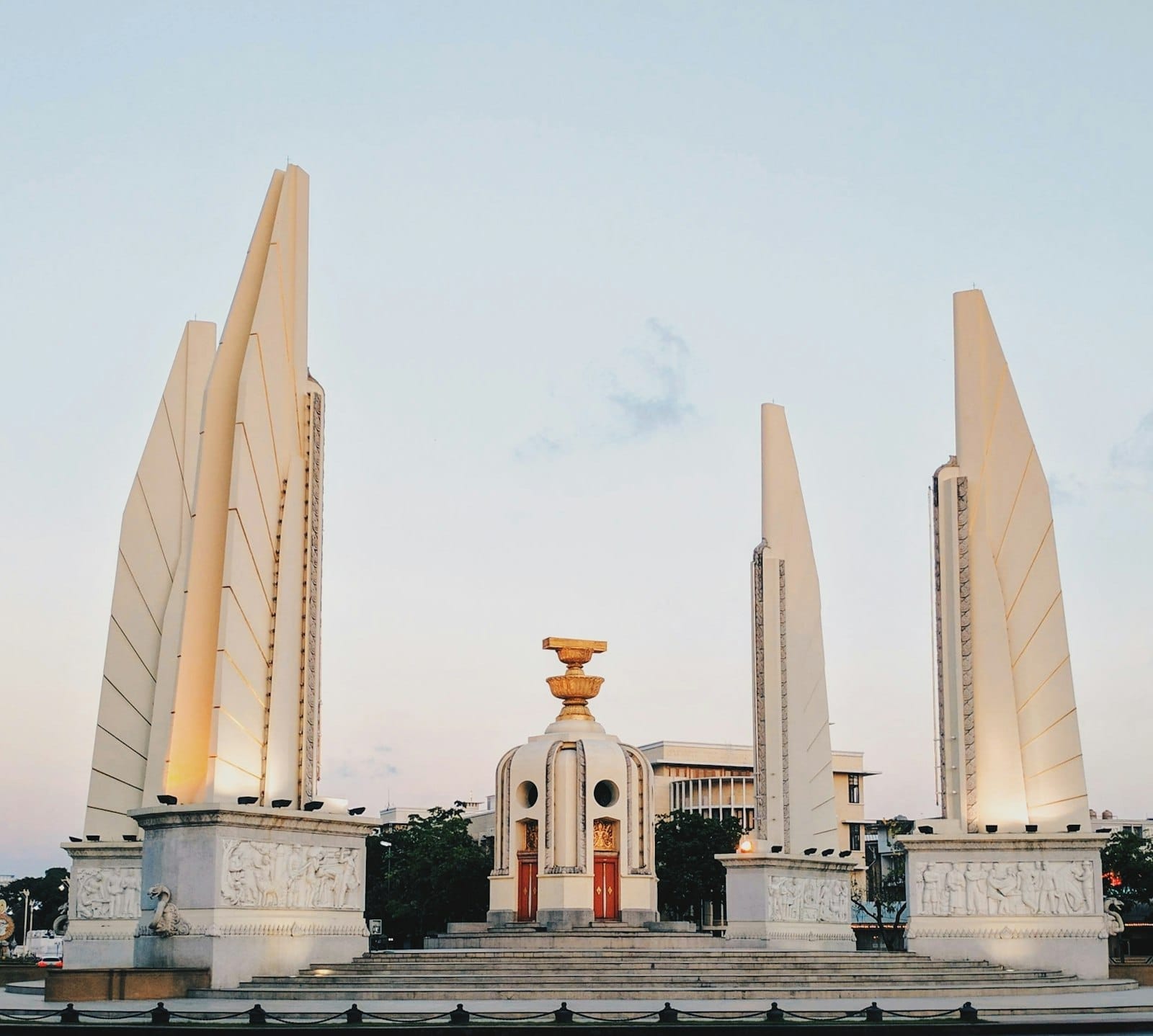
Standing at the heart of Ratchadamnoen Avenue in the Rattanakosin district, the Democracy Monument is Bangkok's most charged political symbol. Built in 1939 to commemorate Thailand's transition from absolute monarchy to constitutional rule, it remains a living stage for the city's public life and a striking piece of art deco civic architecture.
Quick Facts
- Location
- Ratchadamnoen Klang Avenue, Rattanakosin, Bangkok
- Getting There
- MRT Sanam Chai (then taxi/tuk-tuk) or river ferry to Tha Phra Athit Pier
- Time Needed
- 30–60 minutes to walk around; longer if exploring the avenue
- Cost
- Free to visit (outdoor monument)
- Best for
- History buffs, architecture lovers, photography, evening walks
What the Democracy Monument Actually Is
The Democracy Monument (อนุสาวรีย์ประชาธิปไตย) sits at the center of Ratchadamnoen Klang Avenue, Bangkok's grand ceremonial boulevard modeled loosely on the Champs-Élysées. It was commissioned by Field Marshal Plaek Phibunsongkhram and completed in 1939, seven years after the Siamese Revolution of 1932 ended the era of absolute monarchy. The monument was designed by Italian sculptor Corrado Feroci, who had settled in Thailand and become a Thai citizen under the name Silpa Bhirasri. He would go on to found the country's first fine arts university.
The structure is not a statue but a composition of symbolic objects at architectural scale. Four wing-like fin towers, each 24 meters tall, surround a central pedestal that holds a golden constitution book. The number 24 references June 24, 1932, the date of the revolution. The base contains 75 cannons, referencing the Buddhist year 2475, which corresponds to 1932 in the Gregorian calendar. These are not decorative choices. Every dimension was chosen to encode the specific historical moment.
ℹ️ Good to know
The monument is fully outdoors and accessible around the clock. It sits in a traffic roundabout, so approaching it requires using pedestrian crossings. Plan a few extra minutes to cross safely.
The Setting: Ratchadamnoen Avenue
The monument cannot be separated from the boulevard that frames it. Ratchadamnoen Klang is lined with carefully maintained trees, lamp posts in royal yellow, and wide sidewalks built for crowds. It connects Sanam Luang to the west with the Royal Plaza to the north, making it the corridor through which Bangkok stages its most important state events. On national holidays, the avenue fills with enormous portrait banners, royal flags, and organized displays of ceremony.
In the early morning, the avenue is quiet enough to hear birds and the hum of city traffic from a distance. Joggers and cyclists appear around sunrise, and a few food carts set up near the side streets. By midday, the heat radiating off the wide concrete median makes standing in direct sun uncomfortable for most visitors. The best light for photography falls in the late afternoon and just after sunset, when the monument is lit from below and the street lamps create long golden reflections on the pavement. The area around Sanam Luang to the west sees significantly more foot traffic, but the monument itself rarely draws large tour groups.
Tickets & tours
Hand-picked options from our booking partner. Prices are indicative; availability and final rates are confirmed when you complete your booking.
Temples of Bangkok and Grand Palace half-day guided tour
From 18 €Instant confirmationFree cancellationDamnoen Saduak floating market and Maeklong railway guided tour
From 36 €Instant confirmationFree cancellationBangkok tuk-tuk night tour with Chinatown street food meal
From 28 €Instant confirmationFree cancellationAfternoon Tea at Hyatt Regency Hotel Bangkok
From 900 €Instant confirmationFree cancellation
Architecture and Artistic Detail
The four wing towers are constructed from reinforced concrete faced in stone, and their tapered vertical lines reflect the European Art Deco influence that Feroci brought from his training in Italy. Each wing is covered in bas-relief panels depicting soldiers, civilians, and scenes from the 1932 revolution. The reliefs are detailed enough to reward close inspection but are often overlooked by visitors who stay at a distance.
The central octagonal base has multiple levels, and the golden constitution resting at the top is visible from the far ends of the boulevard. The octagonal form appears repeatedly across the monument's geometry, a nod to the eight principles outlined in the 1932 manifesto of the People's Party. The scale is calibrated to feel significant without being overwhelming, which is part of why it photographs well from both close range and from the middle distance along the avenue.
For visitors already exploring the historic core, the monument pairs naturally with a walk toward Wat Saket and the Golden Mount to the southeast, or onward to Wat Ratchanatdaram which is only a short walk from the roundabout.
Political History and Public Memory
Few outdoor spaces in Southeast Asia carry as much political weight per square meter as this roundabout. The Democracy Monument has been the gathering point for major political demonstrations repeatedly across its history: in 1973 during the student uprising against military rule, in 1992 during the Black May protests against General Suchinda Kraprayoon, and again during the Red Shirt and Yellow Shirt movements of the 2000s and 2010s. Some of these events ended in violence.
That history is not marked with plaques on the monument itself, which is part of what makes visiting it interesting and slightly unsettling if you know the context. The government maintains and illuminates it as a civic monument. Civil society has repeatedly used it as a protest stage. Both things are true at the same time, and that tension is embedded in the site. First-time visitors from countries with simpler civic histories sometimes find this layering of official and contested meaning striking.
⚠️ What to skip
During politically sensitive periods or large public demonstrations, the area around the monument can become crowded and occasionally tense. Check local news if you are visiting during election periods or national anniversaries.
Getting There and Moving Around
The Democracy Monument is not directly served by BTS Skytrain or MRT Metro stations. The most practical approach from central Bangkok is to take the MRT to Sam Yot or Sanam Chai station and then board a taxi, tuk-tuk, or motorcycle taxi heading north along Mahachai Road toward Ratchadamnoen. The trip takes roughly 10 to 15 minutes depending on traffic. From the Chao Phraya riverside, the Chao Phraya Express Boat to Tha Phra Athit Pier leaves you about a 15-minute walk away along Ratchadamnoen Klang.
The public bus network serves Ratchadamnoen Klang directly with several routes. If you are already in the Rattanakosin area after visiting the Grand Palace or Wat Pho, a tuk-tuk or a 20-minute walk north along the avenue is the simplest option. There is no dedicated parking lot at the monument, so self-driving visitors typically park along Ratchadamnoen or in nearby streets.
Photography and Practical Notes
The monument's symmetry makes composition straightforward but the traffic circle creates challenges. There is no elevated platform for overhead shots without drone equipment, and civilian drone flights require a permit in central Bangkok. Ground-level photography from the pedestrian median works well with a wide-angle lens. The floodlighting that activates at dusk creates strong contrast between the stone towers and the dark sky, making evening the most dramatic time for images.
Midday sun bleaches the pale stone and creates harsh shadows in the bas-relief panels, which reduces the texture visible in photographs. Overcast days actually produce flattering, even light on the relief work. Rain creates reflections on the surrounding pavement that can be used effectively in wide shots.
💡 Local tip
For the cleanest wide-angle shot of the full monument with the boulevard receding behind it, position yourself on the central pedestrian median about 80–100 meters east or west of the roundabout. The lane markings and tree line create natural leading lines toward the monument.
The site is fully wheelchair accessible by approaching via the pedestrian crossings on Ratchadamnoen Klang. The surrounding pavement is maintained, though uneven in a few spots near the roundabout perimeter. There is no formal visitor center, restrooms, or ticket booth at the monument itself. The nearest public facilities are in the surrounding government buildings and nearby cafes.
Is It Worth Your Time?
As a standalone trip from a hotel in Sukhumvit or Silom, the Democracy Monument requires deliberate effort and does not offer the interior experiences of a museum or temple. Visitors expecting a dramatic exhibit or guided narrative will find an outdoor roundabout with significant but unexplained history. The monument rewards people who arrive with context and are happy to stand somewhere and think.
Paired with a broader walk through Rattanakosin, it becomes one of the most historically loaded stops in the city. The combination of its art deco design, its coded revolutionary symbolism, and its record as a recurring site of political confrontation makes it unlike anything else in Bangkok. If you are following a temples and historic sites itinerary through the old city, the Democracy Monument belongs on that route.
Insider Tips
- Visit on a weekday evening around 7–8pm. The avenue is cooler, lit up, and almost empty of tourists, giving you unobstructed views and calm surroundings that are completely different from daytime.
- Walk the full length of Ratchadamnoen Klang in both directions from the monument. The proportions of the boulevard are designed to be experienced on foot, not from a vehicle window.
- The bas-relief panels on the four wing towers tell the story of the 1932 revolution. Spend a few minutes reading them before moving on. Most visitors photograph the monument from a distance and miss this detail entirely.
- On the King's Birthday (December 5) and Constitution Day (December 10), the avenue is illuminated with elaborate decorations and the monument takes on a ceremonial atmosphere unlike any other time of year.
- If you want a meal nearby, the streets off Ratchadamnoen toward Banglamphu and Khao San Road have dense clusters of affordable Thai restaurants and street food. It is a 10-minute walk from the monument.
Who Is Democracy Monument For?
- Travelers interested in Thai political history and civic architecture
- Photographers looking for dramatic urban compositions, especially at night
- Visitors already exploring the Rattanakosin historic district
- Architecture enthusiasts interested in Art Deco and European-Asian design crossovers
- Travelers who enjoy walking historic boulevards without crowds
Nearby Attractions
Other things to see while in Rattanakosin:
- Bangkok National Museum
The Bangkok National Museum is the largest museum in Southeast Asia and the definitive starting point for understanding Thai history. Spread across a former palace compound near the Grand Palace, it houses royal regalia, pre-Siamese sculpture, intricate funeral chariots, and centuries of Buddhist art under one roof.
- The Giant Swing
The Giant Swing (Sao Ching Cha) stands 27 metres tall in the heart of Bangkok's historic Rattanakosin district, just steps from Wat Suthat. Once the centrepiece of a daring Brahmin ceremony, this centuries-old teak structure is one of Bangkok's most recognisable landmarks — and one of its least-understood.
- Grand Palace Bangkok
The Grand Palace is Bangkok's most recognizable landmark and the ceremonial heart of Thailand. This guide covers what to see, when to go, how to dress, and how to make the most of a visit without the frustration.
- Khao San Road
Khao San Road is one of Bangkok's most recognizable streets, drawing budget travelers, partygoers, and curious visitors from around the world. It delivers cheap cocktails, street food, and a carnival atmosphere after dark, but it polarizes visitors sharply. Here's what you actually need to know before you go.