Grand Palace Bangkok: The Complete Visitor Guide
The Grand Palace is Bangkok's most recognizable landmark and the ceremonial heart of Thailand. This guide covers what to see, when to go, how to dress, and how to make the most of a visit without the frustration.
Quick Facts
- Location
- Na Phra Lan Road, Rattanakosin, Bangkok
- Getting There
- Chao Phraya Express Boat to Tha Chang Pier (N9). No BTS or MRT direct access.
- Time Needed
- 2 to 3 hours minimum
- Cost
- 500 THB per adult (includes entry to Wat Phra Kaew and the Queen Sirikit Museum of Textiles)
- Best for
- First-time visitors, history and architecture enthusiasts, Thai culture and religion
- Official website
- www.royalgrandpalace.th/en/home
What the Grand Palace Actually Is
The Grand Palace is a 218,400-square-metre walled complex on the eastern bank of the Chao Phraya River, built beginning in 1782 when King Rama I relocated the capital from Thonburi to Bangkok. It served as the official residence of the Thai monarch until the early 20th century, and while no king has lived here permanently since Rama VIII, it remains the spiritual and ceremonial nucleus of Thai national identity. State funerals, coronations, and royal ceremonies still take place within these walls.
The complex contains dozens of individual buildings, courtyards, and gardens, but the site that draws the majority of visitors is Wat Phra Kaew, the Temple of the Emerald Buddha. Entry to the Grand Palace compound automatically includes access to the temple, and for most travelers, the two are inseparable.
ℹ️ Good to know
The 500 THB ticket also covers the Queen Sirikit Museum of Textiles on-site. Keep your ticket; some secondary sites check it at the door.
Wat Phra Kaew: The Real Draw
Wat Phra Kaew sits in the northeastern section of the compound and is the most sacred temple in Thailand. The Emerald Buddha itself is surprisingly small, roughly 66 centimetres tall, carved from a single piece of green jasper (not emerald), and seated high on a gilded throne inside the bot (ordination hall). Photography inside the bot is not permitted, which means visitors genuinely stop and look. The effect of hundreds of people silently tilting their heads upward in unison is quietly remarkable.
The surrounding complex compensates for the Buddha's modest scale with relentless visual intensity. The rooflines are layered with glazed ceramic tiles in deep orange and green. Yaksha demon guardian figures stand at each gateway, their surfaces encrusted with small mirrors. The Golden Chedi glitters in direct sun, almost aggressively so in the late morning. If you are walking the perimeter gallery, which is lined with murals depicting the entire Ramakien epic, allow at least 30 minutes for that stretch alone.
Wat Phra Kaew sits within one of Bangkok's most historically dense neighborhoods. If you're building a full day itinerary in the area, see our guide to Wat Pho, just a short walk south, and consider combining it with a visit to the Wat Saket Golden Mount for a wider sense of old Bangkok's temple geography.
Tickets & tours
Hand-picked options from our booking partner. Prices are indicative; availability and final rates are confirmed when you complete your booking.
Temples of Bangkok and Grand Palace half-day guided tour
From 18 €Instant confirmationFree cancellationBangkok temples full-day tour with Grand Palace entry
From 344 €Instant confirmationFree cancellationGrand Palace, Temples, and Canal boat ride private tour
From 479 €Instant confirmationFree cancellationGuided half-day visit to Grand Palace and Wat Phra Kaew
From 238 €Instant confirmationFree cancellation
How the Experience Changes by Time of Day
The gates open at 8:30 AM, and the first hour offers the clearest walking conditions. Tour groups, which arrive in significant waves from around 9:30 AM onward, can make the main pathways feel congested by mid-morning. The combination of crowds and Bangkok's humidity means that by noon, navigating the paved courtyards in direct sun is genuinely uncomfortable. Bring water. The complex provides little shade in the central areas.
The quality of light for photography shifts dramatically across the day. Before 10 AM, the eastern-facing facades of the bot and the Golden Chedi catch warm directional light with clean shadows. By late morning, the light flattens and glare off the mirror-tiled surfaces becomes harsh. Afternoon visits, from around 2 PM onward, see crowds thinning and the western facades catching better light, though heat remains a factor until around 4 PM. The complex closes at 3:30 PM for last entry, with the grounds closing at 4:30 PM.
💡 Local tip
Arrive before 9 AM if you want photographs of the main temple structures without crowds in the foreground. Weekdays in the low season (May to September) are noticeably quieter than weekends or high season.
The Dress Code: Non-Negotiable
This is the single most common source of friction at the entrance. The Grand Palace enforces a strict dress code: shoulders and knees must be covered for both men and women. Sleeveless shirts, shorts, short skirts, and sheer clothing are not permitted. Flip-flops are technically allowed but impractical given the distances walked on rough stone.
If you arrive underdressed, there is a free clothing loan service near the entrance where you can borrow a sarong or long pants. The queue for this service can be slow during peak hours and adds time to your entry. The simpler approach is to dress appropriately from the start, wearing lightweight, loose-fitting long pants or a maxi skirt and a top with sleeves. Light linen or moisture-wicking fabric is noticeably more comfortable than denim in the heat.
⚠️ What to skip
Ignore tuk-tuk drivers near the main entrance who claim the palace is closed for a special ceremony and offer to take you elsewhere. This is a well-documented scam. The palace closes only on specific national holidays; check the official website before visiting.
Getting There and Getting In
The most straightforward route is the Chao Phraya Express Boat, arriving at Tha Chang Pier (N9). From the pier, the palace entrance is a five-minute walk north along Na Phra Lan Road. This approach also gives a view of the outer walls from the river, which is worth the journey in itself. The BTS Skytrain does not reach Rattanakosin; the nearest station is Saphan Taksin, from which you transfer to the river boat.
Taxis and ride-hailing apps (Grab is the most reliable) can drop you on Na Phra Lan Road near the main gate. Traffic in the area during morning hours can be slow. There is no dedicated parking lot of practical use for tourists arriving by car.
The Grand Palace sits at the center of the Rattanakosin district, Bangkok's old royal island, which contains several other significant temples and monuments within walking distance. A full day here can cover considerable ground without needing to take transit again.
Beyond Wat Phra Kaew: The Rest of the Complex
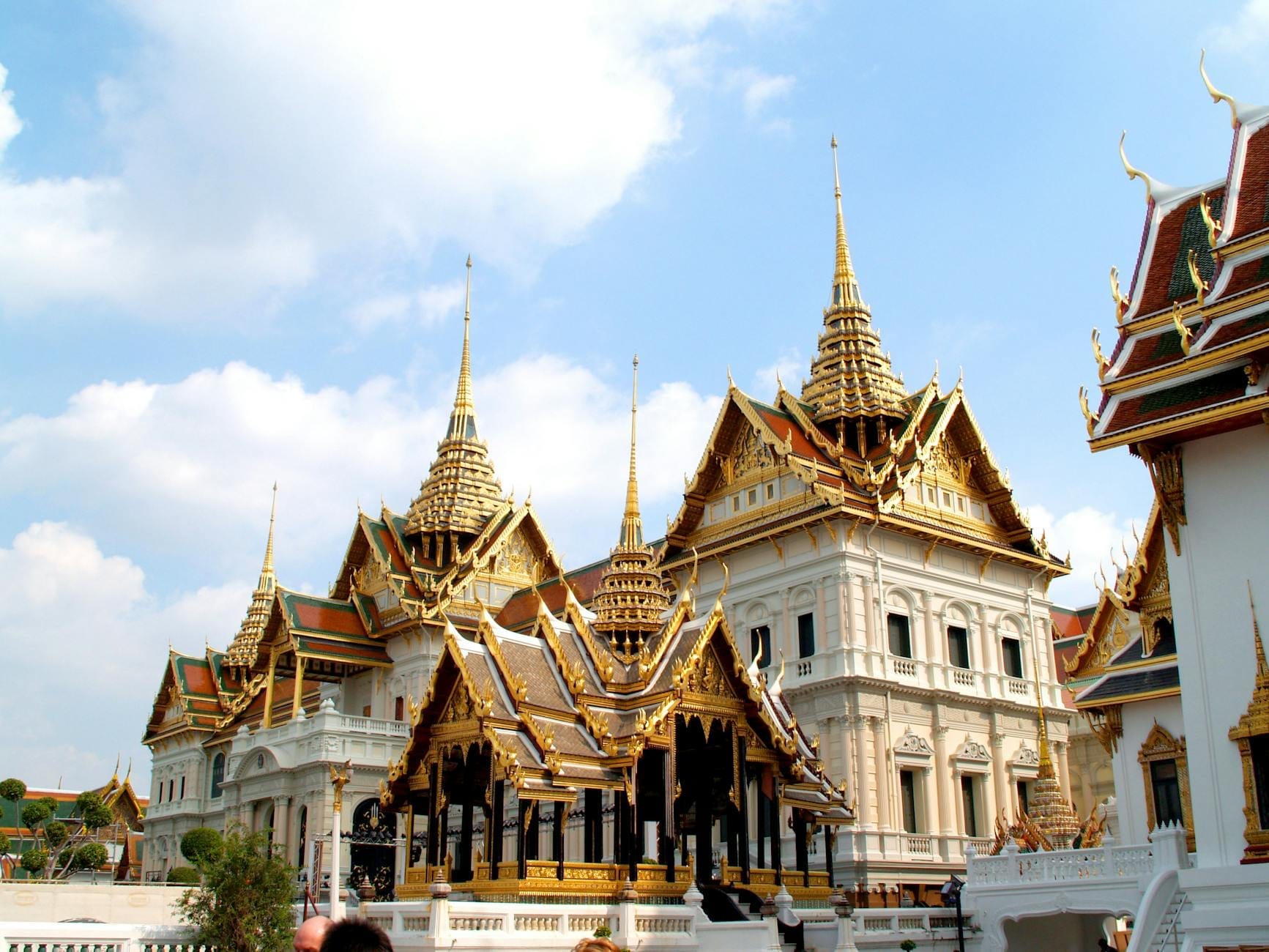
Many visitors spend all their time in the Wat Phra Kaew section and miss the actual palace buildings to the south. The Chakri Maha Prasat Hall, built in 1882, is a striking piece of architectural compromise: a neoclassical European facade topped with three Thai-style prangs. It reflects the diplomatic maneuvering of the Rama V era, when Thailand was navigating the threat of Western colonization.
The Dusit Maha Prasat Hall, built earlier under Rama I, is a purer example of traditional Thai royal architecture, with a four-tiered roof and spired tower. It was historically used for lying-in-state ceremonies. Neither building is fully open for interior tours, but the exterior facades and their surrounding gardens are accessible and far less crowded than the temple area.
If the architecture of the Grand Palace sparks interest in Bangkok's museum culture, the Bangkok National Museum is a short walk away and houses one of the most extensive collections of Thai art and historical objects in the country.
Honest Limitations: Who Might Be Disappointed
The Grand Palace is the most visited attraction in Thailand, and it shows. Queue times at peak hours, tour group congestion, and the intensity of upselling outside the gates can wear on visitors who prefer quieter or more contemplative experiences. The complex does not allow lingering in most areas, and the sheer scale means that less mobile visitors will find it physically demanding without rest spots in key locations.
Repeat visitors to Bangkok may find the experience less rewarding than a first visit. The palace buildings themselves are not open for interior exploration, and there are limited interpretive signs in English outside of the temple zone. If your primary interest is Buddhism rather than royal history, Wat Pho or Wat Suthat offer more meditative environments with less foot traffic.
Insider Tips
- Buy your ticket at the gate directly. Third-party tickets sold outside the walls do not offer discounts and sometimes cause entry confusion.
- The Ramakien mural gallery running around the inner perimeter of Wat Phra Kaew has numbered panels. Panel 1 starts near the north gate of the temple complex. Pick up the free mural guide booklet at the entrance hall.
- There is a small café inside the compound near the ticket hall, run by the royal household. It's clean, air-conditioned, and reasonably priced. Most visitors don't notice it and walk past toward the temple.
- Shoes must be removed before entering the Emerald Buddha bot. Wear footwear you can slip on and off easily. Lockers for shoes are available at the entrance to the bot.
- The outer grounds near the Chakri Maha Prasat Hall are significantly less crowded and offer some of the best architectural photography in the complex, particularly in the early morning when the light is low.
Who Is Grand Palace Bangkok For?
- First-time visitors to Bangkok who want foundational context for Thai culture and history
- Architecture and design enthusiasts interested in the hybrid of Thai, European, and Khmer styles
- Travelers interested in Buddhist iconography and royal ceremonial tradition
- Photographers willing to arrive early and stay patient
- Families with older children who can handle 2 to 3 hours of walking in heat
Nearby Attractions
Other things to see while in Rattanakosin:
- Bangkok National Museum
The Bangkok National Museum is the largest museum in Southeast Asia and the definitive starting point for understanding Thai history. Spread across a former palace compound near the Grand Palace, it houses royal regalia, pre-Siamese sculpture, intricate funeral chariots, and centuries of Buddhist art under one roof.
- Democracy Monument
Standing at the heart of Ratchadamnoen Avenue in the Rattanakosin district, the Democracy Monument is Bangkok's most charged political symbol. Built in 1939 to commemorate Thailand's transition from absolute monarchy to constitutional rule, it remains a living stage for the city's public life and a striking piece of art deco civic architecture.
- The Giant Swing
The Giant Swing (Sao Ching Cha) stands 27 metres tall in the heart of Bangkok's historic Rattanakosin district, just steps from Wat Suthat. Once the centrepiece of a daring Brahmin ceremony, this centuries-old teak structure is one of Bangkok's most recognisable landmarks — and one of its least-understood.
- Khao San Road
Khao San Road is one of Bangkok's most recognizable streets, drawing budget travelers, partygoers, and curious visitors from around the world. It delivers cheap cocktails, street food, and a carnival atmosphere after dark, but it polarizes visitors sharply. Here's what you actually need to know before you go.