Wat Ratchanatdaram and Loha Prasat: Bangkok's Forgotten Metal Castle
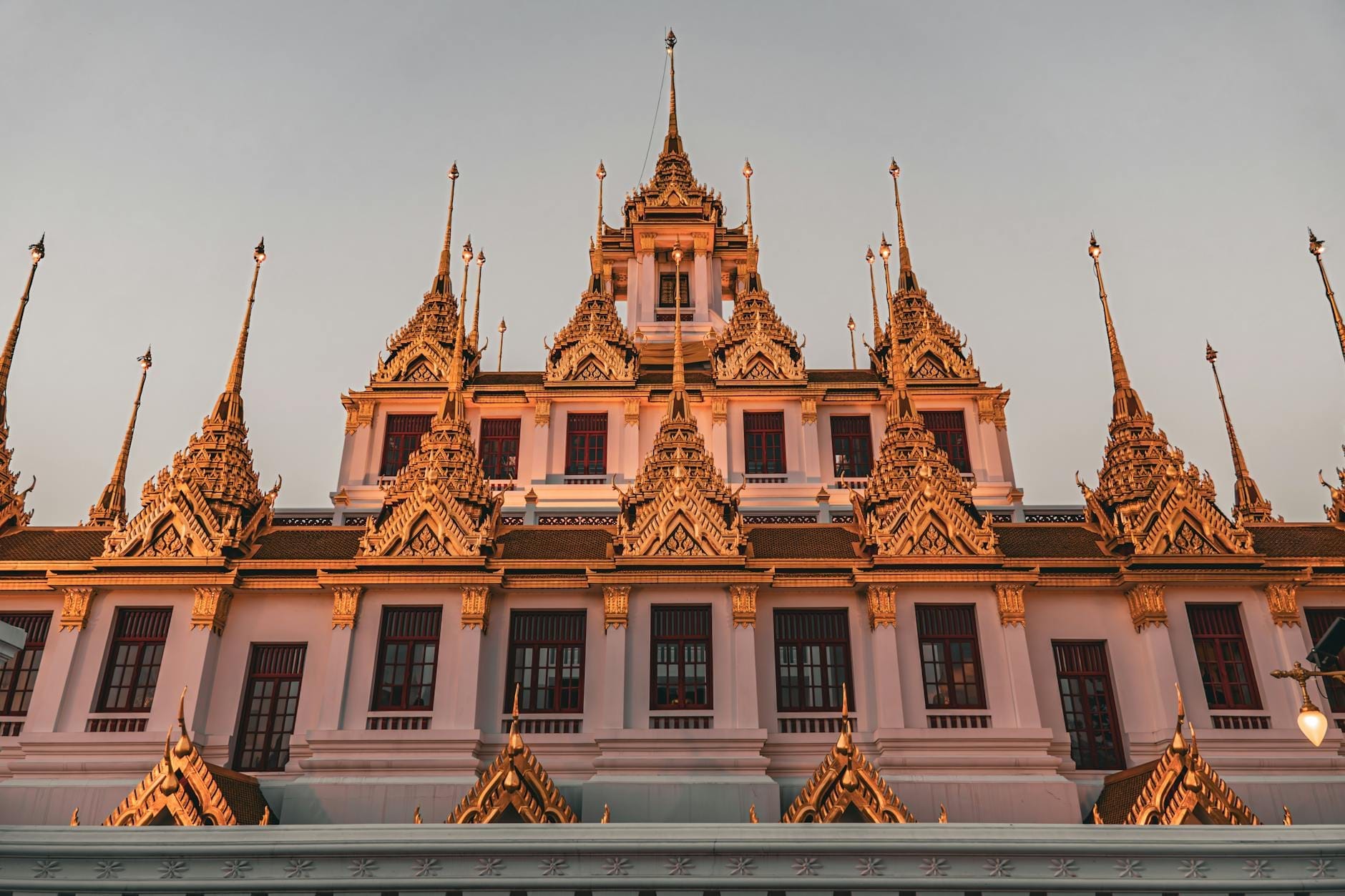
Wat Ratchanatdaram is home to Loha Prasat, one of only three surviving multi-tiered metal spire temples in the world. Standing 36 meters tall with 37 iron-capped turrets, it sits in the heart of Rattanakosin yet receives a fraction of the visitors that crowd nearby temples. For anyone serious about Bangkok's architectural heritage, this is one of the most structurally unusual religious buildings in Southeast Asia.
Quick Facts
- Location
- Rattanakosin, Bangkok (Maha Chai Road, near the Democracy Monument)
- Getting There
- MRT Sam Yot (10–15 min walk) or Phan Fa pier (N3 boat, ~15 min walk)
- Time Needed
- 45 minutes to 1.5 hours
- Cost
- Free to enter the temple grounds; small fee to climb Loha Prasat (confirm at the gate)
- Best for
- Architecture enthusiasts, temple explorers, photographers, and travelers who want religious heritage without the crowds
What Is Loha Prasat and Why Does It Matter?
Wat Ratchanatdaram houses one of the most architecturally singular structures in all of Thai Buddhism: Loha Prasat, literally translated as 'metal castle' or 'iron monastery.' The building rises 36 meters across five stepped tiers, each tier ringed by small iron spires. There are 37 of them in total, each representing one of the 37 virtues on the path to enlightenment in Theravada Buddhist doctrine. The number is not decorative; it is doctrinal.
The form itself is ancient. Loha Prasat belongs to a tradition dating back to a palace described in Buddhist scripture, and only three examples are known to have been built in history. The two others were in India and Sri Lanka but no longer exist. Bangkok's version, completed in its current form during the reign of Rama III in the mid-19th century, is the only fully intact example on earth. That alone justifies a detour.
ℹ️ Good to know
The name 'Loha Prasat' refers specifically to the multi-tiered spire structure within the temple compound. 'Wat Ratchanatdaram' is the name of the broader temple complex surrounding it.
The Temple Grounds: Layout and First Impressions
Entering from Maha Chai Road, the first thing that registers is scale. Loha Prasat's dark iron spires rise above the compound wall before you step through the gate, giving a preview that does not disappoint from close up. The courtyard is clean, quiet, and relatively uncrowded even on weekends, which makes it feel markedly different from the organized chaos outside Wat Pho or Wat Phra Kaew a few hundred meters to the west.
The main ordination hall (ubosot) sits at the front of the compound and contains a large gilded Buddha image. It is functional religious space, not a museum piece, and monks do use it. The ornamentation is detailed but more restrained than the temples that attract tour groups by the busload. Murals on the interior walls are faded in places, which gives them a quality that feels less curated and more genuinely aged.
The compound also connects visually and historically to the broader Rattanakosin district. Walk the area and you'll understand why this neighborhood is considered Bangkok's ceremonial and royal core. Nearby sites like the Democracy Monument and the Giant Swing are within easy walking distance, making Wat Ratchanatdaram a natural anchor point for a half-day heritage walk.
Tickets & tours
Hand-picked options from our booking partner. Prices are indicative; availability and final rates are confirmed when you complete your booking.
Temples of Bangkok and Grand Palace half-day guided tour
From 18 €Instant confirmationFree cancellationDamnoen Saduak floating market and Maeklong railway guided tour
From 36 €Instant confirmationFree cancellationBangkok tuk-tuk night tour with Chinatown street food meal
From 28 €Instant confirmationFree cancellationAfternoon Tea at Hyatt Regency Hotel Bangkok
From 900 €Instant confirmationFree cancellation
Climbing Loha Prasat: The Interior Experience
Access to the interior of Loha Prasat is the main event. A narrow staircase winds upward through the structure's central core, passing through successive floors linked by corridors that circle each tier. The construction uses brick, stucco, and teak wood alongside the iron spires above, and the interior has the slightly cool, dense atmosphere common to thick-walled religious buildings in this climate.
Each level holds small Buddha niches set into the walls at regular intervals, corresponding to meditation cells in the original concept of such a structure. The upper floors feel progressively more intimate as the corridors narrow slightly and the light from the exterior becomes softer. From the upper observation area, the view across Rattanakosin opens up in a way that is less panoramic than the Golden Mount but more meaningful in context, because you are looking directly at the rooflines of Wat Saket, the Grand Palace cluster, and the Chao Phraya River from a building most visitors walk past entirely.
💡 Local tip
Visit on a weekday morning, ideally before 10:00 a.m. The interior of Loha Prasat can feel close and warm later in the day as temperatures rise. Early light also hits the iron spires at a low angle that makes the metal surfaces far more photogenic.
If you're planning a broader temple circuit, Wat Ratchanatdaram pairs logically with Wat Saket and the Golden Mount, which is roughly ten minutes on foot. The two viewpoints complement each other and together give a strong sense of how Rattanakosin developed as a planned royal capital.
Historical Context: A Temple Built for a Royal Purpose
Wat Ratchanatdaram was commissioned by King Rama III in 1846 and built for his granddaughter, Princess Sommanass Waddhanawathy, who later became a queen consort of Rama IV. The name translates roughly as 'Temple of the Royal Niece.' Royal patronage temples in Bangkok tend to receive better maintenance and carry more symbolic weight than ordinary neighborhood wats, and this one is no exception.
Construction of Loha Prasat was not completed during Rama III's reign and continued into the reign of Rama IV (King Mongkut), who is better known in the West through the highly fictionalized account in 'The King and I.' The use of iron for the spires rather than gilded ceramic or stone was deliberate and unusual; it reflected both the doctrinal symbolism of the design and a stylistic departure from the dominant Rattanakosin aesthetic of the period.
Understanding this temple properly requires some context about how Bangkok's historic core was developed. The Rattanakosin district was designed as a deliberate echo of the old capital at Ayutthaya, and each major royal temple was intended to reinforce the legitimacy of the Chakri dynasty. Loha Prasat's architectural uniqueness was part of that ambition.
Practical Walkthrough: What to Expect on Arrival
Dress code is enforced. Covered shoulders and knees are required, and this is genuinely checked at the entrance. Clothing that meets the standard is available to borrow at the gate if needed. Remove shoes before entering any indoor shrine space, including the ubosot and the interior of Loha Prasat itself.
Photography is generally permitted in the courtyard and on the exterior. Inside the climbing structure, photograph the corridor niches and the architecture freely, but be mindful of other visitors in the narrow stairwells. The iron spires on the roof cannot be touched or accessed directly; the observation area is a protected terrace below them.
Accessibility is limited. The staircase inside Loha Prasat is steep and uneven in places, with no lift access. Visitors with limited mobility will find the courtyard and ground-floor ordination hall accessible but the upper levels of the spire tower out of reach.
⚠️ What to skip
This is an active place of worship. If you visit during a merit-making ceremony or a significant Buddhist date on the lunar calendar, parts of the compound may be temporarily restricted. Monks conducting ceremonies take precedence over visitor access.
Who Should Skip This Attraction
Travelers who are primarily looking for a dramatic, postcard-style Bangkok experience may leave underwhelmed. Loha Prasat does not have the same visual explosion as Wat Pho's reclining Buddha or the gold-saturated intensity of Wat Phra Kaew. The building rewards architectural curiosity and historical awareness more than passive sightseeing. If you're doing a one-day sprint through Bangkok's greatest hits, this is a considered addition rather than a default stop.
Families with young children will find little to engage the kids specifically, though the exterior is genuinely striking. For a more child-friendly temple experience in the same area, Wat Pho is better equipped with broader open spaces and the spectacle of the giant reclining Buddha. For those building a deeper Bangkok temple itinerary, the best temples in Bangkok guide offers a fuller overview of how Wat Ratchanatdaram fits into the wider landscape.
Insider Tips
- The iron spires reflect light dramatically in the late afternoon, but the compound can be shadier and cooler in the morning. If photography is a priority, aim for the hour after sunrise for soft directional light on the east-facing facade.
- There is a small amulet market along the exterior wall of the compound facing Maha Chai Road. It operates on most days and is worth a slow browse if you are interested in Thai Buddhist talismans and votive objects.
- The top observation level of Loha Prasat offers a relatively unobstructed view toward Wat Saket's Golden Mount to the northeast. Bring a zoom lens if you want to capture both structures in the same frame.
- Combine this visit with a walk through the surrounding streets toward Sanam Luang in the early morning. The neighborhood feels entirely different before the tourist coaches arrive, and local vendors set up food stalls worth stopping at.
- If you want to understand the structural concept of Loha Prasat before climbing it, spend five minutes outside looking at the building from across the road. From that distance, the tiered system of the spires reads more clearly than it does from directly below.
Who Is Wat Ratchanatdaram For?
- Architecture and design travelers who want to understand the full range of Bangkok's temple traditions
- Photographers looking for a visually distinctive subject that appears in far fewer travel images than the major royal temples
- Repeat Bangkok visitors who have already covered the obvious Rattanakosin highlights and want to go deeper
- Anyone with a particular interest in Theravada Buddhist symbolism and spatial design
- Slow travelers doing a half-day heritage walk through Rattanakosin who want to combine history, architecture, and neighborhood texture
Nearby Attractions
Other things to see while in Rattanakosin:
- Bangkok National Museum
The Bangkok National Museum is the largest museum in Southeast Asia and the definitive starting point for understanding Thai history. Spread across a former palace compound near the Grand Palace, it houses royal regalia, pre-Siamese sculpture, intricate funeral chariots, and centuries of Buddhist art under one roof.
- Democracy Monument
Standing at the heart of Ratchadamnoen Avenue in the Rattanakosin district, the Democracy Monument is Bangkok's most charged political symbol. Built in 1939 to commemorate Thailand's transition from absolute monarchy to constitutional rule, it remains a living stage for the city's public life and a striking piece of art deco civic architecture.
- The Giant Swing
The Giant Swing (Sao Ching Cha) stands 27 metres tall in the heart of Bangkok's historic Rattanakosin district, just steps from Wat Suthat. Once the centrepiece of a daring Brahmin ceremony, this centuries-old teak structure is one of Bangkok's most recognisable landmarks — and one of its least-understood.
- Grand Palace Bangkok
The Grand Palace is Bangkok's most recognizable landmark and the ceremonial heart of Thailand. This guide covers what to see, when to go, how to dress, and how to make the most of a visit without the frustration.