Wat Arun: Bangkok's Temple of Dawn on the Chao Phraya
Wat Arun, the Temple of Dawn, stands on the Thonburi bank of the Chao Phraya River as one of Bangkok's most architecturally distinctive landmarks. Its central prang rises 82 meters and is encrusted with fragments of Chinese porcelain that catch light differently throughout the day. Visiting at dawn, at midday, or at dusk each produces a completely different experience.
Quick Facts
- Location
- 158 Thanon Wang Doem, Wat Arun, Bangkok Yai, Thonburi
- Getting There
- Cross-river ferry from Tha Tien Pier (near Wat Pho) — a short 5-minute boat ride costing around 5 THB
- Time Needed
- 1 to 2 hours for a thorough visit; 45 minutes if you are moving quickly
- Cost
- 200 THB for foreign visitors; Thai nationals enter free
- Best for
- Architecture lovers, photographers, history seekers, and anyone crossing the river from Rattanakosin
What Wat Arun Actually Is
Wat Arun Ratchawararam Ratchawaramahawihan — shortened to Wat Arun by almost everyone — is a royal temple of the first class on the west bank of the Chao Phraya River in the Thonburi district. Its name translates loosely as the Temple of Dawn, a reference to the Hindu god Aruna, deity of the rising sun. The temple's iconic central prang, or Khmer-style tower, reaches approximately 82 meters and is the defining feature of the Bangkok skyline when viewed from the opposite riverbank.
What makes the structure visually striking up close is the surface material: thousands of fragments of Chinese porcelain, ceramic roof tiles, and colored glass arranged into floral patterns, mythological figures, and geometric mosaics. From a distance, the tower shimmers. Up close, you can make out individual pieces of blue-and-white willow ware, celadon, and pink porcelain, many of which came from Chinese cargo ships that used the fragments as ballast. This material choice was practical in origin but became aesthetic over time.
ℹ️ Good to know
Wat Arun is open daily from approximately 08:00 to 17:30. The ticket office closes around 17:00, so plan to arrive well before closing if you want time to climb the prang.
A Short History Worth Knowing
The site has held a temple since the Ayutthaya period, though the structure that visitors see today took its current form during the reign of King Rama II in the early 19th century, with significant additions under Rama III. The central prang was extended and the porcelain mosaic decoration added during the third reign. Before Bangkok became the capital in 1782, this temple briefly served as the repository of the Emerald Buddha, which was later moved to Wat Phra Kaew across the river.
The Emerald Buddha's time here connects Wat Arun to the founding narrative of the Chakri dynasty, which is why the temple carries royal status. Today it is an active place of Buddhist worship as well as a tourist site, and monks still reside in the compound. Visitors approaching from the Tha Tien pier are retracing a route that royal processions once traveled by barge. The royal barge museum, located a short distance north in Thonburi, preserves the actual vessels used for those ceremonies. For broader context on Bangkok's temple landscape, the best temples in Bangkok guide covers how Wat Arun fits alongside Wat Pho, Wat Suthat, and the Grand Palace complex.
Tickets & tours
Hand-picked options from our booking partner. Prices are indicative; availability and final rates are confirmed when you complete your booking.
Bangkok Wat Arun Temple of Dawn self-guided walking tour
From 13 €Instant confirmationFree cancellationBangkok Wat Pho and Wat Arun walking tour with flower market
From 72 €Instant confirmationFree cancellationHalf-day van charter to Wat Phra Kaew and Wat Arun from Bangkok
From 119 €Instant confirmationFree cancellationTemples of Bangkok and Grand Palace half-day guided tour
From 18 €Instant confirmationFree cancellation
How the Experience Changes by Time of Day
Arriving at opening time, around 08:00, gives you the cooler air and long shadows that make the prang's surface texture most visible. The porcelain pieces catch oblique morning light and the colors separate clearly. Crowds at this hour are thin, mostly Thai worshippers and a handful of early travelers.
Midday visits between 11:00 and 14:00 are the hardest to recommend. The stone surfaces radiate heat, the white plaster sections become blindingly bright, and the ferry queue on the Tha Tien side peaks around noon as tour groups move through Rattanakosin. If midday is your only option, bring water, wear a hat, and consider spending only 30 minutes on the grounds.
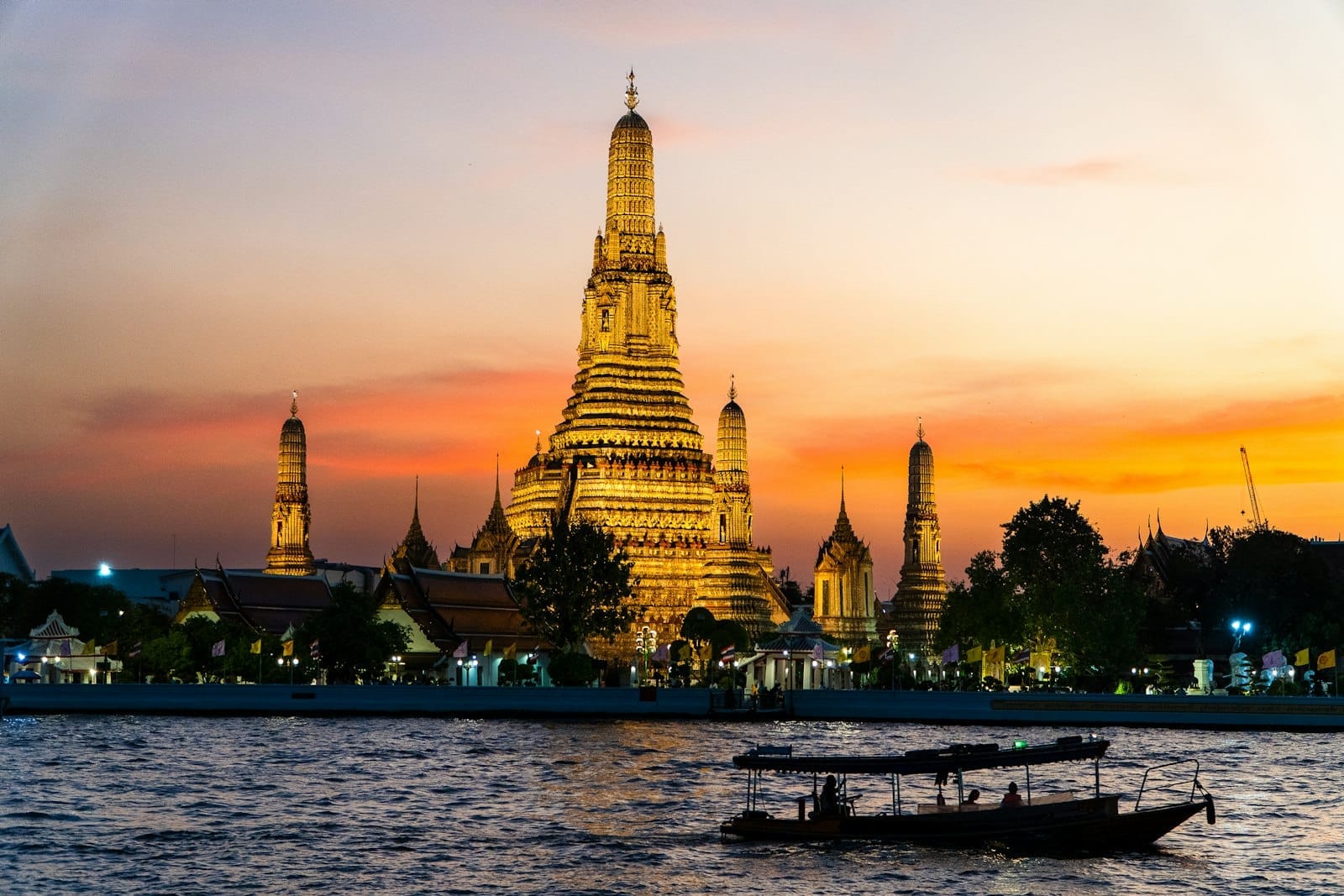
Late afternoon, from around 15:30 onward, is when the light begins to work in your favor again. The sun drops toward the Thonburi side and the prang is front-lit for photographs taken from the river or from the Maharaj Pier area on the opposite bank. By 17:00 the ticket office is closing, but visitors already inside can often linger a few extra minutes. The illuminated temple after dark is best viewed from across the river, from the riverside restaurants and walkways near Tha Tien, rather than from inside the grounds.
💡 Local tip
The most photographed view of Wat Arun is not from inside the temple at all. Walk north from Tha Tien Pier along the Bangkok side of the river for about 200 meters to capture the full prang with the river in the foreground, especially in golden-hour light.
Navigating the Temple Grounds
After buying your ticket at the entrance gate, the path leads toward the central prang and the smaller satellite prangs at the four corners of the mondop, a square platform surrounded by guardian figures and mythological creatures. The main prang is climbable via steep staircases on four sides. The steps are genuinely steep, roughly at a 60-degree angle in places, with rope handrails rather than solid banisters. Visitors with knee problems or vertigo should consider stopping at the lower terrace, which still offers good close-up views of the ceramic decoration.
From the upper terrace of the prang, the view across the Chao Phraya to the Rattanakosin skyline is notable: you can see the spires of Wat Pho, the roofline of the Grand Palace complex, and the river traffic below. There is no shade up there, so the climb is best done in early morning or late afternoon.
The surrounding temple compound also contains the ordination hall, or bot, which houses a large golden Buddha image said to have been created under the supervision of Rama II himself. The interior is cooler than the grounds and worth a few minutes. The compound connects thematically to the broader Rattanakosin island across the river, where Wat Pho and the Grand Palace sit within walking distance of Tha Tien Pier.
Getting There and Dress Code
The standard approach is to take the Chao Phraya Express Boat to Tha Tien Pier (N8), then board the cross-river ferry directly to Wat Arun Pier. The crossing takes under five minutes and costs around 5 THB. Ferries run frequently throughout the day. Alternatively, river taxis and long-tail boats can drop you directly at the Wat Arun pier if you are coming from further upstream or downstream.
The dress code is enforced at the entrance gate. Shoulders and knees must be covered. Sarongs are available for rent or loan at the gate if you arrive in shorts or a sleeveless top, though availability can run low during peak hours. Closed-toe shoes are not required but recommended if you plan to climb, since the stone steps can become slippery when wet or when worn smooth.
⚠️ What to skip
Wat Arun is not fully accessible for wheelchair users. The ferry crossing involves a step onto the boat, and the prang staircases are steep with limited handrails. The lower grounds and ordination hall are walkable on mostly flat stone paths.
Photography Considerations
The porcelain mosaic surface is the main photographic subject on the grounds, and macro or close-up photography rewards patience here. Individual tiles show distinct patterns: roosters, floral sprays, demons, and celestial figures. The morning light from the east illuminates the eastern face of the central prang directly and produces the sharpest detail shots.
For the iconic river-and-prang composition, the opposite bank is your location. The stretch of riverside walkway near the Maharaj development north of Tha Tien Pier provides unobstructed sightlines. Sunset shots from this position work well from October through February when the dry season brings clearer skies. During the rainy season from May through September, dramatic cloud formations behind the tower can produce striking images, though flat overcast light is more common.
If you are building a half-day around photography in this part of the city, the route from Wat Pho to the ferry and then around Wat Arun's compound covers the most ground efficiently. Some photographers also walk south from Wat Arun through Thonburi's quieter lanes toward Kudi Chin, a historic Portuguese-influenced neighborhood with a different visual character.
Is Wat Arun Worth It?
For first-time visitors to Bangkok with more than two days, yes. The crossing alone gives you a water-level perspective on the Chao Phraya that the city's streets cannot replicate. The architectural detail on the prang is genuinely unlike anything else in Bangkok, and the historical connection to the early Chakri period gives the site weight beyond its visual appeal.
Visitors who find temple sites repetitive after hitting Wat Pho and the Grand Palace may feel that Wat Arun covers similar ground. There is truth to that. The experience overlaps thematically, and the compound is smaller than either of those two. But the physical act of climbing the prang, the river crossing, and the reverse view back toward Rattanakosin make it a distinct experience rather than a duplicate one.
Those building a full day in this part of the city should consider pairing Wat Arun with a walk through Rattanakosin on the opposite bank, or continuing further into Thonburi toward Wat Paknam Phasi Charoen, which sees far fewer foreign visitors and offers a different kind of temple atmosphere entirely.
Insider Tips
- Buy your ferry ticket for the cross-river boat from the small booth at Tha Tien Pier rather than from touts near the pier entrance. The official fare is around 5 THB and the booth is clearly signed.
- The best close-up light on the prang's porcelain surface falls on the eastern and southern faces in the morning hours. Arrive before 09:30 to see this without competing for space with large groups.
- If you want the classic river-and-prang photograph without the Maharaj walkway being crowded, shoot from the pier on the Bangkok side just after the morning ferry rush, around 08:30 to 09:00.
- The satellite prangs at the four corners of the platform are less visited than the central tower but contain equally intricate ceramic work and guardian deity figures at eye level, easier to examine than the central structure.
- Combine the visit with a late breakfast or early lunch at one of the riverfront cafes near Tha Tien on the Bangkok side, which offer direct views of Wat Arun across the water while you eat.
Who Is Wat Arun For?
- Architecture and design enthusiasts drawn to the Khmer prang form and decorative ceramic craft
- Photographers working the Chao Phraya riverfront, especially in early morning or golden-hour light
- History-focused travelers interested in the early Rattanakosin period and Chakri dynasty origins
- First-time Bangkok visitors building a Rattanakosin temple circuit across one full day
- Travelers who want a short river crossing experience without committing to a full long-tail boat tour
Nearby Attractions
Other things to see while in Thonburi:
- IconSiam
Sitting on the Thonburi bank of the Chao Phraya River, IconSiam is Bangkok's most architecturally striking shopping complex. Beyond the retail floors, it holds a genuine indoor floating market, sweeping river panoramas, and some of the city's best dining with a view.
- Kudi Chin
Kudi Chin is one of Bangkok's oldest and most atmospheric riverside neighborhoods, tucked into the Thonburi bank of the Chao Phraya. A Portuguese Catholic enclave dating back over 250 years, it layers colonial-era churches, Chinese shrines, and Thai temples into a compact quarter that rewards slow exploration on foot.
- Wat Paknam Phasi Charoen
Wat Paknam Phasi Charoen is one of Bangkok's most visually striking royal temples, set in the residential Thonburi district. Its colossal green-tiled stupa houses a dazzling crystal ceiling and a five-story interior dedicated to Buddhist cosmology. Less crowded than riverside temples, it rewards visitors who make the effort to reach it.