Wat Paknam Phasi Charoen: Thonburi's Royal Temple With a Stupa You Won't Forget
Wat Paknam Phasi Charoen is one of Bangkok's most visually striking royal temples, set in the residential Thonburi district. Its colossal green-tiled stupa houses a dazzling crystal ceiling and a five-story interior dedicated to Buddhist cosmology. Less crowded than riverside temples, it rewards visitors who make the effort to reach it.
Quick Facts
- Location
- Phasi Charoen District, Thonburi, Bangkok
- Getting There
- BTS Pho Nimit, then taxi or motorcycle taxi (~10 min)
- Time Needed
- 1.5 to 2.5 hours
- Cost
- Free entry
- Best for
- Buddhist architecture, photography, off-the-tourist-trail exploration
Why Wat Paknam Phasi Charoen Stands Apart
Wat Paknam Phasi Charoen is not the temple most visitors picture when they think of Bangkok. There is no tuk-tuk queue outside, no postcard stands along the entrance lane, and no river backdrop engineered for Instagram. What you get instead is one of Thailand's most historically significant monasteries, a place of active daily worship, and a piece of architecture that genuinely surprises even experienced temple-goers.
The temple holds Royal Grade status and dates back at least to the Ayutthaya period, making it several centuries old. It gained particular prominence in the 20th century under the abbotship of Luang Pu Sodh Candasaro, the monk credited with reviving the Dhammakaya meditation technique. That legacy draws Thai Buddhist pilgrims from across the country, which means on important religious days the grounds fill with worshippers rather than tourists.
💡 Local tip
Dress modestly before you arrive: shoulders and knees covered, no sleeveless tops. Sarongs are sometimes available at larger Bangkok temples but are not reliably offered here. Coming prepared shows respect and saves awkward moments at the entrance.
The Green Stupa: What You Actually See
The defining structure is an enormous stupa clad in pale green glass tiles, rising approximately 80 meters above the temple grounds. From the surrounding streets it appears almost surreal, its color unlike the gold and white you see at most Thai religious sites. The stupa was completed in 2012 and was built to enshrine relics of Luang Pu Sodh. It is visible from a distance across the low-rise Thonburi skyline, functioning almost as a landmark beacon as you approach.
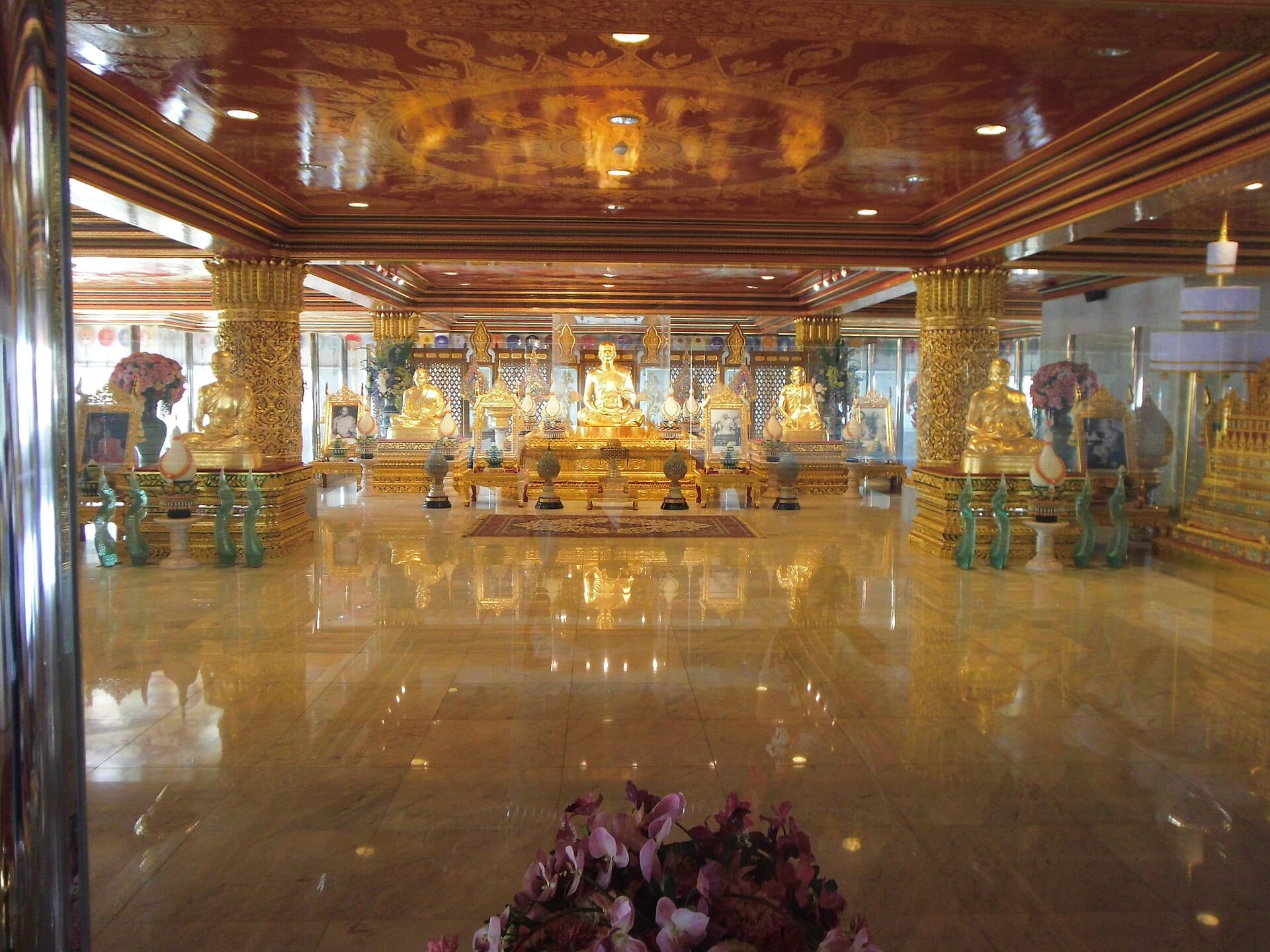
Inside the stupa, which is open to visitors, each of the five floors is dedicated to a different element of Buddhist teaching and cosmology. The visual centerpiece is the ceiling of the topmost floor: a vast, intricately detailed crystal and glass artwork depicting the universe according to Buddhist cosmological understanding. The scale and precision of the work are difficult to describe without sounding hyperbolic. Light refracts across it in ways that change depending on time of day and where you stand beneath it. Allow at least 20 minutes on this floor alone.
The lower floors feature large golden Buddha statues and murals that trace Buddhist scripture in considerable detail. The ground floor entrance is flanked by attendants who will ask you to remove your shoes. The interior is air-conditioned, which comes as a genuine relief on a hot Bangkok afternoon.
Tickets & tours
Hand-picked options from our booking partner. Prices are indicative; availability and final rates are confirmed when you complete your booking.
Temples of Bangkok and Grand Palace half-day guided tour
From 18 €Instant confirmationFree cancellationDamnoen Saduak floating market and Maeklong railway guided tour
From 36 €Instant confirmationFree cancellationBangkok tuk-tuk night tour with Chinatown street food meal
From 28 €Instant confirmationFree cancellationAfternoon Tea at Hyatt Regency Hotel Bangkok
From 900 €Instant confirmationFree cancellation
The Reclining Buddha and the Older Temple Grounds
The stupa is the visual headline, but the broader temple complex is worth unhurried exploration. The main ordination hall contains a revered reclining Buddha image that has been an object of veneration for generations of Thai worshippers. Unlike the famous reclining Buddha at Wat Pho, this one exists in a quieter, more intimate setting where you are likely sharing the space with monks and local devotees rather than tour groups.
The grounds also include multiple smaller shrines, monks' quarters, a meditation hall still used for Dhammakaya practice, and a canal-side boundary that gives the compound a sense of enclosure from the surrounding neighborhood. For context on the broader landscape of significant Bangkok temples, the best temples in Bangkok guide covers how Wat Paknam fits among the city's wider religious heritage.
In the early morning, between 7am and 9am, monks move through almsgiving rituals and the air carries incense smoke mixed with the scent of fresh flower offerings. The sounds are low: chanting from inside the halls, the occasional bell, birds in the trees near the canal. This is when the temple feels most alive in the devotional sense, and when photographs carry the most atmosphere.
How the Experience Changes Through the Day
Morning visits, particularly before 9am, offer the most photogenic light on the stupa's green tiles and the fewest crowds. The crystal ceiling on the upper floor of the stupa catches warm morning light that shifts to a cooler, flatter tone by midday. If photography is a priority, plan to arrive close to opening time.
Midday brings heat and direct sun that washes out the subtle green tone of the stupa exterior. It is also when tourist trickle is at its highest, though 'high' here is relative: even busy days at Wat Paknam feel calm by comparison to peak hours at the Grand Palace or Wat Arun. The interior of the stupa is always a reasonable retreat from the midday heat.
Late afternoon, roughly 3pm to 5pm, brings softer light back to the exterior and a gentle increase in local visitors coming after work or school. The golden hour before closing gives the stupa tiles a warm glow that reads very differently in photographs than the cooler morning light. If you can only visit once and want both exterior and interior shots, late afternoon is probably the better compromise.
ℹ️ Good to know
The stupa and main grounds are generally open daily from around 8am to 5pm, but hours for specific halls can vary around major Buddhist holidays. On days like Makha Bucha or Visakha Bucha, the temple draws large numbers of Thai worshippers and the atmosphere is deeply communal, though access to some areas may be more restricted.
Getting There: The Practical Reality
This is where honest guidance matters. Wat Paknam Phasi Charoen is not on the tourist circuit in the way that Rattanakosin temples are, and getting there takes a bit more effort. The most straightforward route from central Bangkok is to take the BTS Skytrain to the Gold Line connector, then ride to Pho Nimit station. From there, a motorcycle taxi or metered taxi covers the remaining distance in roughly 10 minutes depending on traffic. The ride takes you through residential Thonburi streets that are themselves interesting: small shophouses, canal-side vendors, local markets.
Alternatively, visitors already exploring Thonburi can combine this with other west-bank sites. The neighborhood rewards slower exploration, and the temple fits naturally into a half-day itinerary that might also include a canal boat ride or a walk through the older residential lanes nearby.
⚠️ What to skip
Taxis from tourist-heavy areas like Silom or Siam may quote a flat rate rather than use the meter for this destination. Insist on the meter or agree on a fair price before getting in. The journey should not cost more than 80 to 120 baht from most central Bangkok locations in normal traffic.
Photography, Accessibility, and Practical Notes
Photography is permitted throughout most of the complex, including inside the stupa. The crystal ceiling on the upper floor is a legitimate photographic challenge: the light is often low, the artwork is overhead, and wide-angle lenses do it more justice than a phone held at arm's length. A compact mirrorless camera or a phone with a good wide mode will produce better results than a standard zoom. Tripods are generally not welcome in active worship spaces.
The stupa has elevator access, making the upper floors reachable for visitors with limited mobility. The broader temple grounds include some uneven paving between structures, and the canal-side paths can be narrow. Wheelchairs can access much of the site but the older sections of the grounds require more navigation.
For travelers building a broader Bangkok itinerary, the things to do in Bangkok guide includes itinerary frameworks that incorporate less-visited temples alongside the major sites. Pairing Wat Paknam with a visit to Wat Arun on the same day makes geographic sense, as both are on the Thonburi bank and can be linked by canal taxi or a short ride.
Is It Worth the Trip?
The honest answer is: yes, but with the right expectations. This is not a temple for visitors who want a quick check-off on a list of famous sights. The stupa interior is genuinely extraordinary, in particular the crystal ceiling, and the devotional atmosphere of the broader grounds offers something you will not find at Bangkok's more commercially trafficked temples. But it requires independent navigation, moderate travel time, and an interest in the experience itself rather than the social proof of having visited.
Visitors who enjoy Wat Benchamabophit or Wat Ratchanatdaram Loha Prasat for their architectural distinctiveness tend to respond well to Wat Paknam. Those who come primarily for the famous sights of the Rattanakosin area may find the extra travel time hard to justify on a short trip.
People who will probably not enjoy this visit: travelers with limited time who have not yet seen the Grand Palace complex, visitors primarily interested in nightlife or shopping, and anyone who finds religious sites broadly uninteresting. The stupa is spectacular architecture, but the experience is inseparable from its Buddhist context.
Insider Tips
- The crystal ceiling on the top floor of the stupa photographs best in the morning when natural light enters at a low angle. Position yourself near the center of the room and shoot upward with the widest lens you have.
- A small café and food vendors operate near the temple entrance, especially in the morning. The area is popular with monks and local workers, and the food is inexpensive and good.
- If you visit on a Buddhist holy day, the almsgiving procession in the early morning is worth witnessing. Arrive before 7am and stand respectfully to the side of the main path.
- The canal running along the temple boundary occasionally has long-tail boats passing. The sound carries across the grounds and adds an authentically Thonburi texture to the visit that you will not get at any Rattanakosin temple.
- Free parking is available for visitors arriving by private car or motorbike, which makes this an easy addition to a self-drive itinerary exploring the Thonburi side of the city.
Who Is Wat Paknam Phasi Charoen For?
- Buddhist architecture enthusiasts who want something genuinely unusual
- Photographers looking for dramatic interior spaces without tour group crowds
- Repeat Bangkok visitors who have already covered the main Rattanakosin temples
- Travelers interested in living monastic culture and active devotional practice
- Those building a Thonburi-focused day that explores the west bank of the Chao Phraya
Nearby Attractions
Other things to see while in Thonburi:
- IconSiam
Sitting on the Thonburi bank of the Chao Phraya River, IconSiam is Bangkok's most architecturally striking shopping complex. Beyond the retail floors, it holds a genuine indoor floating market, sweeping river panoramas, and some of the city's best dining with a view.
- Kudi Chin
Kudi Chin is one of Bangkok's oldest and most atmospheric riverside neighborhoods, tucked into the Thonburi bank of the Chao Phraya. A Portuguese Catholic enclave dating back over 250 years, it layers colonial-era churches, Chinese shrines, and Thai temples into a compact quarter that rewards slow exploration on foot.
- Wat Arun
Wat Arun, the Temple of Dawn, stands on the Thonburi bank of the Chao Phraya River as one of Bangkok's most architecturally distinctive landmarks. Its central prang rises 82 meters and is encrusted with fragments of Chinese porcelain that catch light differently throughout the day. Visiting at dawn, at midday, or at dusk each produces a completely different experience.