Bangkok Art and Culture Centre: The City's Contemporary Art Anchor
Perched at the intersection of Rama I and Phayathai roads, the Bangkok Art and Culture Centre is the city's most accessible contemporary arts venue. With free admission to most exhibitions, a striking spiral interior, and a location steps from BTS National Stadium, it rewards even a short visit.
Quick Facts
- Location
- 939 Rama I Rd, Wang Mai, Pathum Wan, Bangkok (corner of Phayathai Rd)
- Getting There
- BTS National Stadium — connected by covered walkway, 2-minute walk
- Time Needed
- 1 to 2 hours for a thorough visit; 45 minutes if browsing
- Cost
- Free entry to most galleries; some curated exhibitions charge 100–200 THB
- Best for
- Art lovers, architecture enthusiasts, solo travelers escaping the heat
- Official website
- www.bacc.or.th/en
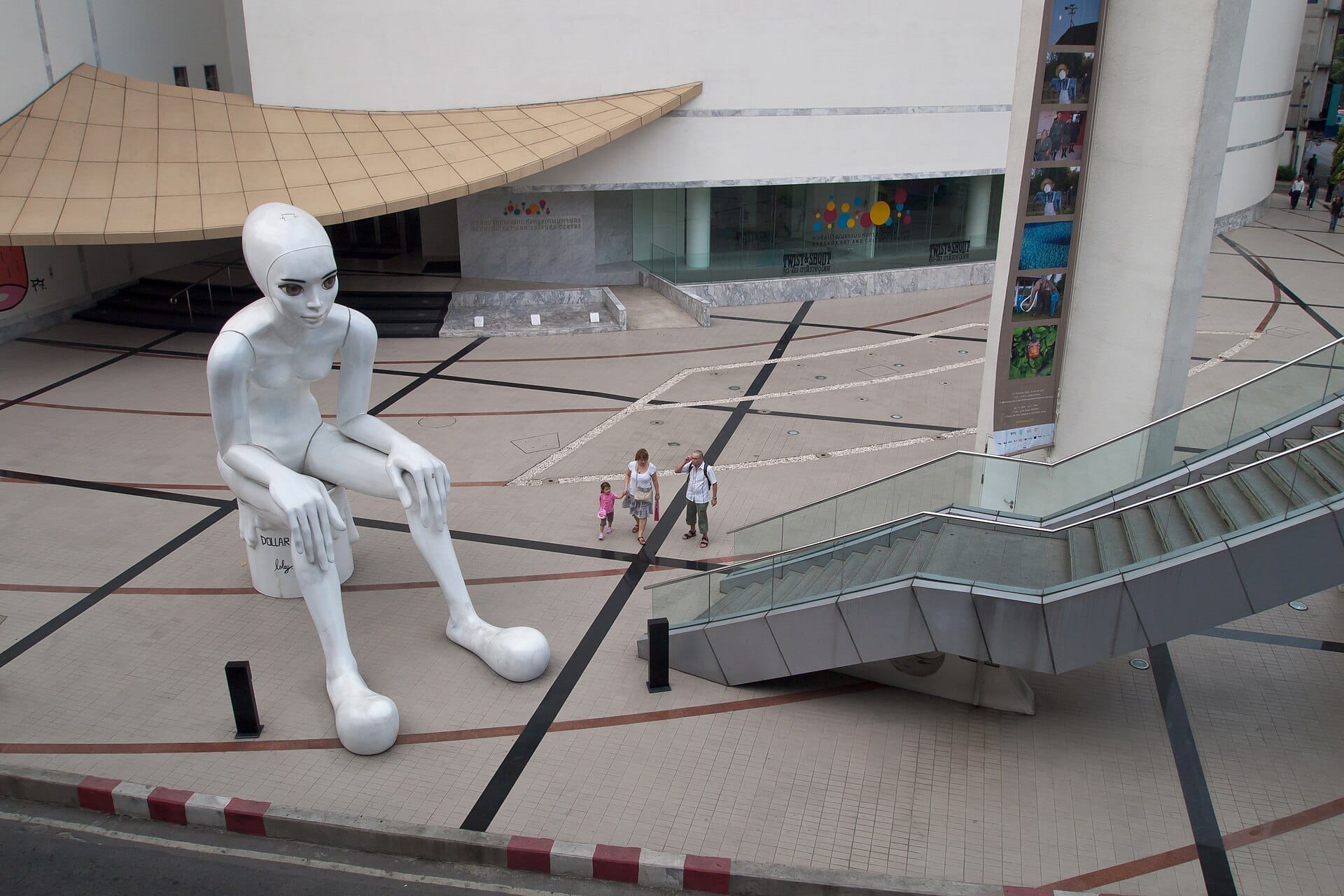
What the Bangkok Art and Culture Centre Actually Is
The Bangkok Art and Culture Centre, commonly shortened to BACC, opened in 2008 after a long and politically complicated development process. The building was proposed in the late 1990s, shelved during the 1997 Asian financial crisis, revived, and eventually completed over a decade later. That backstory matters: the BACC represents Bangkok's deliberate investment in a permanent, centrally located home for contemporary art, not a converted warehouse or temporary pop-up.
The structure itself makes an immediate impression. Designed by Rangsan Torsuwan, the cylindrical white tower rises ten floors above one of the city's busiest intersections. From across Rama I Road, it reads almost like a modern lighthouse dropped between the commercial towers of Siam. Inside, a continuous spiral ramp winds upward from the ground floor, with gallery spaces branching off each level. The design is clearly influenced by the Guggenheim in New York, though the BACC's version is more intimate and considerably less crowded.
ℹ️ Good to know
Most permanent and rotating gallery spaces on the upper floors are free. A small number of special curated exhibitions charge a separate admission fee, typically around 100–200 THB. Check the current schedule at bacc.or.th before visiting.
The Experience Floor by Floor
The ground floor is a soft landing. Cafés, independent design shops, and a small bookstore line the outer ring of the circular space. The air conditioning hits immediately when you step in from the street, which matters more than it sounds after a walk through Siam's midday heat. The atmosphere here is relaxed, with students sketching at tables and locals grabbing coffee before heading upstairs.
Take the ramp rather than the elevator on at least one direction. Walking the spiral gives you the building's rhythm: each half-turn reveals a new gallery entrance, a glimpse into a lower level, or a display case of smaller works integrated into the walkway itself. The ramp's inner wall is often used for text-based or photographic works that don't require a dedicated room. It's an unusually democratic approach to exhibition space, keeping art visible even for visitors who don't enter every gallery.
The upper floors, particularly floors 7 through 9, host the largest and most ambitious exhibitions. These spaces have proper gallery lighting, white walls, and enough square footage for large-scale installations. The quality of work varies significantly depending on what's scheduled. At its best, the BACC shows challenging, regionally relevant contemporary art. At quieter times, the exhibitions can feel thin. Checking the current program online before you go is genuinely worthwhile, not just a formality.
Tickets & tours
Hand-picked options from our booking partner. Prices are indicative; availability and final rates are confirmed when you complete your booking.
Full-day Ayutthaya van charter from Bangkok
From 172 €Instant confirmationFree cancellationHalf-day van charter to Wat Phra Kaew and Wat Arun from Bangkok
From 119 €Instant confirmationFree cancellationCultural Dining Experience with a Local Family in Bangkok
From 38 €Instant confirmationFree cancellationTemples of Bangkok and Grand Palace half-day guided tour
From 18 €Instant confirmationFree cancellation
How the Atmosphere Changes Through the Day
Weekday mornings, particularly between 10am and noon, are the calmest. The galleries are nearly empty, the lighting is unhurried, and you can spend as long as you want in front of any single work without feeling the pressure of a crowd behind you. This is the best window for photography inside the galleries, as the natural light filtering through the building's upper windows is at its softest.
Weekend afternoons shift the tone completely. University students, young couples, and families from outside central Bangkok fill the ramp. The cafés on the ground floor run out of seats by early afternoon on Saturdays. The building never feels dangerously packed, but the contemplative gallery experience gives way to something more social and energetic. Whether that's a problem depends entirely on what you're looking for.
Evening visits, roughly 5pm to 8pm, hit a comfortable middle ground. The post-work crowd arrives but tends to move through quickly. The ground-floor bookstore and design shops are worth a slow look during this window, when staff are attentive and the lighting inside the shops is at its most appealing.
💡 Local tip
The BACC is open Tuesday to Sunday, 10am to 8pm. It is closed on Mondays. Arrive at least 90 minutes before closing if you want to see the upper floors properly — staff begin preparing to close the higher galleries around 8pm.
What Makes the BACC Culturally Significant
Bangkok has no shortage of temples, royal palaces, and historical monuments, but dedicated contemporary art infrastructure has historically been thin. The BACC filled a real gap when it opened. It operates as a public organization under the Bangkok Metropolitan Administration and is positioned deliberately in the city's commercial heart, a statement that contemporary culture belongs at the center of urban life rather than tucked away in an arts district.
The programming reflects Southeast Asian and Thai contemporary voices alongside international names. You'll find work engaging with Thai political history, identity, urbanization, and religion alongside more abstract or formally experimental pieces. For context on how Thai art connects to historical and cultural currents, a visit to the Bangkok National Museum in the Rattanakosin area provides useful grounding in the country's longer artistic traditions.
The building also houses a small arts library and archives, used mostly by researchers and students. It's not a tourist draw in itself, but its presence reinforces that the BACC functions as a genuine civic institution rather than a purely commercial gallery.
Getting There and What's Around It
The BACC's location at BTS National Stadium is one of its biggest practical advantages.The exit brings you to a covered walkway that connects directly toward the building, keeping you out of direct sun for most of the approach. The Siam district surrounding it is Bangkok's commercial core, and the contrast between the BACC's reflective white exterior and the glass facades of Siam Paragon and MBK across the road is striking.
Directly opposite the BACC, MBK Center handles the practical end of a Siam visit, from street-food courts to phone accessories. Siam Paragon and the connected Siam Discovery are a five-minute walk along the BTS walkway. The concentration of options makes the BACC easy to work into a longer Siam afternoon rather than treating it as a standalone destination.
Tuk-tuks and taxis are readily available on Rama I Road, though traffic in this area during evening rush hour, roughly 4:30 to 7pm, can extend short journeys significantly. The BTS is almost always the faster option.
⚠️ What to skip
The BACC does not have a dedicated car park. If arriving by private vehicle, the nearest parking options are inside the adjacent shopping malls, which charge standard hourly rates. Arrive early on weekends if driving, as nearby parking fills quickly by midday.
Accessibility, Photography, and Practical Details
The building is fully elevator-accessible. Each floor is reachable without using the ramp, and the gallery entrances are all at ground level within each floor. Restrooms are clean, well-maintained, and located on multiple floors.
Photography policies vary by exhibition. In common areas and on the ramp itself, photography is generally permitted. Inside individual galleries, look for posted signs at the entrance, as some exhibitions involving loaned or commercial works restrict photography. When in doubt, ask a gallery attendant. They are consistently approachable and some speak English.
The BACC is not a place for young children unless they have a specific interest in art or architecture. There are no interactive children's areas, the galleries require quiet, and the ramp, while safe, can feel monotonous for small kids after a couple of floors. Families visiting Bangkok with children would likely find more engagement at nearby attractions with hands-on elements.
Insider Tips
- The independent design and craft shops on the ground floor carry work by Thai artists and makers that you won't find in the airport or major malls. Prices are fair and the selection changes regularly. Budget 10 minutes here even if the galleries are your priority.
- The café on the ground floor tends to be quieter and cheaper than the options inside Siam Paragon next door. If you need a coffee before or after the galleries, it's a better choice than fighting the lunch crowds at the mall.
- Check the BACC website's event calendar, not just the exhibitions page. The centre regularly hosts free talks, film screenings, and live performances in its outdoor plaza facing Rama I Road, particularly on weekend evenings.
- The view from the upper ramp looking down through the building's central atrium is one of Bangkok's more underappreciated architectural interior shots. Best captured in the late morning when light enters from above.
- If the current exhibition lineup doesn't appeal, the ground-floor bookstore stocks a thoughtful selection of Thai art, design, and architecture titles in both Thai and English — a rare find in the Siam area.
Who Is Bangkok Art and Culture Centre (BACC) For?
- Solo travelers who want a break from temples and street food without leaving central Bangkok
- Art and design enthusiasts tracking contemporary Southeast Asian creative output
- Architecture lovers interested in post-2000 Thai public buildings
- Travelers seeking air-conditioned, culturally substantive ways to spend a hot afternoon
- Anyone curious about what Bangkok's younger creative generation is actually making
Nearby Attractions
Other things to see while in Siam:
- CentralWorld Bangkok
CentralWorld is one of the largest shopping complexes in Southeast Asia, anchoring the Ratchaprasong intersection in the heart of Bangkok. Beyond retail, it draws visitors with its food courts, rooftop dining, event spaces, and easy links to the BTS Skytrain.
- Erawan Shrine
The Erawan Shrine is a small but intensely atmospheric Hindu-Buddhist shrine at one of Bangkok's busiest intersections. Gilded offerings, traditional dancers, and a constant stream of worshippers make it one of the city's most compelling stops — even for non-religious visitors.
- Jim Thompson House
A compound of six traditional Thai teakwood houses overlooking a canal in Siam, the Jim Thompson House is where mid-century design, Southeast Asian art collecting, and one of history's great unsolved disappearances all collide. It rewards curious travelers with genuine depth, not just pretty interiors.
- Madame Tussauds Bangkok: The Complete Visitor Guide
Madame Tussauds Bangkok packs over 90 wax figures across themed zones inside Siam Discovery. From Thai royalty to Marvel superheroes, it draws families and pop culture fans alike. Here is exactly what you get, and whether it is worth your time.