Erawan Shrine: Bangkok's Sacred Corner in the Heart of Siam
The Erawan Shrine is a small but intensely atmospheric Hindu-Buddhist shrine at one of Bangkok's busiest intersections. Gilded offerings, traditional dancers, and a constant stream of worshippers make it one of the city's most compelling stops — even for non-religious visitors.
Quick Facts
- Location
- Corner of Ratchadamri and Ploenchit Roads, Siam, Bangkok
- Getting There
- BTS Chit Lom, a 5-minute walk
- Time Needed
- 20–45 minutes
- Cost
- Free to enter. Offerings (flower garlands, incense) available from 20–50 THB
- Best for
- Cultural curiosity, photography, understanding Bangkok's living faith traditions
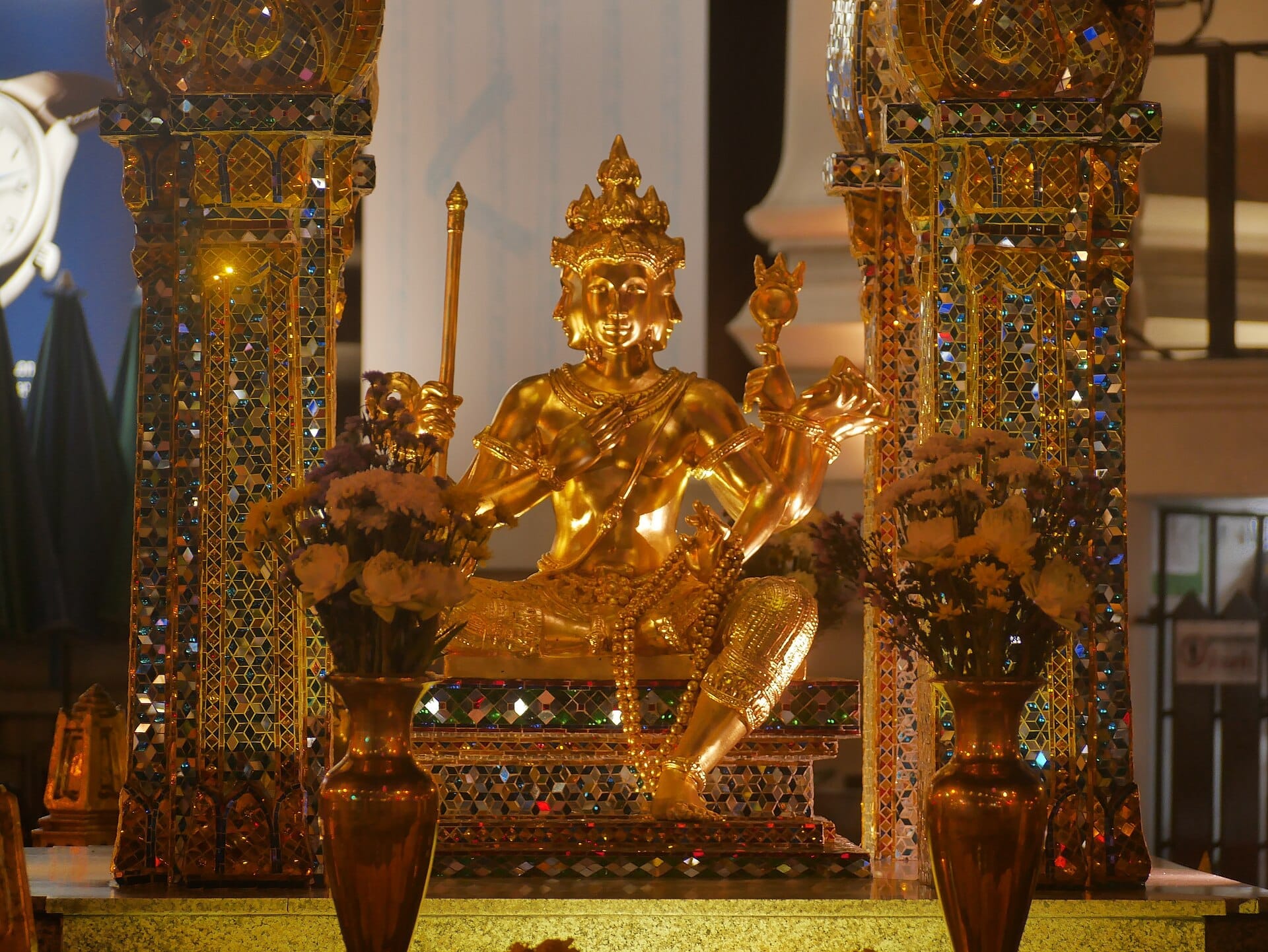
What the Erawan Shrine Actually Is
The Erawan Shrine is an open-air sanctuary dedicated to Thao Maha Phrom, the Thai representation of the Hindu creator deity Brahma. It occupies a modest corner plot at the intersection of Ratchadamri and Ploenchit Roads, surrounded by elevated expressways, luxury hotels, and shopping towers. The contrast is part of what makes it striking: a glittering four-faced golden deity wreathed in jasmine smoke, positioned directly beneath a BTS Skytrain line.
This is not a temple in the architectural sense. There are no corridors, no monks' quarters, no walled compound. It is an altar platform, open on all sides, where worshippers circulate in a clockwise direction around the central statue, pausing at each face to light incense and place offerings. Despite its small footprint, it generates an emotional weight that many larger temples do not.
ℹ️ Good to know
The shrine is open daily from around 6 AM to 10 PM, though the organized dance performances and the largest crowds are concentrated between 7 AM and 8 PM. Early mornings offer a quieter, more contemplative atmosphere.
The History Behind the Shrine
The Erawan Shrine was constructed in 1956 during the building of the original Grand Hyatt Erawan Hotel. Construction on the hotel suffered a series of accidents and setbacks that workers and management attributed to spiritual disturbances — the hotel site sat on ground believed to be inauspicious. On the advice of the Department of Fine Arts and local astrologers, a spirit house dedicated to Brahma was erected to pacify the site.
The decision was deliberate and specific: Brahma was chosen because his four faces are said to radiate compassion, mercy, sympathy, and impartiality in all directions. The name 'Erawan' comes from the mythological three-headed white elephant — Airavata in Sanskrit — the celestial mount of the god Indra in Hindu cosmology, and the name lent to the original hotel. After the shrine's construction, the hotel's misfortunes reportedly ceased, and word spread quickly through Bangkok's community that prayers at this site produced results.
Since then, the shrine has survived Bangkok's transformation from a mid-century city into a modern metropolis. The hotel was demolished and rebuilt as the Grand Hyatt Erawan Bangkok, but the shrine remained untouched and both legally protected and socially unmovable. A 2006 incident in which the statue was damaged resulted in its immediate restoration and reinforced just how deeply the site is woven into Bangkok's collective identity.
Tickets & tours
Hand-picked options from our booking partner. Prices are indicative; availability and final rates are confirmed when you complete your booking.
Erawan National Park guided tour from Bangkok
From 159 €Instant confirmationFree cancellationPrivate tour in a luxury van, Erawan Fall, Floating and Railway Markets
From 884 €Instant confirmationFree cancellationErawan Waterfall, Floating and Railway Market private tour
From 389 €Instant confirmationFree cancellationTemples of Bangkok and Grand Palace half-day guided tour
From 18 €Instant confirmationFree cancellation
What You Will See and Hear
The sensory experience of the Erawan Shrine is immediate and layered. The smell of jasmine garlands and sandalwood incense reaches you before the altar comes into view. Smoke from dozens of incense sticks drifts sideways in the midday heat or rises in thin columns on calmer mornings. The golden statue of Brahma stands tall at the center of the platform, its four faces oriented to the cardinal points, each garlanded with fresh flowers.
On most afternoons, a troupe of classically trained Thai dancers performs in the adjacent covered area, commissioned by worshippers who have made a vow and seen it fulfilled. The dancers wear full traditional costume — layered silk, gilded headdresses, and precise mudra hand gestures — and perform to live accompaniment on piphat instruments, a classical ensemble that includes the ranat xylophone and ching cymbals. This is not a tourist performance. It is a genuine act of religious gratitude, paid for by the devotee as an offering in kind.
Around the perimeter, vendors sell pre-assembled offering trays: lotus buds, marigolds, incense bundles, and small carved wooden elephants. The wooden elephants are a particularly interesting detail. Devotees who receive a wish often donate a carved elephant to the shrine as thanks, which is why you will see dozens of them arranged at the base of the statue and along the railings.
How the Experience Changes by Time of Day
Early morning, before 8 AM, is the most concentrated moment of private devotion. Office workers in formal dress stop on their way to work, press their palms together, and kneel briefly on the marble platform. The light at this hour is soft and the air cooler, which makes it the most pleasant time to observe quietly and take photographs without disturbing anyone. The crowd is respectful and focused.
By midday, the intersection is at full volume. The noise of Ratchadamri Road, tuk-tuks, taxis, and the overhead BTS trains creates a near-constant background roar. The shrine itself becomes crowded with both worshippers and tourists, and the heat radiating from the surrounding pavement is significant from March through May. If you are visiting purely for the atmosphere rather than prayer, midday in the hot season is the least comfortable window.
Evening, roughly 5:30 PM to 7:30 PM, brings a second peak. The sky turns orange above the towers, the incense smoke catches the fading light, and the dance performances are often more frequent because worshippers who finished work earlier commissioned them during the day. This is the most visually dramatic time to visit, and the cooler temperature makes it more comfortable to linger.
💡 Local tip
If you want to see the classical dance performance, arrive on a weekday afternoon around 3–5 PM. Performances are more frequent then, as many worshippers schedule them for auspicious times identified by their fortune tellers.
How to Behave and What to Do as a Visitor
Non-Buddhist and non-Hindu visitors are welcome with no restrictions. There is no dress code enforced at the open-air platform, though removing shoes is not required here as it is at most Thai temples. The general expectation is simply respectful behavior: do not step over offerings on the ground, do not point your feet at the statue, and lower your voice near worshippers who are praying.
If you choose to participate, purchase an offering tray from the vendors outside the platform (around 20–40 THB for a basic set). Walk clockwise around the statue, pausing at each of the four faces, lighting an incense stick at each, and placing a lotus bud or flower near the base. Some visitors also light candles. The vendors will explain the sequence if you ask, and the gesture is appreciated even from non-believers.
Photography is unrestricted at the shrine itself, but use judgment near people in the middle of prayer. The shrine sits in the Siam district, and the surrounding area offers easy access to some of Bangkok's best shopping, making a visit here natural as part of a longer afternoon in this part of the city.
Getting There and Combining with Nearby Attractions
The BTS Skytrain is the most reliable way to reach the shrine. Alight at Chit Lom station and use Exit 1, which deposits you at street level directly adjacent to the shrine's corner. The walk takes under two minutes. Taxis and Grab cars can drop you on Ratchadamri Road, though traffic at this intersection during peak hours can be slow.
The shrine sits steps from the Grand Hyatt Erawan Bangkok and within easy walking distance of CentralWorld, one of Bangkok's largest retail complexes. The Siam Paragon and MBK Center are each reachable in under 10 minutes on the BTS, making it straightforward to fold this stop into a half-day that mixes cultural and commercial Bangkok.
⚠️ What to skip
The area immediately around the shrine has persistent vendors offering 'free' information or offers to take you somewhere by tuk-tuk. This is a well-known scam pattern at major Bangkok tourist sites. Politely decline and move on.
Who Should Consider Skipping This
Travelers with very limited time who have already allocated their cultural hours to Bangkok's major temple circuit — the Grand Palace, Wat Pho, Wat Arun — may find the Erawan Shrine feels minor in comparison. It takes under an hour and does not provide the immersive architectural experience of a full temple complex. It is also not a quiet retreat: it sits at one of Bangkok's noisiest intersections, and the surrounding commercial energy is constant.
That said, for anyone curious about how Thai people practice everyday urban faith, this is one of the most direct windows available. Unlike larger temple complexes, which often feel preserved for ceremony and tourism, the Erawan Shrine is in active, daily, personal use. It connects naturally to a broader exploration of Bangkok's temple landscape, especially for visitors who want to understand the Hindu-Buddhist continuum that underlies so much of Thai religious life.
Insider Tips
- The four faces of Brahma are believed to govern different areas of life depending on which you petition. Many Bangkok locals face the north-oriented face for wealth and career wishes. Ask a nearby vendor which face corresponds to your particular prayer if you want to follow local custom.
- The classical dance troupe is commissioned by devotees, meaning performance timing is unpredictable. If you want to watch a full performance, plan to spend at least 30 minutes at the shrine to improve your odds of catching one.
- Mornings on weekdays see a noticeably higher proportion of Thai office workers at the shrine compared to weekends, which skew toward tourists. If you want to observe genuine local devotion rather than a tourist-heavy scene, a Tuesday or Wednesday morning before 9 AM is the best window.
- The elevated walkway connecting Chit Lom BTS to the adjacent Gaysorn Village mall offers an overhead view of the shrine's roof and the surrounding intersection that is useful for photography with a clear sightline.
- If you are sensitive to incense smoke, be aware that it can be heavy at the platform level, especially when the wind is low. Positioning yourself slightly upwind or visiting in breezier evening hours will make it more comfortable.
Who Is Erawan Shrine For?
- First-time visitors to Bangkok wanting to understand everyday Thai religious practice
- Photographers interested in contrast: sacred ritual set against urban commercial density
- Travelers building a walking afternoon through Siam that combines culture and shopping
- Anyone curious about the Hindu influences woven into Thai Buddhist culture
- People with limited time who want a concentrated, accessible cultural experience without a long detour
Nearby Attractions
Other things to see while in Siam:
- Bangkok Art and Culture Centre (BACC)
Perched at the intersection of Rama I and Phayathai roads, the Bangkok Art and Culture Centre is the city's most accessible contemporary arts venue. With free admission to most exhibitions, a striking spiral interior, and a location steps from BTS National Stadium, it rewards even a short visit.
- CentralWorld Bangkok
CentralWorld is one of the largest shopping complexes in Southeast Asia, anchoring the Ratchaprasong intersection in the heart of Bangkok. Beyond retail, it draws visitors with its food courts, rooftop dining, event spaces, and easy links to the BTS Skytrain.
- Jim Thompson House
A compound of six traditional Thai teakwood houses overlooking a canal in Siam, the Jim Thompson House is where mid-century design, Southeast Asian art collecting, and one of history's great unsolved disappearances all collide. It rewards curious travelers with genuine depth, not just pretty interiors.
- Madame Tussauds Bangkok: The Complete Visitor Guide
Madame Tussauds Bangkok packs over 90 wax figures across themed zones inside Siam Discovery. From Thai royalty to Marvel superheroes, it draws families and pop culture fans alike. Here is exactly what you get, and whether it is worth your time.