Jim Thompson House: Bangkok's Most Compelling Historic Home
A compound of six traditional Thai teakwood houses overlooking a canal in Siam, the Jim Thompson House is where mid-century design, Southeast Asian art collecting, and one of history's great unsolved disappearances all collide. It rewards curious travelers with genuine depth, not just pretty interiors.
Quick Facts
- Location
- 6 Soi Kasemsan 2, Rama 1 Road, Bangkok
- Getting There
- National Stadium BTS Station – 5-minute walk
- Time Needed
- 1.5 to 2.5 hours including the guided tour
- Cost
- 250 THB adults (+21yo), 150 THB (10 - 21yo - ID required), Free for children under 10
- Best for
- Design lovers, history enthusiasts, and anyone wanting a quiet counterpoint to Bangkok's commercial pace
- Official website
- www.jimthompsonhouse.org
Why the Jim Thompson House Still Matters
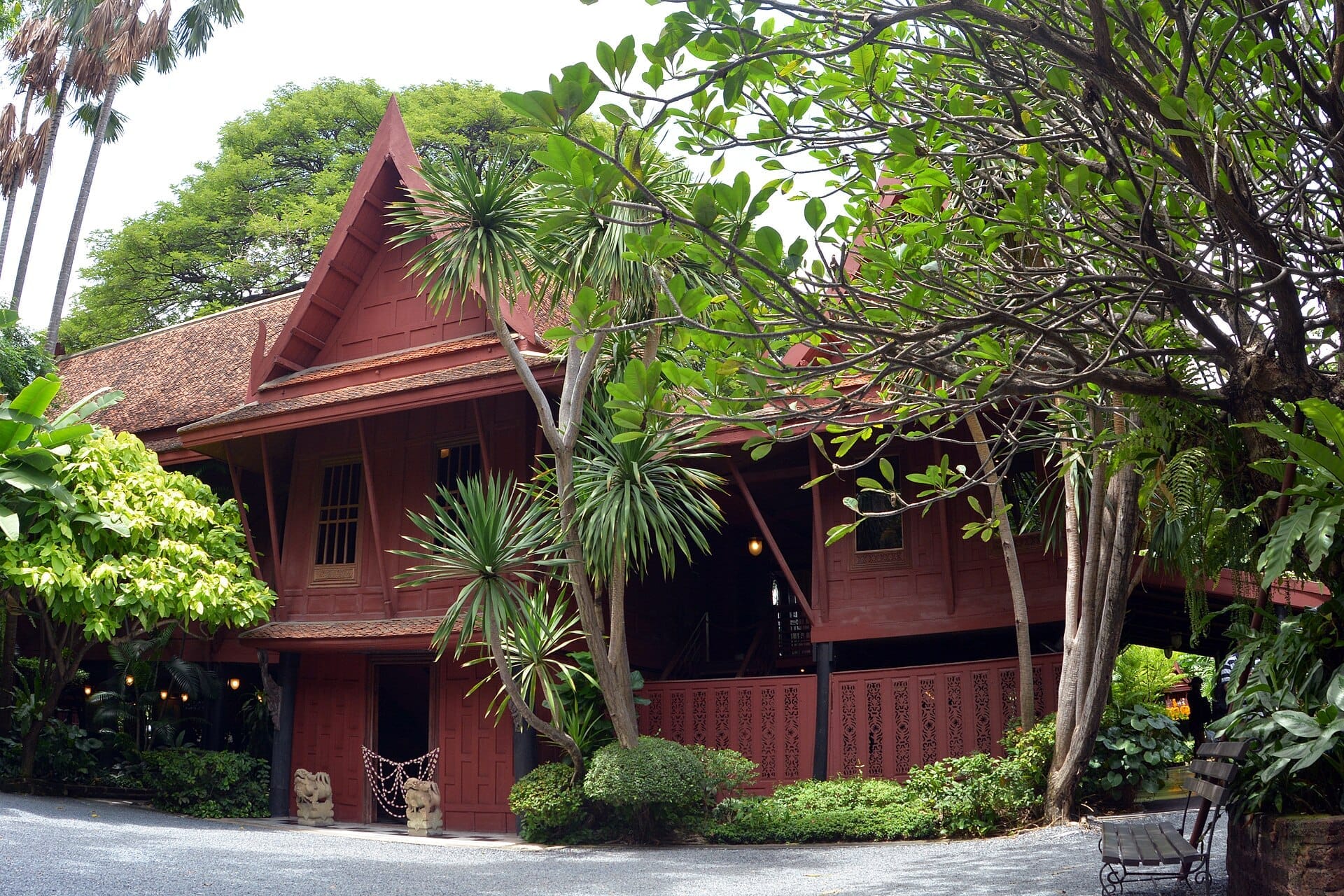
The Jim Thompson House is one of Bangkok's most carefully preserved cultural sites, and unlike many heritage attractions, it earns that status through substance rather than spectacle. The complex consists of six traditional Thai teakwood structures that Thompson assembled along the bank of Saen Saep Canal, creating a private residence that was also a considered work of architecture and curation. Thompson moved some of the houses from the opposite bank and, controversially, flipped one structure so its front facade faces the garden rather than the water, a detail guides are quick to point out.
What makes the site unusual is the double narrative it carries: the beauty of the house itself, and the enduring mystery of the man who built it. Jim Thompson, an American businessman who revitalized the Thai silk industry after World War II, disappeared without a trace in the Cameron Highlands of Malaysia in 1967. No credible explanation has ever been confirmed. That unresolved ending gives the entire property an atmosphere that photographs alone cannot fully convey.
ℹ️ Good to know
Entry is by guided tour only. Tours run continuously throughout opening hours in multiple languages including English, Thai, French, and Japanese. Expect to join a group of 10 to 20 people. Solo entry into the main house is not permitted.
The Architecture: Six Houses, One Vision
The compound is not a single building but a carefully linked series of structures, each dating to the 18th or 19th century. Thompson purchased them between 1958 and 1964 and connected them on the interior with staircases and doorways, creating a flowing residence that feels genuinely livable rather than museum-frozen. The walls of the oldest section are mounted inside-out, the carved exterior panels facing inward where Thompson could admire them from his dining room.
The construction technique visible throughout the main house is classic central Thai wooden architecture: raised on stilts, with steeply pitched rooflines, carved bargeboard trim, and large windows designed to capture canal breezes before air conditioning existed. What Thompson layered onto this framework was a collection of Asian art spanning Burmese statuary, Chinese porcelain, Cambodian sculpture, and Thai lacquerware. The pieces are not arranged as a museum would arrange them. They sit on shelves, windowsills, and dining tables as though someone actually lived here until last week.
For travelers interested in Thai architectural history, this compound provides a rare opportunity to walk through domestic spaces that have been maintained rather than reconstructed. Most of Bangkok's historic wooden buildings have been lost to fire or redevelopment. The Jim Thompson House survived because Thompson willed the property to a charitable foundation before his disappearance.
Tickets & tours
Hand-picked options from our booking partner. Prices are indicative; availability and final rates are confirmed when you complete your booking.
Temples of Bangkok and Grand Palace half-day guided tour
From 18 €Instant confirmationFree cancellationDamnoen Saduak floating market and Maeklong railway guided tour
From 36 €Instant confirmationFree cancellationBangkok tuk-tuk night tour with Chinatown street food meal
From 28 €Instant confirmationFree cancellationAfternoon Tea at Hyatt Regency Hotel Bangkok
From 900 €Instant confirmationFree cancellation
The Collection: Art Without Ropes
Thompson was an obsessive collector, and what he assembled over roughly a decade is genuinely impressive by any standard. The interior holds over 100 Asian antiques and art objects, including a 17th-century Burmese Buddha, Ming dynasty blue-and-white ceramics, and a drawing room dominated by large Thai paintings on lacquer and gold. The density of objects in each room is deliberate, reflecting Thompson's personal taste rather than curatorial restraint.
The guided tour is the only way to see the main house, and a good guide makes a significant difference. The better guides will explain provenance, point out Thompson's habit of removing Thai figurines from their original contexts and displaying them at eye level, and discuss which pieces were acquired legally versus those that would never leave the country today. This is not a collection frozen in reverential silence. It is a collector's home, and it feels that way.
💡 Local tip
Arrive at least 15 minutes before you plan to join a tour. On weekend mornings and during Chinese New Year or Songkran, groups fill quickly and waiting time between tours can stretch to 30 minutes. Weekday mornings between 10am and 11am are consistently the least crowded.
The Gardens, Cafe, and Canal Edge
The grounds surrounding the house are as carefully maintained as the interior. Tropical planting, including banana palms, heliconias, and old-growth frangipani, frames the teakwood structures and softens the contrast with the modern city visible just over the canal wall. Early morning, before tour groups arrive, the garden is genuinely tranquil, with the sounds of canal boats on Saen Saep and birdsong mixing in a way that feels very far from the nearby shopping corridor of Siam.
The on-site cafe and restaurant provide a comfortable place to decompress after the tour. The cafe serves Thai food and international options at reasonable prices for the neighborhood, and the shaded outdoor seating overlooks the canal. The compound also houses a Jim Thompson silk shop, which is worth at least a browse: the brand's signature printed silks and homeware are sold here, and the shop is considerably less hectic than the standalone Jim Thompson stores in the malls.
Time of Day and What Changes
Morning visits, particularly on weekdays, offer the most atmospheric experience. The low-angle light through the teak-slatted windows creates strong shadows across the lacquerware and ceramics, and the garden retains overnight moisture that softens the air with green, damp smells. By midday, group sizes increase and the narrow rooms of the main house can feel crowded, making it harder to linger near specific objects.
Late afternoon light between 3pm and 5pm produces attractive photography conditions in the garden, with warm tones catching the carved woodwork particularly well. However, this window also coincides with school groups and after-work visitors, so tour pacing is faster. If the interior collection is your priority, early morning is the right call. If you want garden photographs, late afternoon light is worth the trade-off.
The house closes in the evening, which means there is no night visit option. Given the absence of dramatic lighting installations, this is not a loss. The atmosphere of the property is entirely dependent on natural light filtering through the original window configurations, which Thompson designed to maximize.
Practical Notes for Visitors
The Jim Thompson House is straightforward to reach from National Stadium BTS Station in under five minutes on foot. Head north along Rama I Road, turn left onto Kasem San 2 Alley, and the entrance gate is on the left before the canal. Tuk-tuks from Siam Paragon or MBK take under 10 minutes but are unnecessary given the BTS proximity.
Photography is permitted throughout the gardens and in some parts of the main house, but flash photography is restricted inside. Shoes must be removed before entering the house, so slip-on footwear makes the tour noticeably more comfortable. The narrow interior staircases require a reasonable degree of mobility, and some rooms have low ceiling clearance. Visitors with significant mobility limitations may find the garden and peripheral structures accessible but the main house tour difficult to complete fully.
The admission fee is modest relative to Bangkok's other heritage attractions. Children and young adults under 22 with a valid ID are offered reduced rates, pricing should be confirmed at the entrance. There is no need to book in advance for individual or small group visits.
⚠️ What to skip
Tuk-tuk drivers near Siam occasionally approach tourists and claim the house is closed for a holiday, then offer to take them to a silk shop instead. The Jim Thompson House closes only on a small number of national holidays. Check the official website before your visit and ignore unsolicited advice near the BTS station.
Who Will Get the Most from This Visit
Travelers with an interest in design, collecting, or mid-century history will find the Jim Thompson House genuinely rewarding. The narrative of Thompson himself, an OSS officer turned silk entrepreneur who transformed a cottage industry into an international brand before vanishing entirely, is one of the more compelling stories attached to any building in Southeast Asia. People who enjoy human stories woven into physical spaces will leave with more than they came with.
Visitors who prefer self-guided exploration at their own pace may find the mandatory group tour format mildly constraining. The tours are well run and the guides are knowledgeable, but you cannot linger independently in front of a specific object while the group moves on. If you are the kind of traveler who reads every label twice and circles back to rooms, this format will require patience.
Young children are welcome but the combination of irreplaceable antiques at low heights and mandatory shoe removal in tight spaces means this is not the most relaxed family visit. It pairs well with a subsequent walk to Chatuchak Park or a browse through the nearby MBK Center if you are building a day itinerary in this part of the city.
Insider Tips
- Ask your guide specifically about the room where Thompson was last seen before leaving for Malaysia. The guides typically don't lead with the disappearance narrative, but most will engage with it directly if you ask, and the detail about his unlocked doors and unfinished meal waiting on his return is worth hearing in context.
- The silk shop on the compound carries a small selection of fabric off-cuts and accessories not available in the mall stores. These make practical, quality souvenirs without the markup of the main retail locations.
- If you arrive before the first tour group of the day, spend time in the garden before joining a tour. The space changes character noticeably once 15 or 20 people are moving through it.
- The cafe's iced Thai tea is among the better versions available in this neighborhood, and the shaded riverside seating is a genuine recovery point after a morning of temple and museum visits.
- Combine this visit with nearby Wat Pathum Wanaram, the temple whose grounds sit between Siam Paragon and CentralWorld, for a morning that costs almost nothing but covers a broad range of what Bangkok's historic and contemporary layers look like side by side.
Who Is Jim Thompson House For?
- Design and architecture travelers wanting to see traditional Thai wooden construction up close
- History enthusiasts drawn to the Cold War-era story of Thompson's silk empire and disappearance
- Art collectors and antique lovers interested in how mid-century Asian collecting looked in practice
- Travelers seeking a quiet, shaded counterpoint to Bangkok's shopping and street-level pace
- Anyone researching the Thai silk industry and wanting context beyond retail stores
Nearby Attractions
Other things to see while in Siam:
- Bangkok Art and Culture Centre (BACC)
Perched at the intersection of Rama I and Phayathai roads, the Bangkok Art and Culture Centre is the city's most accessible contemporary arts venue. With free admission to most exhibitions, a striking spiral interior, and a location steps from BTS National Stadium, it rewards even a short visit.
- CentralWorld Bangkok
CentralWorld is one of the largest shopping complexes in Southeast Asia, anchoring the Ratchaprasong intersection in the heart of Bangkok. Beyond retail, it draws visitors with its food courts, rooftop dining, event spaces, and easy links to the BTS Skytrain.
- Erawan Shrine
The Erawan Shrine is a small but intensely atmospheric Hindu-Buddhist shrine at one of Bangkok's busiest intersections. Gilded offerings, traditional dancers, and a constant stream of worshippers make it one of the city's most compelling stops — even for non-religious visitors.
- Madame Tussauds Bangkok: The Complete Visitor Guide
Madame Tussauds Bangkok packs over 90 wax figures across themed zones inside Siam Discovery. From Thai royalty to Marvel superheroes, it draws families and pop culture fans alike. Here is exactly what you get, and whether it is worth your time.