Washington Square Park: Greenwich Village's Living Room
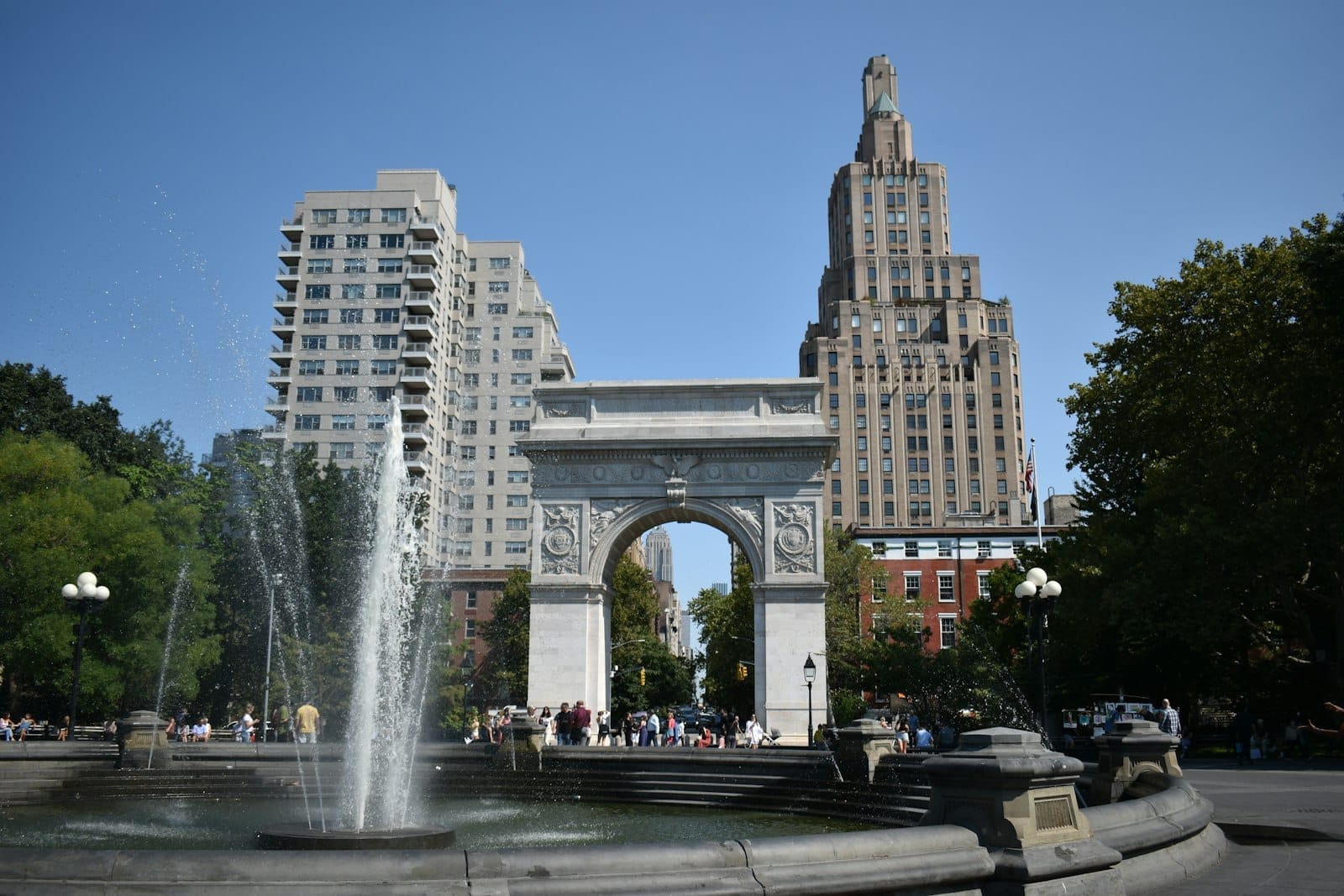
Washington Square Park is the social and cultural heart of Greenwich Village, a free 9.75-acre public square anchored by Stanford White's marble arch and animated by street performers, chess players, NYU students, and longtime locals. Open daily with a curfew from midnight to 6 a.m., it rewards visitors at every hour.
Quick Facts
- Location
- Bounded by 5th Ave, Waverly Place, W 4th St & MacDougal St, Greenwich Village, Manhattan
- Getting There
- W 4th St–Washington Square (A/C/E/B/D/F/M); 8th St–NYU (R/W); buses M1, M2, M3, M8, M55
- Time Needed
- 30 minutes to 2+ hours depending on pace
- Cost
- Free — no admission, no tickets
- Best for
- People-watching, architecture lovers, first-time visitors, solo travelers
- Official website
- www.nycgovparks.org/parks/washington-square-park
What Washington Square Park Actually Is
Washington Square Park is not a quiet retreat. It is a 9.75-acre public square operated by NYC Parks (the New York City Department of Parks and Recreation), and it functions more like an outdoor amphitheater than a conventional park. The central fountain plaza draws performers, protesters, dog owners, and tourists into the same space simultaneously, and the energy shifts noticeably depending on the hour. It is free to enter, open daily with a curfew from midnight to 6:00 a.m., and requires nothing from you except a willingness to be present.
The park sits at the southern terminus of Fifth Avenue in Greenwich Village, which means the marble arch frames that famous avenue in a way that stops even regular New Yorkers mid-stride. The surrounding blocks are dense with NYU buildings, independent cafes, and the kind of pre-war townhouses that explain why Greenwich Village has attracted writers and artists for over a century.
💡 Local tip
Arrive between 10 a.m. and noon on a weekday for the best balance of activity and space. Weekend afternoons from spring through fall are significantly more crowded, especially around the central fountain.
The Arch and the Formal Architecture
The Washington Square Arch is the park's defining feature and one of the most recognizable structures in New York City. Designed by Stanford White in the Beaux-Arts tradition and built from Tuckahoe marble, the permanent arch was completed in 1892 and dedicated in 1895. It replaced a temporary wooden version erected in 1889 to mark the centennial of George Washington's inauguration as the first President of the United States. At roughly 77 feet tall, it reads differently depending on where you stand: from the fountain, it appears as a formal gateway; from Fifth Avenue to the north, it closes the view of the entire street in a way that feels deliberately theatrical.
Look closely at the arch's two piers. The north face bears two sculptural reliefs of Washington: one in military dress on the east pier, one in civilian attire on the west. These were added in the early 20th century (installed between 1914 and 1918) and are easy to walk past without registering. On the interior faces, the stonework shows a level of decorative detail that rewards a slow look upward before you enter the park proper.
For travelers interested in the broader architectural legacy of this neighborhood and city, the arch is a natural starting point. The surrounding blocks of Greenwich Village contain Federal-style and Italianate rowhouses dating to the 1830s and 1840s, and a short walk north connects you to the Flatiron district. The NYC architecture guide covers the full range of what the city's built environment offers.
Tickets & tours
Hand-picked options from our booking partner. Prices are indicative; availability and final rates are confirmed when you complete your booking.
Washington full-day tour from New York in Spanish
From 118 €Instant confirmationFree cancellationWashington, D.C. day tour from New York City
From 115 €Instant confirmationFree cancellation2-day Washington, D.C., Philadelphia and Amish Country tour from NYC
From 349 €Instant confirmationFree cancellationWashington D.C. day trip from New York City
From 160 €Instant confirmationFree cancellation
How the Park Changes Through the Day
Early morning, roughly 6 to 9 a.m., the park belongs to dog walkers, joggers, and the occasional chess player setting up at the permanent concrete tables in the southwest corner. The fountain is usually off in early spring and late fall, turning the central plaza into an open-air social space. The light at this hour cuts low across the arch, making it an excellent time for photography without scaffolding from crowds in your frame.
Midday through mid-afternoon brings NYU students eating lunch, families with young children at the playgrounds on the eastern edge, and street musicians who establish unofficial territory around the fountain. Drummers, jazz instrumentalists, and occasional solo pianists (using a portable keyboard) all occupy the space at different times. The sound carries far in the open plaza, and the fountain's spray, when running in warmer months, creates a constant ambient noise that is more pleasant than it sounds in description.
Late afternoon and early evening, particularly on warm days, is when the park reaches peak density. The fountain plaza fills with people sitting on the rim. The chess tables are rarely vacant. Skateboarders use the southern pathways. The smell of food cart pretzels and occasional incense from vendors along the perimeter mixes with the general urban air. On summer evenings, the park stays lively well past dark, with the arch lit from below, which gives the marble a slightly warm, almost golden quality.
⚠️ What to skip
Washington Square Park is popular with cannabis users, especially in the evenings. This is worth knowing if you are visiting with young children or are sensitive to the smell. The park is open public space and NYPD enforcement in this area has historically been inconsistent.
History Under the Grass
The ground beneath Washington Square Park carries a history that most visitors walk over without knowing. Before the land became a military parade ground in the 1820s, it functioned as a public burial ground—a potter's field where the city interred the poor and those who died without family. Estimates suggest tens of thousands of bodies remain beneath the park. Construction and renovation work over the decades has confirmed this, periodically surfacing human remains.
The City of New York officially designated the combined parcels as Washington Military Parade Ground, a public square, in 1827. By mid-century, the surrounding area had developed into a fashionable residential district, which Henry James captured in his 1880 novel Washington Square, set in the neighborhood's period of social prestige. The park's character shifted considerably over the 20th century: it became a center of the folk music revival in the late 1950s and early 1960s (Bob Dylan performed informally in the park), and a gathering point for counterculture movements through the decades that followed.
A major restoration phase completed in 2009 regraded the lawn areas, repositioned the central fountain to align more precisely with the arch, and upgraded infrastructure throughout. The restoration was controversial among some longtime users who felt it over-formalized a space known for its improvisational character, but the alignment of the fountain axis with the arch is visually striking and clearly intentional.
Practical Walkthrough: How to Move Through the Park
Enter from the north, through the arch, if you are coming from the subway at West 4th Street or from any point on Fifth Avenue. This is the intended ceremonial approach and gives the clearest sense of the park's design logic. Walk south toward the central fountain, then take the diagonal paths toward the southwestern chess tables or the southeastern lawn depending on your interest.
The park is entirely paved or grassed with accessible paths throughout. Major entrances have curb cuts. The paved surfaces are generally even, though older sections of pathway near the perimeter can be uneven in spots. Restrooms are located in the park; the facilities are public and vary in condition depending on the time of day and level of maintenance.
After the park, the surrounding blocks of Greenwich Village are worth at least an hour on foot. The streets west of the park toward Hudson Street contain some of the best-preserved Federal rowhouses in Manhattan. For a longer, structured walk through the neighborhood and beyond, the NYC walking tours guide has curated routes that begin here.
Weather, Seasons, and When to Come
The park is most rewarding from late April through October, when the fountain runs, trees are in leaf, and the outdoor performance culture is at full intensity. Spring brings cherry blossoms along the eastern edge. Summer is lively but hot, and the open central plaza offers little shade during midday hours. Bring water and sunscreen if you plan to spend time there between noon and 3 p.m. in July or August.
Autumn is arguably the finest season here. Temperatures drop to a comfortable range, the light is lower and warmer, and the park's trees produce good fall color in late October. Winter visits are quieter, the fountain is off, and the chess tables attract a more dedicated crowd. Snow transforms the park briefly and photogenically, though it rarely lasts in Manhattan. For a broader picture of when conditions favor outdoor exploration across the city, the best time to visit New York City covers seasonal tradeoffs in detail.
ℹ️ Good to know
Rain affects the park significantly. The central fountain plaza has no shelter. Light rain can be pleasant under the arch, but heavy rain empties the space almost entirely, which actually produces interesting photographs of the empty plaza with the arch.
Who Should Temper Their Expectations
Travelers seeking a quiet, contemplative green space will find Washington Square Park frustrating on busy days. It is not Central Park, where you can walk ten minutes from an entrance and find genuine quiet. The park's open design, its central location, and its role as a neighborhood social hub mean that on a warm Saturday afternoon in June, it is crowded in a way that can feel overwhelming to visitors who did not expect it.
If you want a calmer park experience in lower Manhattan, Hudson River Park offers more space and water views a short walk to the west. If you are specifically looking for elevated views of the city as part of a broader sightseeing day, the park is better treated as a 30-minute stop on a longer Greenwich Village walk rather than a destination in itself.
Insider Tips
- The chess tables in the southwest corner operate on an informal honor system: watch a game first to understand the rhythm before sitting down. Some players are serious competitors and not interested in teaching.
- For the clearest photograph of the arch without crowds in the foreground, come before 8 a.m. on a weekday. The low morning light from the east also catches the marble's texture in a way that afternoon shots rarely replicate.
- The fountain is typically turned on in late spring and off again in October, though the exact dates vary by year. Check before planning a visit specifically to see it running.
- The park's perimeter cafes on MacDougal Street have outdoor seating that faces into the park, which makes them good spots to observe the space from a slight remove without being in the middle of the activity.
- Street performances around the fountain are often more skilled than they appear at a glance. Musicians who hold a spot there regularly do so because they draw audiences, and some are working professionals. Tipping is customary if you stop to watch for more than a few minutes.
Who Is Washington Square Park For?
- First-time visitors to New York City wanting an authentic neighborhood introduction
- Architecture and history enthusiasts interested in the Beaux-Arts arch and the park's layered past
- Solo travelers who enjoy observing urban social life at close range
- Families with children, particularly for the eastern playground areas on quieter weekday mornings
- Photographers working in street and documentary styles
Nearby Attractions
Other things to see while in Greenwich Village:
- Comedy Cellar
Tucked beneath MacDougal Street in Greenwich Village, the Comedy Cellar has been the proving ground for American stand-up comedy since 1981. Small, loud, and brilliantly unpredictable, it remains the club where surprise drop-ins from major names still happen on any given night.
- Stonewall Inn & National Monument
The Stonewall Inn and its surrounding Christopher Park form Stonewall National Monument, the first unit of the U.S. National Park System dedicated to LGBTQ history. This Greenwich Village site marks the location of the 1969 uprising that fundamentally reshaped civil rights in America, and it remains a living gathering place as much as a historic landmark.
- Village Vanguard
Open since 1935, the Village Vanguard is a basement jazz club on 7th Avenue South where the music has never stopped. Two shows nightly, first-come seating, and a one-drink minimum make for an intimate, no-frills experience that serious music lovers rank among the best in the world.