Comedy Cellar: New York's Most Famous Stand-Up Room
Tucked beneath MacDougal Street in Greenwich Village, the Comedy Cellar has been the proving ground for American stand-up comedy since 1981. Small, loud, and brilliantly unpredictable, it remains the club where surprise drop-ins from major names still happen on any given night.
Quick Facts
- Location
- 117 MacDougal Street, Greenwich Village, Manhattan, NY 10012
- Getting There
- W 4 St–Washington Sq (A, C, E, B, D, F, M lines), approx. 5-minute walk west
- Time Needed
- Approximately 75 to 90 minutes per show; arrive 20-30 minutes early
- Cost
- Cover $15–$25 per person depending on the night, plus a 2-item minimum (food or drink) per person
- Best for
- Comedy fans, date nights, solo travelers, New York nightlife seekers
- Official website
- www.comedycellar.com
What the Comedy Cellar Actually Is
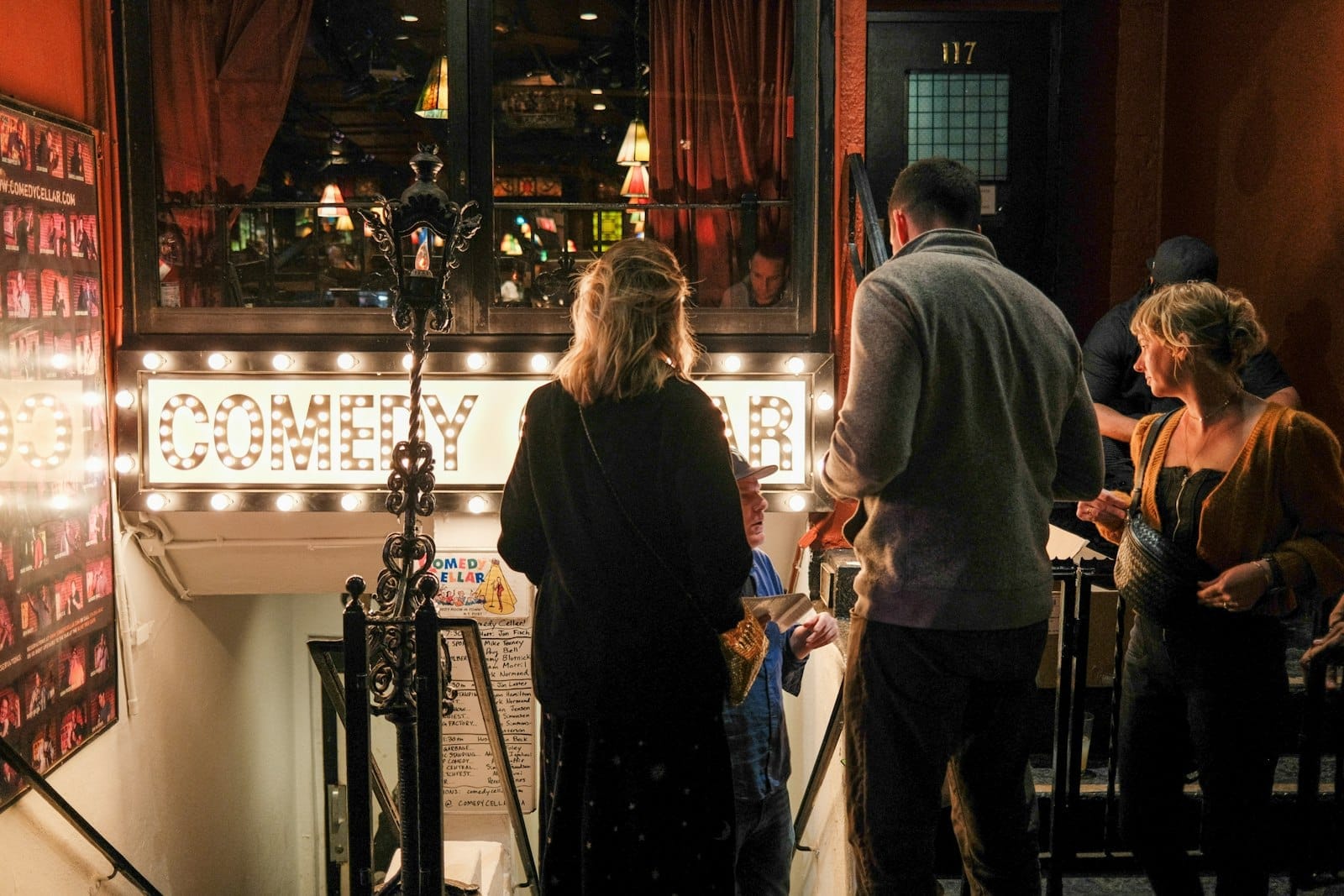
The Comedy Cellar is a stand-up comedy club that has operated at 117 MacDougal Street in Greenwich Village since its founding in 1981 by comedian Bill Grundfest. It is a stand-up comedy club. It is a low-ceilinged, brick-walled basement room beneath a cafe, where tables are set close together and the sightlines to a raised stage are almost uniformly good. The capacity is deliberately limited, which means the energy in the room compounds quickly.
Over four decades, the Cellar became the informal clubhouse for the New York comedy scene. Jerry Seinfeld, Dave Chappelle, Chris Rock, Amy Schumer, and Colin Quinn have all been associated with the club. That tradition continues. Drop-ins from major names are genuinely unannounced and happen with real frequency, particularly on weekend late shows. No one can promise you who will walk through that door, which is precisely what makes the club compelling.
ℹ️ Good to know
The lineup is not announced in advance. You book a seat, not a set list. Part of the appeal is that you genuinely do not know who you will see until they step up to the mic.
The Room Itself: Layout and Atmosphere
The main room sits underground, which affects the experience before a single joke is told. You descend a narrow staircase off MacDougal Street, the street noise cuts away, and you arrive in a space that smells of brick, beer, and whatever the kitchen is running that evening. The walls are bare stone and exposed brick. The ceiling is close. The tables are small and shared, though the club handles seating arrangements, so strangers end up sitting together as a matter of course.
The stage is compact and brightly lit, with the rest of the room kept darker. From nearly any seat, you are within 30 feet of whoever is performing. There is no bad seat in terms of sightlines, though seats along the side walls occasionally require a slight turn of the head. Because the room is small and the lighting contrast is stark, there is very little distance between the performer and the audience. Crowd work is common, and if you are sitting in the front rows, you should expect to be addressed directly.
The Olive Tree Cafe, which operates upstairs, is connected and counts toward the two-item minimum. Food and drink orders are taken before and during the show. The menu runs to standard bar and cafe fare: hummus plates, sandwiches, burgers, and drinks. The food is serviceable rather than notable, but the mandatory minimum keeps things from feeling transactional.
Tickets & tours
Hand-picked options from our booking partner. Prices are indicative; availability and final rates are confirmed when you complete your booking.
Statue of Liberty, Ellis Island, and Brooklyn Bridge Happy Hour Cruise
From 49 €Instant confirmationFree cancellationSpirit of New York Dinner Cruise
From 161 €Instant confirmationFree cancellationNew York City Highlights bike tour
From 70 €Instant confirmationFree cancellationNew York Statue of Liberty and Ellis Island tour by ferry
From 55 €Instant confirmation
Showtimes and How the Schedule Works
The club runs multiple shows per night, seven days a week. On Monday through Wednesday, shows run at 7:30 pm, 9:30 pm, and 11:30 pm. Thursday and Sunday have their own timing structures, with Thursday running at 6:45 pm, 8:45 pm, and 10:45 pm, and Sunday offering afternoon and evening slots at 1:30 pm, 7:00 pm, 9:00 pm, and 11:00 pm. Friday and Saturday are the busiest nights, with shows at 6:45 pm, 8:45 pm, 10:45 pm, and a late-night 12:30 am show.
Cover prices scale with the night. Monday through Wednesday cost $15 per person. Thursday and Sunday are $18. Friday and Saturday, plus holidays and special events, are $25. These are in addition to whatever you spend on the two-item minimum per person. Factor in a couple of drinks or a drink and a plate of food, and a night at the Cellar realistically costs $40 to $60 per person before tip.
💡 Local tip
Reservations are strongly recommended, especially for Friday and Saturday. The club books through its website. Walk-ins are sometimes accommodated, but the late Friday and Saturday shows often sell out well in advance.
Each show typically runs around 75 to 90 minutes and features multiple comedians performing sets. A house emcee opens and closes the show and introduces each act. The pacing is tight. There is almost no dead time between performers, which keeps the energy consistent across a full evening.
When to Go and What to Expect at Different Times
The first shows of the evening, whether the 7:30 pm on a weeknight or the 6:45 pm on a weekend, tend to attract a slightly older and more mixed crowd, including tourists and couples on dinner nights out. The room fills but rarely to the same level of intensity as later shows. These are good options if you want a reliable, controlled experience without the noise level and energy spike that comes with a packed late room.
The late shows, particularly the 11:30 pm on weekdays and the 12:30 am on Friday and Saturday, skew younger and draw more locals and industry people. This is when drop-ins are most likely. The crowd is louder and more reactive, which can work in your favor if you enjoy a charged room, or against you if you prefer attentive quiet. On a Friday or Saturday at 12:30 am, the sound level between sets approaches bar volume.
Sunday afternoons at 1:30 pm are one of the genuinely underrated options. The crowd is small and relaxed, the room is quieter, and the lineup still draws strong working comedians. If you are visiting New York and cannot make a late-night show work logistically, the Sunday matinee is a legitimate alternative that most first-time visitors overlook.
Historical and Cultural Context
The Comedy Cellar opened in 1981 in a neighborhood that was already a long-established hub for New York's intellectual and artistic counterculture. Greenwich Village had been home to folk clubs, jazz rooms, and coffeehouses since at least the 1950s, and the comedians who gravitated to the Cellar in the 1980s and 1990s fit that tradition of creative people finding a basement and making it theirs. The club's proximity to Washington Square Park is not coincidental: the park has long served as an informal gathering point for performers and street artists, and the foot traffic it generates feeds into the MacDougal Street strip.
What distinguished the Cellar from other New York clubs was its table format and its culture of drop-ins. While other clubs ran structured lineups with published headliners, the Cellar encouraged working comedians to show up unannounced and jump into the rotation. The result was an unpredictability that became its own selling point. By the 2000s, the club had appeared in documentary films and in background references across American television, cementing its status as the most name-checked comedy room in the country.
For visitors who want to understand the Cellar's place in New York nightlife, it helps to read it alongside the broader landscape of Greenwich Village entertainment, which has historically included Village Vanguard, a legendary jazz club a few blocks away, and the clubs and performance spaces that have cycled through the neighborhood for decades. The Cellar represents the stand-up side of a neighborhood that has always taken performance seriously.
Practical Walkthrough: Booking, Arriving, and Settling In
Reservations open through the Comedy Cellar's official website. You select your show time, provide contact details, and receive a confirmation. The club's policy requires a credit card to hold a reservation, and cancellations should be made in advance. Groups larger than six may face restrictions on available show times, so larger parties should book early and check current group policy before assuming a specific show will accommodate them.
Doors typically open 30 minutes before showtime. Arriving early matters: seating is assigned by the club based on when you arrive versus when you booked, and arriving at the last minute can land you at a side seat regardless of when you reserved. The entrance on MacDougal Street is unmarked in the theatrical sense, just a door with signage leading down, so look for the queue of people on the sidewalk if you are unsure.
Once seated, a server takes your order. The two-item minimum per person applies to the table. Talking loudly during sets is discouraged, and the Cellar's culture is known for being protective of the performers. Phones should be put away; most shows involve at least a soft request to avoid recording. The club does not currently list a formal bag check policy, but the basement setting means large luggage is impractical.
⚠️ What to skip
The Comedy Cellar is a basement venue with stairs at the entrance. No detailed accessibility statement is published on the website. Guests with mobility needs should contact the club directly at +1 212-254-3480 before booking.
Who Should Reconsider
The Comedy Cellar's reputation can create unrealistic expectations. On a Tuesday or Wednesday night without a notable drop-in, you are watching a lineup of working professional comedians who are genuinely good at their craft, but you will not necessarily see a household name. If you are visiting primarily because you have heard about the famous drop-ins and you attend a mid-week first show, the experience might land below what you imagined.
The room is also loud and physically close. If comedy for you means leaning back with space around you and the sense that no one can see you, this is not that room. Crowd interaction is part of the environment. The content runs toward frank, adult, occasionally sharp material. Visitors who prefer safer or more structured entertainment may find the format disorienting.
Finally, MacDougal Street in Greenwich Village runs busy on weekend nights. The block between West 3rd Street and Minetta Lane has multiple bars and restaurants, and the post-show atmosphere outside the club is noisy rather than reflective. That energy suits some visitors perfectly and suits others less well. If you are exploring Greenwich Village as part of a broader evening, the surrounding streets are worth a walk before or after a show.
Insider Tips
- The Sunday 1:30 pm matinee is the most underbooked show of the week. The lineup quality does not drop significantly, but the crowd is smaller and the experience is far more relaxed than a Friday night.
- Weekday shows (Monday through Wednesday) at $15 cover often feature the same caliber of comedians as weekend shows. The price difference reflects demand, not quality.
- Drop-ins by major names most commonly happen during the late shows on Friday and Saturday, particularly after 10:45 pm. If that is your primary reason for attending, book accordingly rather than assuming any show will deliver one.
- Arrive at least 20 to 25 minutes before showtime rather than just at door-open. Seating is sequential, and early arrivals get center tables with the best sightlines.
- The Olive Tree Cafe above the club is the same operation and counts toward your minimum. If you want to eat before the show without the pressure of the basement service, you can sit upstairs first and have your receipt count toward your minimum, though check with staff as policies can vary.
Who Is Comedy Cellar For?
- Comedy enthusiasts who want to experience the room that defined modern American stand-up
- Date nights where the spontaneous lineup format creates a shared experience
- Solo travelers comfortable with communal seating and unpredictable formats
- New York nightlife explorers looking for something more specific than a bar or theater
- Visitors building a Greenwich Village evening around multiple stops
Nearby Attractions
Other things to see while in Greenwich Village:
- Stonewall Inn & National Monument
The Stonewall Inn and its surrounding Christopher Park form Stonewall National Monument, the first unit of the U.S. National Park System dedicated to LGBTQ history. This Greenwich Village site marks the location of the 1969 uprising that fundamentally reshaped civil rights in America, and it remains a living gathering place as much as a historic landmark.
- Village Vanguard
Open since 1935, the Village Vanguard is a basement jazz club on 7th Avenue South where the music has never stopped. Two shows nightly, first-come seating, and a one-drink minimum make for an intimate, no-frills experience that serious music lovers rank among the best in the world.
- Washington Square Park
Washington Square Park is the social and cultural heart of Greenwich Village, a free 9.75-acre public square anchored by Stanford White's marble arch and animated by street performers, chess players, NYU students, and longtime locals. Open daily with a curfew from midnight to 6 a.m., it rewards visitors at every hour.