Volk's Electric Railway: Riding the World's Oldest Electric Railway in Brighton
Opened in 1883, Volk's Electric Railway runs for about one mile along Brighton's seafront between the Palace Pier and Brighton Marina. It is the oldest operating electric railway in the world, and a ride on it combines a genuine piece of transport history with one of the best sea-view journeys on the south coast.
Quick Facts
- Location
- Madeira Drive, Brighton BN2 1EN — along Brighton seafront between Aquarium Station and Black Rock Station
- Getting There
- Walk downhill from Brighton railway station to the seafront, then east along Madeira Drive to Aquarium Station — approx. 15–20 minutes on foot
- Time Needed
- 30–60 minutes for a return journey; longer if you stop at Halfway Station or combine with a seafront walk
- Cost
- Fares in GBP; check volksrailway.org.uk/visit/times-prices for current single, return, and halfway fares before visiting
- Best for
- Families, history enthusiasts, photography, a seafront alternative to walking
- Official website
- volksrailway.org.uk
What Volk's Electric Railway Actually Is
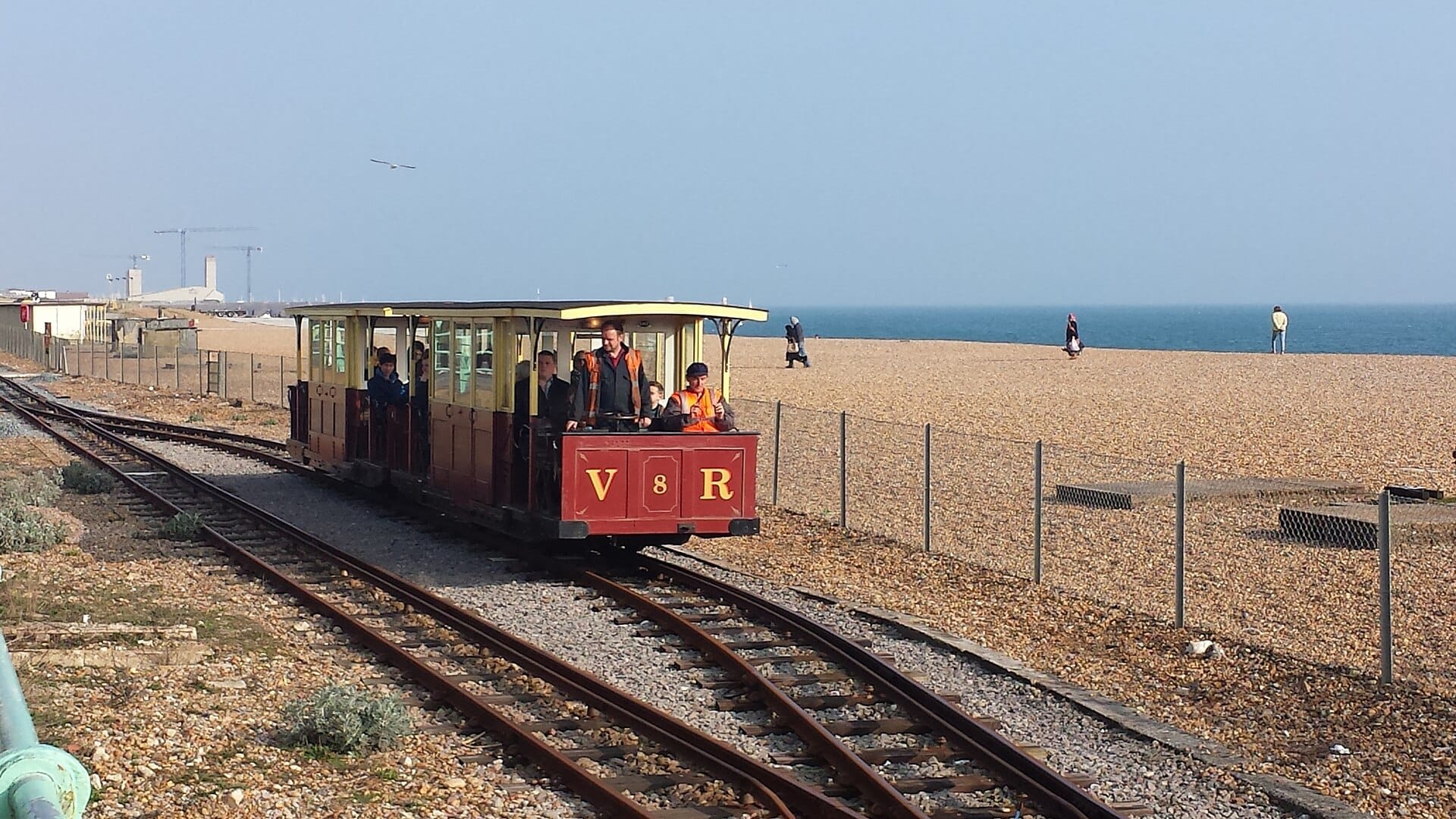
Volk's Electric Railway is not a fairground ride, not a tourist novelty bolted onto an existing attraction, and not a replica of something older. It is the real thing: a working narrow-gauge railway that has been carrying passengers along Brighton's seafront since 4 August 1883. That makes it the oldest operational electric railway anywhere in the world, a title it holds without serious challenge.
The line was built and opened by Magnus Volk, a Brighton-born engineer and inventor who had already installed electric lighting in his own home and in the Royal Pavilion before turning his attention to public transport. The original stretch ran just a quarter of a mile. It was extended over time to its current length of about one mile, running along Madeira Drive between Aquarium Station, close to the Palace Pier and Sea Life Centre, and Black Rock Station near Brighton Marina, with a Halfway Station in between.
The railway operates on a narrow gauge of 2 ft 8½ in (approximately 825 mm), on a single-track line with passing places, powered by an off-centre third rail. The carriages are small, open-sided in warmer configurations, and low to the ground. You sit close to the shingle and the sea wall, which gives the journey a scale and intimacy you do not get from a bus or a walk along the same route.
ℹ️ Good to know
The railway is seasonal and does not run year-round. It typically operates from around Easter to the end of September, with reduced days at the start and end of the season. Always check the official timetable at volksrailway.org.uk/visit/times-prices before visiting, as specific operating days and hours vary considerably by month.
The Journey: What You See and Feel
From Aquarium Station, the train pulls away with a gentle electric hum rather than the diesel clatter you might expect from a heritage railway. The sound is quietly mechanical, almost domestic, which adds to the sense that this is a working piece of infrastructure rather than a museum piece that has been dusted off for weekends.
To your right, the English Channel stretches out flat and grey-green or sparkling blue depending on the light and the season. To your left, the lower face of Madeira Drive runs alongside, with the old arches of the seafront infrastructure above. The journey moves east through a section of seafront that most visitors on foot rarely reach, giving you a perspective on the beach and the lower promenade that is genuinely different from the standard tourist circuit around the pier.
At Halfway Station you can disembark, cross to the beach, or simply stay on and continue to Black Rock. The full about-one-mile journey takes around twelve minutes each way at a leisurely pace. It is not fast. The appeal is not speed but the combination of the sea air, the low viewpoint, and the awareness that the track beneath you has been here for well over 140 years.
The seafront section the railway covers connects naturally to the broader Brighton seafront corridor. If you are planning a full day by the sea, the railway fits naturally into a loop: walk west along the promenade, ride back east on Volk's, or vice versa.
Tickets & tours
Live prices and dates from our booking partner. If you book, we may earn a commission at no extra cost to you.
Brighton city lights flight with welcome drink
From 21 €Instant confirmationCycle along the beachfront with Brighton Beach Bikes hire
From 7 €Instant confirmationFree cancellationTour Brighton's highlights with an exploration game mobile app
From 10 €Instant confirmationFree cancellationExplore Brighton self-guided walking tour using an app
From 11 €Instant confirmation
How the Experience Changes by Time of Day and Season
Morning departures, particularly on weekdays in spring and early summer, tend to be quieter. The light at that hour hits the water at a low angle and the beach is largely empty of the crowds that arrive by midday. If you want unobstructed photographs of the carriages against the sea, early morning is significantly better than the weekend afternoon rush.
By late morning in July and August, the railway attracts families with young children. The carriages fill up, there can be a short wait at Aquarium Station, and the atmosphere shifts toward cheerful chaos rather than quiet contemplation. This is not a criticism: the railway clearly works well as a family activity, and children are genuinely delighted by the small scale of the train and the sea right beside them. But if your priority is a peaceful, reflective journey, aim for a Tuesday or Wednesday morning in June rather than a Saturday afternoon in August.
By September the crowds thin noticeably and the light on the water turns amber and gold in the afternoons. The railway still operates through the month, though on reduced days, and this is arguably the most atmospheric time to ride it. The beach is quieter, the sea is calmer on average, and the seasonal feeling of an attraction winding down for the year gives the journey a reflective quality.
💡 Local tip
If you are visiting Brighton in summer and want to ride Volk's without queuing, aim for a weekday departure before 11am. The first trains of the day are consistently less busy than those running from midday onward.
Historical Context: Why This Railway Matters
Magnus Volk opened this railway four years before the London Underground got its first electric traction, and nearly two decades before electric trams became common across British cities. His line was a working demonstration that electric public transport was practical, safe, and commercially viable at a moment when most of the world was still sceptical. The fact that it has only closed for extended periods a handful of times in its history, including during World War II, for a Heritage Lottery-funded rebuild, and during the COVID-19 pandemic, is a measure of both its resilience and its continued relevance.
The railway is operated by Brighton and Hove City Council, which gives it a different status from a purely commercial heritage attraction. It sits in an interesting middle ground: a genuine piece of transport infrastructure with an unbroken operational history, run as a public service with heritage significance. That dual character is part of what makes it worth understanding rather than simply riding.
Volk's enthusiasm for electricity extended well beyond this railway. He installed electric lighting in the Royal Pavilion in the early 1880s, making it one of the first public buildings in Britain to be lit electrically. The railway was, in a sense, a logical next step from that work.
Practical Walkthrough: Getting There and Buying Tickets
Aquarium Station, the western terminus, sits on Madeira Drive near the Sea Life Brighton aquarium and the base of Brighton Palace Pier. From Brighton railway station, the most straightforward route is to walk south down Queens Road and then east along the seafront until you reach the pier, then continue a short distance further to the station entrance on Madeira Drive. The walk takes around 15 to 20 minutes depending on your pace.
Tickets are purchased at the station. You can buy a single to Black Rock, a return, or a single to Halfway Station if you want to use the railway as one leg of a walk. Fares are in pounds sterling and are updated seasonally, so check the official times and prices page before your visit rather than relying on figures you may have seen elsewhere. The railway accepts payment by card as well as cash.
⚠️ What to skip
The railway is seasonal and the operating schedule is not uniform across the season. In early spring and late September it runs on limited days only. Always verify the current timetable at volksrailway.org.uk before travelling, particularly outside the July to August peak period.
Volk's Railway sits in the middle of a well-connected seafront stretch. To the west, Brighton Palace Pier and Sea Life Brighton are within easy walking distance of Aquarium Station. To the east, the path beyond Black Rock leads toward the Undercliff Walk.
Photography and What to Bring
The carriages themselves are the main photographic subject, particularly at Aquarium Station where the old station infrastructure provides a period backdrop. Shooting from platform level keeps the sea in the background. If you want images of the train in motion along the seafront, position yourself at Halfway Station or along the Madeira Drive embankment before the train departs.
Because the carriages are open or semi-open to the sides, wind off the sea can feel sharp even on warm days. A light jacket is worth carrying regardless of the forecast. The beach and shingle are directly accessible from both Black Rock and Halfway stations if you want to combine the ride with time on the seafront.
For a broader picture of what to do around the seafront area, the Brighton Bandstand and the Kings Road Arches are both within the same seafront corridor and pair naturally with a Volk's ride as part of a longer day out.
Who Will Enjoy This Most, and Who Might Not
Families with young children consistently rate Volk's highly because the train is small, safe, and genuinely exciting for anyone under ten. The short journey length is an advantage here: you get the experience without the attention-span risk of a longer trip. History and transport enthusiasts will find the technical and historical significance rewarding and the original infrastructure worth examining closely.
Visitors looking for dramatic scenery or a long immersive journey will find the one-mile run modest. The ride does not take you to a destination with compelling attractions at the other end: Black Rock Station is near Brighton Marina, which has restaurants and a cinema but is not a major sightseeing draw in itself. If your time in Brighton is limited to a single day, Volk's is worth factoring in, but it works best as part of a seafront itinerary rather than as a standalone reason to visit that end of the beach.
Travellers with significant mobility limitations should contact the railway directly before visiting, as the boarding process involves low-to-ground carriages and the stations are on the lower seafront level. Specific step-free access details and boarding assistance options are best confirmed via the council or the railway contact email: volksbookings@brighton-hove.gov.uk.
If you are building a full Brighton itinerary, the Brighton day trip from London guide includes Volk's Railway in the context of a structured seafront route that covers the main attractions without backtracking.
Insider Tips
- Buy a single to Halfway Station rather than a return to the full terminus. From Halfway you can walk back along the beach at your own pace, which gives you more time on the shingle and a different perspective on the railway from ground level.
- The Aquarium Station building itself is worth a look before you board. The original station infrastructure includes period details that most passengers walk past without noticing. Arrive five minutes early and examine the platform area.
- On bright summer afternoons the sun is directly in front of westbound passengers returning from Black Rock. If glare is an issue for photography or comfort, ride east (toward Black Rock) in the afternoon and return on the outward journey in the morning.
- The railway attracts a significant number of repeat visitors who ride it every year as a seasonal ritual. If you get talking to regular passengers, they often have stories and historical detail about individual carriages that staff are also happy to discuss on quieter days.
- Group bookings and private hire enquiries can be made via volksbookings@brighton-hove.gov.uk. For school groups or large families wanting guaranteed seating on a specific departure, this is worth doing in advance during peak season.
Who Is Volks Electric Railway For?
- Families with young children looking for a safe, manageable seafront activity
- Transport and industrial heritage enthusiasts interested in the history of electrification
- Photographers wanting a low-angle, sea-level perspective on Brighton's seafront
- Visitors who want to reach the eastern end of the seafront without a long walk
- Travellers combining multiple seafront attractions into a single half-day circuit
Nearby Attractions
Other things to see while in Brighton Seafront:
- Brighton Bandstand
Standing on Brighton's Kings Road promenade since 1884, the Brighton Bandstand is a Grade II listed cast-iron landmark that hosts Sunday afternoon concerts through the summer months and often across a broader April–September season. Whether you catch a performance or simply stop to admire the ornate ironwork above the English Channel, it earns a place in any seafront walk.
- Brighton Beach
Brighton Beach stretches for miles along the English Channel, offering a free, accessible seaside experience unlike any sandy resort. Shingle underfoot, sea air, and the city right behind you — this is coastal England at its most characterful.
- Brighton Fishing Museum
Tucked inside the Kings Road Arches on Brighton seafront, the Brighton Fishing Museum is a small, free attraction that tells the story of the city's working fishing community with surprising depth. At its heart sits a 27-foot clinker-built punt boat, surrounded by old photographs, nets, and tools that bring the Fishing Quarter's heritage to life.
- Brighton i360
Standing 162 metres tall on Brighton's seafront, the i360 observation tower lifts a glass pod of up to 200 visitors to 138 metres above sea level for sweeping views of the English Channel, the South Downs, and the city below. Designed by the architects behind the London Eye, it opened in 2016 and is billed as Europe’s tallest moving observation platform.
Planning a trip? Discover personalized activities with the Nomado app.