Brighton Beach: What to Expect from England's Most Famous Pebble Shore
Brighton Beach stretches for miles along the English Channel, offering a free, accessible seaside experience unlike any sandy resort. Shingle underfoot, sea air, and the city right behind you — this is coastal England at its most characterful.
Quick Facts
- Location
- Brighton Seafront, Brighton BN2 1PS, UK — central seafront between the Palace Pier and West Pier ruins
- Getting There
- Brighton Railway Station (Southern/Thameslink); roughly 15–20 min walk downhill to the seafront. Local buses also connect the station to the seafront.
- Time Needed
- 1–4 hours depending on pace; a full afternoon is comfortable for a proper seafront walk plus beach time
- Cost
- Free to access. Paid services (deckchair hire, food, promenade attractions) are separate and vary by operator.
- Best for
- Coastal walks, people-watching, day trips from London, summer sunbathing, off-season atmosphere
- Official website
- www.visitbrighton.com
What Brighton Beach Actually Is
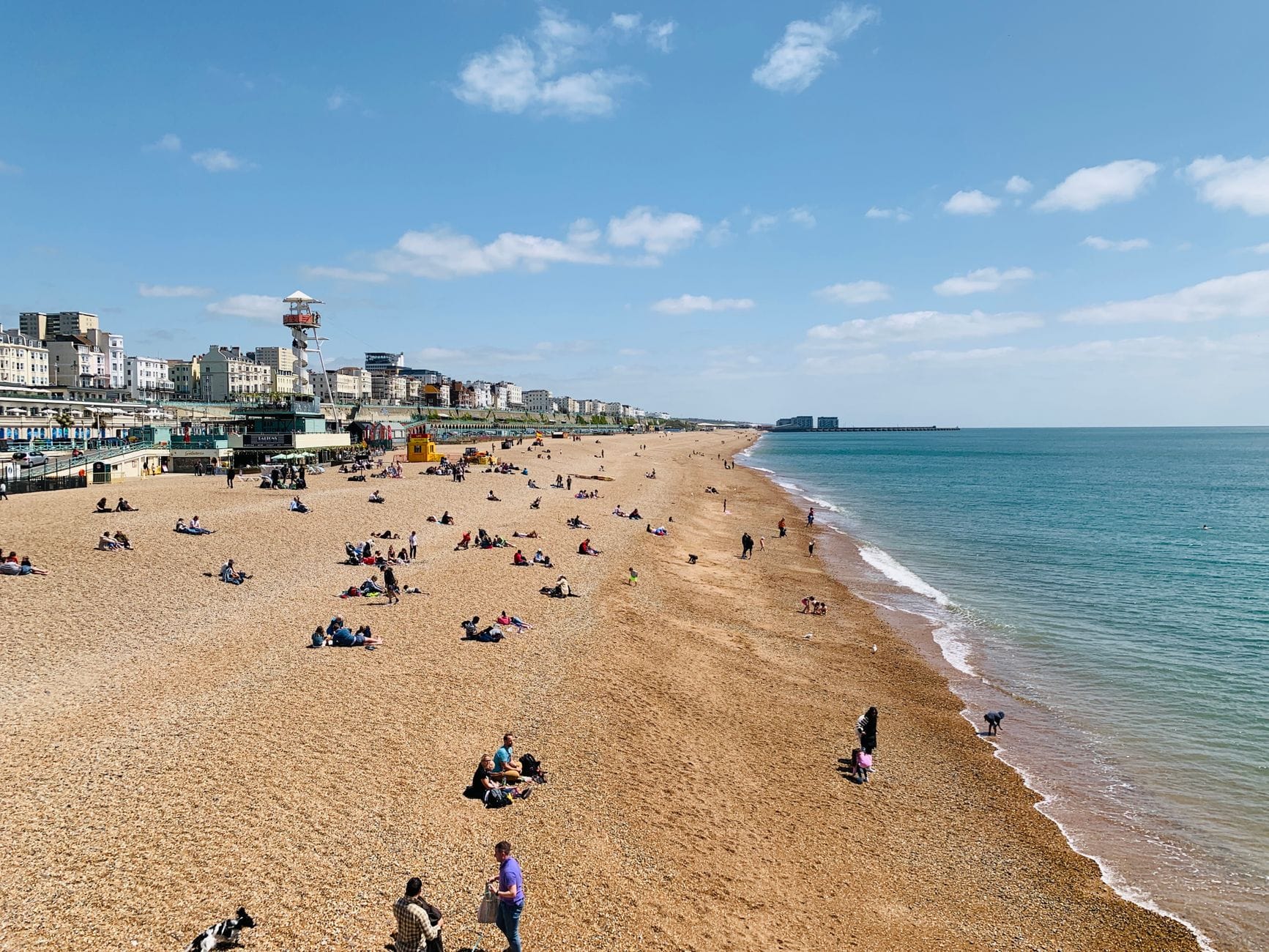
Brighton Beach is a public shingle beach running along the English Channel on the south coast of England, free to access and open around the clock, every day of the year. It forms the southern edge of the city of Brighton and Hove, a unitary authority roughly 80 km south of London in East Sussex. The beach extends approximately 5.4 miles (8.7 km) along the Brighton shingle frontage often cited locally, forming part of an unbroken coastal strip that runs westward toward Hove and beyond.
The first thing to understand is that there is no sand here. Brighton Beach is a pebble beach — shingle, to use the British term — composed of smooth, rounded stones derived from the chalk cliffs characteristic of this coastline. The pebbles are retained by a series of timber and concrete groynes running perpendicular to the shore, designed to slow coastal drift. This matters practically: you will want footwear you can slip off easily, and the uneven surface demands attention when walking toward the waterline.
💡 Local tip
Pack beach shoes or old trainers. Walking across shingle in bare feet is possible, but the stones shift underfoot and can be sharp in places, especially closer to the water's edge.
The Feel of the Place: Morning, Afternoon, and Evening
Early mornings on Brighton Beach are genuinely different from the midday experience. Before 9am in summer, the beach belongs mostly to swimmers, dog walkers (dogs are restricted to certain areas during summer months — check current local council signage), and people arriving for open-water swims. The light at this hour is low and diffuse, giving the water a grey-green tone, and the sound is mostly surf grinding the pebbles in a slow, repetitive rhythm. The smell is classic Channel coast: salt, seaweed, and faint diesel from the fishing boats that still operate from the shoreline.
By late morning on a warm day, the character shifts completely. Families spread towels and windbreaks across the upper beach; the promenade fills with cyclists, joggers, and people pushing buggies. The arches beneath Kings Road — a Victorian subterranean infrastructure running behind the upper beach — begin to hum with activity as cafes, restaurants, and bars open their shutters. The scent of coffee and fried food drifts down toward the shoreline. In July and August, the noise level rises significantly: the jingle of the Palace Pier rides, the crash of waves, and the overlapping conversations of a crowd that can number in the thousands on a hot weekend.
Evenings, particularly in spring and autumn, offer some of the most photogenic conditions. The setting sun drops behind the West Pier ruins to the west, casting long shadows across the shingle and turning the sea copper. By 7pm on a mid-September evening the crowds have thinned, small groups cluster around portable speakers near the water, and the temperature drops fast — a reminder that this is southern England, not southern Europe. Bring a layer.
Tickets & tours
Hand-picked options from our booking partner. Prices are indicative; availability and final rates are confirmed when you complete your booking.
Brighton city lights flight with welcome drink
From 21 €Instant confirmationCycle along the beachfront with Brighton Beach Bikes hire
From 7 €Instant confirmationFree cancellationTour Brighton's highlights with an exploration game mobile app
From 10 €Instant confirmationFree cancellationExplore Brighton self-guided walking tour using an app
From 11 €Instant confirmation
History and How the Resort Came to Be
Brighton's transformation from a small fishing settlement called Brighthelmstone into a major seaside resort unfolded across the 18th century. The catalyst was a combination of physician-promoted sea bathing as a health cure and the patronage of George, Prince of Wales, who first visited in 1783 and later commissioned the Royal Pavilion — his fantastical seaside pleasure palace just a few hundred metres from the shore. The arrival of the railway from London in 1841 democratised access overnight, bringing working-class day-trippers in numbers the town's Georgian development had never anticipated.
That Victorian mass tourism created the physical framework still visible today: the two piers (one of which, the West Pier, is now a skeletal ruin), the ornate seafront terraces, the arched storage vaults beneath Kings Road (now known as Kings Road Arches), and the network of beach groynes. Brighton Palace Pier, which opened to the public in 1899, is the most intact survivor of that era and remains the dominant structure on the eastern beach.
The West Pier, by contrast, opened in 1866 and closed in 1975 after decades of decline. A series of fires in 2003 reduced it to the skeletal ironwork frame visible today, standing offshore as a kind of accidental sculpture. The West Pier ruins are a distinctive part of the Brighton Beach visual experience and worth understanding in context before you visit — many first-time visitors mistake them for a construction site.
Navigating the Beach: A Practical Walkthrough
The beach is broadly divided into an upper shingle section and a lower section closer to the waterline. The upper beach, near the promenade wall, is the most sheltered and where most people set up for the day. Sun loungers and deckchairs are available for hire from private operators along the seafront during summer months (prices vary by operator — verify current rates on arrival). The lower beach closer to the water is narrower and more exposed to wind and wave spray.
The central section of beach, between the Brighton i360 observation tower to the west and the Palace Pier to the east, is the busiest stretch. The area immediately beneath and around Brighton Palace Pier draws the densest crowds in summer, particularly families with children. If you want quieter shingle, walk east past the pier toward the Kemptown end, or west toward Hove, where the beach gradually becomes less packed and the promenade atmosphere calmer.
The promenade above the beach is a wide, flat pathway running the full length of the seafront, shared between pedestrians and cyclists. It connects to the Undercliff Walk to the east, which continues along the base of the chalk cliffs toward Saltdean — a genuinely rewarding extension for anyone who wants to escape the central seafront entirely. The Volks Electric Railway, the world's oldest operating electric railway, runs along the seafront from the Aquarium station near the Palace Pier eastward to Black Rock, and is worth a short ride for the novelty and the seafront views.
ℹ️ Good to know
The beach is publicly owned and access is free at all points. There is no designated 'entrance' — you can step down from the promenade to the shingle at multiple access points along the seafront. Beach huts and certain private operator areas are demarcated, but the general beach is fully public.
Swimming, Water Quality, and Weather Realities
People do swim at Brighton Beach, though the water temperature makes casual dipping a shorter-lived pleasure than it might appear. The English Channel off Brighton is cold by Mediterranean standards: sea temperatures typically range from around 7–9°C in late winter to a peak of roughly 17–20°C in August. The summer peak is comfortable for a confident swimmer prepared for the initial shock; outside June to September, sea swimming is the domain of wetsuits or the genuinely hardy.
Water quality at Brighton's main bathing area is monitored by the Environment Agency under UK bathing water regulations; current classification data is published on the Environment Agency's website and should be checked before visiting, as quality designations are updated following each bathing season. The beach can be affected by urban runoff after heavy rainfall, which may temporarily reduce water quality at specific points.
Wind is a constant factor at Brighton Beach and can significantly change the experience even in summer. The prevailing south-westerly winds mean that a warm, sunny day can still feel sharp near the waterline. Windbreaks — available to hire from some seafront operators — are a genuinely practical purchase rather than a novelty. In winter, the beach takes on a completely different atmosphere: dramatic grey skies, strong swell, and waves that make serious noise as they drag back across the pebbles. Off-season visits are entirely worthwhile for anyone who prefers coastal atmosphere to beach leisure.
⚠️ What to skip
Brighton Beach has seasonal lifeguard cover on the main bathing areas during the summer months, but outside that period swimmers should be aware of conditions, particularly wave height and current, and exercise appropriate caution. Check local signage on arrival.
Getting There, Getting Around, and Accessibility
Brighton Railway Station is the main arrival point for visitors from London and is served by Southern and Thameslink, with trains departing frequently from London Victoria, London Bridge, and St Pancras International. Journey time from central London is typically around one hour. Advance tickets are cheaper than walk-up fares; check National Rail for current pricing before travel. From the station, the seafront is roughly a 15–20 minute walk downhill through the city centre, passing through the main shopping area.
Local bus services run by Brighton & Hove Buses cover routes connecting the station area to various points on the seafront. Uber and Bolt both operate in Brighton for those preferring a direct transfer. If arriving by car, note that seafront parking is limited and expensive in summer; park-and-ride and city centre car parks are the more practical option. For planning around the broader city, the getting around Brighton guide covers your options in full.
Accessibility on the beach itself is limited by the shingle surface. The promenade above the beach is flat and paved, suitable for wheelchairs and pushchairs. The transition from promenade to beach involves steps or sloped access points, and the pebble surface is uneven and difficult to navigate in a wheelchair without assistance. Brighton and Hove City Council provides information on beach accessibility facilities; visitors with specific mobility requirements should consult the council's website for current details on access points and any beach wheelchair availability.
Photography Conditions and Practicalities
The best light for photography falls in the hour after sunrise and the hour before sunset, when the low angle catches the texture of the pebbles and creates long shadows from the groynes. The West Pier ruins photograph best from the west at golden hour, silhouetted against the sky. The Palace Pier is most dramatic from the beach level to the east, looking west along the full length of the structure. Overcast days actually produce good conditions for detail shots of the shingle itself, as the diffuse light eliminates harsh reflections.
In summer, avoid shooting the central beach between 11am and 3pm unless crowds and sun umbrellas are what you want in frame. The i360 observation tower provides an elevated perspective over the full seafront panorama; that view is worth considering if aerial composition is your goal.
Insider Tips
- Walk west past the i360 toward Hove on a summer weekend afternoon. Within ten minutes the crowd density drops noticeably, the beach widens, and you gain more room without sacrificing any of the seafront atmosphere.
- The arches along Kings Road contain some of the best seafood options on the seafront, tucked behind unpretentious shopfronts. Skip the large, banner-fronted restaurants directly facing the beach and look for smaller operations inside the arches themselves.
- If you are visiting in winter, the beach after a storm is worth a specific visit: the swell height and the sound of waves pulling back across several metres of shingle is unlike anything the summer beach offers. Dress for serious wind.
- The section of beach directly below the Bandstand, between the West Pier and the i360, is a slightly quieter pocket in summer compared to the Palace Pier area, and offers clear sightlines to both landmark structures in a single frame.
- Train ticket prices from London fluctuate significantly by departure time and how far in advance you book. Travelling off-peak on a Thursday or Friday often yields meaningfully cheaper fares than weekend travel — worth planning around if cost matters.
Who Is Brighton Beach For?
- Day-trippers from London looking for a classic English seaside experience within easy train distance
- Walkers who want a long, flat coastal route with architecture, food, and points of interest at regular intervals
- Photographers attracted to the combination of Victorian infrastructure, coastal light, and textured shingle
- Visitors who enjoy off-season travel and want dramatic coastal atmosphere without summer crowds
- Families comfortable with a non-sandy beach who want free outdoor space close to paid attractions
Nearby Attractions
Other things to see while in Brighton Seafront:
- Brighton Bandstand
Standing on Brighton's Kings Road promenade since 1884, the Brighton Bandstand is a Grade II listed cast-iron landmark that hosts Sunday afternoon concerts through the summer months and often across a broader April–September season. Whether you catch a performance or simply stop to admire the ornate ironwork above the English Channel, it earns a place in any seafront walk.
- Brighton Fishing Museum
Tucked inside the Kings Road Arches on Brighton seafront, the Brighton Fishing Museum is a small, free attraction that tells the story of the city's working fishing community with surprising depth. At its heart sits a 27-foot clinker-built punt boat, surrounded by old photographs, nets, and tools that bring the Fishing Quarter's heritage to life.
- Brighton i360
Standing 162 metres tall on Brighton's seafront, the i360 observation tower lifts a glass pod of up to 200 visitors to 138 metres above sea level for sweeping views of the English Channel, the South Downs, and the city below. Designed by the architects behind the London Eye, it opened in 2016 and is billed as Europe’s tallest moving observation platform.
- Brighton Palace Pier
Standing 525 metres into the English Channel since 20 May 1899, Brighton Palace Pier is the last of Brighton's three historic piers still operating. Entry is free outside the seasonal admission period, but the experience varies enormously depending on when you visit and what you're looking for.