Brighton i360: What It's Really Like to Ride the Seafront's Sky Pod
Standing 162 metres tall on Brighton's seafront, the i360 observation tower lifts a glass pod of up to 200 visitors to 138 metres above sea level for sweeping views of the English Channel, the South Downs, and the city below. Designed by the architects behind the London Eye, it opened in 2016 and is billed as Europe’s tallest moving observation platform.
Quick Facts
- Location
- Lower Kings Road, Brighton, BN1 2LN (Brighton Seafront)
- Getting There
- Approx. 20-min walk or 15-min bus ride from Brighton Railway Station
- Time Needed
- 1 to 1.5 hours including queuing and the ~25-minute flight
- Cost
- Paid admission; prices vary by date and experience type. Check brightoni360.co.uk for current fares
- Best for
- Clear-day views, sunset flights, families, and architecture enthusiasts
- Official website
- www.brightoni360.co.uk
What the Brighton i360 Actually Is
The Brighton i360 is a vertical observation tower on the seafront, rising 162 metres from the beach at Lower Kings Road. A doughnut-shaped glass pod travels slowly up and down the central mast, carrying up to 200 passengers at a time to a viewing height of approximately 138 metres. Each ascent lasts around 25 minutes from ground to top to ground. That is the entire experience in mechanical terms.
The tower was designed by Marks Barfield Architects, the same practice responsible for the London Eye, and opened on 4 August 2016. It cost around £46 million to build and is promoted as Europe’s tallest moving observation platform. It was branded 'British Airways i360' from opening until the airline sponsorship ended in 2022, when it reverted to its simpler name.
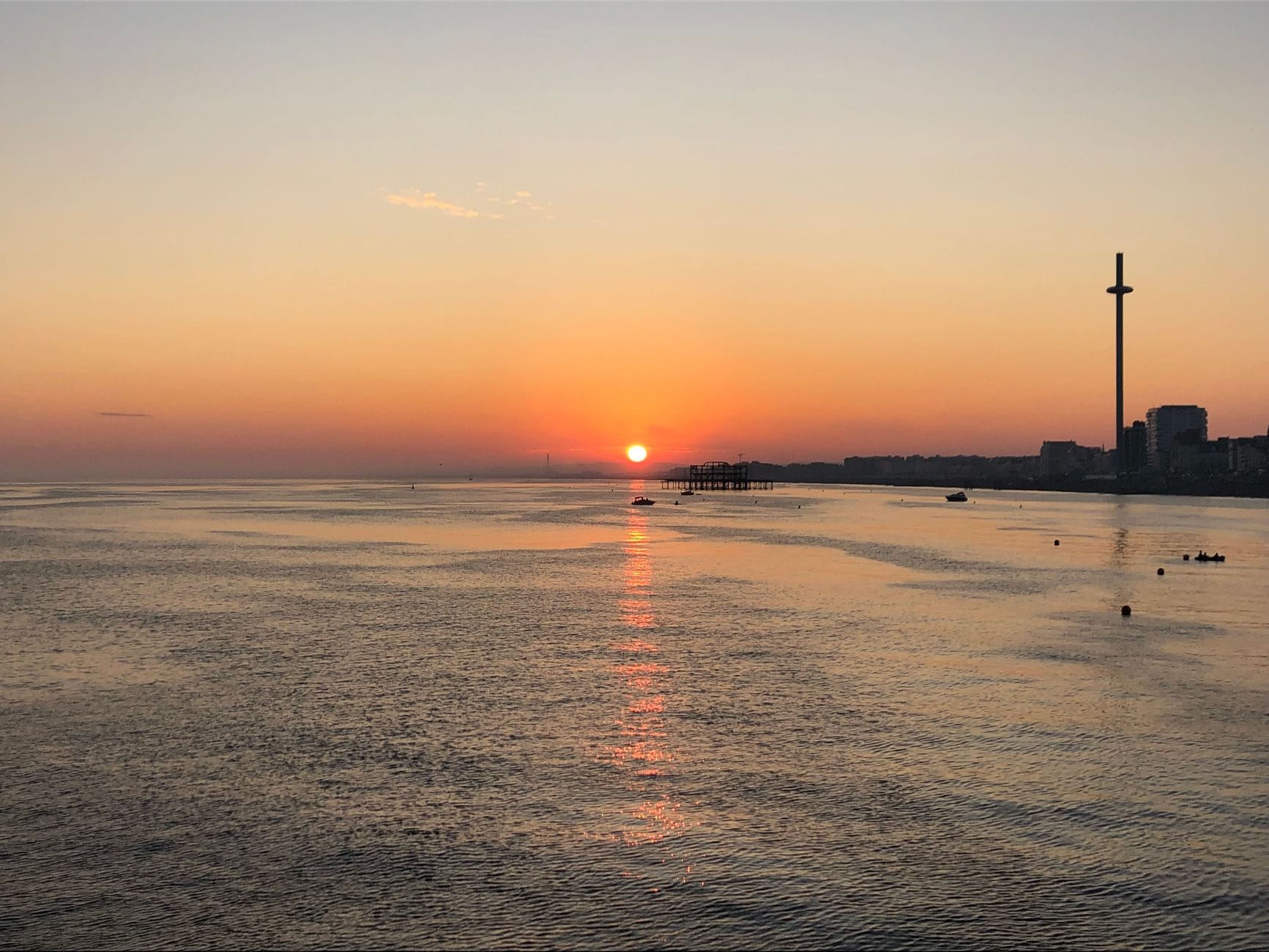
Architecturally, the structure is deliberately slender, a single white mast planted directly beside the skeletal remains of the West Pier ruins. The pairing is striking: one structure a burnt and collapsed relic of Victorian leisure, the other a precision-engineered piece of 21st-century engineering. Looking out from the pod, that contrast directly below you is one of the more memorable sights on the Brighton seafront.
💡 Local tip
Book tickets in advance on the official website. Walk-up tickets are available but flights can sell out on weekends and school holidays, particularly in July and August.
The View: What You Can and Cannot See
On a clear day, the view from 138 metres is genuinely impressive. The English Channel spreads south without interruption. To the north, the chalk escarpment of the South Downs rises above the city, and on the clearest days you can trace the ridge line east toward the Seven Sisters cliffs. The city itself fans out below in a readable way: the Royal Pavilion's onion domes, the two piers, the railway line cutting inland, the dense Victorian grid of terraces.
Visibility, however, is entirely weather-dependent. Brighton's coastal climate means sea haze and low cloud are common, particularly in spring and early summer. On a hazy day, the Channel and the South Downs can both disappear into grey-white flatness, and the experience shrinks considerably. The attraction does not offer refunds for poor visibility, so checking the forecast before booking a specific flight time matters more here than at most attractions.
The pod is fully enclosed in glass and climate-controlled. There is no open-air observation deck, which removes the direct sensory connection to wind and altitude that some visitors expect from a viewpoint. The glass is angled slightly outward at the base to allow downward views, but photography through glass always introduces some reflection, especially at night.
⚠️ What to skip
If visibility is below average when you arrive, ask staff honestly whether the view is currently good. There is no shame in rescheduling your flight to a different time slot if the horizon has disappeared into haze.
Tickets & tours
Live prices and dates from our booking partner. If you book, we may earn a commission at no extra cost to you.
Brighton city lights flight with welcome drink
From 21 €Instant confirmationCity Sightseeing hop-on hop-off bus tour of Brighton
From 20 €Instant confirmationFree cancellationCity Sightseeing hop-on hop-off bus tour of Brighton
From 28 €Instant confirmationFree cancellationGLOBALLS ticket with your choice of mini golf course or Carnival Games
From 13 €Instant confirmationFree cancellation
Time of Day: How the Experience Changes
Morning flights on weekdays (from 10:30) are the quietest. The light is clean and directional, casting shadows across the rooftops that make the city's street pattern legible. The seafront below is calm: dog walkers, a few joggers, early-opening cafes. If your priority is photography with good contrast and minimal crowd noise in the pod, a Tuesday or Wednesday morning in spring or autumn is the best combination.
Sunset flights are the most popular booking, and for obvious reasons. When conditions cooperate, the western sky turns coral behind Hove, the West Pier skeleton goes dark against the light, and the whole seafront catches the last hour of sun. These flights sell out earliest. Book at least a few days ahead in summer, longer if visiting during peak school holidays in late July and August.
Evening flights after sunset offer a different experience: the city lights grid out below, the pier illuminations glow, and the pod itself is lit from inside, which turns the glass into a partial mirror. The views are atmospheric but less informative. Some visitors find this the more romantic option; photographers find the reflections frustrating.
Inside the Pod: What the ~25 Minutes Actually Feels Like
The ascent is slow and smooth. There is no sensation of speed. You hear the mechanical hum of the pod's drive system, low and constant, and the murmur of other passengers. The pod holds up to 200 people but the space feels open rather than cramped when it is not at capacity. There is a bar inside, serving drinks throughout the flight.
At the top, the pod pauses briefly before descending. Staff are present throughout. The full cycle, ground to top to ground, takes roughly 25 minutes, which is enough time to work around the full 360-degree circumference and take in each direction properly without feeling rushed. Children generally find the motion interesting rather than frightening. There is nothing sharp or sudden about the ride.
One practical note on photography: bring a lens cloth. The interior glass picks up fingerprints and, in cold weather, condensation around the edges. Shooting perpendicular to the glass and avoiding the flash entirely gives the cleanest results. Smartphones work well here given the wide angles involved.
Getting There and Practical Planning
The i360 sits at Lower Kings Road on the seafront, at the western end of the central beach area. From Brighton Railway Station, you can walk along Western Road and down to the seafront in around 20 minutes, or catch a seafront bus in approximately 15 minutes. There is no dedicated car park at the tower; the closest parking is at the seafront pay-and-display bays, which fill quickly on summer weekends.
The seafront location means the i360 fits naturally into a broader day on the beach. Brighton Beach is directly in front of the tower, and the Brighton Palace Pier is a short walk east. The Kings Road Arches, a run of seafront units under the promenade, are immediately beside the tower base.
Opening hours for 2026 run from 8 March to 31 December 2026. Monday to Friday the tower opens at 10:30 and closes at 21:00. Saturday and Sunday it opens at 10:00 and closes at 21:00. These hours are seasonal and should be verified on the official site before visiting, as they are subject to change.
ℹ️ Good to know
A free companion ticket is available for guests with a disability. The pod is fully wheelchair accessible. Contact the i360 directly before your visit to confirm specific requirements and arrange any additional support.
Context: Why It Was Built Here
The i360's location is not arbitrary. It stands at the shore end of what was once the West Pier, Brighton's second pleasure pier, which opened in 1866 and was considered one of the finest examples of Victorian seaside engineering in England. The West Pier closed in 1975, was damaged by storms, and suffered two fires in 2003. What remains are the iron skeleton structures visible in the sea, now protected as a listed structure. The West Pier ruins have become an accidental landmark of a different kind: a roosting site for murmurations of starlings in autumn and winter, and a constant reminder of how quickly Victorian ambition can dissolve.
The i360 was partly conceived as a means of regenerating this stretch of seafront and acknowledging the pier's legacy. The project used steel sections from the old pier's structure during construction. Whether you find this meaningful or merely symbolic is a matter of perspective, but it gives the tower a layer of local history that a purely commercial viewing attraction would lack.
Brighton's seafront has always been a place of spectacle, from Regency bathing machines to the fairground excess of the Palace Pier. The i360 fits that tradition more comfortably than it might first appear. For the architectural context of the wider city, the Regency architecture guide covers how Brighton's built environment developed from the late 18th century onward.
Is It Worth the Ticket Price?
That depends on what you are comparing it to. The i360 is not the cheapest attraction in Brighton. If you visit on a clear day with good visibility, the view is excellent and the experience is smooth and well-run. If you visit on a hazy day expecting drama and get a grey smear in every direction, you will feel short-changed regardless of how well the pod itself functions.
The ~25-minute flight is also genuinely brief. Some visitors expect a lingering experience and are surprised by how quickly it is over. There is no option to stay up longer or take a second pass. You get one circuit at the top and come back down.
For visitors on a tight budget, Brighton offers plenty of free viewpoints and coastal walks that deliver outdoor scale without a ticket cost. The Undercliff Walk east of Brighton gives seafront perspective at ground level, and the South Downs above the city offer panoramic views of a different kind. If you want the i360 specifically for the vertical perspective and the architecture of it, it delivers. If you are on the fence, honest weather forecasting should be the deciding factor on the day.
Insider Tips
- The bar inside the pod serves drinks throughout the flight. If you are visiting at sunset, ordering before you ascend means you are not queuing while the best light is happening outside.
- Starling murmurations gather around the West Pier ruins below the tower from October through February, typically at dusk. If you time a late-afternoon winter flight correctly, you may see the murmuration from above, an unusual and striking angle on a well-known Brighton phenomenon.
- The pod's glass curves slightly inward at the top and outward at the base. The clearest downward views, useful for photographing the pier and beach directly below, come from positioning yourself at the lower section of the glass wall rather than standing at eye level.
- Weekday morning flights from opening time are the least crowded. If you want space to move freely around the full 360 degrees without other passengers in your sightlines, Monday to Wednesday before noon in the shoulder season (April to June, September to October) gives the best combination of weather and low crowds.
- The tower is visible from much of the seafront and from the South Downs above the city. If you are taking landscape photographs of Brighton from the hills or from the beach, the i360 mast is a useful compositional anchor and appears in roughly half of all wide seafront shots.
Who Is Brighton i360 For?
- First-time visitors to Brighton who want a quick geographic orientation of the city and coastline
- Families with children who want a smooth, accessible, and contained experience with broad visual interest
- Photographers targeting clear-day or sunset coastal panoramas
- Architecture and engineering enthusiasts interested in the Marks Barfield design legacy
- Visitors who want to see the West Pier ruins and starling murmurations from an elevated angle
Nearby Attractions
Other things to see while in Brighton Seafront:
- Brighton Bandstand
Standing on Brighton's Kings Road promenade since 1884, the Brighton Bandstand is a Grade II listed cast-iron landmark that hosts Sunday afternoon concerts through the summer months and often across a broader April–September season. Whether you catch a performance or simply stop to admire the ornate ironwork above the English Channel, it earns a place in any seafront walk.
- Brighton Beach
Brighton Beach stretches for miles along the English Channel, offering a free, accessible seaside experience unlike any sandy resort. Shingle underfoot, sea air, and the city right behind you — this is coastal England at its most characterful.
- Brighton Fishing Museum
Tucked inside the Kings Road Arches on Brighton seafront, the Brighton Fishing Museum is a small, free attraction that tells the story of the city's working fishing community with surprising depth. At its heart sits a 27-foot clinker-built punt boat, surrounded by old photographs, nets, and tools that bring the Fishing Quarter's heritage to life.
- Brighton Palace Pier
Standing 525 metres into the English Channel since 20 May 1899, Brighton Palace Pier is the last of Brighton's three historic piers still operating. Entry is free outside the seasonal admission period, but the experience varies enormously depending on when you visit and what you're looking for.
Planning a trip? Discover personalized activities with the Nomado app.