West Pier Ruins: Brighton's Most Haunting Landmark
The West Pier Ruins are the skeletal remains of what was once Brighton's grandest pleasure pier. Closed since 1975, ravaged by storms and fires in 2003, and now standing offshore as a Grade I listed ruin, the structure is viewed from the Kings Road promenade and beach. Few sights on the south coast are quite as atmospheric.
Quick Facts
- Location
- Kings Road, Brighton BN1 2FL, on the seafront near Brighton i360
- Getting There
- 10–15 min walk from Brighton railway station via Queens Road; local buses run along Kings Road (check Brighton & Hove Buses for current routes)
- Time Needed
- 20–45 minutes to walk around, photograph, and take it in properly
- Cost
- Free — the ruins are viewed from the public promenade and beach
- Best for
- Photography, architecture enthusiasts, history lovers, and anyone curious about Brighton's past
- Official website
- www.westpier.co.uk
What the West Pier Ruins Actually Are
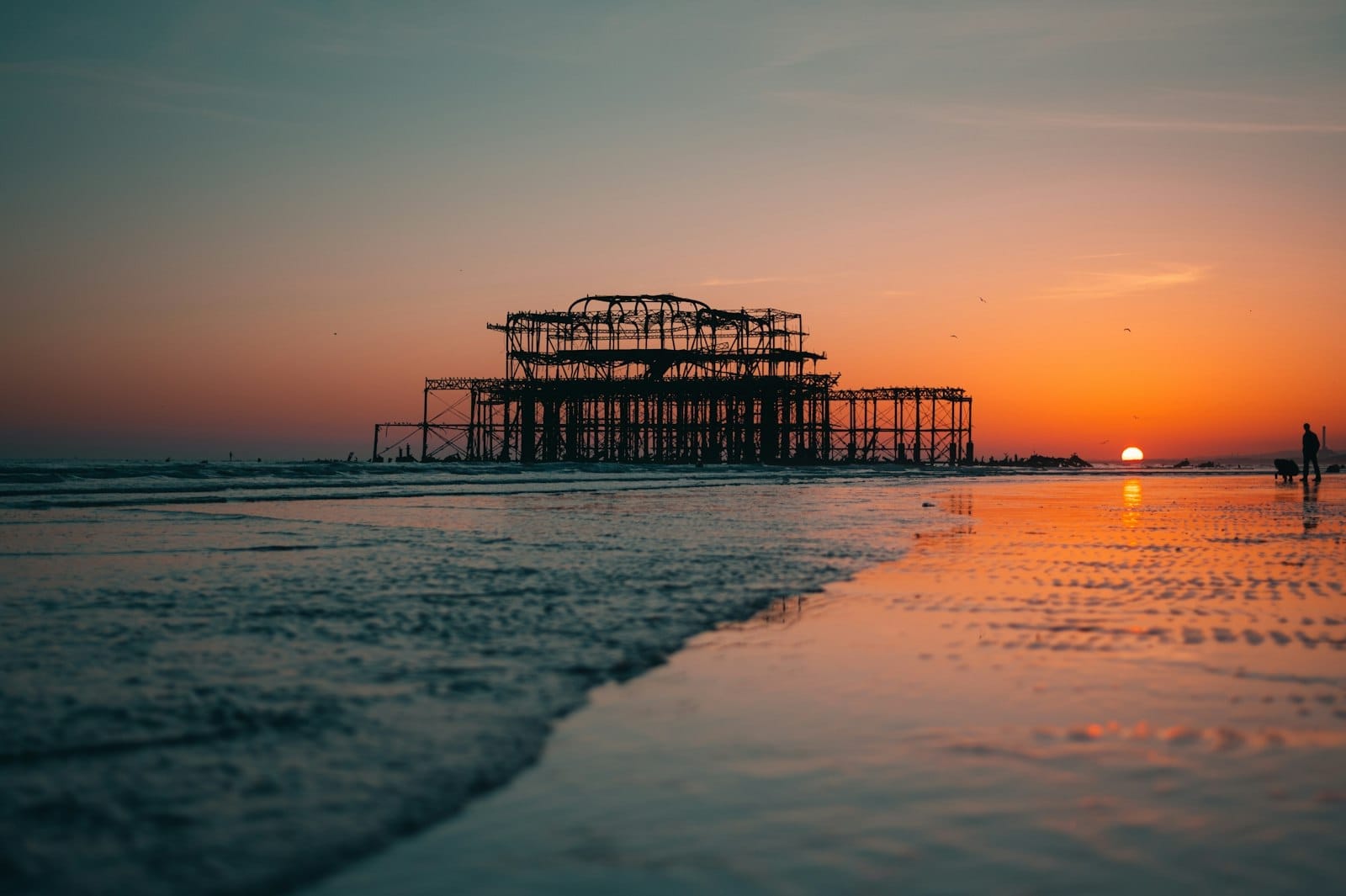
The West Pier Ruins are the remains of the West Pier, Brighton, a Victorian pleasure pier designed by the celebrated pier engineer Eugenius Birch and opened on 6 October 1866. At its peak it stretched over 1,115 feet (340 metres) into the English Channel, with a concert hall and ornate pavilions drawing hundreds of thousands of visitors a year. Today the structure stands offshore as a blackened iron skeleton, inaccessible and in a state of active collapse, visible from the promenade at any hour.
It holds an unusual distinction: the West Pier was the first pier in England to receive a Grade I listing from Historic England, making it the country's most legally protected pier category. That listing survived everything — closure, storms, arson — and remains in place today over a ruin that can no longer be entered. The gap between its legal status and its physical condition is part of what makes it such a striking subject.
ℹ️ Good to know
The offshore structure is dangerous and must not be approached. Sections continue to fall. All viewing is done from the promenade or beach, which is free and open at any time.
A Short History of Rise and Ruin
When it opened in 1866, the West Pier was considered a more refined alternative to Brighton's existing Chain Pier, drawing a wealthier seaside clientele. It was extended and improved through the late Victorian and Edwardian periods, eventually hosting concerts, variety performances, and a substantial concert hall added in 1916. At its commercial height in the early twentieth century, it attracted close to two million visitors a year.
Decline came gradually. The pier closed to the public in 1975 due to structural deterioration and ongoing maintenance costs that no owner could sustain. Restoration campaigns ran for decades, hampered by funding shortfalls, legal disputes, and bureaucratic delays. Then in 2003, two separate fires in January and March destroyed what remained of the buildings on the pier head, leaving only the cast-iron framework you see today.
The West Pier Trust continues to manage the site, operate a small interpretation centre on the seafront (open Friday to Monday, typically 12:00–15:00, though hours can vary with weather), and advocate for the pier's legacy. For context on how this history fits into Brighton's broader architectural story, the Brighton Regency architecture guide covers the city's Victorian and Edwardian building heritage in more depth.
Tickets & tours
Hand-picked options from our booking partner. Prices are indicative; availability and final rates are confirmed when you complete your booking.
Brighton city lights flight with welcome drink
From 21 €Instant confirmationCycle along the beachfront with Brighton Beach Bikes hire
From 7 €Instant confirmationFree cancellationTour Brighton's highlights with an exploration game mobile app
From 10 €Instant confirmationFree cancellationExplore Brighton self-guided walking tour using an app
From 11 €Instant confirmation
What You See From the Promenade
Standing on Kings Road, the ruins present as a series of corroded iron columns rising from the sea, connected by latticed ironwork that has lost all its original cladding and ornamentation. Sections lean at different angles. The outline of the old concert hall platform is still legible from certain angles, but only just. What reads as chaotic up close becomes something close to elegant at distance, especially when silhouetted against a bright sky or a sunset.
In the morning, particularly in autumn and winter, the ruin often appears against a pale grey sky with mist over the water, which gives it a quality that feels more Northern European than English seaside. At that hour the promenade is quiet, and the only sounds are typically the waves on the shingle and the occasional call of a gull. By mid-morning on a summer weekend, the same spot is crowded with people photographing it from the beach below the promenade wall.
One of the genuinely spectacular things to observe here, and something that occurs seasonally, is the murmuration of starlings that roost on the pier's ironwork between autumn and early spring. Thousands of birds wheel over the sea in tight, shifting formations before settling on the structure at dusk. The timing varies, but on evenings when conditions are right, crowds gather on the promenade specifically to watch. It is one of the more extraordinary free spectacles Brighton offers.
💡 Local tip
For starling murmurations, arrive at the seafront roughly 30 minutes before sunset between October and February. The display typically lasts 15–30 minutes and does not happen every evening — calm, dry evenings produce the most reliable gatherings.
How the Experience Changes by Time of Day and Season
Early morning, before 9am, is the least crowded time to view the ruins. The light from the east catches the ironwork at a low angle, and the beach is mostly empty. Photographers who want the structure without figures in the frame, or who want to hear the sea clearly, should aim for this window. In winter this can mean arriving in the dark or near-dark, which produces its own kind of atmosphere.
Midday in summer is the worst time to come if you are sensitive to crowds. The promenade between Brighton Palace Pier and the i360 is one of the busiest stretches of seafront in the city, and the beach immediately west of the pier bandstand fills quickly. The ruins are still there to photograph, but the visual clutter of beach furniture, ice cream stalls, and large groups makes it harder to compose a clean shot.
Sunset from October to April is the specific window worth planning around if you are in Brighton for a short stay. The sun sets roughly to the west-southwest in those months, which means it dips toward and sometimes behind the ruins as seen from the promenade. Combined with a possible murmuration, this is when the West Pier most rewards an extended stop.
Weather affects the experience significantly. On clear days the structure reflects brightly in wet sand at low tide. On overcast days it reads as a dark, brooding outline against flat grey water. Rain is not a reason to avoid it — the promenade can be walked in almost any weather — but strong winds off the Channel make standing still for photographs difficult. The best time to visit Brighton guide covers seasonal conditions for the city as a whole.
Photography: Practical Notes
The West Pier Ruins photograph well from several positions. The promenade level gives a direct, eye-height view that emphasises the skeletal ironwork against the sky. The beach below the promenade wall allows a lower angle, with the possibility of foreground interest from the shingle and wet-sand reflections at low tide. The approach from the i360 footbridge gives a slightly elevated position and a wider context shot that includes the structure and the sea beyond.
A longer focal length (85mm or above on a full-frame equivalent) compresses the distance and isolates the structure from its surroundings more effectively than a wide lens. At dusk and during murmurations, a faster shutter speed (at least 1/500s for the birds) is useful, which typically means raising ISO if you are shooting in low light. The structure itself does not move, so longer exposures work well for the ruins alone.
⚠️ What to skip
Do not attempt to walk or swim out to the pier. Beyond the obvious physical danger of a collapsing iron structure in open water, the West Pier Trust actively manages the site and warns the public against any approach to the structure itself.
Getting There and Getting Around
Brighton railway station is the most practical arrival point. From the station, Queens Road leads directly south to the seafront clock tower, from which a right turn onto Kings Road (heading west) brings you to the ruins in about ten minutes of walking along the promenade. Total walking time from the station is typically 10 to 15 minutes at a relaxed pace.
Local Brighton and Hove buses run along Western Road and Kings Road. The stop closest to the ruins is near the Brighton i360, which sits immediately adjacent on the seafront. Check Brighton and Hove Buses for current route numbers and timetables before travelling, as services change.
The promenade itself is fully step-free and wide enough for wheelchairs and mobility scooters. Beach access involves descending ramps or steps to shingle, which is uneven and slopes toward the water. The Brighton i360 observation tower is immediately next to the ruins and can be combined in the same visit. The nearby Brighton Bandstand is a short walk east along the seafront.
Who Should Temper Their Expectations
The West Pier Ruins are a ruin. There is no visitor experience in the conventional sense: no entrance, no exhibits, no guided tour, no shelter. If you are visiting Brighton primarily for indoor activities or are not interested in architecture and history for their own sake, the ruins may hold your attention for only a few minutes before you move on. That is entirely reasonable.
Families with young children may find that the novelty wears off quickly, particularly if the weather is cold or windy. The beach nearby is accessible and popular in summer, which provides a natural extension to a short stop here, but the ruins themselves offer nothing interactive for children.
Those expecting a walkable pier in the style of the Brighton Palace Pier will find something entirely different here. The West Pier cannot be entered, touched, or even approached from the water. Its value is visual and historical, not experiential in an amusement sense.
Insider Tips
- If you want a murmuration, aim for a calm, dry evening in November or December around 20–30 minutes before sunset. Check local wildlife or birdwatching social media on the day — residents often post whether a murmuration is forming that evening.
- The beach directly below the ruins at low tide produces reflective wet-sand surfaces that make for unusually clean long-exposure photographs of the structure, particularly in the hour after sunrise.
- The West Pier Centre interpretation space on the seafront (typically open Friday to Monday, 12:00–15:00) contains historical photographs and information about the pier's history. It is small, free, and worth five minutes if it is open when you arrive.
- Standing at the western end of Kings Road Arches and looking back east places both piers in the same frame: the intact Palace Pier on the right, the skeletal West Pier on the left. This comparison shot captures something about Brighton's history that neither pier conveys alone.
- The ruins look markedly different depending on the state of the tide. At low tide the iron legs extend visibly from exposed shingle; at high tide the base disappears into the water and the structure appears to float. Checking tide times before you visit is worth the 30 seconds it takes.
Who Is West Pier Ruins For?
- Photographers and artists drawn to industrial decay, silhouettes, and dramatic coastal light
- Architecture and history enthusiasts interested in Victorian engineering and the story of British seaside piers
- Wildlife watchers who want to catch a starling murmuration over the sea between October and February
- Visitors on a tight budget who want a genuinely memorable Brighton experience without spending anything
- Walkers doing a full seafront route who want to understand what they are looking at as they pass
Nearby Attractions
Other things to see while in Brighton Seafront:
- Brighton Bandstand
Standing on Brighton's Kings Road promenade since 1884, the Brighton Bandstand is a Grade II listed cast-iron landmark that hosts Sunday afternoon concerts through the summer months and often across a broader April–September season. Whether you catch a performance or simply stop to admire the ornate ironwork above the English Channel, it earns a place in any seafront walk.
- Brighton Beach
Brighton Beach stretches for miles along the English Channel, offering a free, accessible seaside experience unlike any sandy resort. Shingle underfoot, sea air, and the city right behind you — this is coastal England at its most characterful.
- Brighton Fishing Museum
Tucked inside the Kings Road Arches on Brighton seafront, the Brighton Fishing Museum is a small, free attraction that tells the story of the city's working fishing community with surprising depth. At its heart sits a 27-foot clinker-built punt boat, surrounded by old photographs, nets, and tools that bring the Fishing Quarter's heritage to life.
- Brighton i360
Standing 162 metres tall on Brighton's seafront, the i360 observation tower lifts a glass pod of up to 200 visitors to 138 metres above sea level for sweeping views of the English Channel, the South Downs, and the city below. Designed by the architects behind the London Eye, it opened in 2016 and is billed as Europe’s tallest moving observation platform.