King's Road Arches: Brighton's Victorian Seafront Underbelly
Constructed around 1890, the King's Road Arches form a row of 76 brick vaults beneath Brighton's seafront promenade. Free to explore and home to an ever-changing mix of independent businesses, they offer one of the most atmospheric stretches of the Brighton seafront — especially at low tide, when the smell of salt and seaweed fills every opening.
Quick Facts
- Location
- Kings Road Arches, Brighton seafront (A259), East Sussex (stretch with multiple BN1/BN2 postcodes)
- Getting There
- Brighton railway station (approx. 15 min walk south); multiple Brighton & Hove Bus routes along King's Road
- Time Needed
- 30–60 minutes to walk the full stretch; longer if browsing individual studios or cafes
- Cost
- Free to walk through; individual businesses charge their own prices
- Best for
- Architecture lovers, independent-cafe seekers, seafront walkers and anyone curious about Brighton's working waterfront history
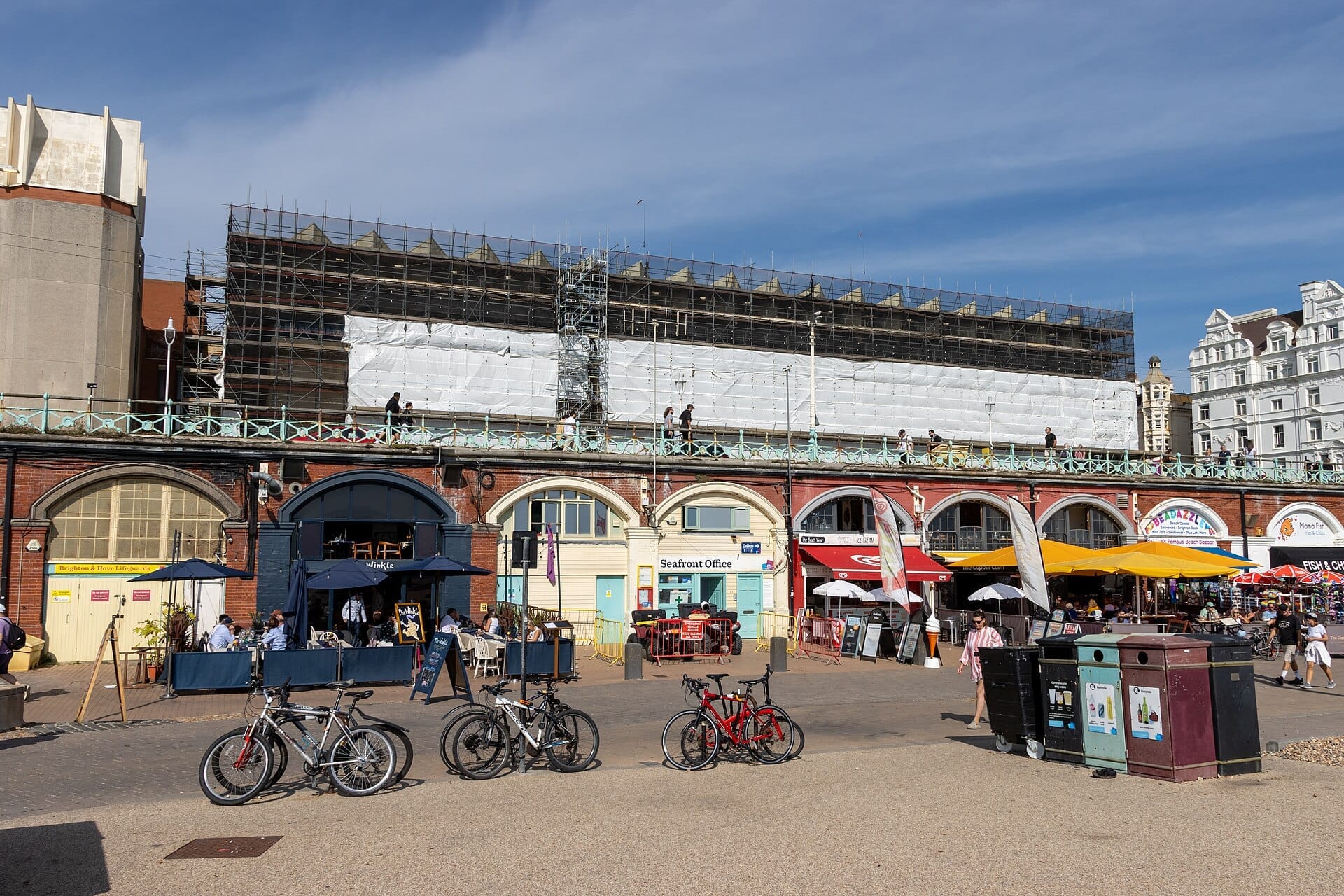
What the King's Road Arches Actually Are
The King's Road Arches are a series of 76 Victorian brick vaults built around 1890 beneath Brighton's seafront promenade and the busy A259 trunk road that runs above them. They stretch along the lower level of the seafront between the two most recognisable landmarks on this part of the coast, and for most visitors arriving from the beach, they appear as a long colonnade of arched openings cut into a thick wall of pale masonry, each one framing a different small business or studio.
This is not a curated tourist attraction with a single ticket desk and a leaflet. It is a working stretch of Victorian civil engineering that happens to contain independent cafes, artists' studios, a fishing heritage site, surf hire shops, street food traders and the odd gallery. The experience of walking through it changes completely depending on the day, the season and how far along you go.
ℹ️ Good to know
The arches are free to enter as a public space. There is no admission charge and no fixed opening time for the walkway itself. Individual businesses inside set their own hours, so some units will be shuttered on weekday mornings in winter.
The Setting: What You See and Smell
Approach from the beach and the arches loom as a low, solid wall running parallel to the shoreline. The brickwork is aged and salt-worn in places, with the kind of surface texture that reminds you this structure has spent over 130 years facing Channel weather. At ground level, the arched openings are around four metres wide, deep enough to feel genuinely sheltered, and most are fronted with painted shutters or folding glass panels that businesses use to open up to the sea air in good weather.
The smell shifts as you walk. Near the fishing boats hauled up on the shingle, there is brine, diesel and the faint trace of caught fish. A few arches along, fresh coffee takes over where a cafe has its windows open. In wet weather, the interior of each vault has a particular damp stone quality that reinforces just how old the structure is. It is not unpleasant — it is specific to the place in a way that no amount of renovation has managed to erase.
The shingle beach immediately in front of the arches is part of Brighton Beach, and at low tide the foreshore opens up considerably, giving the arches more visual breathing room. At high tide the sea comes closer and the sound of waves on pebbles becomes a constant backdrop.
Tickets & tours
Hand-picked options from our booking partner. Prices are indicative; availability and final rates are confirmed when you complete your booking.
Explore Brighton self-guided walking tour using an app
From 11 €Instant confirmationBrighton city lights flight with welcome drink
From 21 €Instant confirmationCycle along the beachfront with Brighton Beach Bikes hire
From 7 €Instant confirmationFree cancellationTour Brighton's highlights with an exploration game mobile app
From 10 €Instant confirmationFree cancellation
Morning, Afternoon and Evening: How the Arches Change
Early morning on a weekday, the arches belong almost entirely to dog walkers, open-water swimmers heading for the sea and the occasional fisherman. Perhaps a third of the units are open at this hour, mostly the coffee spots. The light at this time of day is worth noting: low morning sun catches the south-facing arch openings and turns the interior brickwork a warm amber that photographers tend to appreciate.
By mid-morning on weekends, particularly in summer, the character shifts fast. Families arrive, tourists move along from Brighton Palace Pier, and the cafes and food traders fill their outside spaces with folding chairs. The walkway can feel genuinely crowded between roughly 11am and 3pm on a sunny Saturday in July or August. If you want to look closely at the architecture or have a conversation in one of the smaller studios, this is not the window to do it.
Late afternoon in spring and autumn offers the best balance: enough foot traffic to give the arches some life, enough quiet to actually look at what is around you. Sunset from this stretch of the seafront is frequently spectacular. The western end of the arches faces directly into the fading light, and the silhouette of the West Pier ruins to the west makes the view compositionally complete in a way that is hard to predict until you are standing there.
💡 Local tip
Visit on a weekday morning in May, June or September for the fewest crowds, the best light for photography and a realistic chance of finding a table at the seafront cafes.
History and Structural Significance
The arches were constructed around 1890 as part of a broader engineering effort to stabilise and formalise Brighton's seafront. The promenade above, and the road that evolved into the modern A259 trunk route, needed substantial underpinning along a stretch of coastline that had historically been subject to erosion and ad hoc development. The solution was a continuous arcade of brick arches, load-bearing in function but also immediately practical as sheltered commercial space at beach level.
Brighton & Hove City Council has undertaken ongoing work on the arches in recent years, with a programme focused on structural repair and the upgrading of individual units to make them commercially viable for modern tenants while preserving the Victorian fabric of the structure. This has been a slow and sometimes contentious process, with some units remaining closed for extended periods during works.
The arches sit at the eastern end of Brighton's seafront civic infrastructure, a stretch that also includes the Brighton Bandstand and connects westward toward Hove. Understanding this geography matters: the arches are not a standalone object but part of a continuous seafront experience that rewards walking rather than destination-jumping.
What Is Inside: A Practical Walkthrough
The mix of tenants changes periodically and is not fixed by any central management structure in the way a shopping centre would be. As a general guide, the arches contain: independent cafes and beach bars, surf and watersports hire operations, artists' studios and small galleries, a tattoo studio or two, seafood vendors, gift shops and, at the eastern end closer to the pier, the Brighton Fishing Museum.
The Brighton Fishing Museum occupies one of the arches and is free to enter. It documents the town's fishing heritage with boats, photographs and archive material, and it sits comfortably alongside the working boats still drawn up on the shingle immediately outside. It is small but genuinely informative and less visited than it deserves to be.
Studios housing working artists occasionally open to the public, particularly during Brighton's Open Houses season in May. Outside of that period, some studios operate by appointment or sell work directly from their arch. It is worth peering in through open doors even if there is no sign out front.
💡 Local tip
The annual Brighton Festival and Open Houses event in May brings many arch studios to life. If your visit falls in that window, pick up a map at the Tourist Information Centre to find out which units are participating.
Getting There and Getting Around
From Brighton railway station, the arches are roughly a 15-minute walk heading south to the seafront and then west along the lower promenade. Brighton & Hove Buses run along King's Road above; several routes stop at the seafront and the walk down to beach level is short. There is no dedicated parking at the arches, and driving to this stretch of seafront on a busy summer day is not practical.
The walkway along the arches is at beach level, which means it is on shingle and paving rather than a formal footpath in places. Mobility considerations matter here: the paved sections are accessible, but parts of the foreshore involve loose pebbles that can be difficult with a pushchair or wheelchair. The promenade above on King's Road provides a smoother, fully paved alternative with views down to the arches.
The arches connect naturally to a longer seafront walk. Heading east takes you toward the Brighton Palace Pier and then onward to the Kemp Town end of the seafront. Heading west leads toward the West Pier ruins and eventually the calmer stretches of Hove Lawns and Beach.
Photography and Weather Considerations
The arches are photogenic in a way that rewards patience. Shooting from the beach at low tide with a wide lens captures the full rhythm of the repeated arch openings. Backlit shots through individual arches, with the sea visible behind a figure or a cafe table, tend to work well in the late afternoon. Overcast days are not a write-off here: the diffuse light softens the brickwork texture and removes the harsh shadows that direct sun creates inside the darker vaults.
In strong onshore winds, which Brighton gets regularly, particularly from autumn through spring, the open arches channel the breeze and can feel significantly colder than the promenade above. A layer that covers your ears is not an overreaction in November. Heavy rain is less of a problem than you might expect because the arches themselves provide shelter, but the shingle approach from the beach becomes slippery.
⚠️ What to skip
In winter and on quiet midweek days outside the main tourist season, a significant number of arch units will be closed. Do not plan a visit primarily around the shops or cafes without checking ahead with individual businesses.
Insider Tips
- Walk the arches from east to west, starting near the Fishing Museum, so you finish at the western end in time for the sunset view across to the West Pier ruins — the light direction rewards this order.
- The cafes and bars at beach level inside the arches are often cheaper and considerably less crowded than the seafront restaurants on King's Road above, partly because they are less visible from the main pedestrian flow.
- During Brighton's May Open Houses season, several artist studios within the arches participate in public opening events. Check the Brighton Open Houses programme before your trip to see which arches are involved.
- If you are interested in the architecture rather than the shops, the best unobstructed view of the full arcade is from the beach at low tide, looking back toward shore from about 30 metres out on the shingle.
- The Brighton Fishing Museum inside the arches is free and genuinely small — allow 20 minutes rather than an hour — but the collection of historic photographs showing the beach in the late 19th and early 20th centuries gives useful context for what the whole seafront looked like before the pier and promenade reached their current form.
Who Is Kings Road Arches For?
- Walkers doing a full seafront route who want natural stopping points for coffee or food
- Architecture and urban history enthusiasts interested in Victorian coastal engineering
- Visitors in Brighton during the May festival season wanting to find working artists' studios
- Photographers looking for textured, atmospheric backgrounds away from the pier's crowds
- Travellers who want a free, low-pressure way to spend an hour on the seafront without committing to a ticketed attraction
Nearby Attractions
Other things to see while in Brighton Seafront:
- Brighton Bandstand
Standing on Brighton's Kings Road promenade since 1884, the Brighton Bandstand is a Grade II listed cast-iron landmark that hosts Sunday afternoon concerts through the summer months and often across a broader April–September season. Whether you catch a performance or simply stop to admire the ornate ironwork above the English Channel, it earns a place in any seafront walk.
- Brighton Beach
Brighton Beach stretches for miles along the English Channel, offering a free, accessible seaside experience unlike any sandy resort. Shingle underfoot, sea air, and the city right behind you — this is coastal England at its most characterful.
- Brighton Fishing Museum
Tucked inside the Kings Road Arches on Brighton seafront, the Brighton Fishing Museum is a small, free attraction that tells the story of the city's working fishing community with surprising depth. At its heart sits a 27-foot clinker-built punt boat, surrounded by old photographs, nets, and tools that bring the Fishing Quarter's heritage to life.
- Brighton i360
Standing 162 metres tall on Brighton's seafront, the i360 observation tower lifts a glass pod of up to 200 visitors to 138 metres above sea level for sweeping views of the English Channel, the South Downs, and the city below. Designed by the architects behind the London Eye, it opened in 2016 and is billed as Europe’s tallest moving observation platform.