Royal Pavilion Brighton: Inside the Prince's Impossible Palace
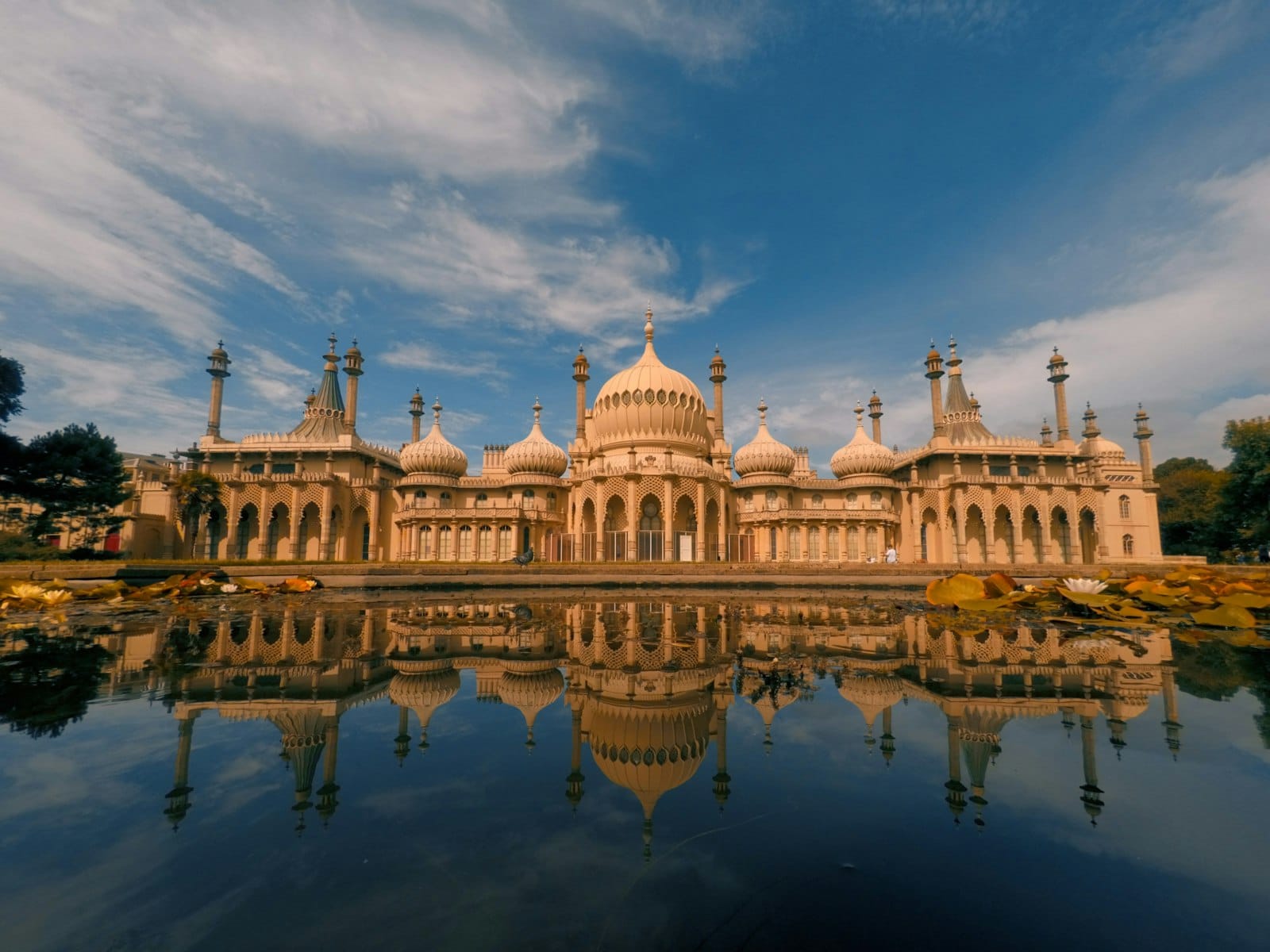
The Royal Pavilion is a Grade I listed former royal palace in the centre of Brighton, combining Indian exterior domes with Chinese-inspired interiors. Built as a seaside retreat for King George IV, it remains one of the most architecturally distinctive buildings in England.
Quick Facts
- Location
- Royal Pavilion & Garden, Brighton, BN1 1FN — near The Lanes and Brighton seafront
- Getting There
- Around 10–15 minutes’ walk from Brighton railway station (Southern/Thameslink services)
- Time Needed
- 1 to 2 hours for interior and gardens
- Cost
- Adult £21.50 / Child (5–18) £13.00 / Resident £16.50 / Family (1+4) £31.25 / Family (2+4) £50.75 (1 Apr 2026–31 Mar 2027). Prices correct at time of writing — verify before visiting.
- Best for
- Architecture lovers, history enthusiasts, families, first-time Brighton visitors
- Official website
- brightonmuseums.org.uk/visit/royal-pavilion-garden
What the Royal Pavilion Actually Is
The Royal Pavilion is a former royal palace in the centre of Brighton, originally begun in 1787 as a modest seaside retreat for King George IV, then Prince Regent. What stands today is the result of two major transformations: first by architect Henry Holland in the 1800s, then comprehensively by John Nash between 1815 and 1823. Nash's final vision produced something that has no real equivalent anywhere else in Britain: a palace whose silhouette is defined by Indian-style onion domes and minarets on the outside, while the interiors draw heavily on Chinese Regency decoration — lacquerwork, dragon motifs, bamboo-effect ironwork, and hand-painted wallpapers.
The building is a Grade I listed structure, meaning it sits at the highest level of England's heritage protection system. That designation reflects not just its rarity but the quality of its surviving interiors, many of which have been carefully restored using original records. The Pavilion is managed by the Royal Pavilion & Museums Trust on behalf of Brighton & Hove City Council, which now owns it after the former Brighton Corporation purchased it from Queen Victoria in 1850 once the royal family had largely abandoned it.
💡 Local tip
Last admission is 60 minutes before closing in summer and 45 minutes before closing in winter. In summer (1 April to 30 September), the Pavilion opens at 09:30 and closes at 17:45 (last admission 17:00). In winter (1 October to 31 March), hours shift to 10:00–17:15 (last admission 16:30). The Pavilion closes on 25 and 26 December and 1 January, and closes at 14:30 on 24 December.
First Impressions: Arriving and the Exterior
Most visitors approach the Royal Pavilion from the Old Steine junction or through the surrounding garden, and the first view tends to stop people mid-step. The cluster of white domes and pointed minarets rising above the manicured lawns creates a silhouette that reads as genuinely Indian from a distance, though Nash's design was an imagined Orientalism rather than a faithful reproduction of any specific Mughal building. Up close, the render surface shows its age in certain lights — the building has a slightly weathered grandeur that feels more honest than a pristine replica.
The surrounding Royal Pavilion Garden is free to enter and worth pausing in before you go inside. It underwent a major restoration project completed in 2021, returning it to a design closer to the original Regency layout with period-appropriate planting. On warm afternoons, the lawn fills with people eating lunch or simply lying in the grass, which creates a relaxed contrast to the formality of the palace itself. Early morning — before 10:00 on summer weekdays — the garden is almost empty, and the building reads most clearly without crowds in the foreground.
The Pavilion sits at the edge of The Lanes, Brighton's network of historic narrow streets. The juxtaposition is striking: you walk out of a labyrinth of fishermen's cottages turned jewellery shops and boutiques, and then there's a Mughal-influenced palace directly ahead. It's an odd piece of urban geography that still catches people off-guard.
Tickets & tours
Hand-picked options from our booking partner. Prices are indicative; availability and final rates are confirmed when you complete your booking.
Brighton city lights flight with welcome drink
From 21 €Instant confirmationCycle along the beachfront with Brighton Beach Bikes hire
From 7 €Instant confirmationFree cancellationTour Brighton's highlights with an exploration game mobile app
From 10 €Instant confirmationFree cancellationExplore Brighton self-guided walking tour using an app
From 11 €Instant confirmation
Inside the Palace: Room by Room
The interior circuit takes visitors through a sequence of state rooms, each decorated to a different pitch of Regency excess. The Banqueting Room is typically the one that draws the longest pauses: the ceiling is painted to resemble a sky through plantain leaves, and from its centre hangs a massive chandelier held in the claws of a cast-iron dragon. The effect at full illumination is theatrical in a way that photographs never quite capture, partly because the scale of the room is hard to judge until you're standing inside it.
The Music Room is similarly elaborate, with a domed ceiling of gilded scales and enormous Chinese-style lanterns. It was reportedly one of George IV's favourite spaces, and it's easy to understand why — the acoustics and ornamentation made it an ideal setting for the royal concerts that were central to Regency court life. The long corridor connecting the main rooms is lined with hand-painted Chinese wallpaper, much of it original or faithfully restored, and the low light used to protect the paper gives the whole passage a slightly amber, museum-like atmosphere.
The kitchen — the Great Kitchen — is one of the more surprising rooms. It was technologically advanced for its era, with cast-iron columns designed to look like palm trees supporting the ceiling, and equipment that could produce elaborate multi-course dinners for dozens of guests simultaneously. It reads as a working space, which gives it a different energy from the show rooms upstairs. Families with children often linger here longer than in the state rooms.
ℹ️ Good to know
Audio guides are included in the ticket price and add considerable context to the interiors. The route is self-guided, so you can spend as long as you like in any room — useful in quieter periods, but something to be mindful of when the building is busy and rooms become congested.
Historical Weight: Beyond the Decoration
George IV's taste for the extraordinary extended well beyond aesthetics. The Royal Pavilion was genuinely innovative in its use of prefabricated cast iron and early gas lighting, technologies that Nash incorporated into a building that looked entirely pre-industrial. The tension between the medieval-fantasy exterior and the technical ambition inside is part of what makes the building historically interesting beyond its surface.
During World War I, the Pavilion served as a military hospital for Indian soldiers fighting for the British Army, a use with a particular resonance given the building's Indian architectural references. Between 1914 and 1916, thousands of soldiers were treated here. Some accounts of this period are incorporated into the current displays, and they give the building a chapter in its history that most visitors don't expect.
The Pavilion doesn't exist in isolation from Brighton's broader Regency heritage. If the architecture interests you, the Brighton Regency architecture guide covers the wider pattern of terraces, squares, and set-piece developments that transformed Brighton from a fishing village into a fashionable resort during the same period the Pavilion was being built.
Visiting in Practice: Crowds, Timing, and Photography
The Pavilion is consistently one of Brighton's most visited paid attractions, and crowd management inside the building is worth thinking about before you go. The busiest periods are weekend afternoons in summer (July and August), school holidays, and any weekend following a major feature in travel media. At these times, the Banqueting Room and Music Room can feel uncomfortably full, and the audio guide experience suffers when you can't hear yourself think.
The clearest practical advice is to book online in advance and arrive when the doors open. The building is quieter in its first hour of operation on weekdays, particularly in spring and early autumn, when visitor numbers are lower than peak summer weekends.
Photography rules allow visitors to take non-flash photos throughout most of the building for personal use. The Banqueting Room chandelier photographed from directly below is a reliable shot; so is the Music Room's ceiling detail. The exterior photographs well in morning light from the garden's south side, when the domes catch the sun without the harsh midday flattening that affects the detail of the render. Avoid the streetside view from North Street or the Old Steine, which are always congested with traffic and pedestrians.
⚠️ What to skip
The building has a complex interior layout across multiple levels. While the Royal Pavilion & Museums Trust provides accessibility information on their official site, visitors with mobility considerations should check the current access arrangements directly before visiting, as not all areas have step-free routes.
Is It Worth It?
At £21.50 for an adult ticket, the Royal Pavilion sits at the higher end of Brighton's attraction pricing. Whether it justifies that cost depends largely on what you're looking for. If you have any interest in architecture, design history, or the culture of the Regency period, the answer is clearly yes. The interiors are genuinely extraordinary and the restoration work is of high quality. If you're primarily a beach-and-seafront visitor and historical buildings aren't your priority, you may find the ticket price hard to rationalise for an experience that takes under two hours.
Brighton and Hove residents in BN1, BN2, BN3, and BN41 postcodes receive discounted admission, which makes repeat visits more practical. It's worth knowing that the gardens are free and open to all, so a first visit could involve a walk around the exterior at no cost before committing to a ticket.
For visitors planning a full day out, the Pavilion pairs naturally with the Brighton Museum and Art Gallery, which is directly adjacent in the same complex and included in many combined visit plans. Afterwards, The Lanes are immediately to the south for lunch or browsing, and the seafront is a short walk beyond that.
If you're planning a trip to Brighton and want to understand how the Pavilion fits into a wider itinerary, the guide to things to do in Brighton covers how to prioritise across the city's main draws depending on your interests and time available.
Insider Tips
- Book tickets online rather than at the door — the online system lets you select a timed entry slot during busy periods, and you avoid any queue at the ticket desk.
- The garden's northeast corner, near the café, gives the clearest full-length view of the Pavilion's east facade. Most visitor photographs are taken from the south lawn, but the northeast angle includes more of the minarets without shooting into the light.
- If you're visiting on a budget, the garden is free and gives you a complete view of the exterior. Combine this with the free
- Brighton and Hove residents should always ask about the resident rate (adult £16.50 at the time of writing for 1 Apr 2026–31 Mar 2027) — you'll need proof of address in a qualifying postcode.
- The Great Kitchen is often underappreciated. Allow extra time here; the palm-tree cast-iron columns and the original cooking equipment are genuinely interesting and the room is usually less crowded than the state rooms above.
Who Is Royal Pavilion For?
- Architecture and design enthusiasts who want to understand the full scope of Regency-era ambition
- First-time visitors to Brighton who want a single attraction that explains the city's unusual character
- Families with older children interested in history — the Great Kitchen and the WWI hospital displays hold attention well
- Day-trippers from London who want a focused cultural experience alongside the seafront
- Anyone with an interest in the history of British colonial-era taste and Orientalist aesthetics
Nearby Attractions
Other things to see while in The Lanes:
- Brighton Dome
Brighton Dome is a Grade I listed arts complex on the Royal Pavilion Estate, comprising the Concert Hall, Corn Exchange, and Studio Theatre. Originally built as William Porden's royal stables and riding house for the Prince Regent, it now hosts everything from classical concerts and comedy to trade fairs and festivals across three distinctive spaces.
- Brighton Museum & Art Gallery
Brighton Museum & Art Gallery sits inside the Royal Pavilion Gardens and holds one of the south coast's most engaging collections, spanning Art Nouveau, Surrealism, Modernism and Brighton's own social history. It's a serious museum that rewards curiosity without demanding a full day.
- Brighton Police Cells Museum
Beneath Brighton Town Hall, the Old Police Cells Museum preserves Brighton Borough's historic main police station and holding cells, in use from the early 19th century through much of the 20th century. Tours run on a handful of days each week and must be booked in advance, making this one of the most distinctive and intimate history experiences in Brighton.
- Brighton Theatre Royal
Theatre Royal Brighton has been staging professional productions continuously since it opened in 1807, making it one of the longest-running working theatres in England. Located on New Road in the heart of The Lanes, its restored Regency auditorium seats around 952 people and hosts everything from West End transfers to touring opera and dance.