Brighton Dome: Inside One of England's Most Architecturally Remarkable Venues
Brighton Dome is a Grade I listed arts complex on the Royal Pavilion Estate, comprising the Concert Hall, Corn Exchange, and Studio Theatre. Originally built as William Porden's royal stables and riding house for the Prince Regent, it now hosts everything from classical concerts and comedy to trade fairs and festivals across three distinctive spaces.
Quick Facts
- Location
- Church Street / 29 New Road, Brighton, BN1 1UG (Royal Pavilion Estate, central Brighton)
- Getting There
- 10-minute walk from Brighton railway station; central bus routes stop nearby on North Street and Old Steine
- Time Needed
- 2-3 hours for an event; 15-20 minutes to walk the exterior and foyers
- Cost
- Free to £60+ depending on event; no fixed admission fee — check the programme for each show
- Best for
- Live music, comedy, festivals, architecture enthusiasts, and Brighton Festival visitors
- Official website
- brightondome.org
What Is Brighton Dome, Exactly?
Brighton Dome is not a single building but a complex of three interconnected performance spaces: the Concert Hall, the Corn Exchange, and the Studio Theatre. Together they form part of the Royal Pavilion Estate in central Brighton, physically linked by corridors and underground passages to both the Royal Pavilion and Brighton Museum and Art Gallery. The whole complex sits on Church Street and New Road, just a few minutes' walk from the seafront.
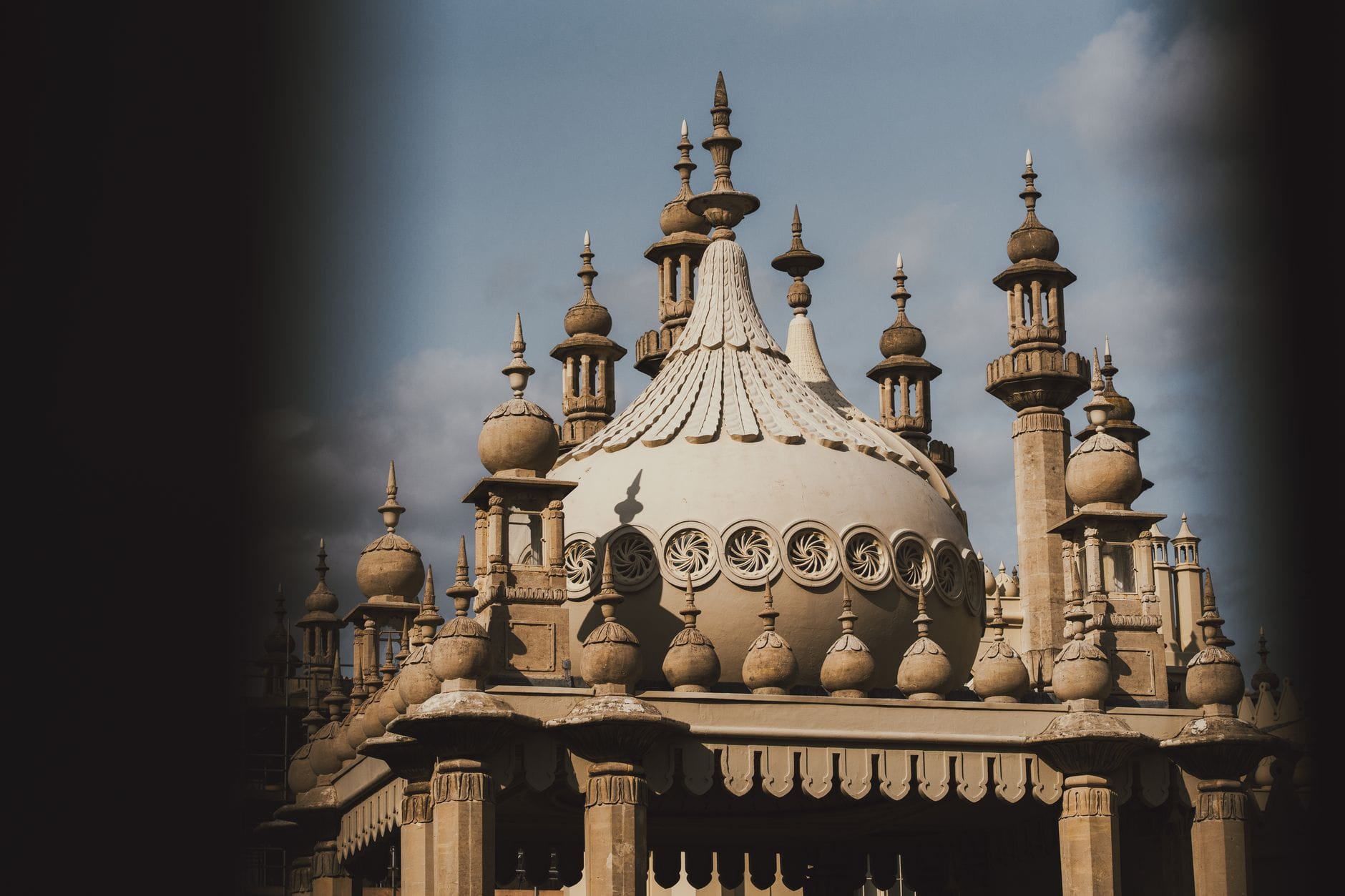
The entire site is Grade I listed on the National Heritage List for England, placing it among the country's most architecturally significant buildings. Arriving from North Street or New Road, the first thing you notice is the scale: the domed Concert Hall roof rises above the rooflines of the surrounding Lanes area, and the Indo-Saracenic detailing on the exterior walls mirrors the extravagance of the Royal Pavilion next door.
If you are planning a broader day around the area, the Royal Pavilion and Brighton Museum and Art Gallery are on the same estate and easy to combine in a single visit.
The Architecture: Royal Stables Turned Concert Venue
The buildings began as William Porden's royal stables and riding house for the Prince Regent in the early 19th century (John Nash later remodelled the Pavilion itself, not these structures). The circular Concert Hall, with its copper dome, was originally the stables; the Corn Exchange was the riding house. The Concert Hall was converted in 1867 and then significantly restored in 1935 with a striking art deco interior that still defines the space today.
Inside the Concert Hall, the art deco work is not the subtle kind. The restored ceiling, tiered balconies, and geometric detailing give it a glamour that you don't expect from a building whose bones date back to the Regency era. The acoustics are well-regarded, and the oval shape means sight lines are good from most positions. Capacity sits at around 1,700 for standing events and somewhat less for seated shows.
The Corn Exchange, accessed from New Road, is the more flexible of the two main spaces. Its most notable structural feature is the timber roof, which contains what is described as the widest span timber frame in the country. This was revealed and celebrated during recent refurbishment works. The space now has retractable seating, full disabled access throughout, and a ground-floor layout that suits everything from trade fairs to live gigs.
ℹ️ Good to know
The tunnels and corridors connecting Brighton Dome to the Royal Pavilion and Brighton Museum are not open to the general public as a touring route, but the physical connection means the buildings share service infrastructure and are managed as part of the same estate.
Tickets & tours
Hand-picked options from our booking partner. Prices are indicative; availability and final rates are confirmed when you complete your booking.
Brighton city lights flight with welcome drink
From 21 €Instant confirmationCycle along the beachfront with Brighton Beach Bikes hire
From 7 €Instant confirmationFree cancellationTour Brighton's highlights with an exploration game mobile app
From 10 €Instant confirmationFree cancellationExplore Brighton self-guided walking tour using an app
From 11 €Instant confirmation
The Programme: What Actually Goes On Here
Brighton Dome runs a year-round programme that covers classical and orchestral concerts, comedy, spoken word, contemporary dance, electronic music, club nights, and large-scale conferences. The range is genuinely broad. On a typical month, the Concert Hall might host a touring orchestral performance on a Friday, a stand-up comedy night on Saturday, and a community event on Sunday afternoon.
The Studio Theatre is the smallest of the three spaces, suited to more intimate performances, experimental work, and smaller touring productions. It tends to attract audiences who already know what they're coming for rather than walk-in visitors.
The venue is most heavily associated with Brighton Festival, the major arts festival held each May. During that fortnight, Brighton Dome becomes the central hub for the city's cultural programme, with the Concert Hall and Corn Exchange both in continuous use. If you are visiting during May, checking the festival programme before you travel is strongly advised, as key events sell out weeks in advance.
Brighton Festival is covered in more detail in our Brighton Festival guide, which includes ticketing advice and how to plan your time around the programme.
What It Feels Like on a Visit
On a non-event day, the exterior is worth seeing in its own right, particularly the Concert Hall dome viewed from the Royal Pavilion Gardens to the south. The foyers are generally accessible when events are scheduled, and there is a bar and cafe space that opens in the run-up to performances. Outside of event times, the public areas are quieter and you may find staff and crew at work.
On a performance night, the approach along New Road or through the Pavilion Gardens has a particular energy. The buildings are lit, the bars fill with pre-show crowds, and the mix of audiences reflects the breadth of the programme: smart-casual for classical nights, more varied for club events, relaxed and mixed for comedy. The pre-show atmosphere in the Concert Hall bar tends to be convivial rather than formal.
💡 Local tip
Pre-show bars open around 45-60 minutes before curtain. Arriving early gives you time to explore the foyer spaces, read the programme notes, and get a drink without queuing. The foyer areas themselves are worth a look for their architectural detail.
Acoustically, the Concert Hall rewards live orchestral and acoustic performances. For amplified shows, the sound quality is solid, though the curved walls can create some variation depending on where you are seated or standing. The upper balcony is not for those uncomfortable with heights, but it does offer an unusual perspective on the art deco ceiling.
Practical Information: Tickets, Access, and Getting There
There is no general admission ticket for Brighton Dome. All visits are event-based, meaning you need a ticket for a specific show or concert. Ticket prices range from free to over £60 depending on the event, with most mid-programme shows falling in the £15-£35 range. Concessions are available for many events. Book directly through the Brighton Dome website or box office to avoid third-party fees.
Brighton Dome is roughly a 10-minute walk from Brighton railway station. Head south along Queen's Road, then turn left onto North Street and right onto New Road; the entrance at 29 New Road (BN1 1UG) is on the right. From the seafront, walk north up East Street or Middle Street through The Lanes and the venue is clearly signposted. There is no dedicated parking, but the NCP car park on Church Street is nearby.
Accessibility has been significantly improved, particularly in the Corn Exchange, which now has full wheelchair access including accessible foyers, ticket desk, bars, and auditorium. The Concert Hall's historic structure presents more constraints, but the venue provides accessibility information for each event on its website. Hearing loops are available in the main performance spaces.
⚠️ What to skip
Opening times vary entirely by event schedule. Do not turn up without checking the Brighton Dome website in advance. The building is not a walk-in attraction with fixed daily hours.
The surrounding area is covered in our guide to The Lanes, which includes restaurants and bars close to the venue that are useful for pre-show dining.
How Brighton Dome Fits Into the Wider City
Brighton Dome sits at the cultural centre of the city in a very literal sense. The Royal Pavilion Estate occupies a chunk of central Brighton between the seafront and the North Laine, and the Dome is the performing arts anchor of that estate. It has a peer relationship with the Brighton Theatre Royal on New Road, which is around 100 metres away, meaning that New Road becomes a cultural corridor on busy performance evenings.
For visitors building a cultural itinerary, the best museums in Brighton guide covers the nearby Brighton Museum and Art Gallery, which is on the same estate and charges admission.
Brighton as a city has a stronger-than-average arts infrastructure for its size, and Brighton Dome is one of the main reasons for that. The venue attracts productions that might otherwise only play London, and during Brighton Festival it becomes genuinely world-class in the range of what it programmes. For visitors who care about live performance, it is one of the more compelling reasons to be in the city.
Who Should and Should Not Prioritise This Venue
If you are visiting Brighton primarily for the beach, the pier, or the street food scene, Brighton Dome will not be on your path unless you specifically plan an evening event. It is not a daytime walk-in attraction. The building's exterior can be admired while passing through the Royal Pavilion Estate, but the interior is only accessible during scheduled events.
For visitors with an interest in Regency architecture, the exterior alongside the Royal Pavilion is worth studying. The contrast between Nash's exotic Pavilion domes and Porden's stables-turned-concert-hall tells you something useful about how the Prince Regent's tastes shaped a whole corner of the city. But that requires no ticket and takes 15 minutes.
Insider Tips
- The Concert Hall's upper balcony seats are cheaper and offer a clearer view of the art deco ceiling than ground-floor positions. For concerts where the visual spectacle of the room matters as much as the performance, they can be the better choice.
- New Road fills up with pre-show pedestrian traffic from both Brighton Dome and the Theatre Royal on busy nights. If you are eating nearby before a show, aim to finish dinner by 45 minutes before curtain to avoid the last-minute rush to the bar.
- Brighton Festival events at the Dome sell out significantly faster than regular-season shows. If you are planning a May visit around the festival, check the programme and book within the first week of tickets going on sale.
- The Corn Exchange is also used for trade fairs, food markets, and private events outside the main performance programme. Check the full calendar rather than just the ticketed arts listings if you want a full picture of what is happening on a given day.
- Parking on Church Street NCP is reasonably convenient for evening events, but if you are coming by train, the walk from Brighton station is flat and straightforward. Evening trains back to London run late enough to cover most performance end times.
Who Is Brighton Dome For?
- Live music and concert-goers looking for a historic and well-regarded venue
- Brighton Festival visitors who want to see major programme events in May
- Architecture enthusiasts interested in Regency and art deco interiors
- Travellers building a cultural evening combining the Dome with nearby Theatre Royal and Lanes restaurants
- Groups looking for a high-quality event venue in central Brighton
Nearby Attractions
Other things to see while in The Lanes:
- Brighton Museum & Art Gallery
Brighton Museum & Art Gallery sits inside the Royal Pavilion Gardens and holds one of the south coast's most engaging collections, spanning Art Nouveau, Surrealism, Modernism and Brighton's own social history. It's a serious museum that rewards curiosity without demanding a full day.
- Brighton Police Cells Museum
Beneath Brighton Town Hall, the Old Police Cells Museum preserves Brighton Borough's historic main police station and holding cells, in use from the early 19th century through much of the 20th century. Tours run on a handful of days each week and must be booked in advance, making this one of the most distinctive and intimate history experiences in Brighton.
- Brighton Theatre Royal
Theatre Royal Brighton has been staging professional productions continuously since it opened in 1807, making it one of the longest-running working theatres in England. Located on New Road in the heart of The Lanes, its restored Regency auditorium seats around 952 people and hosts everything from West End transfers to touring opera and dance.
- Royal Pavilion
The Royal Pavilion is a Grade I listed former royal palace in the centre of Brighton, combining Indian exterior domes with Chinese-inspired interiors. Built as a seaside retreat for King George IV, it remains one of the most architecturally distinctive buildings in England.