Brighton Museum & Art Gallery: Art, Design and Local History in the Heart of Brighton
Brighton Museum & Art Gallery sits inside the Royal Pavilion Gardens and holds one of the south coast's most engaging collections, spanning Art Nouveau, Surrealism, Modernism and Brighton's own social history. It's a serious museum that rewards curiosity without demanding a full day.
Quick Facts
- Location
- Pavilion Gardens, Brighton BN1 1FN, inside the Royal Pavilion Gardens
- Getting There
- Brighton railway station (15–20-min walk via Queen's Road and North Street); North Street and Old Steine bus stops served by multiple Brighton & Hove Buses routes
- Time Needed
- 1.5 to 3 hours depending on how closely you read the design galleries
- Cost
- Adults £10.50, ages 5–18 £5.00, family (2 adults + up to 4 children) £23.50. Verify current prices before visiting.
- Best for
- Design enthusiasts, families with older children, anyone interested in Brighton's cultural and social past
- Official website
- brightonmuseums.org.uk/brighton-museum-art-gallery
What Brighton Museum & Art Gallery Actually Is
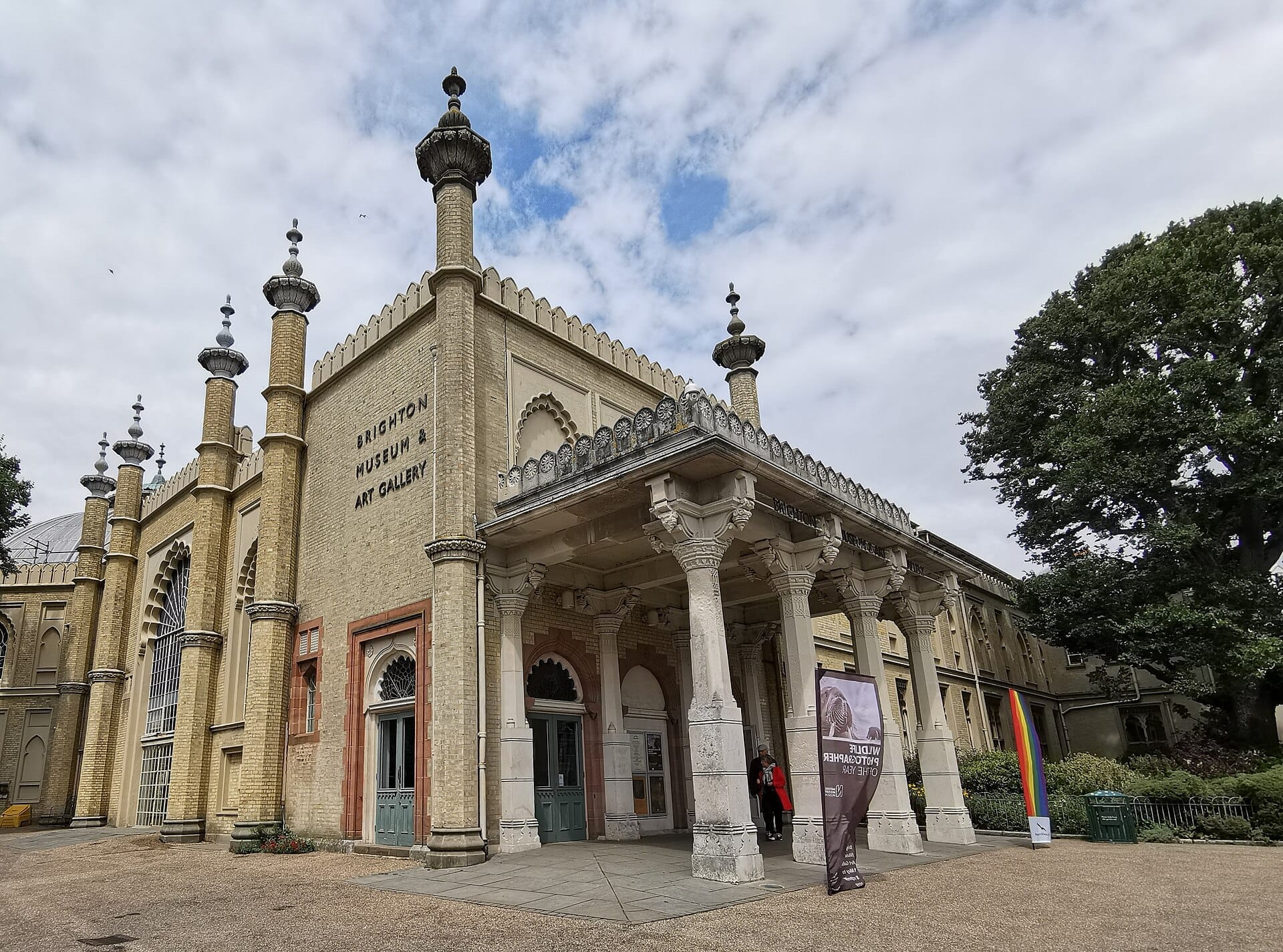
Brighton Museum & Art Gallery is a compact, well-curated city museum with particular strengths in 20th-century decorative arts and design, while also giving serious space to Brighton's own history and identity. The building sits directly inside the Royal Pavilion Gardens, occupying an elegant Regency-era structure that feels at home among the gardens' ornamental planting and wrought-iron railings.
The museum is one of five sites operated by Brighton & Hove Museums under the Royal Pavilion & Museums Trust, alongside the Royal Pavilion, the Booth Museum of Natural History, Hove Museum and Preston Manor. Each site has a distinct character. Brighton Museum is the one most focused on art, design and the city's own social story.
ℹ️ Good to know
Opening hours: Tuesday to Sunday, 10:00–17:00. Closed Mondays apart from Bank Holidays (10:00–17:00). Check the official website before visiting for seasonal closures, particularly around Christmas.
The Collections: What You Will Actually See
The 20th-century art and design galleries are the museum's strongest claim on your attention. The collection traces a clear arc from Art Nouveau through Modernism and Surrealism to Postmodernism and beyond, with furniture, ceramics, glass and fashion given as much weight as paintings on canvas. You might move from an ornate Lalique piece to a spare Bauhaus chair within a few steps, which makes the trajectory of the century feel unusually tangible.
The fashion and dress collection is worth pausing over. Items range from 18th-century garments to pieces from within living memory, and the curation pays attention to how clothing functioned socially, not just how it looked. Labels tend toward the informative rather than the academic, which makes the galleries accessible without feeling dumbed down.
The World Art gallery holds objects from Africa, the Americas, Asia and the Pacific, collected largely during the Victorian and Edwardian periods when Brighton's museum was building its holdings. The displays acknowledge the colonial context of acquisition, which some visitors will appreciate as an honest framing of how these objects arrived in Sussex.
The Brighton History gallery is where the museum earns particular local loyalty. It covers the town's transformation from a fishing village to a fashionable Georgian resort and then to a city of around 280,000 people, with photography, objects and maps that document specific streets, industries and communities rather than offering a generic civic narrative. If you want to understand what you are walking through when you explore the city outside, this gallery provides a useful frame.
Tickets & tours
Live prices and dates from our booking partner. If you book, we may earn a commission at no extra cost to you.
The Building and Its Setting
The museum building was originally designed as a stable block and riding house for the Prince Regent, the same patron who commissioned the extraordinary Royal Pavilion next door. The Regency-era structure was later converted for public use and expanded over time. The result is a building that feels slightly composite from the outside but opens into well-proportioned gallery spaces inside.
The position within the Royal Pavilion Gardens means the approach to the museum is genuinely pleasant. The gardens themselves are free to enter and worth spending time in before or after your visit. Emerging back into the gardens after the galleries, particularly on a clear morning, is one of the better transitional moments in central Brighton. The Royal Pavilion Gardens are manicured but feel used by local people rather than roped off for tourists, which gives the whole area an easy, lived-in quality.
When to Visit and How Crowds Behave
The museum sees noticeably higher footfall on summer weekends, particularly from late July through August when Brighton's tourist season peaks. Arriving close to the 10:00 opening time on a weekday tends to give you the galleries at their quietest. By early afternoon on Saturdays in summer, the ground floor and the Brighton History gallery can feel congested, especially near the more interactive elements.
Winter visits have their own appeal. The galleries are calm, the light through the upper windows is softer, and you can spend time with individual objects without feeling rushed by other visitors. Brighton's winter temperatures sit around 7 to 9°C on average, so the museum makes a natural refuge during a grey day in the city. Wet weather weekends in autumn tend to produce longer queues at the ticket desk, so arriving early still pays off.
💡 Local tip
Tuesday mornings are consistently among the quietest times across the week. If you have flexibility, this is the slot that gives you the most space in the design galleries.
If you are planning a visit as part of a longer day in central Brighton, the museum pairs naturally with the Royal Pavilion (which shares the same gardens), a walk through the Lanes to the south, or time at Brighton Beach, which is only a few minutes' walk downhill. A half-day that combines the museum with the Royal Pavilion and a walk to the seafront covers a lot of the city's most significant heritage in a compact area.
Getting There and Getting Around
Brighton railway station is the main arrival point for visitors coming from London or elsewhere in the south-east. From Gatwick Airport, Southern and Thameslink trains reach Brighton in around 30 minutes. From the station, the museum is roughly a 15–20-minute walk south along Queen's Road and then east along North Street toward the Pavilion Gardens. The walk takes you through the heart of the shopping district and is straightforward to navigate.
Multiple Brighton & Hove Buses routes stop on North Street and Old Steine, both within a few minutes' walk of the museum entrance. If you are arriving from elsewhere in the city, these are the most practical bus options. There is no dedicated museum car park, and central Brighton parking is expensive and limited, so the train or bus is the sensible approach.
The museum is wheelchair accessible, with level or ramped access throughout the main gallery spaces and a passenger lift serving upper floors. The on-site cafe and museum shop are located on the ground floor. Pushchair users will find the layout manageable, though some of the upper gallery sections involve stairs, so it is worth confirming lift access when planning a visit with young children.
Who Should Come, and Who Might Leave Disappointed
Brighton Museum & Art Gallery is a solid, well-maintained regional museum with a genuinely strong design collection. It is not the kind of encyclopedic institution that justifies a trip on its own from central London, but for anyone spending a day or more in Brighton, it is well worth the admission cost.
The museum will be most rewarding for visitors with an existing interest in 20th-century decorative arts, local history, or fashion history. Families with children under about eight may find that the label-heavy design galleries hold their attention less well than, say, the Sea Life Brighton or the Palace Pier. Children aged nine and upwards tend to engage much better, particularly in the Brighton History and World Art sections.
Visitors primarily interested in fine art rather than design and applied arts may find the collection slightly narrower than expected. The museum does hold paintings, but the decorative arts are where the depth of collection really lies. If contemporary fine art is your focus, Brighton has a number of commercial galleries that may better serve that interest.
⚠️ What to skip
The museum is closed on Mondays (apart from Bank Holidays). This catches visitors out surprisingly often, particularly those combining the museum with a Royal Pavilion visit on a Monday city break. Check the official website for current hours and any temporary exhibition closures.
Photography and Practical Notes
Photography for personal use is generally permitted in the permanent collection galleries, though flash photography and tripods are typically restricted. Temporary exhibitions may have different rules depending on the terms of any loans, so it is worth checking signage at the gallery entrance. The natural light in some of the upper galleries is good for photography without flash, particularly in the morning hours before the overhead skylights are obscured by cloud.
The museum shop carries a reasonable selection of design and art books, many connected to the collection themes, as well as gifts oriented toward the local and the independent. If you are also visiting the Booth Museum of Natural History on the same trip, note that it is located in a different part of the city, on Dyke Road, and requires separate travel.
Insider Tips
- The temporary exhibition programme at Brighton Museum regularly brings in work from national collections and touring shows. These are often the strongest reason to visit on a specific trip, so check the museum website for what is showing before you plan your day.
- Art Fund members get free entry to the permanent collection at Brighton Museum & Art Gallery, which significantly reduces the cost for visitors who hold a membership card. If you visit multiple museums across the UK, the card pays for itself quickly.
- The café inside the museum tends to get busy around 12:00 to 13:30. If you want a quiet coffee and somewhere to sit, arriving before noon or after 14:00 gives you a better chance of finding a seat without waiting.
- The museum's connection to the Royal Pavilion means some joint ticketing options may be available. Check the Brighton Museums website directly rather than booking through third-party platforms, as bundled options tend to offer better value.
- The Brighton History gallery has a searchable archive element that allows you to look up historical photographs of specific streets. If you are staying in a particular part of the city, this can produce genuinely surprising results about how recent the neighbourhood's character is.
Who Is Brighton Museum & Art Gallery For?
- Design and decorative arts enthusiasts with an interest in the 20th century
- Visitors combining a morning at the museum with an afternoon at the Royal Pavilion and the Lanes
- Families with children aged nine and upward who can engage with label-based displays
- Brighton residents and repeat visitors who want to understand the city's own history more deeply
- Travellers caught by wet weather who want a few hours of genuinely good indoor content
Nearby Attractions
Other things to see while in The Lanes:
- Brighton Dome
Brighton Dome is a Grade I listed arts complex on the Royal Pavilion Estate, comprising the Concert Hall, Corn Exchange, and Studio Theatre. Originally built as William Porden's royal stables and riding house for the Prince Regent, it now hosts everything from classical concerts and comedy to trade fairs and festivals across three distinctive spaces.
- Brighton Police Cells Museum
Beneath Brighton Town Hall, the Old Police Cells Museum preserves Brighton Borough's historic main police station and holding cells, in use from the early 19th century through much of the 20th century. Tours run on a handful of days each week and must be booked in advance, making this one of the most distinctive and intimate history experiences in Brighton.
- Brighton Theatre Royal
Theatre Royal Brighton has been staging professional productions continuously since it opened in 1807, making it one of the longest-running working theatres in England. Located on New Road in the heart of The Lanes, its restored Regency auditorium seats around 952 people and hosts everything from West End transfers to touring opera and dance.
- Royal Pavilion
The Royal Pavilion is a Grade I listed former royal palace in the centre of Brighton, combining Indian exterior domes with Chinese-inspired interiors. Built as a seaside retreat for King George IV, it remains one of the most architecturally distinctive buildings in England.
Planning a trip? Discover personalized activities with the Nomado app.