U Fleků Brewery and Restaurant: Prague's Living Brewing Tradition
Founded in 1499 and brewing continuously ever since, U Fleků is one of Prague's oldest working breweries. Set in New Town just minutes from the National Theatre, it offers a single dark lager brewed on-site, hearty Czech food, and an atmosphere that has changed surprisingly little across five centuries.
Quick Facts
- Location
- Křemencova 11, New Town (Nové Město), Prague 1
- Getting There
- Metro B – Národní třída; Tram – Myslíkova or Karlovo náměstí stops
- Time Needed
- 1.5 to 2.5 hours for a full meal and beer
- Cost
- No entry fee; pay for food and drink. Brewery museum excursion approx. 200 CZK (verify before visiting)
- Best for
- Czech beer history, traditional cuisine, group dinners, rainy-day culture
- Official website
- en.ufleku.cz
What U Fleků Actually Is
U Fleků is not a pub that happens to brew beer in a back room. It is a full working brewery, producing a single recipe of dark 13-degree lager that you can only drink on these premises. The first written record of the building dates to 1499, when it was purchased by a maltster named Vít Skřemenec, and the brewery has operated here for more than 500 years, surviving wars, regime changes, and nationalization under communist rule. It was returned to the Brtník family in 1991 and has operated privately since.
The official name is Pivovar a restaurace U Fleků, and the scale of the place surprises almost every first-time visitor. This is not a cozy neighborhood tavern with a few dozen seats. There are multiple rooms, several courtyards, a cabaret stage, a beer garden, and a small brewery museum. On a summer evening, the outdoor sections can seat several hundred people simultaneously, and the noise level rises accordingly.
ℹ️ Good to know
U Fleků brews exactly one beer: a dark, malty 13-degree lager that is not available anywhere else in Prague. If you are specifically seeking a wide tap selection or rotating IPAs, this is not the right stop. If you want to drink something genuinely irreplaceable in its home setting, it is.
The Space Itself: Rooms, Courtyards, and the Brewery
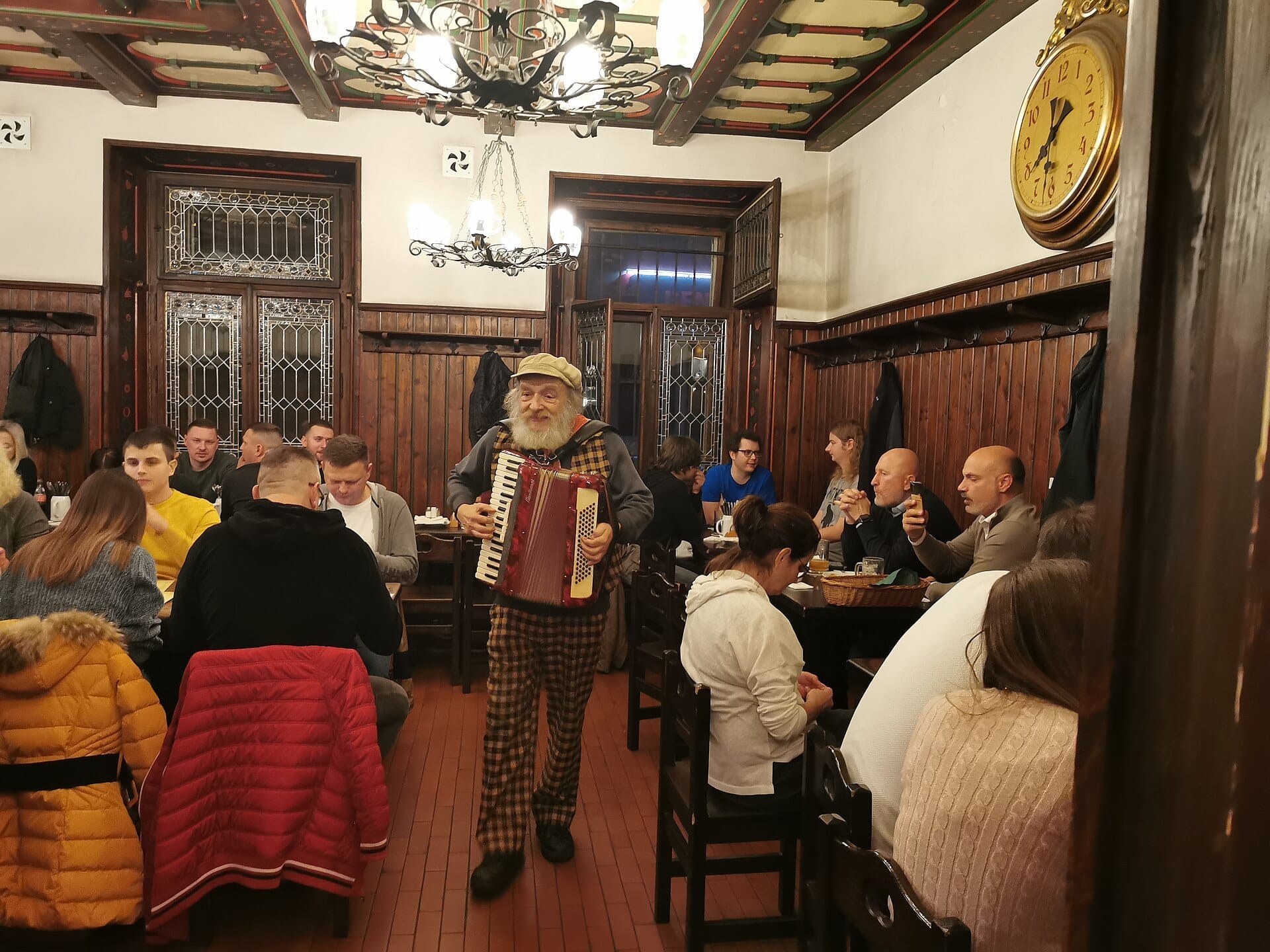
Walking through the gate on Křemencova 11, you enter a covered courtyard that opens into a sequence of dining rooms. The oldest sections have low, vaulted ceilings with dark timber and walls covered in illustrated ceramic tiles. The rooms smell of malt, wood polish, and decades of accumulated cooking, a combination that hits you before you see a single beer glass. The main hall seats large groups at long communal tables, and waitstaff move through it at a pace that signals this is a high-volume operation.
The inner courtyard, which converts to a beer garden in warmer months, has a different atmosphere. Sunlight reaches it in the afternoon, and the stone paving and surrounding walls absorb the heat. It is slightly quieter than the interior rooms in the early part of an evening. On summer weekends, however, it fills quickly and maintains that volume until closing.
A small brewery museum is accessible on-site. It covers the history of the building and production process, with period equipment on display. Access is typically via reservation or a separate excursion fee reported at around 100 CZK, though you should verify current terms directly with the brewery before visiting.
Tickets & tours
Hand-picked options from our booking partner. Prices are indicative; availability and final rates are confirmed when you complete your booking.
Prague self-guided audio tour with beer exhibition
From 28 €Instant confirmationFree cancellation3 Hour Microbrewery Tour in Prague
From 52 €Instant confirmationFree cancellationNizbor glass factory and Pilsner Urquell brewery tour day trip
From 119 €Instant confirmationFree cancellationCzech Medieval Experience with Castle, Brewery Visit and Dinner Show
From 85 €Instant confirmationFree cancellation
The Beer: What You Are Actually Drinking
The U Fleků dark lager is brewed to 13 degrees Plato, which places it in the Czech category of 'třináctka,' a stronger, richer style than the standard 10 or 12-degree lagers. The flavor profile is roasted malt with a persistent sweetness and low bitterness, closer in character to a Munich dunkel than to a hoppy modern ale. It is served at cellar temperature, which in practice means colder than many visitors expect but not ice-cold.
The beer arrives in ceramic or glass mugs depending on the room and the occasion. Waitstaff operate on a tally-card system: a small card at your table is marked each time a new drink is brought. This is standard Czech pub practice, and the drinks come frequently and without being requested. If you do not want another round, you need to say so clearly, or place the lid on your mug if one is provided.
⚠️ What to skip
The 'shot of herbal liqueur brought by staff without being ordered' situation is common at U Fleků and reported by many visitors. These shots are added to your bill. You are entitled to decline them. Doing so politely at the start of your visit avoids any later confusion.
Food: Traditional Czech Kitchen, No Surprises
The kitchen at U Fleků serves Czech pub food in quantities calibrated for people who have been drinking dark lager. The menu runs to svíčková (beef sirloin in cream sauce with bread dumplings), pork knuckle, goulash, and variations on fried cheese. Portions are large. The food is not destination dining in a culinary sense, but it is honest and consistently prepared for the volume the kitchen handles.
Vegetarian options exist but are limited, as is typical of traditional Czech pub menus. The fried cheese (smažený sýr) is the most reliable non-meat option. Bread and soup are solid starters. If you are visiting primarily to eat rather than drink, expectations should be set at satisfying rather than exceptional.
For context on where U Fleků sits in Prague's broader dining picture, the Prague food guide covers the full range from market stalls to fine dining, which helps calibrate what a traditional brewery restaurant does and does not offer.
When to Visit and What to Expect by Time of Day
U Fleků is open daily from 10:00 to 23:00, and is closed on 24 December. The morning hours are quiet and genuinely different in character: a handful of locals, the smell of the kitchen starting up, and a pace that makes the architecture easier to appreciate. If you want to look at the space and drink one beer without managing a crowd, arriving before noon on a weekday is an effective strategy.
From around 17:00 onward, particularly on weekends, group bookings dominate. Tour groups from across Europe arrive in coordinated numbers, and the cabaret in some rooms operates on a schedule that involves music, comedy, and a level of organized entertainment that not everyone will find comfortable. By 20:00 on a Friday or Saturday, the larger rooms are loud and chaotic in a way that is either part of the appeal or a reason to go elsewhere, depending on your preferences.
The quietest reliable window is weekday afternoons between 13:00 and 16:00. Lunch crowds have thinned, evening groups have not yet arrived, and the courtyard or a smaller interior room gives you something close to the experience on your own terms.
💡 Local tip
Reserve a table if you plan to visit on a Friday or Saturday evening, especially if you are a group of four or more. Walk-ins are possible but can mean a long wait or placement in a high-volume room next to organized tour parties.
Historical Context: 500 Years in One Building
The 1499 date is not marketing shorthand. Czech brewing records from that period are unusually well-preserved due to the legal and commercial importance of brewing rights in Bohemia, and the Křemencova site has continuous documentation. The brewery was nationalized after 1948 along with most private enterprise in Czechoslovakia and operated as a state concern for over four decades. The 1991 return to private ownership under the Brtník family coincided with the broader restitution process following the Velvet Revolution.
Understanding that background makes the visit read differently. This is not a recreation of a historical brewery; it is the actual one, operating through interruptions that mirror Czech national history more broadly. For further context on how that history shaped the city's character, the Prague history guide covers the key periods in depth.
New Town (Nové Město), where U Fleků is located, was established by Charles IV in 1348 as an expansion of the medieval city. The area around Křemencova and Národní třída is dense with 19th and early 20th century architecture, including the nearby National Theatre, one of the defining landmarks of the Czech national revival period. U Fleků sits comfortably within this layer of the city.
Getting There and Practical Logistics
The address is Křemencova 11, Praha 1. The street is short and easy to miss if you are navigating from Národní třída. The entrance gate is not large and does not have the visual weight you might expect for a centuries-old institution. Use the street number and look for the brewery sign rather than expecting an obvious landmark.
Metro line B to Národní třída is the most direct public transport option. From the exit, the walk is about five minutes. The Národní divadlo and Myslíkova tram stops, served by multiple lines, are equally convenient alternatives if you are arriving from the riverfront or Karlovo náměstí direction. The area is walkable from Old Town in around 15 minutes.
U Fleků is a natural endpoint for anyone doing the southern stretch of New Town on foot. The Prague walking tour guide maps several logical routes through this part of the city that can incorporate the brewery as a stopping point rather than a standalone trip.
Accessibility information is not published in detail on the official website. The medieval-origin building has uneven floors, low thresholds between rooms, and sections that involve steps. Visitors with mobility requirements should contact the brewery directly before visiting to confirm which areas are accessible.
Honest Assessment: Who This Is For and Who Should Reconsider
U Fleků is a legitimate piece of Czech brewing history and worth visiting for that reason alone. The beer is the real product: brewed on-site, available nowhere else, and genuinely distinctive. The food is competent traditional Czech cooking that works well alongside the lager. The older rooms have architectural character that has not been renovated into blandness.
The complications are real too. In peak evening hours, the venue operates more like an organized tourist event than a pub. The unsolicited shots added to tabs are a source of genuine frustration for visitors who are not expecting them. The noise in the main hall can make conversation difficult. None of this is hidden, but reviews that describe U Fleků purely as a charming historical inn are not describing peak weekend evenings accurately.
Travelers who want a quieter, less structured version of traditional Czech beer culture might find more satisfaction at neighborhood pubs in Vinohrady or Žižkov, where the clientele skews local and the format is more relaxed.
Insider Tips
- Request a table in one of the smaller side rooms rather than the main hall. They are quieter, have more architectural detail, and give you a better sense of the building's age.
- Arrive at 10:00 or 11:00 on a weekday if you want to explore the space at your own pace. Morning hours are genuinely calm and the kitchen is already running.
- The tally card system means drinks are added to your total continuously. If you want to control the pace or the bill, clearly tell your server when you do not want another drink, or cover/stack your empty mug rather than leaving it upright.
- Decline the herbal liqueur shots if they are not what you want. Tell your server at the start of your visit. This avoids a recurring point of friction that appears in nearly every critical review of the brewery.
- The brewery museum is a small but worthwhile detour, particularly if you are interested in the production history. Confirm current access and pricing directly with U Fleků, as terms vary and are not comprehensively published online.
Who Is U Fleků Brewery and Restaurant For?
- Beer history enthusiasts who want to drink from a single-recipe, single-site brewery with a 500-year continuous record
- Groups looking for a reliable, spacious Prague dinner venue with no language barrier and a fixed traditional menu
- Visitors combining a cultural walk through New Town with a sit-down stop that has historical weight
- Travelers curious about Czech pub culture who want the full traditional format, including the tally-card ordering system
- Rainy-day visitors who want to spend two hours somewhere warm, substantial, and genuinely rooted in the city
Nearby Attractions
Other things to see while in New Town (Nové Město):
- Dancing House (Tančící dům)
Designed by Frank Gehry and Vlado Milunić and completed in 1996, the Dancing House stands on the Vltava embankment as one of Prague's most photographed and debated buildings. Here's what the experience actually looks like from the outside, from the rooftop bar, and from the gallery inside.
- Franciscan Garden
Hidden behind the commercial noise of Wenceslas Square, the Franciscan Garden (Františkánská zahrada) is a free, walled courtyard garden Hidden behind the commercial noise of Wenceslas Square, the Franciscan Garden (Františkánská zahrada) is a free, walled courtyard garden with roots in the 14th century, a Baroque pavilion, and rose beds that offer genuine quiet in the middle of Prague's busiest district. Entry is free, and the contrast with the streets outside is immediate., a Baroque pavilion, and rose beds that offer genuine quiet in the middle of Prague's busiest district. Entry is free, and the contrast with the streets outside is immediate.
- Jerusalem Synagogue
Built in 1904–1906, the Jerusalem Synagogue is the largest synagogue of Prague's Jewish community and one of the most visually arresting religious buildings in the city. Its exterior fuses Moorish Revival arches with Art Nouveau ornament, while the interior overwhelms with color, pattern, and scale.
- Kafka's Rotating Head (Franz Kafka Sculpture)
Standing 11 metres tall outside the Quadrio shopping centre in New Town, the Head of Franz Kafka is a kinetic sculpture of 42 polished stainless steel layers that slowly rotate out of sync, fragmenting and reassembling Kafka's face. It is free to see at any time, though the programmed rotation runs at set intervals between morning and late evening, and it is one of the most photographed modern artworks in the Czech Republic.