Turtle Lake Roundabout (Hồ Con Rùa): District 3's Favorite Public Square
Tucked inside a busy roundabout in District 3, Turtle Lake (Hồ Con Rùa) is a free public square where Saigon residents come to eat, socialize, and unwind. It carries over a century of layered history, from a French colonial water tower to a South Vietnamese monument, and today draws both locals and curious visitors who wander up from the cathedral end of Phạm Ngọc Thạch street.
Quick Facts
- Location
- Intersection of Phạm Ngọc Thạch, Trần Cao Vân & Võ Văn Tần, District 3
- Getting There
- 10-15 min by Grab or taxi from District 1; no direct metro yet — future Lines 1 and 4 station planned beneath the square
- Time Needed
- 30–60 minutes; longer if you linger for street food
- Cost
- Free entry; open 24 hours
- Best for
- People-watching, street food snacking, photography, and understanding everyday Saigon life
What Is Turtle Lake, Exactly?
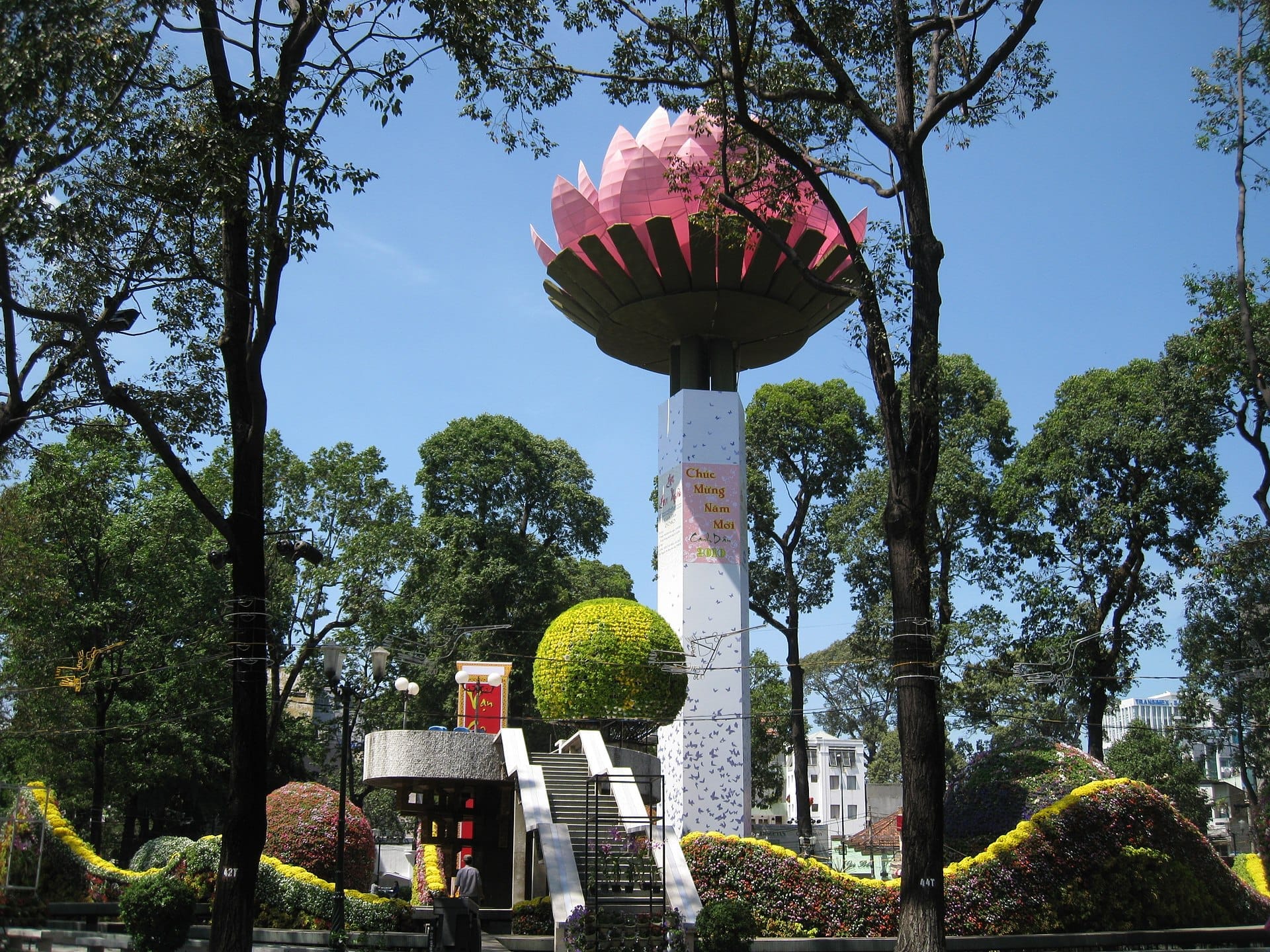
Turtle Lake Roundabout, formally known as Hồ Con Rùa or Công trường Quốc Tế (International Square), sits at the convergence of three streets in District 3. It is not a lake in the conventional sense. At its center is a raised circular platform supporting a concrete column monument, surrounded by a shallow decorative pool and ringed by seating terraces. Traffic circles it continuously, which gives the square an island-within-the-city quality that residents seem to relish.
The name comes from a turtle statue that once sat at the base of the central pillar. That statue was removed in 1978, but the nickname stuck so firmly that few people today would recognize it by its official name. Ask a local for Công trường Quốc Tế and you may get a blank stare. Say Hồ Con Rùa and they will point you immediately in the right direction.
💡 Local tip
The easiest approach is by Grab from District 1 — it takes around 10 minutes and drops you directly at the roundabout. Crossing the street on foot requires patience: there are no pedestrian signals, so wait for a natural gap in traffic and move at a steady pace.
A History Layered in Concrete and Circumstance
The site has held something of civic importance since the French colonial era. A water tower was constructed here in 1878, which was later replaced by a small lake and monument in 1921. That infrastructure was eventually cleared away, and in 1969 architect Nguyễn Kỳ unveiled the monument that stands today: a slender concrete column rising from the pool platform, flanked by a ring of curved colonnades that were added during renovations between 1970 and 1974.
There is also a Feng Shui dimension to the square's story. Local lore connects this spot to the ancient citadel gates of Saigon and suggests the turtle — a Vietnamese symbol of longevity and stability — was placed here deliberately to anchor the city's spiritual geography. Whether or not one subscribes to that reading, it explains why the turtle's removal in 1978 was felt as more than a minor aesthetic change.
The square sits near Notre Dame Cathedral and Reunification Palace, both roughly ten minutes on foot — which makes this stretch of District 3 one of the more historically dense corridors in the city. If you are building a walking route through the French Quarter remnants, Turtle Lake fits naturally as a mid-route pause.
Tickets & tours
Live prices and dates from our booking partner. If you book, we may earn a commission at no extra cost to you.
Private full-day trip from Ho Chi Minh City to Mekong Delta
From 52 €Instant confirmationFree cancellationLandmarks of Ho Chi Minh City half-day tour
From 33 €Instant confirmationFree cancellationCu Chi tunnels guided experience from Ho Chi Minh City
From 33 €Instant confirmationFree cancellationHalf-day Cu Chi Tunnels guided tour from Ho Chi Minh City
From 21 €Instant confirmationFree cancellation
How the Square Changes Through the Day
Early mornings, from around 6:30 to 9 AM, are when Turtle Lake feels most authentically local. Older residents come for exercise, slow walks around the outer ring, and quiet conversation on the stone benches. The surrounding streets are relatively calm, the air has not yet thickened with exhaust, and the light hits the pale concrete column at a low angle that makes it look more photogenic than it does at midday.
By late morning the crowd thins. The square sits relatively quiet through the hottest part of the afternoon, when sensible Saigon residents retreat indoors. The benches are still there, and the pool's low concrete edge provides shade-free seating — but this is not an hour for leisurely exploring unless you are well hydrated and heat-tolerant.
Evening is the square's prime time. From around 5 PM onward, food vendors position themselves on the surrounding pavements and the nearby alleys fill with the smell of grilled corn, sugarcane juice, and bánh tráng trộn (a rice paper salad snack popular with students). The surrounding café terraces, some of which overlook the roundabout directly, fill with young people ordering drinks and staying for hours. Street noise increases, scooters weave more densely, and the whole scene acquires the informal energy that Saigon evenings are known for.
ℹ️ Good to know
In 2023, the area around the roundabout was developed further as a pedestrian-friendly zone, with improved paving and lighting on the inner island. The renovation makes evening visits noticeably more comfortable than they were a few years ago.
Street Food at the Roundabout
Turtle Lake has its own small street food ecosystem, separate from the larger scenes at Bến Thành Market or the backpacker strip. The vendors here cater almost entirely to locals, which keeps quality honest and prices low.
Look for carts selling bánh tráng nướng (grilled rice paper topped with egg, dried shrimp, and green onion), fresh coconut, and corn on the cob brushed with butter and dried shrimp paste. Several small cafés and tea houses are tucked into the shophouses facing the roundabout, with seating that faces the monument — a good option if you want to sit somewhere cool and watch the traffic and foot traffic simultaneously.
For a broader sense of Ho Chi Minh City's food landscape, the Ho Chi Minh City street food guide maps out where to eat across the different districts and neighborhoods.
Photography and Practical Walkthrough
The monument itself — a tapered concrete pillar with a flared crown, surrounded by low curved colonnades — is not conventionally beautiful, but it is genuinely interesting as an artifact of late-1960s South Vietnamese civic architecture. It reads differently depending on the hour. At dawn, with soft light and almost no traffic, it photographs cleanly. At dusk, with motorbikes streaming past in all directions and vendor lights flicking on, it photographs dynamically.
To reach the central island, you cross the roundabout on foot — there are no formal crossings with signals, so watch for a lull in the circular traffic flow and cross in one confident move. Once inside the island perimeter, a short flight of stairs leads up to the platform level. From up there, the surrounding streetscape of low-rise shophouses and larger apartment blocks gives a readable sense of how District 3 is structured compared to the denser high-rise core of District 1.
For accessibility: the stairs to the platform level are unavoidable if you want to reach the central monument. The outer ring of the square, however, is flat and reachable from the surrounding streets, and the food vendors and café seating are all at street level.
Who Will Get the Most Out of Turtle Lake
This is not an attraction that rewards a rushed visit. Travelers who are working through a packed itinerary of major landmarks, checking off the War Remnants Museum and Reunification Palace in a single morning, may find little reason to stop here. The monument is modest, there is no exhibition, and there are no guided tours.
But for anyone who wants to see how Saigon residents actually use public space — who sits where, what they eat, how they interact — Turtle Lake offers that in concentrated form. It is particularly good for slow travelers, repeat visitors who already have the major sites covered, and anyone who walks the District 3 corridor between the cathedral and the old French Quarter.
Families with young children will find the square manageable and low-pressure, though crossing the roundabout with small children requires extra care. Solo photographers and itinerary planners building a walking day through District 3 will find it fits naturally into a route without requiring a dedicated trip.
Insider Tips
- The cafés on the Phạm Ngọc Thạch side of the roundabout often have upper-floor seating that looks directly down onto the square — a better photography angle than ground level, and a cooler place to wait out the afternoon heat.
- If you visit in the evening, look for the bánh tráng trộn vendors: it is a cold, tangy, addictive rice paper snack that rarely appears on tourist restaurant menus and costs next to nothing.
- The square is rarely listed in standard tour itineraries, which means weekday mornings are genuinely quiet. Come then if you want the monument to yourself for photographs.
- A future metro station is planned beneath the square for Lines 1 & 4, though construction timelines for Ho Chi Minh City's metro network have shifted repeatedly. Check current status before your trip if you are planning transit routes.
- From here, the walk south along Phạm Ngọc Thạch toward Notre Dame Cathedral takes about 10 minutes and passes several French-era buildings still in active use as offices and cultural institutions — a worthwhile detour before or after visiting the square.
Who Is Turtle Lake Roundabout For?
- Slow travelers who want to observe everyday Saigon life rather than tick off landmark lists
- Photographers looking for a mix of architecture, street food vendors, and candid local scenes
- Visitors building a walking day through District 3's French-era corridor
- Families wanting a low-cost, low-pressure stop with food options immediately at hand
- Repeat visitors to Ho Chi Minh City who have the major museums covered and want something quieter
Nearby Attractions
Other things to see while in District 3:
- Tan Dinh Church (Pink Church)
Built in 1876 and painted its signature shade of rose pink in 1957, Tan Dinh Church is one of Ho Chi Minh City's most photographed religious landmarks. Located on Hai Ba Trung Street in District 3, it offers a quieter, more genuine alternative to the city's more tourist-heavy churches, with free admission and a striking Gothic-Romanesque bell tower rising 52.6 metres above the street.
- Vĩnh Nghiêm Pagoda
Built between 1964 and 1971, Vĩnh Nghiêm Pagoda is one of Ho Chi Minh City's most architecturally significant religious sites. Its 7-story, 40-metre tower anchors a 6,000 m² campus that offers genuine spiritual atmosphere without the tourist crowds of more central attractions. Entry is free.
- War Remnants Museum
The War Remnants Museum in District 3 is the most emotionally demanding attraction in Ho Chi Minh City, and one of the most important. Housing photographic archives, military hardware, and documentation of wartime consequences, it draws hundreds of thousands of visitors annually for good reason. This guide tells you what to expect, how long to allow, and how to approach the experience with the gravity it deserves.
Planning a trip? Discover personalized activities with the Nomado app.