Tan Dinh Church: Saigon's Pink Church in District 3
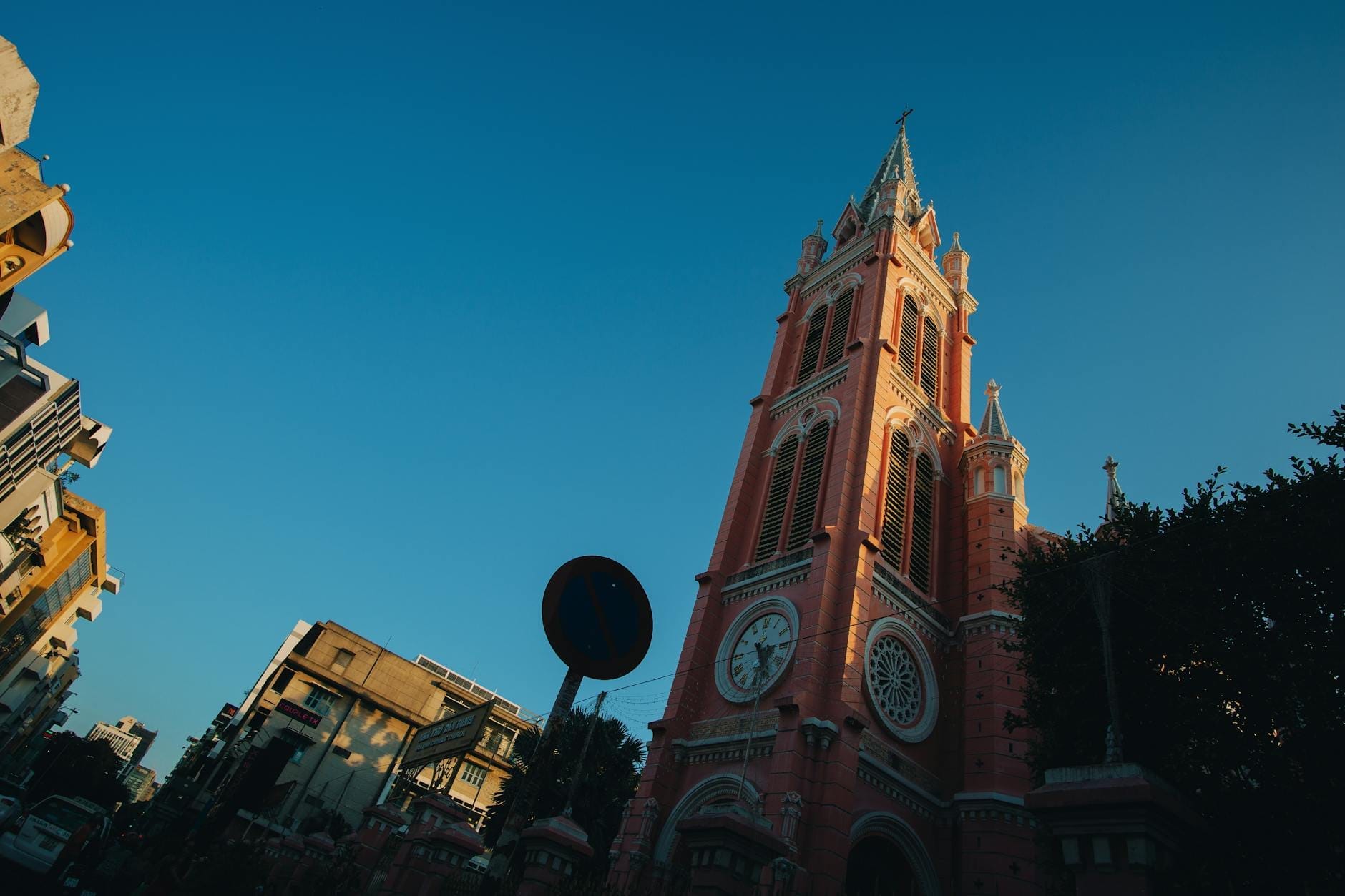
Built in 1876 and painted its signature shade of rose pink in 1957, Tan Dinh Church is one of Ho Chi Minh City's most photographed religious landmarks. Located on Hai Ba Trung Street in District 3, it offers a quieter, more genuine alternative to the city's more tourist-heavy churches, with free admission and a striking Gothic-Romanesque bell tower rising 52.6 metres above the street.
Quick Facts
- Location
- 289 Hai Ba Trung Street, District 3, Ho Chi Minh City
- Getting There
- 3 km north of Ben Thanh Market; grab taxi, ride-hail app, or motorbike taxi from District 1
- Time Needed
- 30–45 minutes for exterior and courtyard; longer if attending mass
- Cost
- Free admission
- Best for
- Architecture lovers, photography, quiet reflection, and travellers curious about Saigon's colonial religious history
- Official website
- http://www.giaoxutandinh.net
What Is Tan Dinh Church?
Tan Dinh Church, officially named Nhà thờ Thánh Tâm Chúa Giêsu (Church of the Sacred Heart of Jesus), is the second-largest Catholic church in Ho Chi Minh City and one of the oldest, with its foundation dating to the 1870s and its inauguration in December 1876. It sits on Hai Ba Trung Street in District 3, roughly three kilometres north of the city centre, in a neighbourhood that feels distinctly residential compared to the tourist-dense streets of District 1.
What makes the church immediately recognisable is its colour. In 1957, the entire facade was painted in a deep, saturated shade of rose pink that has become the building's defining identity. Combined with the Gothic-Romanesque architecture imported by French colonial builders, the result is something genuinely unusual: a European cathedral silhouette rendered in a colour more commonly associated with a candy shop. It reads as striking rather than kitschy in person, particularly in morning light.
The church sits in District 3, a quieter and greener part of the city centre that rewards slow exploration on foot or by motorbike. It pairs naturally with the elegant streets and heritage villas nearby, and it makes a logical stop on any broader tour of Ho Chi Minh City's historic landmarks.
Architecture and History
Construction on the church began in the 1870s during the French colonial period, and the building was formally inaugurated in December 1876. It underwent significant expansions in 1898 and again between 1928 and 1929, when the bell tower was added, rising to a height of approximately 52.6 metres and capped with a bronze cross standing 3 metres tall. The tower is the most visible element from the street and gives the church a presence that exceeds its surroundings.
The architectural style blends Gothic verticality with Romanesque rounded arches, a combination common in French colonial religious architecture from the late nineteenth century. The interior reportedly features Italian marble, imported decorative elements, and stained glass that diffuses coloured light across the nave during morning services. Visitors should note that access is typically limited to the entrance gate and immediate forecourt area; the full interior may not always be open during non-service hours.
For context on how this fits into Saigon's broader religious heritage, it's worth comparing with the more famous Notre Dame Cathedral in District 1, which was built around the same era and is currently undergoing restoration. Tan Dinh offers a similar architectural experience with significantly fewer tour groups.
Tickets & tours
Live prices and dates from our booking partner. If you book, we may earn a commission at no extra cost to you.
Tan Son Nhat International Airport Business Lounge Service
From 26 €Instant confirmationFree cancellationTan Son Nhat International Airport Fast Track with SIM Card Option
From 25 €Instant confirmationFree cancellationPrivate Transfer Tan Son Nhat Airport to or from Mui Ne
From 185 €Instant confirmationFree cancellationGuided tour Long Tan battlefield memorial with lunch
From 124 €Instant confirmationFree cancellation
What the Visit Actually Looks Like
💡 Local tip
Arrive between 8:00 AM and 11:00 AM on a weekday for the best light and the fewest visitors. The pink facade catches direct sunlight from the east in the morning, which makes a significant difference for photography.
The approach along Hai Ba Trung Street gives little warning before the church appears. You round a corner and the pink tower is simply there, rising above the traffic and roadside trees with an incongruous grandeur. The forecourt is modest, framed by a low gate, with enough space to step back and frame the full facade. On quiet mornings, the soundscape is mostly birds in the courtyard trees and distant motorbike traffic rather than the tourist shuffle you get near the central landmarks.
The facade rewards close inspection. The surface texture of the painted stonework, the carved detailing around the arched windows, and the layering of the tower floors give the building depth that photographs don't fully capture. The bronze cross at the top is visible from several blocks away. At street level, you'll often see local parishioners arriving for daily mass, older residents sitting near the entrance, and occasionally school groups from the neighbourhood.
Interior access depends on the time of day and whether a mass is in progress. Visitors are not permitted inside during services, which is standard practice for active places of worship. When the interior is accessible, the scale and the quality of the imported marble and stained glass are worth the look. If you find the gate closed, the exterior alone justifies the visit.
Visiting Hours and Practical Access
Visiting hours vary; search results indicate Monday–Friday access with restricted Saturday afternoon visits and Sunday closures for non-worshippers, though specific times are not consistently published in official sources, as the weekend schedule is reserved for the parish community.
⚠️ What to skip
Do not visit on Sunday expecting access. Sunday is a full church day for the congregation and the building is not open for tourist visits. Saturday morning is also restricted after midday.
Getting here from the city centre is straightforward. From Ben Thanh Market or the core of District 1, the journey takes around 10 to 15 minutes by ride-hail app (Grab is the dominant platform) or motorbike taxi. Walking from the Dong Khoi area takes around 25 to 30 minutes along Hai Ba Trung Street and makes for a pleasant route through an increasingly residential stretch of the city. There is no dedicated metro station nearby; bus options exist but routes change, so ride-hailing is the most reliable approach for visitors.
If you're combining this with other sites in the area, consider pairing it with a walk through the streets near Turtle Lake or crossing back into District 1 for lunch along Dong Khoi Street. The church also sits within reasonable distance of several District 3 heritage buildings.
Photography: Angles, Light, and What Not to Miss
Morning light from approximately 8:00 AM to 10:00 AM strikes the east-facing facade directly, deepening the pink to a near-coral tone and eliminating the flat midday wash that makes afternoon shots look overexposed. The best position for a full facade shot is from the opposite side of Hai Ba Trung Street, which is wide enough to capture the entire tower without distortion. A wide-angle lens or a phone held horizontally is sufficient for most purposes.
The bell tower photographs particularly well from a slight diagonal angle, which reveals the layering of the four floors. Detail shots of the carved stonework around the windows and the arched entrance are worth taking in the morning before direct sun flattens the texture. Note that photography is permitted in the designated exterior areas; respect any signage or staff guidance regarding what is restricted inside.
ℹ️ Good to know
At evening mass hours (8:00 PM to 9:00 PM), the exterior lighting gives the pink facade a warm, amber-tinted glow that is distinctly different from the daytime look. If you have time for two visits, the evening window is worth a return trip.
Context: How It Compares to Other Saigon Churches
Notre Dame Cathedral is the default recommendation in most guidebooks, and it is an impressive building. But it has been partially scaffolded for restoration work in recent years, the forecourt crowds are dense on weekends, and the overall experience is compressed by foot traffic. Tan Dinh Church offers a functionally similar architectural experience, a more striking colour, comparable historical depth, and a fraction of the visitor pressure.
That said, Tan Dinh is an active parish church serving a real community, not a heritage tourist attraction. Services are regularly held, the interior is not always accessible, and the atmosphere shifts noticeably when the congregation is present. This is not a drawback. It is a reminder that the city's colonial-era religious buildings are still in use, which gives them a different quality than preserved-but-inert monuments.
Travellers who want a broader picture of Ho Chi Minh City's religious architecture should also consider the Jade Emperor Pagoda for a contrast in tradition, or the Vinh Nghiem Pagoda for a mid-twentieth-century Buddhist counterpoint.
Who Should Skip This Attraction
Travellers with very limited time who are trying to cover the maximum number of District 1 landmarks in a single day may find the detour to District 3 difficult to justify. The church is photogenic and historically significant, but the exterior visit is short, and if the interior is closed, there is limited additional content. If your itinerary is already full and you are not specifically interested in religious architecture or colonial heritage, it is reasonable to leave this one out.
Visitors with mobility considerations should note that information about wheelchair access is limited. The church was built in the 1870s and expanded piecemeal; the entrance area may involve steps, and the interior layout is not confirmed to be fully accessible. Contact the church directly at +84 28 3829 0093 before planning a visit if accessibility is a requirement.
Insider Tips
- Visit on a weekday morning, not the weekend. Sunday is closed entirely to non-worshippers, and weekday mornings between 8:00 and 11:00 AM give you the best light and the fewest other visitors simultaneously.
- The evening visiting window (8:00 PM to 9:00 PM, weekdays) is rarely mentioned in travel guides. The church is lit at night and the exterior looks completely different under artificial amber lighting, making it worth a second visit if you're nearby for dinner.
- Stand on the opposite pavement on Hai Ba Trung Street rather than pressing up against the gate. The street is wide enough that you can take in the full tower height comfortably, which gives the building its proper scale.
- If you arrive and mass is in progress, don't leave immediately. Wait near the entrance and you'll often see the interior briefly when the doors open between services. It's a natural pause that costs nothing and reveals the stained glass and marble that most visitor photos miss.
- Combine the visit with a slow walk south along Hai Ba Trung Street toward District 1. The route passes through a stretch of the city that feels genuinely residential, with local coffee shops and street food stalls that see almost no tourist traffic.
Who Is Tan Dinh Church (Pink Church) For?
- Architecture enthusiasts interested in French colonial religious buildings
- Photographers who want a striking, colour-saturated subject with manageable crowds
- Travellers exploring District 3 who want historical context alongside quieter streets
- Anyone who found Notre Dame Cathedral overcrowded or partially obscured by scaffolding
- Visitors with a full Ho Chi Minh City itinerary who want a quick, high-impact stop between District 1 and further north
Nearby Attractions
Other things to see while in District 3:
- Turtle Lake Roundabout
Tucked inside a busy roundabout in District 3, Turtle Lake (Hồ Con Rùa) is a free public square where Saigon residents come to eat, socialize, and unwind. It carries over a century of layered history, from a French colonial water tower to a South Vietnamese monument, and today draws both locals and curious visitors who wander up from the cathedral end of Phạm Ngọc Thạch street.
- Vĩnh Nghiêm Pagoda
Built between 1964 and 1971, Vĩnh Nghiêm Pagoda is one of Ho Chi Minh City's most architecturally significant religious sites. Its 7-story, 40-metre tower anchors a 6,000 m² campus that offers genuine spiritual atmosphere without the tourist crowds of more central attractions. Entry is free.
- War Remnants Museum
The War Remnants Museum in District 3 is the most emotionally demanding attraction in Ho Chi Minh City, and one of the most important. Housing photographic archives, military hardware, and documentation of wartime consequences, it draws hundreds of thousands of visitors annually for good reason. This guide tells you what to expect, how long to allow, and how to approach the experience with the gravity it deserves.
Planning a trip? Discover personalized activities with the Nomado app.