Tram 28E: Lisbon's Most Iconic Ride (And How to Actually Enjoy It)
The Elétrico 28E is Lisbon's most photographed tram route, threading through centuries-old neighborhoods on wooden carriages from the 1930s. It's part genuine transit, part rolling viewpoint. Here's what the experience really involves, and how to make the most of it.
Quick Facts
- Location
- Praça Martim Moniz to Campo de Ourique (Prazeres), passing through Alfama, Baixa, Chiado, and Estrela
- Getting There
- Walk from Figueira Square to Martim Moniz (eastern terminus); boards marked 28E
- Time Needed
- 45 minutes end-to-end; allow more if you plan to hop off and reboard
- Cost
- Single ticket ~€3 (via Carris); free with Lisbon Card
- Best for
- First-time visitors wanting a geographic overview; architecture lovers; those with limited mobility for steep hills
- Official website
- www.carris.pt/en/travel/carreiras/28e
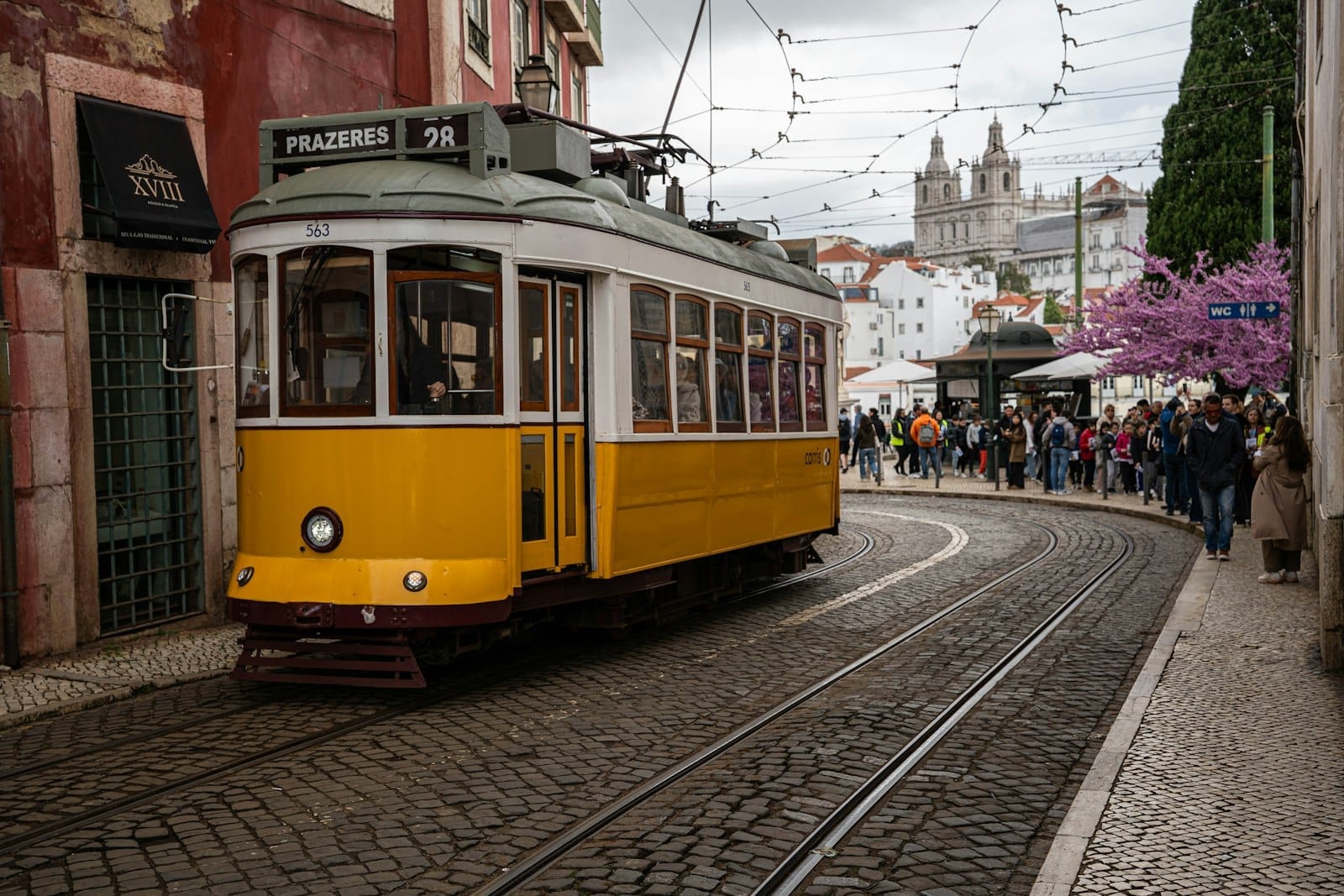
What Tram 28E Actually Is
The Elétrico 28E is a fully operational public transit line run by Carris, Lisbon's city transport authority. It is not a tourist train or a heritage ride in the theme-park sense. The same wooden Remodelado carriages that carry tourists also carry elderly residents heading to the market, schoolchildren, and locals running errands. That dual identity is exactly what makes it worth riding.
The tram covers 7 kilometers from Praça Martim Moniz in the east to Campo de Ourique (Prazeres) in the west, cutting through some of Lisbon's most geographically and historically distinct neighborhoods in a single ride. In roughly 45 minutes, the route passes through Graça, dips into Alfama, crosses the flat grid of Baixa, climbs into Chiado, and rolls through Estrela toward the Prazeres cemetery terminus. No other transit line in the city covers this much character per kilometer.
💡 Local tip
Board at Praça Martim Moniz (the eastern terminus) rather than midway along the route. You are guaranteed a seat, and you get the full experience without the stress of finding space on a packed car.
The History Behind the Yellow Cars
Lisbon's tram network dates to 1873, when animal-drawn cars first rolled through the city. Electrification came in 1901, and what became the 28E route was inaugurated in 1914. The Remodelado carriages now running the line were built in the 1930s, though many were substantially refurbished in later decades. They run on narrow-gauge 900 mm track, which is why they can squeeze through lanes in Alfama that look too tight for a car.
These are not replica trams manufactured to look old. The wooden interiors, the leather straps hanging from the ceiling for standing passengers, the mechanical bell the driver rings at tight corners: all of it is original in spirit if not always in individual component. Lisbon kept this network running while other European cities ripped up their tracks in the mid-20th century, partly out of budget constraints and partly because the steep, narrow streets of Alfama left no practical alternative.
The route passes directly in front of the Sé Cathedral, skirts the walls of São Jorge Castle high above, and rolls past the Basílica da Estrela near its western terminus. The geography the tram covers is effectively a condensed history of Lisbon's urban layers.
Tickets & tours
Live prices and dates from our booking partner. If you book, we may earn a commission at no extra cost to you.
Hills Tramcar Tour in Lisbon
From 20 €Instant confirmationFree cancellationLisbon bus and tram hop-on hop-off combined tickets
From 38 €Instant confirmationFree cancellationAll in one in Lisbon bus, tram and boat
From 47 €Instant confirmationFree cancellationBelem and Modern Lisbon bus hop-on hop-off combined tickets
From 28 €Instant confirmationFree cancellation
The Ride Itself: What You See and Feel
Leaving Martim Moniz, the tram climbs almost immediately. The grade is steeper than it looks from street level, and you can hear the motor strain on the ascent into Graça. Through the windows, laundry hangs between buildings close enough to touch. Residents sit on stoops. The tram's bell rings at nearly every corner, not for show but out of necessity: some bends are sharp enough that pedestrians cannot see the car coming.
Descending into Alfama, the ride becomes a sensory layering. The smell of charcoal from a grillhouse drifts through the open windows. The narrow streets amplify the clatter of the wheels on the joins between track sections. At the Largo das Portas do Sol stop, you are a short walk from one of Lisbon's finest river viewpoints. Most tourists stay on the tram; getting off here and catching the next one later is the smarter move.
If you do step off in Alfama, the Miradouro das Portas do Sol and the nearby Miradouro de Santa Luzia are within a two-minute walk of the tram stop. Both offer unobstructed views over the terracotta rooftops toward the Tagus.
As the tram crosses into Baixa and then ascends to Chiado, the character changes sharply. The tight medieval lanes give way to wider 18th-century streets, and the crowd on board shifts from curious tourists to locals with shopping bags. By the time the tram reaches Estrela. If you are riding after dark, factor this into your plans.
Crowds: When to Ride and When to Avoid
Between roughly 10 AM and 6 PM in summer, Tram 28E is frequently at capacity by the time it reaches its second or third stop. Passengers board at Martim Moniz with seats and then spend the rest of the ride watching people unable to squeeze on at intermediate stops. This is not an exaggeration: during July and August, some stops see trams pass without stopping because there is simply no room.
⚠️ What to skip
Pickpocketing is a real risk on the 28E, particularly on crowded midday trams in summer. Keep valuables in a front pocket or zipped bag. The tram is not dangerous, but the density of distracted tourists makes it a known target area.
The best windows to ride are before 9 AM and after 7 PM. Early morning, the tram carries workers rather than tourists. The light is also better for photography at that hour, with long shadows and warm tones across the facades of Alfama. Evening rides, particularly in the golden hour before sunset, offer a calmer experience with a better chance of a window seat. The tram operates daily, so neither weekends nor holidays change the calculation much; time of day is everything.
In winter, particularly November through February, crowds thin considerably. The experience is more authentic, and you will often find the carriage less than half full at midday. Rain does not stop the service, though wet cobblestones do extend journey times slightly as the driver takes corners more carefully.
Practical Details: Fares, Boarding, and Accessibility
Tram 28E is operated by Carris and uses the standard Lisbon public transport fare system. A single ticket costs approximately €3, purchased from the driver on board. If you have a Lisbon Card, the ride is included. The Navegante card (rechargeable transit card) is another option if you are staying several days and plan to use buses and metro as well.
The Remodelado carriages are not wheelchair accessible. Entry requires climbing two or three steps, the interior is narrow, and standing room is limited. Travelers with mobility difficulties who still want to cover the same route might consider a taxi or Uber, which can follow much of the same path through Alfama and into Chiado.
There is no app-based tracking for individual trams that is consistently reliable, so allow buffer time if you are planning to catch it to a specific stop for another commitment. Frequency varies, but during peak hours trams generally run every 10 to 15 minutes from the terminus.
Photography and What to Bring
The tram itself photographs best from the outside, not from inside it. If you want the classic image of a yellow tram grinding around a tight corner in Alfama, position yourself at one of the sharp bends near the Largo da Sé or on the ascent above Portas do Sol and wait. Trams pass frequently enough that you will not wait long. A 50mm equivalent lens is ideal; anything wider distorts the proportions of the narrow lanes.
From inside the tram, shoot through the open windows rather than the glass. The texture of the wooden interior frames, the worn leather straps, and the driver's cabin all make for compelling close-up images. The most photographed tram corners in Lisbon are on the Alfama descent, particularly near the Sé Cathedral.
Wear comfortable, closed-toe shoes with grip. If you are standing during the ride, the tram lurches on inclines and corners, and the leather straps are the only handhold. Light layers work well year-round since the interiors can feel warm when full but the open windows let in cool air at speed.
Is It Worth It? An Honest Assessment
Tram 28E is not a comfortable, predictable experience at peak hours. The carriages are small, sometimes overcrowded, and the route does not move quickly. If your primary goal is efficient transit from one neighborhood to another, a taxi or the metro will serve you better for most journeys.
What the tram offers instead is spatial orientation and atmosphere. Riding it end-to-end once, especially on your first day in Lisbon, gives you a geographic intuition for how the city's neighborhoods connect that no map fully conveys. You understand, in a physical way, why Alfama feels ancient and Chiado feels elegant, and how Baixa sits between them as a rational grid imposed on an irrational terrain.
Travelers who find crowds stressful, who have mobility limitations, or who have already spent significant time in Lisbon may find the 28E less compelling. But for anyone on a first visit, pairing the tram ride with a walk through Alfama's streets afterward makes for one of the more complete half-days the city offers.
Insider Tips
- Board at Praça Martim Moniz, the eastern terminus. It is the only stop where a seat is virtually guaranteed, and you get the full 7-kilometer route rather than joining midway in a crowd.
- If you want a seat on the right side of the tram heading west, you get slightly better views of the Alfama hillside facades. Left side gives you glimpses down toward the Tagus between buildings.
- The tram pauses at certain stops for a minute or two, particularly at Largo da Sé. Use these moments to step off briefly for a photo of the exterior, then reboard before it departs. The driver does not wait, but the pause is long enough if you are quick.
- If you are riding late, plan accordingly or take a taxi the remaining distance.
- The tram passes the Feira da Ladra flea market area on Tuesday and Saturday mornings. If you time your ride to arrive at Santa Apolónia early, you can walk to the market and catch the tram back afterward.
Who Is Tram 28 For?
- First-time visitors who want a geographic overview of Lisbon's neighborhoods in one continuous journey
- Architecture and heritage enthusiasts drawn to the 1930s Remodelado carriages and the pre-modern urban fabric they navigate
- Travelers whose itinerary takes them from Alfama to Chiado or Estrela, making the tram both scenic and practical
- Photographers working in the early morning or golden hour, when light on the Alfama facades is at its warmest
- Visitors who want to experience Lisbon as residents use it, on the same tram, at the same pace, through the same streets
Nearby Attractions
Other things to see while in Alfama:
- Feira da Ladra
Feira da Ladra is Lisbon's oldest and most atmospheric flea market, spreading across Campo de Santa Clara in the Alfama district every Tuesday and Saturday. Free to enter, historically rich, and genuinely unpredictable, it rewards early arrivals and curious browsers willing to dig past the obvious.
- Miradouro das Portas do Sol
Perched above the rooftops of Alfama, Miradouro das Portas do Sol offers one of Lisbon's most layered views: the Tagus River, the dome of São Vicente de Fora, and the terracotta maze of the city's oldest neighborhood. It's free, open around the clock, and rewards visitors who time their visit right.
- Miradouro de Santa Luzia
Perched above the rooftops of Alfama, Miradouro de Santa Luzia offers a wide terrace shaded by a bougainvillea-draped pergola, extraordinary views across the Tagus estuary, and two landmark azulejo panels that tell the story of Lisbon before its greatest disaster. Entry is free, and the terrace is open 24/7.
- National Pantheon
The National Pantheon, housed inside the 17th-century Igreja de Santa Engrácia in Alfama, is one of Lisbon's most architecturally striking monuments. With free admission, a soaring Baroque dome, and a rooftop terrace at 40 metres, it rewards visitors who make the uphill effort. Inside rest some of Portugal's most celebrated figures, from fado queen Amália Rodrigues to football legend Eusébio.
Planning a trip? Discover personalized activities with the Nomado app.