Feira da Ladra: Inside Lisbon's over 750-year-old Flea Market
Feira da Ladra is Lisbon's oldest and most atmospheric flea market, spreading across Campo de Santa Clara in the Alfama district every Tuesday and Saturday. Free to enter, historically rich, and genuinely unpredictable, it rewards early arrivals and curious browsers willing to dig past the obvious.
Quick Facts
- Location
- Campo de Santa Clara, Alfama, Lisbon
- Getting There
- Tram 28 (stop near Campo de Santa Clara) or Santa Apolónia Metro station
- Time Needed
- 1.5 to 3 hours depending on how seriously you browse
- Cost
- Free entry; budget varies by purchases
- Best for
- Curious travelers, antique hunters, photography, Sunday-style slow mornings (on a Tuesday or Saturday)
What Feira da Ladra Actually Is
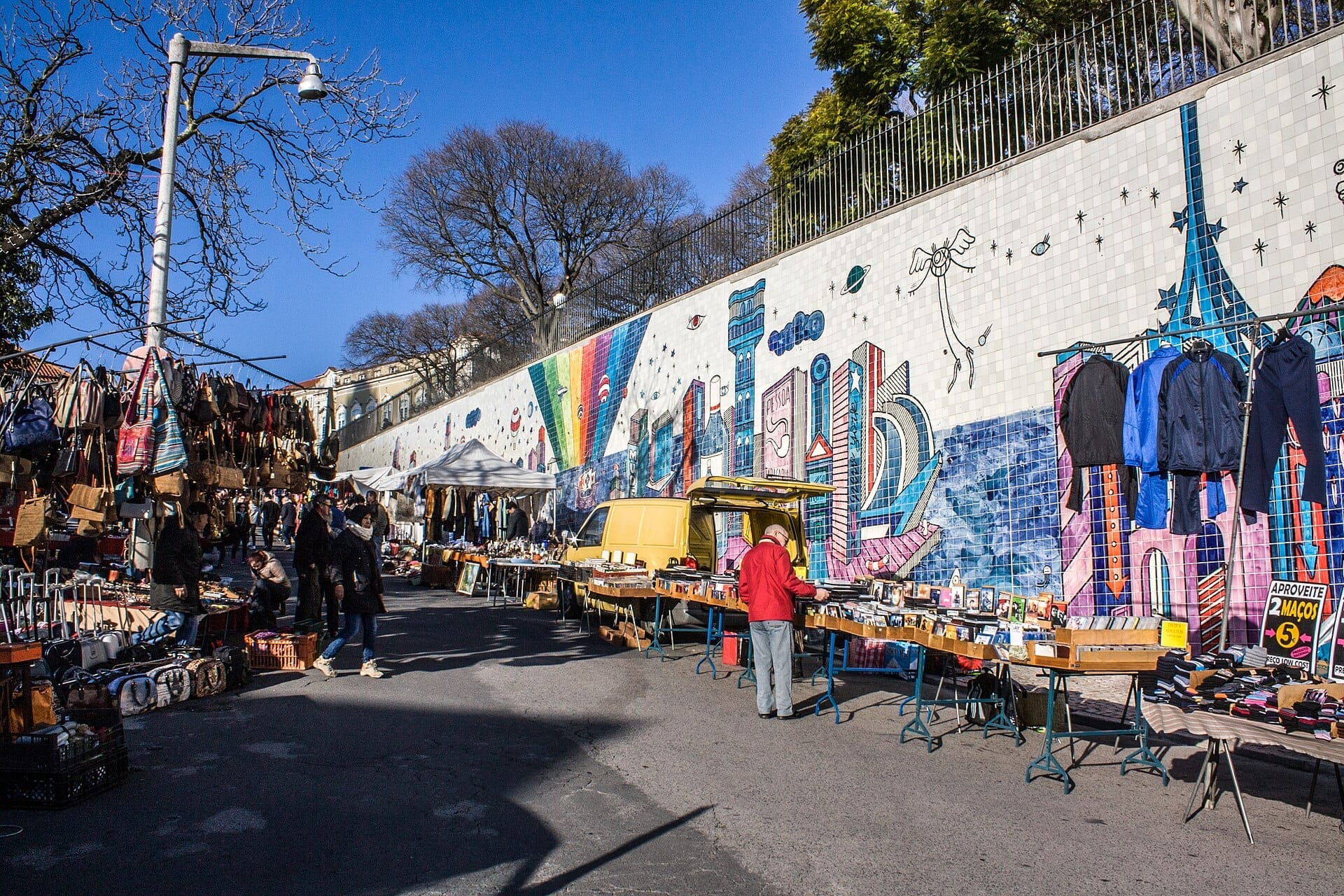
Feira da Ladra translates, loosely, as the Thieves' Market, a name that has stuck since it was first mentioned by name in the 17th century, though the market itself is far older. Its origins trace to 1272, a free trading market that predates much of the city's recognizable architecture. It settled permanently at its current home on Campo de Santa Clara in 1882, and began running on both Tuesdays and Saturdays from 1903. That makes it not just Lisbon's oldest flea market, but one of the oldest continuously operating open-air markets in Europe.
The market spreads across a wide sloping square behind the monastery of São Vicente de Fora, in the upper reaches of the Alfama district. On market days, the square fills with somewhere between 200 and 500 vendors depending on the season, selling everything from cracked porcelain figurines to vinyl records, colonial-era military medals, old Portuguese comic books, second-hand clothing, hand tools, religious icons, and the occasional genuinely valuable antique tucked between junk that no one can quite explain.
💡 Local tip
Arrive by 9 or 10 am for the best selection. Many vendors begin packing up well before the official close, and by 2 pm the market is noticeably thinner. Saturday mornings are larger and more lively than Tuesdays.
The Feel of the Market at Different Times
Early morning is when the market earns its reputation. By 9 am, the light is low and angled across the square, the tiles on surrounding walls catch it, and vendors are still arranging their goods. The atmosphere is quieter and more transactional. Serious collectors and local dealers move quickly through the stalls at this hour, which means both that the best items get picked over fast and that the crowd is more interesting to observe.
By mid-morning, between 10 and 11 am, the square is at its fullest. You can smell coffee drifting from the small cafés near the edge of the square, mixed with the faint dustiness that old cloth and paper always carry outdoors. Vendors sit on folding chairs, occasionally bargaining, occasionally ignoring customers entirely. The pace is unhurried. People bring dogs. Someone is always playing music from a phone propped against a box of cassette tapes.
By early afternoon the energy shifts. The lower-tier vendors pack first, leaving gaps in the layout. The remaining stalls tend to be the more established dealers with proper tables and organized displays. On hot summer days, the square can feel relentlessly sunny with limited shade, which adds urgency to finishing your browsing before noon.
⚠️ What to skip
In July and August, Campo de Santa Clara can get uncomfortably hot by midday. Wear sunscreen, bring water, and plan to finish by noon if you're sensitive to heat.
Tickets & tours
Live prices and dates from our booking partner. If you book, we may earn a commission at no extra cost to you.
Belem and Modern Lisbon bus hop-on hop-off combined tickets
From 28 €Instant confirmationFree cancellationSt. George Castle E-ticket and Audio Tour
From 28 €Instant confirmationLisbon Story Centre entrance tickets
From 7 €Instant confirmationFree cancellationYellow boat river tour
From 24 €Instant confirmationFree cancellation
What You'll Find (and What You Won't)
The inventory at Feira da Ladra resists easy categorization. The upper section of the square, closest to the National Pantheon, tends to attract the more organized antique dealers with glass cases, labeled items, and prices that reflect market awareness. This is where you're most likely to find Portuguese tiles (azulejos), silverware, coins, and framed prints from the 19th and early 20th centuries. These vendors know what they have.
The lower and outer edges of the market are looser and more chaotic. Tables covered with whatever someone has cleared from an apartment, cardboard boxes of cassettes, single shoes, broken electronics, stacks of magazines from the 1970s and 1980s. This is where the unexpected finds happen, but it takes patience and a willingness to crouch and dig. Prices here are generally negotiable, and many vendors price low simply because they want to move items.
One thing the market does not offer in abundance: polished tourist goods. You won't find the kind of standardized azulejo magnets or cork products available in Baixa shops. This is both a strength and a limitation depending on what you're after. If you're looking for a souvenir with a specific appearance, look elsewhere. If you're looking for something genuinely old and Portuguese, this is the right place.
The market sits adjacent to the São Vicente de Fora monastery, which is worth visiting on the same trip. Its rooftop terrace has one of the more underrated panoramic views in Lisbon.
The Square Itself: Campo de Santa Clara
Even on non-market days, Campo de Santa Clara is a pleasant place to visit. The square is flanked on one side by the 17th-century facade of São Vicente de Fora and on another by the dome of the National Pantheon, one of Lisbon's most striking baroque structures. The geometry of the space changes completely when the market is absent, suddenly feeling wider and quieter.
A notable feature that most visitors walk past without noticing: the Jardim Botto Machado, the small garden on the edge of the square, is surrounded by a 188-metre tile mural featuring thousands of hand-painted tiles created by artist André Saraiva. Given that Lisbon is defined in large part by its tile tradition, this is a fitting detail for a market that deals so heavily in old Portuguese objects.
The National Pantheon is directly adjacent and open to visitors on the same morning as the market. Combining the two in one trip is efficient and worthwhile.
Getting There and Getting Around
The market is in the Alfama district, which sits on the eastern hillside of central Lisbon. Getting there requires some navigation. Tram 28E, one of Lisbon's most well-known routes, passes through the area. Santa Apolónia Metro station is also walkable, though the route involves a modest uphill climb. Uber and Bolt are reliable alternatives if you want to avoid the walk.
Driving to the market is not recommended. Parking in this part of Alfama is extremely limited on market days, and the surrounding streets are narrow enough that approaching by car creates more frustration than convenience.
Wear comfortable shoes. The square itself is cobblestoned, and the surrounding streets are uneven. If you plan to walk through Alfama before or after the market, which is a sensible plan, expect more of the same. This is not the place for luggage or a stroller.
ℹ️ Good to know
Campo de Santa Clara is about a 20-25 minute walk from Rossio Square. A downhill walk back through Alfama after the market is more pleasant than the uphill approach.
Photography and Practical Details
Feira da Ladra photographs well in almost any light, but the morning hours offer the best combination of soft light and human activity without overcrowding. The stacked objects, weathered faces, and tile-covered walls provide strong visual material without needing to search for it. Ask before photographing vendors or their goods closely; most are agreeable, but a quick gesture of acknowledgment makes the interaction smoother.
The market is free to enter and there is no formal perimeter, so you drift in and out naturally. Cash is strongly preferred at most stalls. A few of the more established antique dealers may take card payments, but do not count on it. Bring small bills for easier transactions, and treat listed prices as opening offers rather than fixed points.
If you want broader context on Lisbon's tile tradition before visiting, the National Tile Museum is one of the best single-subject museums in the city and pairs well with an Alfama morning.
Who This Market Is Not For
Feira da Ladra is genuinely chaotic and unedited. If you're looking for a curated antique experience with organized displays and guaranteed quality, this market will frustrate you. A portion of what's on offer is simply old junk, and distinguishing it from the good material takes time and some knowledge. Visitors who prefer structured, predictable shopping environments tend to leave underwhelmed.
Mobility constraints are also a real consideration. The cobblestone surfaces and the general layout of Campo de Santa Clara present challenges for wheelchairs and limited-mobility visitors. There is no formal accessibility infrastructure documented at this site.
If you want a more curated, comfortable market experience, Mercado de Campo de Ourique offers a different kind of Lisbon market, more food-focused and more accessible.
Insider Tips
- Tuesday mornings are quieter than Saturday and attract more local dealers than tourists. If you're serious about finding something specific, Tuesday gives you more negotiating room and less competition.
- The stalls closest to the National Pantheon tend to be the most established and organized. Start there if you're looking for azulejos, coins, or silverware, then work your way down toward the outer edges for the more random discoveries.
- Bring cash in small denominations. A 50-euro note will complicate a 3-euro negotiation and may cause a vendor to lose interest entirely.
- The café tables on the eastern edge of the square are a good place to rest and watch the market activity without committing to more browsing. Order a bica (espresso) and take stock before diving back in.
- If a vendor quotes a price that seems high, walking away slowly is often more effective than counter-offering immediately. Many will call you back within a few steps.
Who Is Feira da Ladra For?
- Antique hunters and collectors willing to spend time digging
- Photographers looking for candid street and market scenes
- Travelers interested in Portuguese history and material culture
- Those combining the market with a morning walk through Alfama
- Budget travelers seeking a free, genuinely local Lisbon experience
Nearby Attractions
Other things to see while in Alfama:
- Miradouro das Portas do Sol
Perched above the rooftops of Alfama, Miradouro das Portas do Sol offers one of Lisbon's most layered views: the Tagus River, the dome of São Vicente de Fora, and the terracotta maze of the city's oldest neighborhood. It's free, open around the clock, and rewards visitors who time their visit right.
- Miradouro de Santa Luzia
Perched above the rooftops of Alfama, Miradouro de Santa Luzia offers a wide terrace shaded by a bougainvillea-draped pergola, extraordinary views across the Tagus estuary, and two landmark azulejo panels that tell the story of Lisbon before its greatest disaster. Entry is free, and the terrace is open 24/7.
- National Pantheon
The National Pantheon, housed inside the 17th-century Igreja de Santa Engrácia in Alfama, is one of Lisbon's most architecturally striking monuments. With free admission, a soaring Baroque dome, and a rooftop terrace at 40 metres, it rewards visitors who make the uphill effort. Inside rest some of Portugal's most celebrated figures, from fado queen Amália Rodrigues to football legend Eusébio.
- São Jorge Castle
Perched on Lisbon's highest hill in the Alfama district, Castelo de São Jorge is a Moorish fortress with roots stretching back over two millennia. It offers some of the city's widest panoramic views, layers of archaeology, and a rare sense of how Lisbon looked before the 1755 earthquake reshaped everything below.
Planning a trip? Discover personalized activities with the Nomado app.