Igreja de São Vicente de Fora: Royal Tombs, Azulejo Cloisters, and Alfama Rooftop Views
Built between 1582 and 1627 on a site consecrated by Portugal's first king, São Vicente de Fora is Lisbon's most architecturally significant church outside Belém. Its cloisters hold one of the world's largest collections of baroque azulejo tile panels, and its rooftop terrace offers a sweeping panorama over Alfama and the Tagus River.
Quick Facts
- Location
- Largo de São Vicente, 1100-472 Lisboa (Alfama)
- Getting There
- Bus 28E, 37, 42, 718, 742, 759, or 794 to Igreja Madre de Deus; or 6-20 min walk from Santa Apolónia train station
- Time Needed
- 1 to 1.5 hours
- Cost
- Paid entry (check official site for current prices in EUR)
- Best for
- History enthusiasts, architecture lovers, azulejo tile admirers, rooftop views
- Official website
- mosteirodesaovicentedefora.com/en/inicio-english
What Is São Vicente de Fora?
The Igreja de São Vicente de Fora, or Church of Saint Vincent Outside the Walls, is one of the most layered monuments in Lisbon. The name refers to its original position beyond the medieval city walls, a detail that still gives you a sense of how far Alfama has grown over the centuries. What stands today is a Mannerist church and monastery complex completed in 1629, built to replace a Romanesque church founded in 1147 by Afonso Henriques, Portugal's first king, on the very site where Moorish Lisbon fell to the Christian Reconquista.
The church serves as the royal pantheon of the House of Braganza, the dynasty that ruled Portugal from 1640 until the republic was proclaimed in 1910. That alone gives it historical weight that few buildings in the city can match. But São Vicente de Fora earns its place on an itinerary through three distinct experiences: the solemn baroque interior, the cloister corridors lined floor to ceiling with 18th-century azulejo tile panels, and the rooftop terrace with a panoramic view that rivals any of Lisbon's formal miradouros.
💡 Local tip
Arrive before 10am on a weekday if you want the cloisters to yourself. By mid-morning, group tours arrive and the narrow tile corridors become crowded. The light in the cloisters is also better in the morning hours.
The Architecture and the Façade
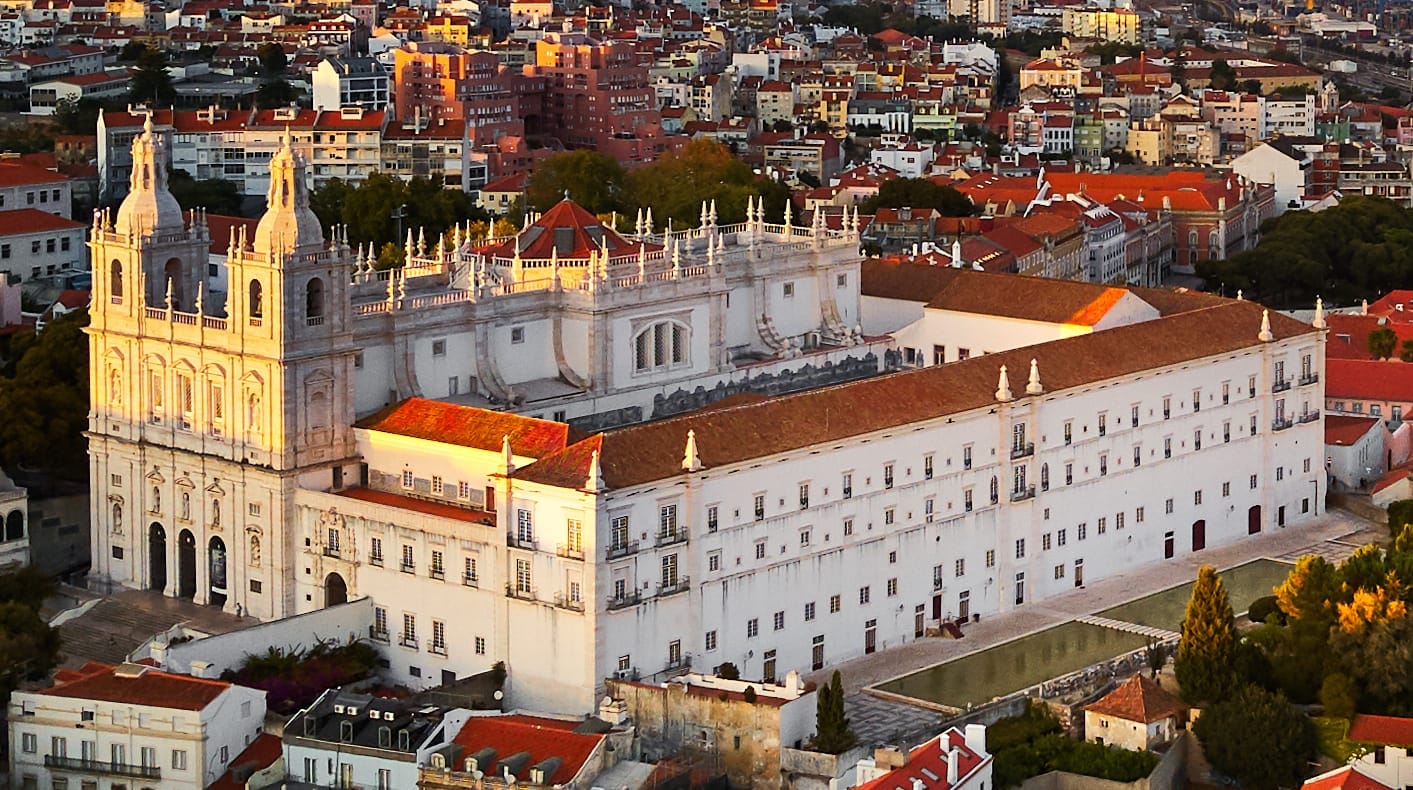
The church was designed by the Italian architect Filippo Terzi and construction ran from 1582 to 1627, making it a defining example of Portuguese Mannerism. The façade is composed in a sober, geometric style that deliberately avoids the ornamental excess of Manueline architecture. Two symmetrical towers flank the entrance, and the proportions are confident rather than showy. It reads as serious and institutional, which suits a building that was both a place of royal burial and a monastery of the Augustinian Canons Regular.
Standing at Largo de São Vicente in the late afternoon, the limestone façade catches warm light in a way that softens the severity of the design. The square in front is small and often quiet compared to the tourist density a few streets down toward the Sé Cathedral. Street vendors occasionally set up on the steps, and on Saturday mornings the nearby Feira da Ladra flea market draws a different kind of foot traffic to the area, filling the lanes between São Vicente and the National Pantheon with the particular sound of haggling and transistor radios.
The church sits at the northeastern edge of Alfama, where the hillside begins to flatten out slightly before dropping toward the river. Its elevated position means you can spot the twin towers from several points in the lower city, and it forms part of the skyline silhouette that many visitors associate with the eastern horizon of Lisbon.
Tickets & tours
Live prices and dates from our booking partner. If you book, we may earn a commission at no extra cost to you.
Inside the Church: Marble, Gilding, and Royal Silence
The nave interior is tall, single-aisled, and finished in polished marble and dark stone. There is gilded woodwork at the high altar and in the side chapels, but the overall effect is restrained by baroque standards. The church is active, meaning masses are still celebrated here, and this gives it a different atmosphere from purely museum-style monuments. Candles burn in some chapels throughout the day, and the smell of wax and cool stone is present from the moment you step through the door.
The nave is long enough that the high altar seems to recede as you enter. Look up at the barrel-vaulted ceiling, where decorative elements are carved rather than painted. The floor is a patchwork of marble slabs, many of them memorial stones for clergy and benefactors from the monastery's centuries of operation. It takes a few minutes for your eyes to adjust from the bright exterior and begin reading the details.
There is no ambient music or audio tour by default. The church interior is quiet in a way that larger tourist monuments rarely are, which makes it easier to spend time looking at specific details rather than moving through in a crowd-driven shuffle.
The Azulejo Cloisters: The Real Reason to Come
The cloister galleries are where São Vicente de Fora earns serious attention from anyone with an interest in Portuguese decorative arts. The walls are covered almost entirely in large-format blue-and-white azulejo panels dating from the 18th century, depicting scenes from the fables of La Fontaine, hunting scenes, rural landscapes, allegorical figures, and historical narratives. The consistency of the program across two full cloister levels is remarkable, and the total area of tilework is substantial enough to justify the claim that this is one of the most extensive baroque azulejo collections in the world.
The panels are not simply decorative. They were installed with a didactic and narrative purpose, which is common in Portuguese azulejo traditions. If you have already visited the National Tile Museum in Lisbon, you will have the vocabulary to read these panels more fluently. But even without that background, the sheer visual density of the corridors is arresting.
Walk slowly. Each panel rewards close inspection, and the quality of the draftsmanship in the tilework varies from section to section, with some scenes more finely executed than others. The second level of the cloister, accessible via a stone staircase, is generally less visited and gives you a different vantage point over the courtyard, which is planted with a small garden.
ℹ️ Good to know
Photography of the cloisters is permitted. The blue-and-white tiles photograph well in diffuse light, which makes overcast days actually preferable to strong direct sunlight, which creates glare on the glazed tile surfaces.
The Royal Pantheon of the Braganzas
Accessed from the monastery section of the complex, the Braganza pantheon is housed in the former refectory. Here you will find the marble sarcophagi of most of the kings and queens of Portugal's last ruling dynasty, from João IV, who restored Portuguese independence from Spain in 1640, to Manuel II, who went into exile in 1910 and died in London in 1932. The tombs are arranged in a modest room that has none of the theatrical grandeur of, say, the Royal Crypt in Vienna or Westminster Abbey in London. The effect is more intimate and, for that reason, somewhat more affecting.
Two Braganza monarchs are notably absent: Pedro IV (who became Emperor of Brazil) and his daughter Maria II. Several sarcophagi are also reserved for children of the dynasty who died young, and these smaller tombs, placed alongside the adult ones, give the room an unexpected solemnity. Labels identify the occupants, though you will want to have some basic familiarity with Portuguese history to place the names in context.
The Rooftop Terrace and Practical Walkthrough
The rooftop is accessed via stairs from the upper cloister level and requires some navigating. There are no elevators, and the steps are stone and uneven in places. The reward is a terrace that sits level with the domes and gives an unobstructed 180-degree view over the eastern roofscape of Alfama, with the Tagus in the middle distance and, on clear days, the hills of the Arrábida peninsula visible to the south. It is less well-known than the dedicated miradouros in the area, which means it is rarely crowded.
From here you can see the dome of the National Pantheon very clearly, as well as the orange-tiled rooftops that define the Alfama hillside. On Saturday mornings, you can look down over the edge and see the Feira da Ladra market filling the Campo de Santa Clara directly below.
⚠️ What to skip
The rooftop is not suitable for visitors with mobility difficulties or a fear of heights. The final stairs are steep and the terrace balustrade, while present, is not low. Wear shoes with grip on the stone steps.
Allow at least an hour inside the complex. A full visit covering the church interior, both cloister levels, the pantheon room, and the rooftop terrace takes closer to 90 minutes if you move at a relaxed pace. The complex can be done as part of a broader walk through Alfama that also takes in the Sé Cathedral and one of the nearby viewpoints. If you are visiting on a Saturday, combining it with a morning at the Feira da Ladra makes logistical sense, as the market is a five-minute walk from the church entrance.
Who Should Skip This
Visitors with very limited time in Lisbon who are already planning to visit the Jerónimos Monastery in Belém may find São Vicente de Fora somewhat redundant, as both offer cloisters, tilework, and royal funerary monuments. If forced to choose, Jerónimos is architecturally more spectacular. But São Vicente de Fora is a quieter, less-polished experience, and for many visitors that is precisely its appeal. It also sits in a more interesting street context, embedded in a living neighborhood rather than on a monumental waterfront esplanade.
Visitors primarily interested in views rather than architecture might find the entry fee hard to justify when free viewpoints like the Miradouro das Portas do Sol are just a short walk away. The church is, however, genuinely worth the cost for anyone with serious interest in Portuguese history, baroque decorative arts, or the Braganza dynasty.
Insider Tips
- The Feira da Ladra flea market at Campo de Santa Clara runs every Tuesday and Saturday and is a five-minute walk from the church. Pairing both in a single morning is one of the better half-day itineraries in this part of Lisbon.
- The upper cloister corridor sees far fewer visitors than the ground level. Spend time up there with the tile panels before the tour groups arrive and fill the lower galleries.
- Check the official website before visiting for current opening hours, as the complex occasionally closes for private events and religious ceremonies.
- The stone floors and thick walls keep the interior cool even in summer, making this a useful mid-afternoon refuge when the Alfama hillside gets hot.
- The rooftop is one of the few elevated positions in eastern Lisbon where you can photograph the National Pantheon dome at close range with the river behind it. Morning light falls on the dome's eastern side.
Who Is São Vicente de Fora Church For?
- History and heritage travelers interested in Portuguese royal history and the Braganza dynasty
- Architecture enthusiasts drawn to Mannerist and early baroque design
- Azulejo and decorative arts admirers who want to see baroque tilework in situ rather than in a museum setting
- Photographers seeking a less-visited rooftop perspective over Alfama
- Visitors combining the church with the nearby Feira da Ladra market on a Tuesday or Saturday morning
Nearby Attractions
Other things to see while in Alfama:
- Feira da Ladra
Feira da Ladra is Lisbon's oldest and most atmospheric flea market, spreading across Campo de Santa Clara in the Alfama district every Tuesday and Saturday. Free to enter, historically rich, and genuinely unpredictable, it rewards early arrivals and curious browsers willing to dig past the obvious.
- Miradouro das Portas do Sol
Perched above the rooftops of Alfama, Miradouro das Portas do Sol offers one of Lisbon's most layered views: the Tagus River, the dome of São Vicente de Fora, and the terracotta maze of the city's oldest neighborhood. It's free, open around the clock, and rewards visitors who time their visit right.
- Miradouro de Santa Luzia
Perched above the rooftops of Alfama, Miradouro de Santa Luzia offers a wide terrace shaded by a bougainvillea-draped pergola, extraordinary views across the Tagus estuary, and two landmark azulejo panels that tell the story of Lisbon before its greatest disaster. Entry is free, and the terrace is open 24/7.
- National Pantheon
The National Pantheon, housed inside the 17th-century Igreja de Santa Engrácia in Alfama, is one of Lisbon's most architecturally striking monuments. With free admission, a soaring Baroque dome, and a rooftop terrace at 40 metres, it rewards visitors who make the uphill effort. Inside rest some of Portugal's most celebrated figures, from fado queen Amália Rodrigues to football legend Eusébio.
Planning a trip? Discover personalized activities with the Nomado app.