Miradouro de Santa Luzia: Alfama's Most Storied Viewpoint
Perched above the rooftops of Alfama, Miradouro de Santa Luzia offers a wide terrace shaded by a bougainvillea-draped pergola, extraordinary views across the Tagus estuary, and two landmark azulejo panels that tell the story of Lisbon before its greatest disaster. Entry is free, and the terrace is open 24/7.
Quick Facts
- Location
- Largo de Santa Luzia, Alfama, Lisbon 1100-487
- Getting There
- Tram 12E or 28E to Largo Santa Luzia; Bus 737 from Praça da Figueira
- Time Needed
- 20–45 minutes; longer if you linger at the café
- Cost
- Free entry
- Best for
- Sunset views, tile art, photography, couples, history buffs
What Is Miradouro de Santa Luzia?
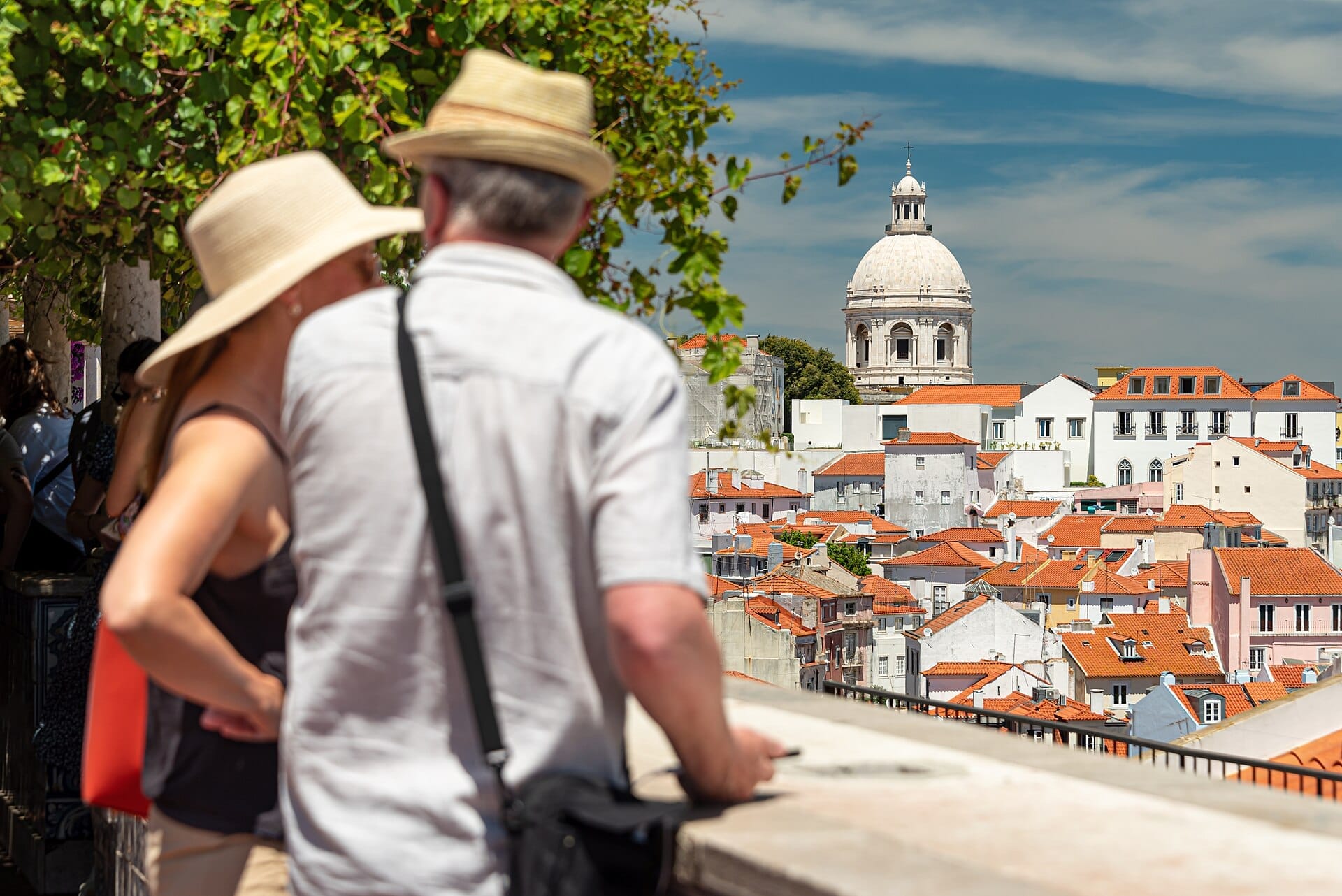
Miradouro de Santa Luzia, officially also known as Jardim Júlio de Castilho, is a landscaped terrace viewpoint in the heart of Alfama, Lisbon's oldest surviving quarter. Set at the edge of a retaining wall above the medieval street grid, the terrace looks south and east across a cascade of terracotta rooftops toward the wide mouth of the Tagus River. It is one of the few miradouros in Lisbon that feels genuinely curated: a pergola strung with bougainvillea, geometric patterned tile flooring, iron benches, potted plants, and a small upper-terrace café give it the feel of a private garden rather than a tourist overlook.
The viewpoint sits directly adjacent to the Church of Santa Luzia, which serves as the headquarters of the Order of Malta in Portugal, and is a short walk from the Lisbon Cathedral and the base of São Jorge Castle. That geographic position means you arrive here already deep inside historic Alfama, which makes the view feel earned.
💡 Local tip
Arrive before 9:00 AM or after 7:00 PM if you want the terrace largely to yourself. Midday, particularly between 11:00 AM and 3:00 PM, sees the heaviest foot traffic from tour groups disembarking from Tram 28.
The View: What You Actually See
From the main terrace railing, the panorama opens to the south. In the immediate foreground, the stepped, irregular rooflines of Alfama stack downhill in overlapping layers of orange and faded ochre. Laundry lines thread between windows. Satellite dishes sit incongruously atop centuries-old chimney stacks. Beyond the rooftops, the Tagus broadens into its wide estuary, and on clear days the far bank at Almada is sharp enough that you can pick out the hillside Cristo Rei statue with the naked eye.
To the east, container ships and tankers move slowly upstream. To the west, you can trace the waterfront promenade toward Baixa. The view has depth in every direction, which is why photographers return here repeatedly at different hours. Morning light falls across the rooftops from the east, illuminating the Alfama facade with a warm directional glow. Late afternoon turns the Tagus into a sheet of hammered copper. At night, the terrace stays open until midnight, and the lit windows of the old quarter below create an effect closer to a scale model than a real neighborhood.
If Lisbon's viewpoints are new to you, it helps to understand that Santa Luzia competes directly with several others nearby. Miradouro das Portas do Sol is literally 90 seconds away on foot and offers a slightly different angle. Miradouro da Graça sits higher up and gives a broader citywide sweep. Santa Luzia wins on atmosphere and the intimacy of its garden layout.
Tickets & tours
Live prices and dates from our booking partner. If you book, we may earn a commission at no extra cost to you.
Belem and Modern Lisbon bus hop-on hop-off combined tickets
From 28 €Instant confirmationFree cancellationSt. George Castle E-ticket and Audio Tour
From 28 €Instant confirmationLisbon Story Centre entrance tickets
From 7 €Instant confirmationFree cancellationYellow boat river tour
From 24 €Instant confirmationFree cancellation
The Azulejo Panels: Lisbon Before and After Its Defining Moment
The most historically significant elements at Santa Luzia are not the view but the two large azulejo tile panels mounted on the south-facing wall of the church beside the terrace. Created by artist António Quaresma, these blue-and-white panels reward close inspection.
The first panel depicts Lisbon's Baixa waterfront as it appeared before the earthquake and tsunami of November 1, 1755, one of the most destructive natural disasters in European history. The composition shows a dense, structured city that no longer exists: the Ribeira Palace, merchant buildings lining the Tagus bank, and a commercial quay that was swallowed by the earthquake-triggered waves and then rebuilt from scratch in the rationalist grid layout that defines Baixa today. Standing before this panel, you are looking at a city that was erased in minutes.
The second panel depicts the Christian Crusaders storming the Moorish castle in 1147, a siege that lasted approximately five months and ended with Afonso Henriques, the first King of Portugal, taking Lisbon from its Moorish rulers. The castle visible at the top of the hill behind the terrace is the same fortification shown in that panel, which gives the image an unusually direct spatial relationship with the real landscape around you.
Near the panels, a bronze bust honors Júlio de Castilho, the 19th-century Lisbon historian after whom the garden's official name is taken. Castilho spent decades documenting the city's streets, traditions, and buildings, much of which would have otherwise been lost. The decision to name a garden here after him is fitting.
ℹ️ Good to know
The azulejo panels are mounted at eye level in a shaded alcove beside the church wall. They are easy to miss if you walk straight to the railing. Allow a few minutes to examine them closely before or after taking in the view.
Getting There and Moving Around
The most atmospheric way to arrive is aboard Tram 28E, Lisbon's most iconic tram line, which stops directly at Largo Santa Luzia. The ride up through Alfama is steep, slow, and frequently crowded, but the street-level passage through the narrow lanes is part of the experience. Tram 12 also stops here. Bus 737 from Praça da Figueira provides an alternative for those coming from Baixa.
On foot from Lisbon Cathedral, the climb takes about five minutes and involves uneven cobblestone. Wear shoes with grip; smooth-soled footwear slips easily on polished stone when wet. From Terreiro do Paço (Praça do Comércio), the walk is roughly eight minutes. From Santa Apolónia train station, allow nine to ten minutes. The Lisboa Card covers tram and bus fares and pays for itself quickly if you are using public transit multiple times in a day.
Accessibility is limited by the nature of the surrounding streets. The terrace itself is paved and relatively level, but the approach from most directions involves steps or steep cobblestone gradients. Visitors with mobility limitations should factor this in. There is no dedicated parking immediately adjacent.
The Café and the Upper Terrace
A small café occupies the upper terrace level above the main viewing area. It is a functional stop rather than a destination in itself: coffee, cold drinks, and simple snacks at prices appropriate to the location. The seating is exposed to sun during the afternoon hours, so it is most comfortable in the early morning or evening. The pergola below provides better shade during the hottest part of the day in summer, when temperatures can approach 30°C or above.
If you want a proper meal nearby, Alfama's narrow streets have a handful of small tascas within a few minutes walk. Avoid places with laminated menus and photographs of food at the immediate entrance to the terrace; these tend to be tourist traps rather than neighborhood restaurants.
When to Visit and What to Expect by Time of Day
Early morning (before 9:00 AM) is genuinely quiet here. The Alfama neighborhood stirs slowly, and the terrace may have only a handful of visitors, mostly locals taking a shortcut or workers from nearby streets. The eastern light is sharp and direct in summer months, making it good for photography of the rooftops below but harsh for portraits.
Midday brings the largest crowds, especially when Tram 28 disgorges groups onto Largo Santa Luzia. The terrace is not large, and it can feel congested between 11:00 AM and 2:00 PM. This is the least comfortable time to visit in summer, both due to crowd density and direct sun exposure on the open terrace.
Late afternoon into early evening is widely considered the best window. The western light softens, the Tagus reflects amber, and Alfama begins its quiet evening rhythm. The terrace fills again but with a mix of travelers and local residents rather than tour groups. By 8:00 PM in summer, the temperature has dropped enough to be comfortable, and the pergola provides a pleasant sheltered area to sit. After 10:00 PM the terrace is almost always sparse, and the night view of the illuminated rooftops below is surprisingly affecting.
⚠️ What to skip
In wet weather, the tile flooring on the terrace becomes slippery. The pergola provides partial cover, but the viewing railing area is fully exposed. Bring a light waterproof layer if there is any chance of rain, particularly between October and April.
Is Santa Luzia Worth Your Time?
For most visitors, yes, but with one honest caveat: if you have already seen a couple of Lisbon's higher viewpoints, the panorama here will feel familiar. Santa Luzia's value is less about the view being unique and more about the coherence of the space: the tile panels, the pergola garden, the church wall, and the rooftop foreground all combine to create something more layered than a simple overlook.
Those who might not get much from this stop: visitors who are viewpoint-fatigued after doing multiple miradouros in one day, people who find cobblestone walks difficult, and anyone specifically looking for a panoramic view of the whole city rather than a close-range study of Alfama. The viewpoint at Graça or Senhora do Monte offers wider city coverage. But as a place to pause, read the azulejo panels, and sit in a garden above one of Europe's oldest urban neighborhoods, Santa Luzia earns its reputation without needing to oversell it.
Santa Luzia fits naturally into a broader Lisbon itinerary and pairs especially well with a walk through the rest of Alfama toward the National Pantheon or a session at one of the neighborhood's fado houses in the evening.
Insider Tips
- The tile panels are on the wall to your right as you face the church, not at the main railing. Most visitors miss them entirely by walking straight to the view. Spend five minutes there first.
- If Tram 28 is packed when you board, consider walking up from the Cathedral instead. The 5-minute climb through Rua de São João da Praça gives you a real sense of the street fabric of Alfama before you arrive at the terrace.
- The upper café terrace has a slightly elevated angle compared to the main pergola level, which can give a cleaner line of sight over the railing for photography. It is less obvious than the lower terrace but worth checking.
- Visit after 9:00 PM in summer. The terrace is nearly empty, the temperature is pleasant, and the lit rooftops below look completely different from the daytime view. The spot is open 24/7.
- Miradouro das Portas do Sol is 90 seconds east on foot and worth combining with this visit. The two viewpoints look in slightly different directions and together give you a fuller read of the Alfama roofscape.
Who Is Miradouro de Santa Luzia For?
- Travelers interested in Lisbon's history before the 1755 earthquake
- Photographers looking for layered rooftop foregrounds with river background
- Couples wanting a quieter, garden-like setting compared to busier viewpoints
- First-time visitors to Alfama wanting context for the neighborhood's layout
- Evening walkers who want a scenic stop that stays open late
Nearby Attractions
Other things to see while in Alfama:
- Feira da Ladra
Feira da Ladra is Lisbon's oldest and most atmospheric flea market, spreading across Campo de Santa Clara in the Alfama district every Tuesday and Saturday. Free to enter, historically rich, and genuinely unpredictable, it rewards early arrivals and curious browsers willing to dig past the obvious.
- Miradouro das Portas do Sol
Perched above the rooftops of Alfama, Miradouro das Portas do Sol offers one of Lisbon's most layered views: the Tagus River, the dome of São Vicente de Fora, and the terracotta maze of the city's oldest neighborhood. It's free, open around the clock, and rewards visitors who time their visit right.
- National Pantheon
The National Pantheon, housed inside the 17th-century Igreja de Santa Engrácia in Alfama, is one of Lisbon's most architecturally striking monuments. With free admission, a soaring Baroque dome, and a rooftop terrace at 40 metres, it rewards visitors who make the uphill effort. Inside rest some of Portugal's most celebrated figures, from fado queen Amália Rodrigues to football legend Eusébio.
- São Jorge Castle
Perched on Lisbon's highest hill in the Alfama district, Castelo de São Jorge is a Moorish fortress with roots stretching back over two millennia. It offers some of the city's widest panoramic views, layers of archaeology, and a rare sense of how Lisbon looked before the 1755 earthquake reshaped everything below.
Planning a trip? Discover personalized activities with the Nomado app.