Basílica da Estrela: Lisbon's Royal Basilica and the World's First Sacred Heart Church
The Basílica da Estrela is one of Lisbon's most graceful landmarks, a late 18th-century royal church commissioned by Queen Maria I and the first church in the world dedicated to the Sacred Heart of Jesus. Beyond its free-entry nave, a rooftop terrace rewards the climb with sweeping views across the city. Inside, the queen herself is buried beneath the ornate floor.
Quick Facts
- Location
- Praça da Estrela, Santos-Cais do Sodré, Lisbon
- Getting There
- Tram 28 (terminal stop); Bus 713, 720, 738
- Time Needed
- 45–90 minutes (add 20 min for rooftop)
- Cost
- Basilica free; rooftop terrace €5
- Best for
- Architecture lovers, history seekers, Tram 28 riders, rooftop views
What Is the Basílica da Estrela?
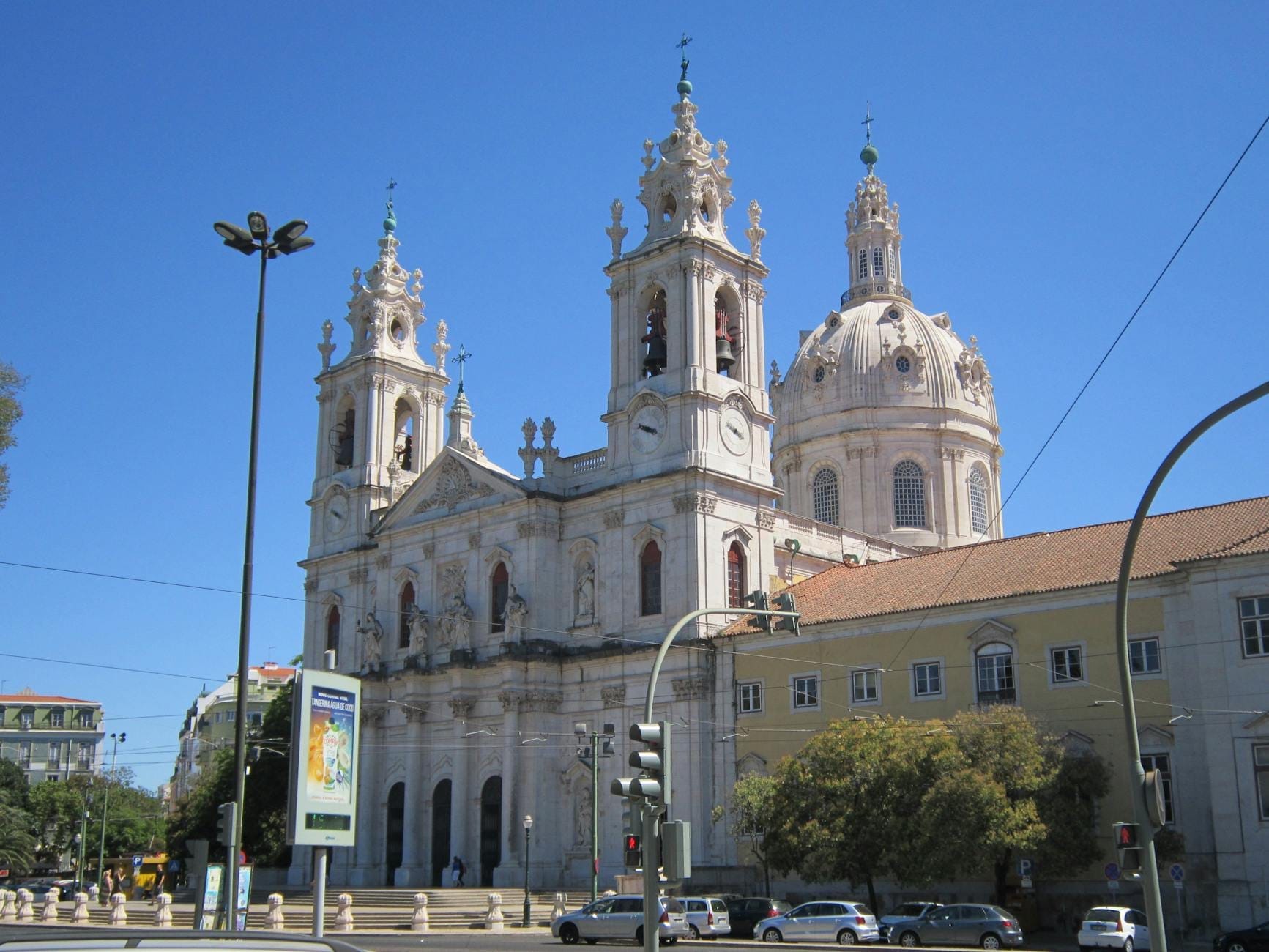
The Basílica da Estrela, formally known as the Basílica Real e Conventual de Nossa Senhora da Estrela, stands at the top of a gentle rise in western Lisbon, its twin bell towers and pale limestone dome visible from several of the city's viewpoints. It is one of the finest examples of late Portuguese Baroque and early Neoclassical architecture in the country, and it holds the distinction of being the first church in the world dedicated to the Sacred Heart of Jesus.
Its origins are personal rather than civic. Queen Maria I made a vow in 1760: if she gave birth to a male heir, she would build a church dedicated to the Sacred Heart. When the heir arrived, she kept her word. Construction began in 1779 under architects Mateus Vicente de Oliveira and Reinaldo Manuel dos Santos, and the basilica was completed in 1790. The result is a building of genuine grandeur that manages to feel intimate once you step inside.
ℹ️ Good to know
Entry to the basilica nave is free. The rooftop terrace costs €5 and is worth every cent for the elevated view across Lisbon's western districts. Opening hours vary; check the official website for current schedule.
The Architecture: What You're Looking At
Approaching from Praça da Estrela, the facade reads as restrained power. Two symmetrical bell towers frame a wide central section topped by a Rococo dome, one of the largest in Portugal. The exterior stonework is cream-colored and relatively free of decoration compared to the more theatrical churches of the Baroque period, which gives the building an almost serene quality from a distance. Up close, the carved stone detailing around the doorways and windows reveals considerable craft.
Inside, the central nave is tall and barrel-vaulted, with colored marble floors, gilded chapels along the sides, and light pouring in from high windows and the lantern above the dome. The proportions are generous without being overwhelming. The marble here is real, not painted plaster, which gives the interior a solidity and coolness you feel immediately on a warm afternoon. Sound behaves unusually in the space: footsteps echo softly, and even a low conversation carries further than expected.
Queen Maria I is buried in the basilica, in a chapel to the right of the main altar. Her tomb is marked but not showy, easy to walk past if you're moving quickly. She ruled Portugal from 1777, was the first queen regnant of Portugal, and later became the first monarch of Brazil. The room containing her remains is one of the quieter, more affecting corners of the building.
Tickets & tours
Live prices and dates from our booking partner. If you book, we may earn a commission at no extra cost to you.
Belem and Modern Lisbon bus hop-on hop-off combined tickets
From 28 €Instant confirmationFree cancellationSt. George Castle E-ticket and Audio Tour
From 28 €Instant confirmationLisbon Story Centre entrance tickets
From 7 €Instant confirmationFree cancellationYellow boat river tour
From 24 €Instant confirmationFree cancellation
The Nativity Scene: Portugal's Largest
One of the most specific and surprising things inside the Basílica da Estrela is the nativity scene created by sculptor Joaquim Machado de Castro, one of the most important Portuguese sculptors of the 18th century. The piece contains more than 500 individual figures made from terracotta and cork, arranged across a detailed landscape depicting the biblical nativity alongside 18th-century Lisbon life.
It is considered the largest nativity scene in Portugal and a significant work of decorative religious art. The level of individual characterization in the figures is remarkable, from soldiers to merchants to animals, each rendered with careful attention to posture and expression. The scene is displayed behind glass in a side room off the main nave. It is easy to spend fifteen minutes here without noticing the time pass.
The Rooftop Terrace: Climb the 114 Steps
For €5, visitors can access the rooftop terrace via a staircase of 114 steps. The climb is steady and not particularly difficult, though the staircase narrows and turns as it approaches the top. The reward is a 360-degree view that takes in Parque Eduardo VII to the north, the Tagus River to the south, the dome of the Panteão Nacional to the east, and the rolling residential neighborhoods to the west.
Unlike Lisbon's dedicated miradouros, this terrace sees relatively few visitors at any given time, which makes it one of the calmer elevated viewpoints in the city. Morning visits, before 10 AM, offer soft light and near-empty conditions. In the afternoon, particularly in summer, the stone of the terrace absorbs heat, so bring water and expect direct sun with limited shade.
💡 Local tip
For rooftop photography, late afternoon light (around 5–6 PM in summer, 3–4 PM in winter) hits the dome and the surrounding rooftops at a favorable angle. Arrive 30 minutes before to avoid any small queues at the terrace entrance.
When to Visit and How to Get There
The basilica is one of the terminal stops of Tram 28E, Lisbon's most famous tram route, which passes through Alfama, Baixa-Chiado, and the Estrela neighborhood before reaching Praça da Estrela. Riding Tram 28E to reach the basilica is a practical and scenic approach, though the tram runs crowded through most of the day, particularly in summer.
Buses 713, 720, and 738 also stop near the basilica for a less congested alternative. If you are walking from Baixa-Chiado, the route up through Bairro Alto takes roughly 20 minutes on foot and is mostly uphill. From the Jardim da Estrela — the elegant public garden directly across from the basilica — it is a 30-second walk.
The basilica is open daily from 8:45 AM to 8:00 PM. Weekday mornings between 9 AM and 11 AM are the quietest periods. Weekend afternoons attract larger groups, including organized tours. Attending a morning mass is possible and gives the space a different character entirely: candlelit, attended by local parishioners, and nearly silent.
⚠️ What to skip
This is an active place of worship. Maintain quiet inside the nave, particularly during mass times. Shoulders and knees should be covered, or bring a scarf. Loud conversations or photography during services are inappropriate.
The Surrounding Area: Estrela and Santos
The basilica sits within the broader Santos-Cais do Sodré zone, a neighborhood that blends residential calm with cultural depth. The Jardim da Estrela across the street is one of Lisbon's most pleasant green spaces, with a pond, a Victorian-era bandstand, and peacocks. It is the kind of place that reveals itself slowly rather than announcing itself, and it pairs well with the basilica as part of a two-hour loop.
Heading downhill toward Santos brings you to the waterfront, the LX Factory creative hub, and the broader riverfront area. Heading in the opposite direction, the Museu Nacional de Arqueologia and Belém are accessible by tram further along the line.
The Estrela neighborhood itself has a local character that has not been fully absorbed by tourism. There are neighborhood cafés on the surrounding streets where a coffee costs under two euros and the clientele is almost entirely Portuguese. If you are spending a morning at the basilica and the garden, this area is a pleasant place to slow down for an hour before moving on.
Is It Worth Your Time?
The Basílica da Estrela delivers at two distinct levels. As a free architectural experience, the interior is among the more accomplished in Lisbon, easier to absorb than the Jerónimos Monastery in Belém, less crowded than the Sé Cathedral in Alfama, and genuinely moving in its proportions and materiality. As a paid experience, the rooftop at €5 is one of the better-value elevated viewpoints in the city.
Visitors who prioritize Lisbon's major monuments — Jerónimos Monastery or São Jorge Castle — sometimes overlook this one entirely. That is partly why it remains calmer and more accessible than the tourist-heavy sites. It is the kind of church that rewards unhurried attention rather than a quick photo stop.
Who might skip it: travelers on a very tight schedule with only one day in Lisbon who have already allocated time to bigger sites will likely find this doesn't fit. Also, those with mobility limitations should be aware that the rooftop involves a steep, narrow staircase with no elevator access, though the nave itself is accessible at ground level.
Insider Tips
- The dome interior is best appreciated by standing directly beneath its center and looking straight up. The painted oculus and the geometry of the vaulting are more complex than they appear from the sides.
- The nativity scene room is easily overlooked because it's off the main nave without prominent signage. Look for the door to the right-hand side near the transept and ask a staff member if it appears closed.
- Tram 28E arrives at Praça da Estrela as its western terminus, meaning the tram is usually less crowded here than it is mid-route through Alfama. If you start your Tram 28 journey at this end, you have a better chance of getting a seat.
- The Jardim da Estrela across from the basilica has a small café kiosk near the pond entrance — good for a coffee before or after your visit, with benches that face the basilica façade directly.
- If you visit on a clear day, the rooftop terrace offers a direct sightline toward the Tagus River and, on exceptional days, you can see as far as the Serra de Sintra hills to the northwest.
Who Is Basílica da Estrela For?
- Architecture and history travelers looking for depth beyond the obvious monuments
- Tram 28E riders who want to make the most of the route's western terminus
- Visitors seeking a rooftop viewpoint that avoids the larger crowds
- Those interested in Portuguese royal history and 18th-century religious art
- Travelers pairing a morning walk through the Estrela neighborhood with a nearby green space
Nearby Attractions
Other things to see while in Santos & Cais do Sodré:
- Jardim da Estrela
Jardim da Estrela is a 19th-century public garden in the Lapa-Estrela quarter, steps from the Basílica da Estrela. Free, open until midnight, and genuinely beloved by locals, it offers a rare pause from sightseeing crowds. Come for the iron bandstand, the duck pond, and the rare pleasure of sitting where tourists rarely bother to stop.
- LX Factory
A former 19th-century textile factory reborn as Lisbon's most distinctive creative complex, LX Factory fills 23,000 square metres of industrial space with independent bookshops, design studios, cafés, restaurants, vintage boutiques, and street art. On Sundays, its courtyard transforms into one of the city's most atmospheric markets.
- Pink Street (Rua Nova do Carvalho)
Once a rough sailors' red-light district, Rua Nova do Carvalho is now Lisbon's most photographed street after dark. The bright pink pavement, vintage bar fronts, and the legendary Pensão Amor make it the beating heart of the Cais do Sodré nightlife scene.
- Ponte 25 de Abril
Stretching 2.277 kilometers across the Tagus River, Ponte 25 de Abril is one of Europe's longest suspension bridges and an unmistakable part of Lisbon's skyline. Built in 1966 and renamed after the Carnation Revolution that ended 42 years of dictatorship, it connects the city to Almada on the south bank and carries roughly 150,000 vehicles and 157 trains every single day.
Planning a trip? Discover personalized activities with the Nomado app.