Ponte 25 de Abril: The Bridge That Carries Lisbon's History
Stretching 2.277 kilometers across the Tagus River, Ponte 25 de Abril is one of Europe's longest suspension bridges and an unmistakable part of Lisbon's skyline. Built in 1966 and renamed after the Carnation Revolution that ended 42 years of dictatorship, it connects the city to Almada on the south bank and carries roughly 150,000 vehicles and 157 trains every single day.
Quick Facts
- Location
- Tagus River, between Lisbon (north) and Almada (south), near Santos/Alcântara
- Getting There
- Train to Alcântara-Mar station (Cascais Line); Bus 714, 727, 751 to Alcântara
- Time Needed
- 30–60 min to photograph and observe; longer if combining with Almada or Cristo Rei
- Cost
- €2 road toll (northbound only); free to view from riverbanks and viewpoints
- Best for
- Architecture lovers, photographers, history enthusiasts, river cruise passengers
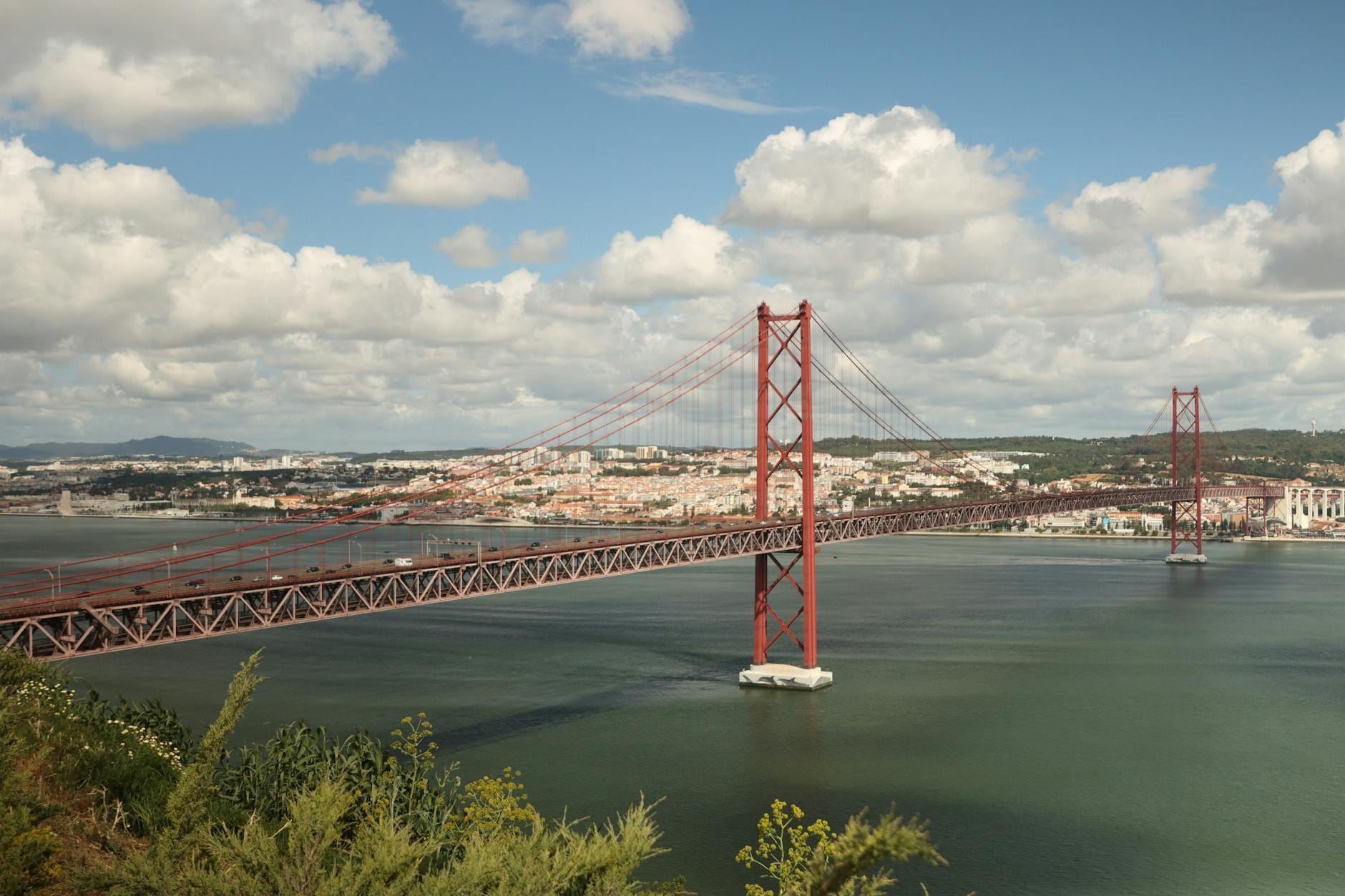
What You're Actually Looking At
Ponte 25 de Abril is a steel suspension bridge spanning 2.277 kilometers across the Tagus River, connecting central Lisbon on the north bank to Almada on the south. Its two rust-orange towers rise 190 meters above the riverbed, and the deck clears the water by 70 meters at mean high tide, leaving enough room for fully laden container ships to pass beneath without slowing down. The main span alone measures 1,012 meters, making it one of the longest suspension bridges in Europe.
The bridge operates on two levels. The upper deck carries six road lanes and handles approximately 150,000 vehicles per day. The lower deck, added in 1999, runs two railway tracks and carries 157 trains daily on the Fertagus suburban rail service. This dual-level design is relatively rare in Europe and contributes to the bridge's considerable visual mass when seen from close range along the waterfront.
ℹ️ Good to know
The bridge is painted International Orange, the same color used on the Golden Gate Bridge in San Francisco. Both bridges were designed by the American Bridge Company, which also designed the Golden Gate Bridge. The color choice is practical: it remains highly visible in fog.
History and Political Significance
Construction began in 1962, and the bridge opened on August 6, 1966, finishing after 45 months of construction. It was originally named Ponte Salazar, after António de Oliveira Salazar, the dictator of Portugal until 1974. The name reflected the political culture of the Estado Novo regime: major infrastructure projects were frequently named in honor of the dictator.
That changed on April 25, 1974, when a left-wing military coup overthrew the Estado Novo in what became known as the Carnation Revolution. The uprising was almost entirely bloodless: soldiers placed red carnations in their rifle barrels, and crowds filled the streets of Lisbon in celebration. The bridge was renamed Ponte 25 de Abril the same year, and its name has since become one of the most direct references to Portugal's transition to democracy. Understanding this history changes how the bridge reads in the landscape. It is not just an engineering feat or a scenic backdrop. It is a physical marker of a political turning point.
The Carnation Revolution's legacy is visible throughout Lisbon, from the National Pantheon in Graça, which contains the tombs of figures central to Portuguese republican history, to the fado traditions of Alfama that survived and in some ways were shaped by decades of Estado Novo censorship.
Tickets & tours
Live prices and dates from our booking partner. If you book, we may earn a commission at no extra cost to you.
Yellow boat river tour
From 24 €Instant confirmationFree cancellationLisbon private cruise with a welcome drink
From 290 €Free cancellationLisbon surf experience with transport
From 39 €Instant confirmationFree cancellationArrabida wine tour
From 79 €Instant confirmationFree cancellation
Engineering Details Worth Knowing
The south tower's foundation extends 79 meters below the surface of the water, anchored into bedrock beneath the Tagus. That kind of depth was necessary given the river's soft alluvial floor and the seismic risk in the region. The bridge was designed to withstand an earthquake four times more powerful than the catastrophic 1755 Lisbon earthquake, which killed tens of thousands of people and destroyed much of the city.
The American Bridge Company built the structure using suspension cables that collectively weigh thousands of tonnes. Each main cable contains thousands of individual steel wires twisted together. The roadway hangs from vertical hanger cables, a configuration you can observe clearly from the Alcântara waterfront, where the geometry of the bridge becomes apparent at eye level rather than from above or below.
How and Where to Experience It
Most visitors see Ponte 25 de Abril from a distance, framed against the Tagus at dusk, from one of Lisbon's hilltop viewpoints or from the riverfront promenade near Alcântara. That distance perspective, with the Cristo Rei statue visible on the Almada shore directly beneath the bridge, is the one that appears on most photographs. It works because the composition mimics, loosely, the view of the Golden Gate from the Marin Headlands.
For a closer encounter, walk or take a taxi down to the Alcântara waterfront, just west of Santos. From there you can walk along the riverbank bike path toward the bridge's northern anchorage and stand directly beneath the cables. The scale becomes much harder to absorb from close range: the main cables are thicker than a person and the towers disappear into their own height. If you look up at the underside of the deck, you can hear trains passing on the lower level before you see them.
💡 Local tip
A river cruise is one of the best ways to see the bridge in full context. Several operators depart from Belém and Cais do Sodré and pass under the bridge, giving you an upward view of both deck levels and the tower foundations. This perspective is impossible to replicate from land.
The bridge can also be seen clearly from several of Lisbon's elevated miradouros. Miradouro da Graça and Miradouro da Senhora do Monte both offer elevated westward views across the rooftops toward the Tagus, with the bridge visible in the middle distance on clear days.
Time of Day and Conditions
The bridge looks different at every hour. In the morning, the eastern sun hits the orange towers from behind if you are standing on the Lisbon shore, putting them in partial silhouette. Late afternoon is when the light is most flattering from the city side: the low western sun catches the paint and turns the cables almost copper-colored. Sunset from the Alcântara waterfront, with the bridge in the foreground and the sky above Almada going orange and pink, is genuinely one of Lisbon's better photographic moments.
At night, the bridge is lit but not elaborately so. The towers glow a warm amber, and the cables are visible against the dark sky. Traffic continues around the clock, and you can see the headlights of vehicles moving across the high deck. The sound is constant: a low metallic hum from the cables vibrating in the wind, the deeper rumble of trucks, and the occasional sharp clatter of a train on the lower level.
Weather matters considerably. On clear days the views extend to the Serra da Arrábida hills south of Almada. When Atlantic fog rolls in from the west, the towers can disappear entirely, and the bridge becomes more atmospheric than scenic. Wind is a factor at the waterfront, particularly in winter and early spring, so bring an extra layer if you plan to spend time along the riverbank.
⚠️ What to skip
There is no pedestrian access to the bridge deck. It carries road traffic only on the upper level and rail only on the lower. Do not attempt to walk or cycle across: there are no footpaths and access is restricted. Viewing is from the banks, from viewpoints, or from the water.
Getting There and Practical Notes
The most straightforward public transport option is the Cascais suburban train line from Cais do Sodré station to Alcântara-Mar, a journey of about four minutes. From there it is a short walk to the riverfront, where the bridge is clearly visible. Several bus routes also serve Alcântara from central Lisbon, including lines 714, 727, and 751. Uber and Bolt are both reliable options if you prefer to go directly.
If you are combining this with a visit to LX Factory, the repurposed industrial complex directly beneath the bridge's northern approach, that makes for a practical and worthwhile pairing. LX Factory's market runs on Sundays and is particularly good in the morning before the bridge viewing crowds arrive.
Driving across the bridge costs €2, charged via automatic toll readers in the northbound direction only. Southbound crossing is free. If you are renting a car, Portugal uses electronic tolling on most motorways and bridges, so ensure your rental vehicle has a Via Verde transponder or that your rental company has arranged toll payment on your behalf.
For context on how the bridge fits into Lisbon's wider geography, the Lisbon bridges guide covers both Ponte 25 de Abril and the newer Ponte Vasco da Gama to the east, which at 17.2 kilometers is one of the longest bridges in Europe.
Who Will Get the Most From This Visit
Architecture and engineering enthusiasts will find the bridge endlessly interesting, particularly from the Alcântara waterfront where the scale of the structure becomes physically apparent. Photographers will want to plan around the light: late afternoon on the city side, or early morning from Almada, where the bridge frames the Lisbon skyline. History-focused travelers who understand the Carnation Revolution will feel the weight of the name in a way that casual visitors may not.
Travelers who are primarily interested in museums, restaurants, or nightlife may find a dedicated trip to see the bridge less compelling. It is not an attraction with interior spaces, exhibits, or a curated experience. It is infrastructure, and the satisfaction of seeing it comes from understanding what it is. If you happen to be passing through Alcântara or visiting LX Factory, adding 20 minutes to walk down to the waterfront requires no extra journey and is entirely worth it. But it does not justify a special trip for everyone.
Insider Tips
- Take the Cascais line train from Cais do Sodré to Alcântara-Mar and walk west along the riverside bike path toward the bridge's anchorage. This approach gives you a gradually escalating sense of scale that arriving by car completely misses.
- Sunday mornings work particularly well: visit LX Factory's weekly market first, then walk five minutes down to the waterfront. You get two very different Lisbon experiences in one morning without significant travel.
- If you want the classic San Francisco-style composition, you need to cross to the Almada side by ferry or car and position yourself on the waterfront at Cacilhas. From there, the Cristo Rei statue and the bridge combine with the Lisbon skyline in the background.
- The bridge hums. Stand near the northern anchorage cables on a windy day and you can feel a low vibration through your feet and hear a deep resonance in the steel. It is not something that appears in photographs.
- For river cruise passengers, ask the operator specifically whether the route passes beneath the bridge. Not all cruises do. Those that do offer a perspective that no land-based viewpoint can replicate.
Who Is Ponte 25 de Abril For?
- Architecture and engineering enthusiasts who want to understand suspension bridge design at full scale
- Photographers working the late-afternoon golden hour from the Alcântara or Santos waterfront
- History travelers interested in Portugal's 1974 Carnation Revolution and Estado Novo era
- River cruise visitors seeking Lisbon's most recognizable landmark from the water
- Visitors combining Alcântara with LX Factory for an efficient half-day on the western waterfront
Nearby Attractions
Other things to see while in Santos & Cais do Sodré:
- Basílica da Estrela
The Basílica da Estrela is one of Lisbon's most graceful landmarks, a late 18th-century royal church commissioned by Queen Maria I and the first church in the world dedicated to the Sacred Heart of Jesus. Beyond its free-entry nave, a rooftop terrace rewards the climb with sweeping views across the city. Inside, the queen herself is buried beneath the ornate floor.
- Jardim da Estrela
Jardim da Estrela is a 19th-century public garden in the Lapa-Estrela quarter, steps from the Basílica da Estrela. Free, open until midnight, and genuinely beloved by locals, it offers a rare pause from sightseeing crowds. Come for the iron bandstand, the duck pond, and the rare pleasure of sitting where tourists rarely bother to stop.
- LX Factory
A former 19th-century textile factory reborn as Lisbon's most distinctive creative complex, LX Factory fills 23,000 square metres of industrial space with independent bookshops, design studios, cafés, restaurants, vintage boutiques, and street art. On Sundays, its courtyard transforms into one of the city's most atmospheric markets.
- Pink Street (Rua Nova do Carvalho)
Once a rough sailors' red-light district, Rua Nova do Carvalho is now Lisbon's most photographed street after dark. The bright pink pavement, vintage bar fronts, and the legendary Pensão Amor make it the beating heart of the Cais do Sodré nightlife scene.
Planning a trip? Discover personalized activities with the Nomado app.