Torres de Quart: Inside Valencia's Scarred Medieval Towers
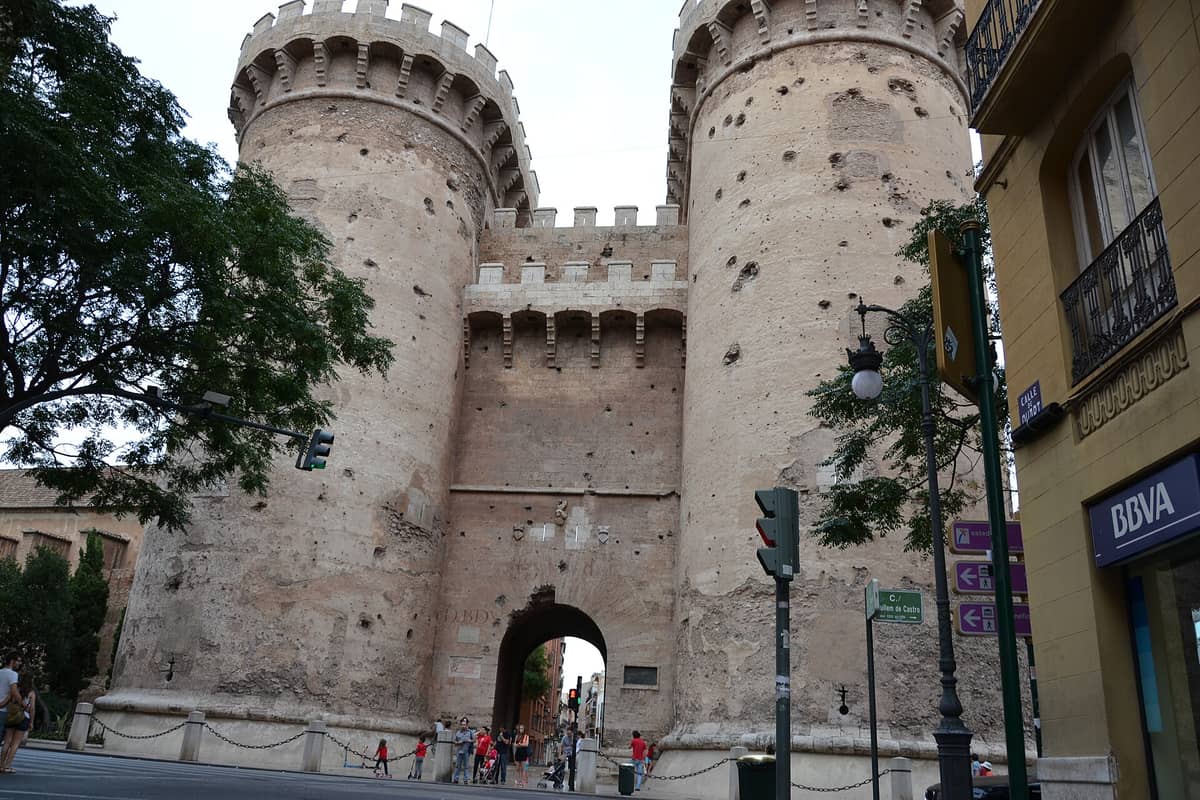
Torres de Quart are the most striking survivors of Valencia's medieval city walls, two cylindrical Gothic towers completed in 1460 and still bearing the cannonball craters of a Napoleonic siege. For €2, you climb to a rooftop terrace with direct views over the Barrio del Carmen and the old city. This guide covers what to expect, when to visit, and how to fit the towers into a wider walk.
Quick Facts
- Location
- Plaza de Santa Úrsula 1 / Guillem de Castro 89, Barrio del Carmen, Valencia
- Getting There
- City bus routes serve Guillem de Castro and the surrounding streets, but specific lines and stops change periodically; check current EMT Valencia maps or apps before you travel. It is also easily walkable from the historic centre
- Time Needed
- 30 to 45 minutes
- Cost
- €2 general; €1 reduced (students, pensioners, groups); free on Sundays and public holidays
- Best for
- History enthusiasts, architecture lovers, photographers, and anyone doing a walking tour of the old city
- Official website
- cultural.valencia.es/en/museu/torres-de-quart
What Are the Torres de Quart?
The Torres de Quart (also known as Puerta de Quart or Quart Gate) are a pair of cylindrical military towers that once formed the western gate of Valencia's medieval city walls. Built between 1441 and 1460, they are one of only two fortified gates from that wall system still standing in the city, the other being the Torres de Serranos to the north. Together they frame the ghost of a walled city that has otherwise almost entirely disappeared.
What sets Torres de Quart apart from its twin is texture. The outer face of the towers is pocked with shallow craters where cannonballs struck during the French siege of 1808, part of the Peninsular War. The craters were never filled in, and that decision, whether deliberate or simply practical, turned the stone surface into an open-air record of the siege. You can press your hand into those indentations. It is one of the more visceral historical encounters available in Valencia at any price, let alone €2.
ℹ️ Good to know
Opening hours: Monday to Saturday 10:00–19:00; Sundays and public holidays 10:00–14:00. Closed 1 and 6 January, 1 May, and 25 December. In winter, closing time may be brought forward depending on daylight, and last entry is 20 minutes before closing. The towers also close on rainy days for safety reasons
Architecture and Historical Context
The towers belong to the tradition of late military Gothic architecture and were modelled on the towers of Castelnuovo in Naples, reflecting the close political ties between the Crown of Aragon and the Kingdom of Naples in the fifteenth century. The design is deliberately imposing: two semi-circular towers rising to a height that would have dominated the flat agricultural plain stretching west from the city. The gateway arch between them was wide enough for loaded carts entering Valencia along the road toward Quart de Poblet, the town that gave the gate its name.
The construction spanned nearly two decades and used local limestone. Up close, the masonry still shows the careful coursing typical of Valencia's late medieval civic building projects, the same era that produced La Lonja de la Seda and much of the cathedral complex. The towers were never purely defensive in a military sense: they were also a statement of civic ambition from a city that was then one of the wealthiest in the Mediterranean world.
For a broader sense of how these towers fit into Valencia's architectural history, the Valencia architecture guide covers the city's built heritage from Roman foundations through to Santiago Calatrava's futuristic structures at the Ciudad de las Artes y las Ciencias.
Tickets & tours
Hand-picked options from our booking partner. Prices are indicative; availability and final rates are confirmed when you complete your booking.
Valencia Silk Museum tickets and audio guide
From 7 €Instant confirmationFree cancellationSaint Nicholas Church Entrance Tickets and Audioguide
From 11 €Instant confirmationHistoric Valencia walking tour
From 27 €Instant confirmationFree cancellationNatural thermal springs and Girlfriend Waterfall tour from Valencia
From 89 €Instant confirmationFree cancellation
The Visit: What You Actually Experience
Entry is through a small door at the base of one of the towers. The interior is spare: stone stairways wind upward through several levels, with rooms used for temporary exhibitions about the towers' history and the medieval city. The exhibition materials are modest but informative, with plans, historical images, and explanations of the siege damage. Do not come expecting a lavish museum experience. The building itself is the exhibit.
The stairways are original medieval stone, worn smooth and unevenly spaced. The handrails are modern additions, but the climb still demands attention, especially on the way down. There is no lift, and the interior is not accessible for visitors with significant mobility limitations. If you are comfortable with steep spiral stairs, the ascent takes around five minutes per tower.
The top of the towers opens onto a terrace walkway that connects the two structures. From here you look directly down the Calle Guillem de Castro and across the rooftops of the Barrio del Carmen. The view is not a panoramic sweep of the whole city, but it is intimate and precise: you see the layered texture of the old quarter, with church towers, terracotta tile, and the occasional palm breaking the skyline. On clear mornings, there is a quality of light up here that photographers find consistently rewarding.
💡 Local tip
Photography tip: the best light on the outer face of the towers, where the cannonball craters are most visible, falls in the late afternoon when low sun rakes across the stone surface from the west. Morning light is better for the rooftop views toward the city interior.
How the Experience Changes Through the Day
Torres de Quart sits at the boundary between the Barrio del Carmen and the street grid outside the old walls. In the morning, the street below, Guillem de Castro, carries a steady flow of locals heading to work and school. The towers themselves are quiet at opening time, often with only a handful of other visitors. The stone interior stays cool even in summer, which makes an early visit comfortable when temperatures outside are already climbing.
By midday on weekdays, tour groups pass through, though the space never becomes crowded in the way that the Cathedral or the Mercado Central can. On Sunday mornings, when entry is free, there is noticeably more foot traffic, and the lower exhibition rooms can feel slightly cramped. If you visit on a Sunday, arrive close to 10:00 to have the upper terrace to yourself. Note that Sunday closing is at 14:00, which is significantly earlier than on weekdays.
In summer, the terrace in the middle of the afternoon is exposed and hot. Bring water and, if you are heat-sensitive, plan the visit for the morning window. In winter, the towers can be cold and breezy at the top, and the site closes entirely on rainy days for safety. Before making Torres de Quart the centerpiece of a winter day, check the forecast.
Fitting the Towers into a Wider Walk
The towers mark the western edge of the Barrio del Carmen, Valencia's oldest residential neighbourhood. From the gate, you are a short walk from the bulk of the old city's historic streets, and the neighbourhood rewards slow exploration: narrow lanes, Romanesque and Gothic church facades, and street art concentrated especially in the northern part of the barrio.
A natural itinerary pairs the Torres de Quart with the Torres de Serranos at the northern end of the old city. The two gates are roughly fifteen minutes apart on foot through the Carmen, and seeing both in the same morning gives a clear sense of the scale of the original walled city. The walking tour of Valencia's old city covers a logical route between them.
Just outside the western wall, the Jardín del Turia runs along the old riverbed to the north. From the base of the towers, it is a few minutes' walk to the park's tree-lined paths, which offer shade and a route back toward the city centre or out toward Gulliver Park and the Ciudad de las Artes.
Who Should Skip the Torres de Quart
If you have no particular interest in medieval history or architecture, the experience may feel thin. The exhibition inside is informative but brief, and the views from the top, while pleasant, are not the most expansive in Valencia. Visitors looking primarily for sweeping city panoramas will find more satisfaction at the Torres de Serranos, which offers a slightly different perspective over the old city and the Turia park.
Visitors with significant mobility difficulties should be aware that the site is entirely accessed via stone stairways with no lift. The ground floor of the towers is accessible on foot, and the cannonball-scarred exterior can be appreciated from street level at no cost, but the upper terrace is not reachable without climbing. Anyone traveling with young children in pushchairs will face the same limitation.
Insider Tips
- The cannonball craters on the outer (west-facing) wall are most dramatically lit in the late afternoon, when low sunlight hits the stone at an angle and casts each crater into shadow. If you want to photograph the damage, time your arrival for around 17:00 in summer.
- Entry is free every Sunday and on public holidays. If you are on a tight budget and your visit falls on a Sunday, the only cost is arriving before 14:00 when the site closes.
- The towers close on rainy days without advance notice, citing safety on the stone stairways. Always check the forecast if you are planning your day around this visit, particularly from October through February.
- From the rooftop terrace, look directly west along Guillem de Castro toward the modern city. The visual contrast between the medieval gate framing a contemporary urban street is one of the more striking compositions in Valencia for photography.
- Last entry is 20 minutes before closing. Do not arrive less than 20 minutes before closing on a weekday expecting a full visit: you will be turned away at the door
Who Is Torres de Quart For?
- History and medieval architecture enthusiasts who want to read a building rather than just photograph it
- Budget travelers: at €2, or free on Sundays, it is one of the best-value historical monuments in the city
- Photographers interested in textured stone, afternoon raking light, and the contrast between old and modern Valencia
- Walkers building a route through the Barrio del Carmen who want historical anchors at the start or end of their loop
- Visitors pairing it with Torres de Serranos for a complete picture of Valencia's surviving medieval defences
Nearby Attractions
Other things to see while in Barrio del Carmen:
- Casa-Museo Benlliure
Tucked into a narrow street in the historic El Carme quarter, the Casa-Museo Benlliure preserves the home and studio of José Benlliure Gil exactly as the painter left it. With original furnishings, Italian treasures, and a rear garden studio, it offers an unusually intimate glimpse into 19th-century Valencian artistic life — at a price that makes it one of the most accessible museums in the city.
- Centre del Carme Cultura Contemporània (CCCC)
The Centre del Carme Cultura Contemporània occupies a historic monastery complex in the heart of El Carme. Today it hosts rotating contemporary art exhibitions, all free to enter, inside one of Valencia's most atmospheric historic complexes.
- Iglesia de San Nicolás
Hidden in plain sight on Calle Caballeros, the Iglesia de San Nicolás is one of Valencia's oldest churches and its most visually overwhelming interior. A Gothic shell completely transformed by Renaissance frescoes, it rewards visitors who look up the moment they step through the door.
- IVAM – Institut Valencià d'Art Modern
The IVAM, or Institut Valencià d'Art Modern, is Valencia's flagship museum of modern and contemporary art, housed in a purpose-built concrete complex on the edge of the historic Barrio del Carmen. With a permanent collection built around sculptor Julio González and a rotating programme of international exhibitions, it delivers more than its reputation suggests for a regional institution.