CF Toronto Eaton Centre: Inside North America's Busiest Shopping Mall
CF Toronto Eaton Centre is a landmark downtown shopping complex at the corner of Yonge and Dundas Streets, drawing up to around 48 million visitors a year. With over 230 retailers across four levels beneath a soaring Victorian-inspired glass galleria, it is as much a piece of Toronto's urban fabric as it is a place to shop.
Quick Facts
- Location
- 220 Yonge Street, Downtown Toronto, ON M5B 2H1
- Getting There
- Queen Station (Line 1) and Dundas Station (Line 1) — both have direct indoor mall access
- Time Needed
- 1–4 hours depending on purpose; quick pass-through or half-day shop
- Cost
- Free entry; parking available for a fee; individual store prices vary
- Best for
- Shoppers, architecture enthusiasts, rainy-day escapes, transit-connected errands
- Official website
- shops.cadillacfairview.com/toronto-eaton-centre.html
What CF Toronto Eaton Centre Actually Is
CF Toronto Eaton Centre is not just a mall. It is a 201,320-square-metre retail and office complex that opened in 1977 and has since become one of the defining pieces of downtown Toronto's built environment. Spanning four levels of retail, four office towers, and two parkades, it stretches along Yonge Street between Queen Street to the south and Dundas Street to the north — a distance of roughly two to three city blocks. The complex is operated by Cadillac Fairview and carries the CF branding, though most Torontonians simply call it the Eaton Centre.
With over 230 retailers, restaurants, and services under one roof, and visitor counts reported at around 48 million annually, Destination Toronto has described it as the busiest shopping mall in North America. That figure is worth pausing on: it is busier by footfall than most international tourist attractions. What explains it is not just shopping. It is location. The mall sits directly atop two TTC subway stations and acts as a warm, dry, year-round shortcut through one of the densest parts of the city.
ℹ️ Good to know
Both Queen Station and Dundas Station (TTC Line 1) connect directly into the mall's lower level. You can enter the Eaton Centre without ever stepping outside, making it a particularly useful waypoint on cold or rainy Toronto days.
The Architecture: A Galleria Worth Looking Up At
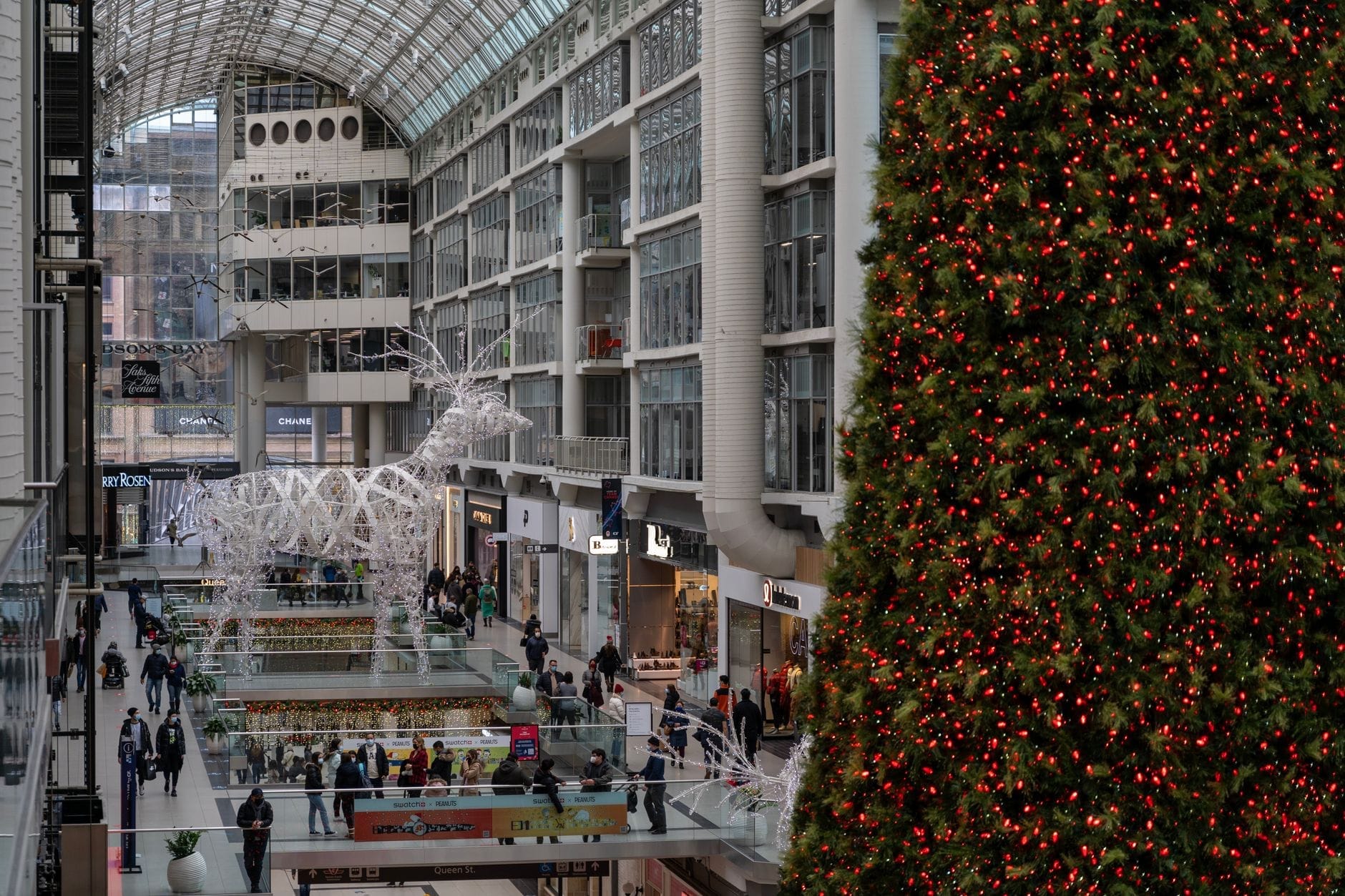
The mall's most celebrated feature is its central galleria, a long barrel-vaulted glass ceiling that runs the length of the building. Designed by the architectural firm Bregman and Hamann (with Zeidler Partnership Architects), it draws clear visual inspiration from Milan's Galleria Vittorio Emanuele II and London's Victorian shopping arcades. The steel-and-glass roof floods the interior with natural light during the day, making the space feel markedly less oppressive than a typical enclosed mall.
Suspended from that roof is one of Toronto's most photographed artworks: Michael Snow's 'Flight Stop' (1979), a flock of 60 fibreglass Canada geese installed at varying heights in the galleria. Snow originally won an injunction in 1982 to have Christmas ribbons removed from the geese, arguing it violated his moral rights as an artist. The legal dispute drew national attention and became a landmark case in Canadian copyright law. Today the geese hang undisturbed, and spotting all 60 has become something of an unofficial visitor ritual.
The building's relationship to its surroundings is also architecturally significant. The south end of the mall faces Old City Hall, a Richardsonian Romanesque sandstone courthouse completed in 1899. Preservationists fought hard to prevent the Eaton Centre's original footprint from demolishing Old City Hall entirely. The compromise is visible in the mall's curved south facade, which was redesigned to preserve the view corridor to the historic building. It is a rare case of a major retail development bending to heritage concerns.
💡 Local tip
For the best view of the galleria and the Snow geese, position yourself on Level 3 near the central walkway overlooking the atrium. The light is best on clear mornings between 10am and noon, when sun angles through the south-facing glass roof.
Tickets & tours
Live prices and dates from our booking partner. If you book, we may earn a commission at no extra cost to you.
LEGOLAND Discovery Centre Toronto tickets
From 16 €Instant confirmationFree cancellationToronto Old Town: Dark Side Exploration Game and Tour
From 12 €Instant confirmationFree cancellationToronto 'Little Canada' entrance tickets
From 27 €Instant confirmationFree cancellationNiagara Falls tour with local winery visit from Toronto
From 70 €Instant confirmationFree cancellation
How the Crowd Behaves at Different Times
Weekday mornings before noon are the quietest window. The lower food court fills gradually with office workers from the surrounding towers, but the upper retail floors remain uncrowded and navigable. This is the best time to move through the building if you have specific stores in mind or want to appreciate the architecture without the press of bodies.
Saturday afternoons, particularly between 1pm and 5pm, are when the mall operates closest to capacity. The Yonge Street entrances feed a near-constant stream of visitors, and the escalators at the central atrium back up. The food court at lower level fills to standing-room during the lunch window. If you are visiting on a weekend, arriving when the mall opens at 10am gives you a noticeably more pleasant experience.
December is a category of its own. The Christmas Market period and holiday shopping weeks turn the Eaton Centre into one of the most densely packed indoor spaces in the city. The decorations are elaborate and worth seeing, but factor in significantly longer times at any checkout, and expect noise levels that make conversation difficult. The Toronto Christmas Market at the nearby Distillery District draws additional foot traffic to the Yonge corridor during this period.
⚠️ What to skip
Parking in the on-site parkades is expensive and fills quickly on weekends and during holiday periods. Transit is strongly preferable: both subway stations inside the mall make this one of the easiest destinations in Toronto to reach without a car.
Navigating the Four Levels
The layout is a single elongated corridor rather than a traditional multi-wing mall, which means navigation is straightforward: you walk north or south along the galleria and turn into side wings as needed. Level 1 (street level) has the most prominent flagship stores and primary entrances from Yonge Street. Level 2 carries a second tier of mid-range and specialty retail. Level 3, often overlooked, has the best overhead views of the galleria and tends to be slightly quieter. The lower level connects to the food court, the subway concourse, and the PATH underground pedestrian network.
The PATH connection is worth noting for visitors using the mall as part of a longer downtown route. From the lower level you can access the PATH underground city and walk to destinations including Union Station, the Financial District, and Brookfield Place without returning to street level. The signage inside PATH can be confusing; pick up a map at an information kiosk before committing to a long underground walk.
The food court on the lower level is one of the larger ones in the city, with a range that reflects Toronto's multicultural food culture: Japanese, Korean, South Asian, Middle Eastern, and North American fast food options all have permanent stalls. The quality varies considerably by vendor; local regulars have clear preferences that they rarely share with visitors. For a more considered meal, the upper-level restaurant tenants and the surrounding streets off Yonge offer better options.
Retail Mix: What Is Actually Here
The Eaton Centre's tenant roster covers most of the mainstream mid-market brands that operate in Canadian cities: Zara, H&M, Uniqlo, Nike, Apple, Sephora, and (until 2023) a Nordstrom-anchored department store presence, alongside a range of Canadian specialty chains. It is not a luxury mall in the way that Yorkville's Mink Mile positions itself, and it is not particularly oriented toward independent or local retail. What it offers is breadth and convenience in a single building.
Visitors looking for high-end Canadian or international luxury labels should note that the concentration of those stores is higher along Bloor-Yorkville's Mink Mile, roughly 15 minutes north by subway. Visitors seeking independent vendors, vintage clothing, or local food producers will find more character in Kensington Market or the city's neighbourhood shopping streets.
That said, for picking up Canadian-made goods, outerwear suited to the climate, or practical items mid-trip, the Eaton Centre is hard to beat for sheer concentration of options. The Apple Store on Level 1 is also one of the busiest in Canada and operates a Genius Bar, which is useful for travelers dealing with device issues on the road.
Practical Details for Visitors
General mall hours as listed by Destination Toronto are Monday through Sunday 10:00am to 9:00pm. Individual store hours vary and some anchor tenants maintain different closing times. Hours also change seasonally and on public holidays, so checking the Cadillac Fairview website before a specific trip is sensible if timing matters.
The mall is directly accessible from Queen Station and Dundas Station, both on TTC Line 1 (Yonge-University). The 501 Queen streetcar stops at Yonge and Queen Street at the mall's south entrance, and the 505 Dundas streetcar stops at the Dundas Street north entrance. By car, the on-site parkades are entered from James Street to the west and Victoria Street to the east, but as noted, weekend and holiday parking fills quickly.
Accessibility is thorough. Both subway station connections are elevator-served, the mall floors are connected by escalators and elevators, and surface-level entrances from Yonge Street are step-free. The parkades include electric vehicle charging stations. Cadillac Fairview's accessibility policy for the property is available on their official site for visitors with specific requirements.
For visitors planning a broader downtown day, the Eaton Centre is within a short walk of several other significant sites: Yonge-Dundas Square is directly across Dundas Street at the mall's north end, and Nathan Phillips Square with Toronto City Hall is a 5-minute walk west along Queen Street.
Insider Tips
- The lower-level food court has a seating area near the south end that is noticeably less crowded than the main central seating. It is also slightly quieter and closer to the Queen Station exit if you need to leave quickly.
- Michael Snow's 'Flight Stop' geese are visible from multiple floors, but the best full-flock perspective is from Level 3 looking south toward the Queen Street end. Bring a phone camera with a wide angle setting rather than a zoom — you need breadth, not depth.
- The Eaton Centre connects to the PATH underground network at its lower level. If you are heading to Union Station or the Financial District, this route is faster and fully weatherproof — particularly useful during Toronto's winters or summer heat.
- If you need to pick up currency, there are exchange kiosks inside the mall. Rates vary; compare with your bank's card rate before using them, as the convenience markup can be significant.
- The Yonge Street-facing entrances at both the Queen and Dundas ends are the most crowded. The side entrances off James Street and Trinity Square (on the west side) are almost always quieter and save time when the main doors back up during peak hours.
Who Is CF Toronto Eaton Centre For?
- Shoppers wanting broad mid-market retail in a single, transit-connected location
- Architecture enthusiasts interested in late-1970s Canadian commercial design and the Snow galleria installation
- Visitors caught in bad weather who need an indoor, walkable downtown destination
- Travelers using the PATH network and needing a landmark waypoint between Queen and Dundas stations
- Families looking for a warm, accessible, low-cost environment with food options and room to walk
Nearby Attractions
Other things to see while in Downtown Toronto:
- Allan Gardens Conservatory
Allan Gardens Conservatory is a free, year-round botanical conservatory at 160 Gerrard Street East in downtown Toronto. Housed in six glass display houses anchored by a 1910 Edwardian Palm House, it holds about 1,500 m² of tropical palms, cacti, orchids, and seasonal blooms. One of the oldest parks in Toronto, it remains one of the city's most underrated green spaces.
- Art Gallery of Ontario
The Art Gallery of Ontario is one of North America's largest art museums, housing over 90,000 works inside a landmark Frank Gehry-renovated building in downtown Toronto. From Indigenous Canadian art to European masters and contemporary photography, the AGO rewards focused visitors and casual explorers alike.
- Brookfield Place (Allen Lambert Galleria)
The Allen Lambert Galleria inside Brookfield Place is a free, publicly accessible arcade designed by architect Santiago Calatrava between 1987 and 1992. Its arching steel-and-glass canopy, rising between two of downtown Toronto's tallest towers, is one of the most impressive interior spaces in Canada.
- Campbell House Museum
Built in 1822 for Upper Canada's Chief Justice, Campbell House Museum is the oldest surviving residence from the original Town of York. Moved to its current downtown corner in 1972 and opened as a museum in 1974, it offers an intimate, unhurried window into early colonial Toronto — a sharp contrast to the glass towers surrounding it.
Planning a trip? Discover personalized activities with the Nomado app.