Sankofa Square (Formerly Yonge-Dundas Square): Toronto's Times Square, Honestly Assessed
Sankofa Square sits at the southeast corner of Yonge and Dundas in the heart of downtown Toronto, a 1-acre public plaza that draws crowds around the clock. Free to enter, loud, bright, and unapologetically commercial, it is the city's closest equivalent to a true urban crossroads.
Quick Facts
- Location
- 1 Dundas Street East, Toronto, ON M5B 2R8 — intersection of Yonge Street and Dundas Street East
- Getting There
- TMU Station (TTC Line 1 subway), a 2-minute walk; multiple TTC streetcar and bus routes stop at Yonge and Dundas
- Time Needed
- 20–45 minutes to soak in the atmosphere; longer if an event is running
- Cost
- Free public access; no admission fee
- Best for
- People-watching, outdoor concerts, city orientation, photography at night
- Official website
- www.sankofasquare.ca
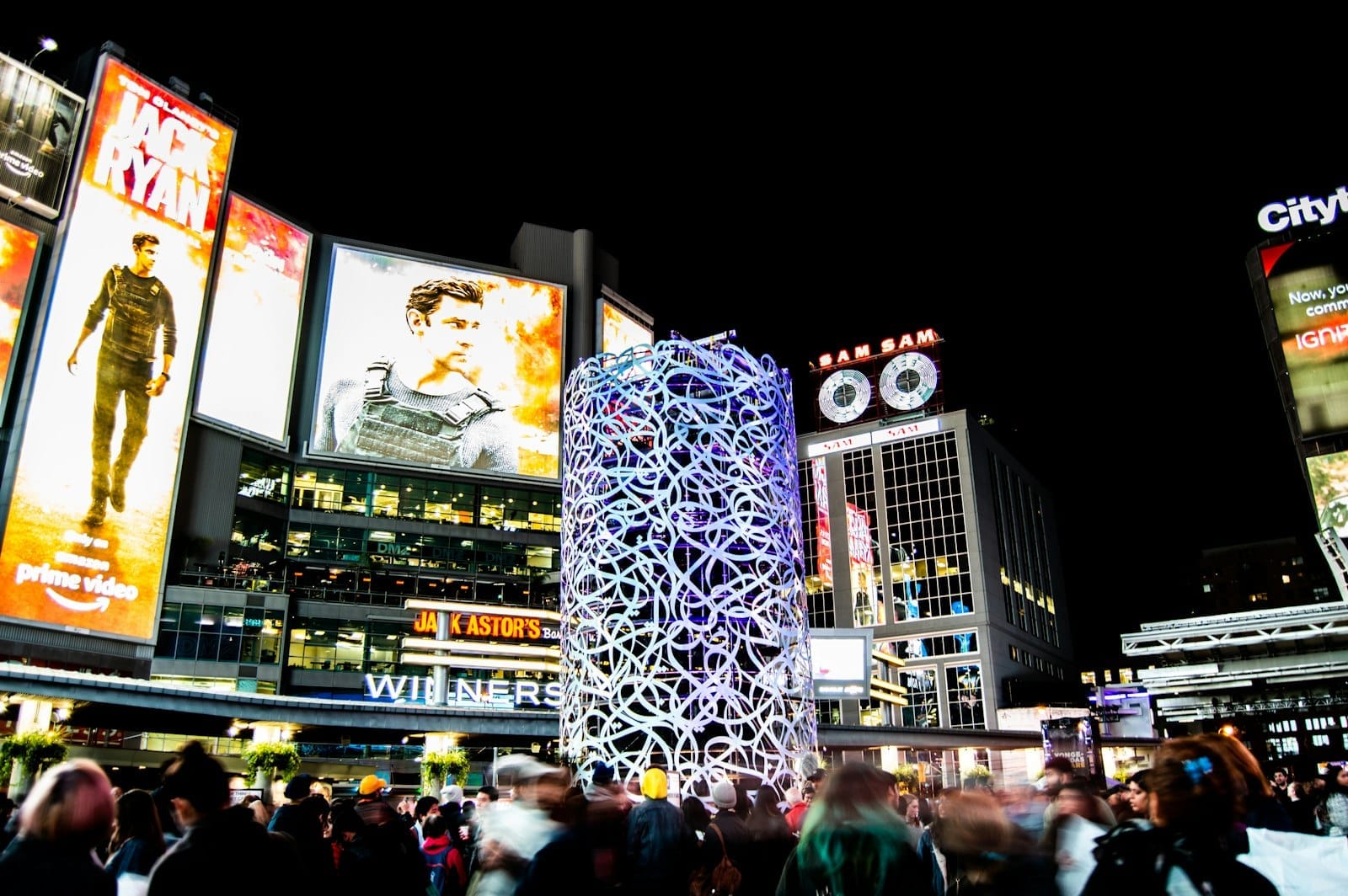
What Is Sankofa Square and Why Does the Name Matter?
The square's official name is Sankofa Square, renamed from Yonge-Dundas Square. The site's official website describes it as 'Sankofa Square' and notes that it was formerly known as Yonge-Dundas Square. The renaming reflects a broader civic conversation in Toronto about public space, history, and whose names get attached to the city's most visible landmarks. Visitors searching for Yonge-Dundas Square will still find it at the same corner, at the same address, with the same screens and benches, but the new name is now the one used in official communications and is being rolled out across physical signage.
Sankofa is a word from the Akan people of Ghana, meaning roughly 'go back and get it' or 'to retrieve what was left behind.' The name signals that this downtown plaza, opened in 2004, is being repositioned as a space that acknowledges and honours the fuller story of the city. Whether you engage with that history or simply cross the square to reach the Toronto Eaton Centre, the name change is a factual part of visiting downtown Toronto in 2024 and beyond.
The Physical Space: What You Actually See
At exactly 1 acre, Sankofa Square is smaller than first-time visitors expect. It is an open, largely flat granite plaza ringed by large-format digital advertising screens that run continuously day and night. The screens are genuinely enormous by street-level standards, and at dusk they become the dominant visual feature of the space, casting colour across the pavement and reflecting off nearby glass towers.
There are water features built into the plaza surface, retractable bollards used to reconfigure the space for events, and seating areas along the perimeter. The surrounding streetscape is dense: the Toronto Eaton Centre anchors the southwest corner, fast-food chains and international retail line the remaining sides, and the illuminated facades of several mid-rise buildings create a wall of signage that makes the square feel more enclosed than its footprint suggests.
ℹ️ Good to know
The square sits directly on top of TMU Station (TTC Line 1). If you arrive by subway, you surface almost exactly at the plaza entrance — one of the most direct subway-to-attraction connections in the city.
Tickets & tours
Live prices and dates from our booking partner. If you book, we may earn a commission at no extra cost to you.
Toronto Old Town: Dark Side Exploration Game and Tour
From 12 €Instant confirmationFree cancellationLEGOLAND Discovery Centre Toronto tickets
From 16 €Instant confirmationFree cancellationToronto 'Little Canada' entrance tickets
From 27 €Instant confirmationFree cancellationNiagara Falls evening tour with boat, dinner and Illumination Tower
From 77 €Instant confirmationFree cancellation
How the Square Changes Through the Day
Early morning, roughly before 8 a.m., Sankofa Square is quieter than almost any other time. Delivery trucks use the surrounding streets, and a handful of commuters cut through the plaza on their way to the subway. The advertising screens are already running, but without the crowds, the effect is more surreal than stimulating. This is the single best window for photography if you want the screens and architecture without people obscuring your frame.
From mid-morning through early afternoon on weekdays, the square fills with a mix of office workers, tourists, students from Toronto Metropolitan University (formerly Ryerson University, located one block east), and shoppers heading into the Eaton Centre. Street evangelists, musicians, and the occasional small protest are all common sights. The noise level is high: transit vehicles, music from nearby stores, and conversations in a remarkable variety of languages all layer on top of one another.
Weekend afternoons bring the densest crowds, particularly in summer when the square hosts free outdoor concerts, film screenings, cultural festivals, and markets. On event days, the plaza fills to capacity and the screens display event-specific content rather than advertising. These events are worth planning around; check the official schedule at sankofasquare.ca before your visit if you want to time your arrival to an event, or avoid the square entirely if you prefer quieter conditions.
After dark, especially on Friday and Saturday nights, the square transitions into a different atmosphere entirely. The advertising screens read as neon from a distance. Groups gather, street performers compete for audiences, and the Yonge and Dundas intersection becomes one of the loudest intersections in the city. If you are sensitive to light, noise, or high foot-traffic density, evening visits are not recommended.
Historical and Urban Context
The square opened in 2004 as part of a redevelopment project intended to activate what had been a poorly regarded stretch of Yonge Street north of Queen. The surrounding block was cleared and rebuilt with the explicit goal of creating a Times Square-style environment for downtown Toronto. That comparison has followed the space ever since, sometimes approvingly and sometimes critically.
The Yonge and Dundas intersection has been a commercial crossroads in Toronto for well over a century. Yonge Street running north-south forms the spine of the original city grid, intersected here by Dundas Street running east-west. The area developed into a dense commercial corridor through the twentieth century, drawing independent shops, theatres, and retailers before the construction of the Toronto Eaton Centre in the late 1970s reshaped retail gravity in the core. For more on how the broader downtown area developed, the Toronto architecture guide provides useful context on the city's urban planning history.
Today the square functions as the de facto orientation point for tourists arriving in downtown Toronto for the first time. It is one of the few large open spaces in the core where you can stand still without blocking traffic, look up at the skyline, and get your bearings. That practical usefulness is real, even if the space itself prioritises commercial activation over green space or tranquility.
Events and Programming
The square hosts a substantial calendar of free public events across the year. Summer is the most active season, with outdoor concerts, cultural celebrations, and the Canada Day programming drawing large crowds to the plaza. The screens can be taken over entirely for event broadcasts, creating an outdoor cinema effect. Film screenings, sporting event watch parties, and community festivals have all taken place on the main stage that can be erected in the central plaza area.
Winter programming uses the square differently. The screens provide warmth visually if not literally, and seasonal events around the holidays bring a different crowd. If you are visiting Toronto in the colder months and want to compare the atmosphere of the square against other winter-friendly options, the Toronto in winter guide covers seasonal events and indoor alternatives across the city.
💡 Local tip
Check sankofasquare.ca for the current events calendar before your visit. During major events, the surrounding streets fill quickly and TTC platforms at Dundas Station can become congested. Arriving 20 minutes early gives you room to find a good vantage point.
Photography at Sankofa Square
The square rewards photographers who work with the artificial light rather than against it. Shooting in the blue hour just after sunset, when there is still some ambient sky colour but the screens are fully illuminated, produces the most balanced exposures. The granite pavement reflects the screen colours noticeably after rain, creating a mirror effect that is difficult to replicate anywhere else in downtown Toronto.
The corner of Yonge and Dundas looking south gives you the Eaton Centre facade, the screen walls, and the street activity all in one frame. For comparison shots showing the square within a broader skyline context, Toronto's best viewpoints offers elevated options within a short walk.
Honest Assessment: Who Should Visit and Who Should Skip
Sankofa Square is not a destination in the way a museum or a park is a destination. Nobody travels from another country specifically to stand in a 1-acre commercial plaza. What the square does well is provide a central, free, always-open public space where the city's density and diversity are on full display. On a Saturday afternoon in summer during a free concert, it is genuinely energetic and worth your time.
Visitors looking for green space, quiet reflection, or natural beauty will not find it here. For parks within the downtown core, Nathan Phillips Square two blocks south offers a different public space experience, including the reflecting pool and the city hall architecture. Those seeking nature entirely should look further afield.
Families with young children can visit comfortably during daylight hours and during daytime events. Late-night weekend visits are louder and more crowded, and the concentration of foot traffic and street-level vendors makes navigation with strollers difficult. Travellers with sensitivity to bright lights or loud environments should plan their visits to early morning or weekday afternoons.
⚠️ What to skip
The Yonge and Dundas intersection is one of the busiest pedestrian crossings in Canada. Pickpocketing in dense crowds is a real concern. Keep bags closed and in front of you during events and rush-hour periods.
Getting There and Practical Details
TMU Station on TTC Line 1 puts you directly at the plaza. The subway runs frequently and the station exit brings you up onto Dundas Street East within steps of the square's northeast corner. Multiple TTC bus and streetcar routes also converge at this intersection, making it one of the most transit-accessible points in the city.
If you are navigating downtown for the first time, the getting around Toronto guide covers TTC fares, Presto card setup, and route planning in detail. Current TTC fares are published at ttc.ca and change periodically, so verify before your trip.
The square is an outdoor public space with no formal opening hours. It is accessible at all hours, though the formal event schedule and any staffed facilities follow programmed times. No admission fee is charged for general public access. Accessibility across the plaza is generally good given its flat, paved surface, though individual event setups can vary.
Insider Tips
- The screens run advertising content most of the time, but during free public events they switch to event-specific visuals. If you want to photograph the screens without advertising, arrive during a scheduled event or in the brief window around 6 a.m. when the square is empty.
- Dundas Station has multiple exits. Use the Yonge Street exit rather than the Dundas Street East exit if you want to arrive directly facing the main plaza area with the full screen wall in front of you.
- Rain transforms the plaza's granite surface into a reflective mirror for the overhead screens. A wet evening visit after a shower produces dramatically different photography conditions than a dry night.
- The square's perimeter benches fill up fast during events. If you want a seated view of the main stage, arrive 20 to 30 minutes before the listed start time. Standing room fills even faster at free concerts.
- Toronto Metropolitan University's campus begins one block east on Dundas. Student food options on the side streets between the campus and the square are consistently cheaper and higher quality than the chain restaurants directly facing the plaza.
Who Is Yonge-Dundas Square For?
- First-time visitors to Toronto wanting a quick read of the city's downtown energy
- Night photographers working with artificial light and reflective surfaces
- Travellers who want free outdoor concerts and cultural events without booking in advance
- Urban observers interested in how Canadian cities design and activate public space
- Anyone using the Eaton Centre, nearby theatres, or Dundas Station as a hub for the day
Nearby Attractions
Other things to see while in Downtown Toronto:
- Allan Gardens Conservatory
Allan Gardens Conservatory is a free, year-round botanical conservatory at 160 Gerrard Street East in downtown Toronto. Housed in six glass display houses anchored by a 1910 Edwardian Palm House, it holds about 1,500 m² of tropical palms, cacti, orchids, and seasonal blooms. One of the oldest parks in Toronto, it remains one of the city's most underrated green spaces.
- Art Gallery of Ontario
The Art Gallery of Ontario is one of North America's largest art museums, housing over 90,000 works inside a landmark Frank Gehry-renovated building in downtown Toronto. From Indigenous Canadian art to European masters and contemporary photography, the AGO rewards focused visitors and casual explorers alike.
- Brookfield Place (Allen Lambert Galleria)
The Allen Lambert Galleria inside Brookfield Place is a free, publicly accessible arcade designed by architect Santiago Calatrava between 1987 and 1992. Its arching steel-and-glass canopy, rising between two of downtown Toronto's tallest towers, is one of the most impressive interior spaces in Canada.
- Campbell House Museum
Built in 1822 for Upper Canada's Chief Justice, Campbell House Museum is the oldest surviving residence from the original Town of York. Moved to its current downtown corner in 1972 and opened as a museum in 1974, it offers an intimate, unhurried window into early colonial Toronto — a sharp contrast to the glass towers surrounding it.
Planning a trip? Discover personalized activities with the Nomado app.