Tomb of the Unknown Soldier: Warsaw's Most Solemn Memorial
The Tomb of the Unknown Soldier stands beneath the last surviving arcade of the Saxon Palace at Piłsudski Square, a quiet but powerful monument to Poland's fallen soldiers. Free to visit at any hour, it is one of the few places in Warsaw where the weight of the country's history feels genuinely present.
Quick Facts
- Location
- plac Marszałka Józefa Piłsudskiego 1–3, Warsaw 00-078
- Getting There
- Nowy Świat–Uniwersytet or Świętokrzyska metro stations, both within walking distance
- Time Needed
- 20–40 minutes
- Cost
- Free, open 24/7
- Best for
- History lovers, those seeking a quiet reflective moment, anyone tracing Warsaw's wartime story
- Official website
- www.wojsko-polskie.pl/dgw/unknown_soldier
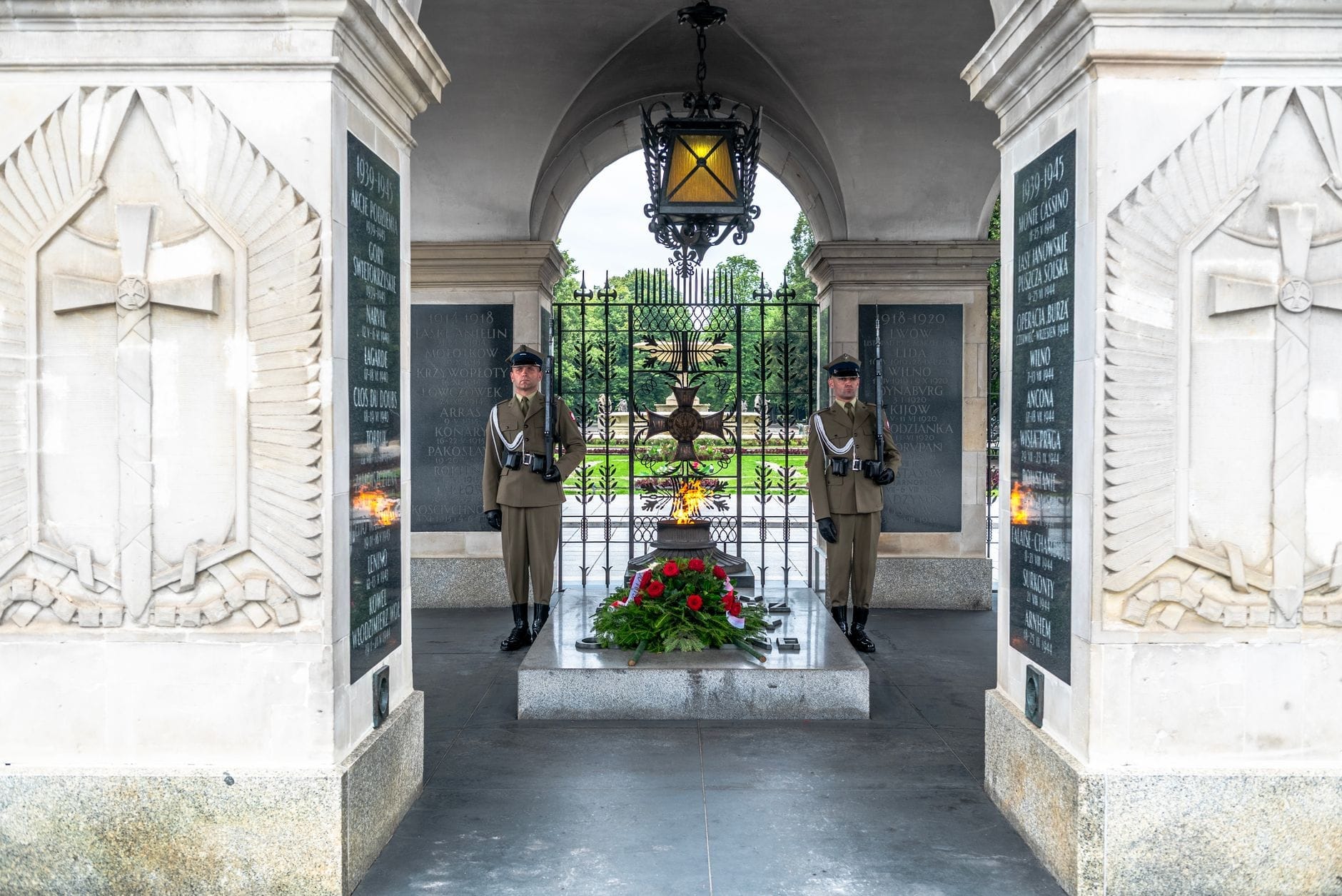
What the Tomb of the Unknown Soldier Actually Is
The Tomb of the Unknown Soldier (Polish: Grób Nieznanego Żołnierza) occupies a shallow arcade on the eastern side of Piłsudski Square, the largest public square in Warsaw. What you see today is a fragment: three arches of stone that once belonged to the grand Saxon Palace, a baroque royal residence that dominated this part of the city for two centuries. German forces demolished the palace during the systematic destruction of Warsaw in 1944. These surviving arches were spared — or rather, left standing by accident — and the decision was made after the war to preserve them as a frame for the memorial rather than rebuild the palace itself.
Beneath the central arch, a granite slab marks the resting place of an unidentified Polish soldier killed in battle. An eternal flame burns at the foot of the tomb. Flanking the flame, two soldiers stand guard in formal dress uniform, motionless except for the slow sweep of their eyes. The combination of blackened stone, open sky, and absolute stillness creates an atmosphere that most visitors feel immediately, regardless of whether they know the history.
ℹ️ Good to know
The Tomb of the Unknown Soldier is accessible 24 hours a day, 7 days a week. Admission is free. The guard is changed at set intervals — weekend ceremonial changings draw larger crowds. Check schedules in advance if the ceremony is important to your visit.
A Century of History Behind Three Arches
The memorial was first inaugurated on 2 November 1925, using the remains of an unidentified soldier who fell defending Lviv in 1920 during the Polish-Soviet War — a conflict little known outside Poland but foundational to the country's interwar independence. The date chosen, All Souls' Day, was deliberate: a day when Polish families traditionally light candles at graves and cemeteries across the country.
When Nazi forces razed Warsaw following the 1944 Warsaw Uprising, the Saxon Palace was among thousands of structures deliberately detonated. The arcade survived. After Poland's liberation, the tomb was rededicated on 8 May 1946 — VE Day in Western Europe — a symbolic act of continuity connecting the postwar Polish state to the soldiers who died fighting for it. Over subsequent decades, the urns beneath the arcade were expanded to include soil from battlefields across multiple wars and theatres, including Monte Cassino, Narvik, the Eastern Front, and sites from the 1939 September Campaign.
This layered history makes the Tomb of the Unknown Soldier something more complex than a single-war memorial. To understand its place in the city's story, it helps to read it alongside other sites nearby. The Saxon Garden directly behind the square was part of the same royal complex and survived the war largely intact, offering a calmer green backdrop to the open expanse of Piłsudski Square.
Tickets & tours
Hand-picked options from our booking partner. Prices are indicative; availability and final rates are confirmed when you complete your booking.
Museum of John Paul II and Primate Wyszyński entrance ticket
From 8 €Instant confirmationPub crawl in Warsaw
From 28 €Instant confirmationFree cancellationWarsaw Museum of Modern Art entrance ticket
From 8 €Instant confirmationSafe and Convenient Luggage Storage in Warsaw Old Town
From 6 €Instant confirmationFree cancellation
Visiting the Memorial: What to Expect on the Ground
The tomb sits at the far western end of the square, set slightly back beneath the arcade. Approaching from Krakowskie Przedmieście, you cross a large open plaza of grey paving stones that can feel vast and exposed in winter wind or bleached and hot in July afternoon sun. The walk itself prepares you: there are no trees, no street furniture, nothing to distract from the scale of the space and the low stone structure at its far end.
Up close, the stonework of the arcade shows its age and its damage. The surfaces are not pristine. Discolouration, patches of repair, and the weight of decades are visible in the grain of the stone. The eternal flame flickers in a low bronze fixture. The soldiers on guard maintain absolute stillness — no acknowledgement of tourists, no reaction to noise from the square. This formality is part of the point. Visitors who approach respectfully and take a moment of silence are rewarded with a sense of presence that photographs rarely convey.
Flowers and wreaths are frequently laid at the tomb. On national holidays — particularly Independence Day (11 November) and the anniversary of the Warsaw Uprising (1 August) — official delegations arrive with full ceremony, and the square fills with onlookers. If you visit on an ordinary weekday, you may have the space almost to yourself.
💡 Local tip
For the quietest visit, come on a weekday morning before 10:00. The square is largely empty at that hour, the light is soft from the east, and the guard ceremony — when it occurs — feels genuinely intimate rather than performative.
How the Experience Changes by Time and Season
At dawn, Piłsudski Square has an almost eerie quality. The stone is grey, the pigeons are still settling, and the flame at the tomb burns more visibly against the dim light. This is when the memorial is at its most austere. A handful of joggers cross the square at the edges, but almost no one approaches the arcade itself.
Midday in summer brings tour groups and school parties. The square gets noisy at its centre, but the tomb retains a degree of quiet because the guards' presence creates an invisible boundary. Most people instinctively lower their voices as they approach. In winter, especially after a snowfall, the scene shifts entirely. Snow accumulates on the tops of the arches and on the paving stones, and the flame at the base of the tomb becomes the only warm color in view. It is arguably the most photogenic condition, but also the coldest — dress accordingly.
Evening visits work well in summer when long twilight lingers over the square. The eternal flame becomes more prominent after dark, and the empty square amplifies the sense of solemnity. For context on how this part of the city fits into a longer walk, the nearby Krakowskie Przedmieście connects the square northward toward the university and the Old Town, making it easy to combine both in a single afternoon route.
Practical Details for Getting There
Piłsudski Square is in the heart of Warsaw's Śródmieście district. The two most convenient metro stations are Nowy Świat–Uniwersytet (Line M1) and Świętokrzyska (Lines M1 and M2), both reachable on foot within ten to fifteen minutes. Multiple tram and bus lines stop along Krakowskie Przedmieście, which borders the square to the east. From the Old Town, it is a flat, fifteen-minute walk north along Krakowskie Przedmieście.
The square itself and the area immediately in front of the tomb are fully accessible to wheelchair users. The paving is even, there are no steps at the memorial, and the approach from the Saxon Garden involves no significant obstacles. Parking nearby is limited and not recommended given the central location and good transit connections.
If you are planning a wider day in central Warsaw, the tomb pairs naturally with the Presidential Palace a short walk to the south, and with the Saxon Garden directly behind the square. Together, these three sites form a coherent half-day route through the civic and ceremonial heart of the city.
Photography and Honest Expectations
The memorial photographs well but requires patience. The eternal flame is small and can wash out in bright midday light. The best images tend to use the depth of the arcade as a frame, shooting from slightly off-center to include one of the flanking arches and the open square beyond. A wide-angle lens in the morning, or a longer focal length from across the square at dusk, both produce strong results.
Be aware: this is not a large attraction. The physical footprint of the memorial is modest. Visitors expecting an elaborate museum experience or extended spectacle may find it underwhelming. What the Tomb of the Unknown Soldier offers is something quieter and harder to quantify — a direct encounter with Polish national grief that requires no prior knowledge to feel. If you are the kind of traveler who finds meaning in standing still in a charged place, this is worth twenty minutes of your time regardless of the season.
⚠️ What to skip
On major national holidays, Piłsudski Square closes to general visitors during official ceremonies. Crowds on 11 November (Independence Day) and 1 August (Warsaw Uprising anniversary) can be very large. Plan accordingly if you want a quiet visit on those dates.
Connecting the Tomb to Warsaw's Broader History
The Tomb of the Unknown Soldier is most affecting when visited as part of a larger engagement with Warsaw's wartime history rather than as a standalone stop. The Warsaw Uprising Museum offers the most comprehensive account of the 1944 events that destroyed the city around this very site. Further west, the POLIN Museum documents the parallel destruction of Warsaw's Jewish community. Together, these sites form a triangle of memory that no serious student of 20th-century history should ignore.
For those following Warsaw's military history more broadly, the Polish Army Museum holds an extensive collection of equipment and documents spanning multiple centuries of Polish military history. A visit there before or after the tomb adds factual context to what is otherwise a purely emotional experience at Piłsudski Square.
Insider Tips
- The guard change ceremony on weekends is more elaborate than on weekdays. If you want the full ceremonial experience with additional soldiers and a formal march, check the schedule in advance and arrive at least fifteen minutes early to get a clear sightline.
- The Saxon Garden directly behind the square is an underused retreat. After standing in the open expanse of Piłsudski Square, the garden's old trees and ornamental fountains offer a marked contrast. It takes less than five minutes to walk there.
- The stone plaques at the base of the arcade list battlefield names from multiple Polish wars. Take time to read them — the range of locations, from Monte Cassino to the Soviet steppe, conveys the scope of Polish sacrifice across different theatres far more immediately than any caption.
- If you are visiting in November, the approach to All Souls' Day (2 November) sees additional flowers and candles laid at the tomb by ordinary citizens, not just official delegations. It is one of the more quietly moving times to visit.
- Avoid visiting during large political rallies or state ceremonies on the square if you want contemplative access. Check local Warsaw event calendars around national anniversaries.
Who Is Tomb of the Unknown Soldier For?
- Travelers interested in 20th-century Polish and European history
- Visitors who appreciate memorials and ceremonial military sites
- Those combining the tomb with a walking route along Krakowskie Przedmieście
- Photographers seeking architectural contrast and emotional subject matter
- Anyone wanting a free, no-queue experience at one of Warsaw's most significant public monuments
Nearby Attractions
Other things to see while in City Centre (Śródmieście):
- Fryderyk Chopin Museum
Housed inside the 17th-century Ostrogski Palace near Warsaw's Royal Route, the Fryderyk Chopin Museum holds one of the world's richest collections of Chopin memorabilia. Closed for full renovation throughout 2026; reopening is planned for 2027 — plan post-renovation visits and confirm dates on the official site.
- Grand Theatre – National Opera
The Grand Theatre – National Opera (Teatr Wielki – Opera Narodowa) is one of the largest opera houses in Europe, anchoring Theatre Square in central Warsaw with a neoclassical facade that survived war and rebuilding. Whether you attend a full opera, a ballet, or simply walk across the square to take in the architecture, this institution rewards both serious culture-seekers and curious first-time visitors.
- Hala Koszyki Food Hall
Built in 1909 and reborn in 2016, Hala Koszyki is a restored Art Nouveau market hall in central Warsaw where locals actually eat, drink, and shop. Free to enter, open daily until 1am, and genuinely good.
- Holy Cross Church (Kościół Świętego Krzyża)
One of Warsaw's most historically charged sites, Holy Cross Church on Krakowskie Przedmieście holds the preserved heart of Frédéric Chopin in a nave pillar. A Minor Basilica with a Baroque facade, 17th-century origins, and free entry, it rewards visitors who take the time to look closely.