Théâtre Royal de Toone: Brussels' Last Puppet Theatre
Tucked down a narrow alley metres from the Grand-Place, the Théâtre Royal de Toone is Brussels' sole surviving traditional puppet theatre. Performances run Thursday to Saturday in a candlelit room above a centuries-old tavern, keeping alive a working-class art form that once packed the Marolles district.
Quick Facts
- Location
- Impasse Sainte-Pétronille, 66 rue du Marché-aux-Herbes, 1000 Brussels
- Getting There
- Tram 4 or 10 to Bourse (6 min walk); metro De Brouckère on lines 1/5, then short walk
- Time Needed
- 2–3 hours (show + tavern drink + museum)
- Cost
- Shows approx. €12 standard; museum spaces free
- Best for
- Culture lovers, families, anyone seeking something off the tourist circuit
- Official website
- www.toone.be
Finding the Theatre: A Disappearing Act in Plain Sight
The Théâtre Royal de Toone is not easy to stumble upon, and that is part of what makes arriving there feel like a small achievement. From the Grand-Place, walk north along the rue du Marché-aux-Herbes for about two minutes. At number 66, a low archway opens into the Impasse Sainte-Pétronille and the narrow Schuddeveldgang beyond, a cobbled sequence of passages barely wide enough for two people to pass comfortably. The alley bends slightly, the city noise drops away, and you find yourself in front of a doorway that opens into a traditional Belgian estaminet with wooden tables, low ceilings darkened by years of pipe smoke, and shelves lined with marionettes in various states of theatrical undress.
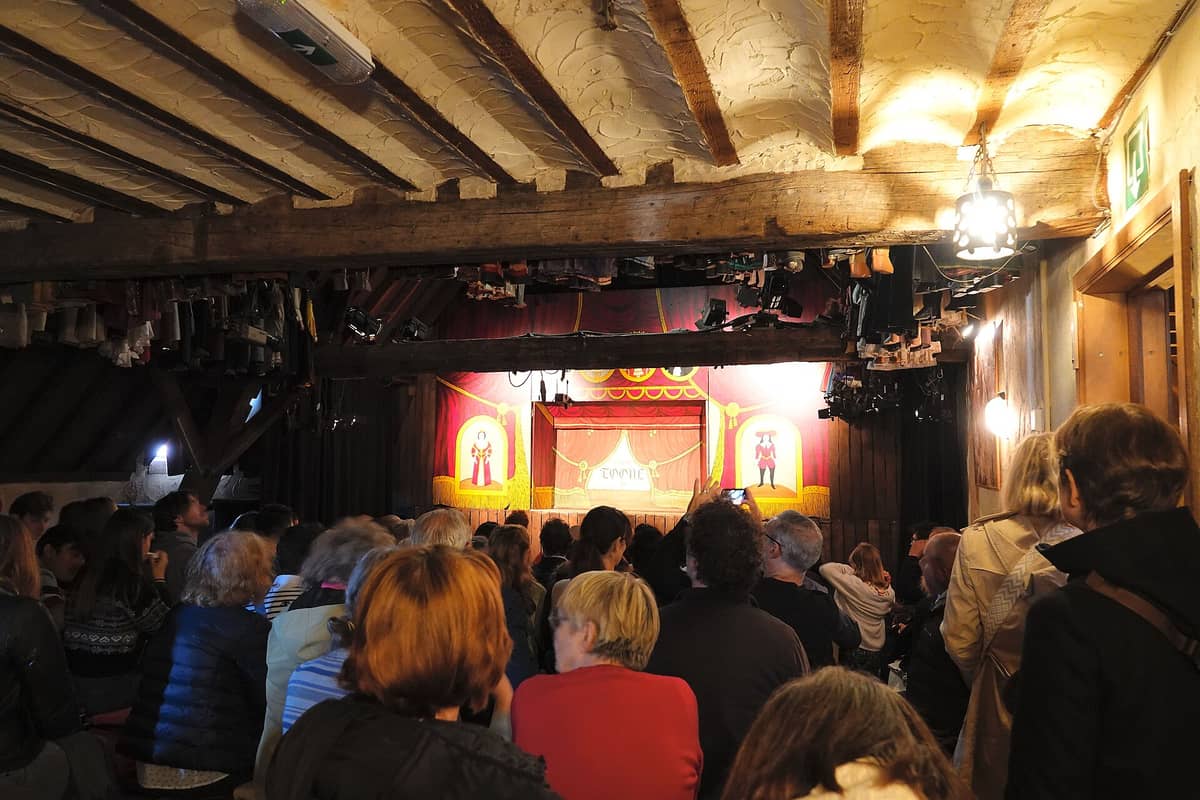
The theatre itself sits above the tavern. The entrance gives no hint of the performance space upstairs: a snug, warmly lit room where rows of wooden chairs face a stage fitted with a hand-painted backdrop and operated by a single puppeteer visible to no one in the audience. It is a traditional configuration dating back centuries, and the proportions of the space make the marionettes feel almost life-sized.
💡 Local tip
The address is officially 66 rue du Marché-aux-Herbes, with the entrance through the Impasse Sainte-Pétronille alleyway accessed via a low arch off the street. If you are standing on the street looking at a door, you have missed the turn. Look for the low arch to your right.
History: From the Marolles to a European Heritage Site
The roots of Toone go back to the popular puppet theatre tradition of nineteenth-century Brussels, when large marionette shows in the Marolles working-class district drew local crowds. The original Toone was Antoine Genty, who gave his nickname to the company. The tradition passed through multiple generations of puppeteers, each adopting the name Toone, preserving both the characters and the tradition of performing in Brussels dialect, Brusseleer, a hybrid of French and Dutch that is itself nearly extinct.
Since the early 1960s, with the relocation completed in 1963 and an inauguration of the renovated premises in 1966, the theatre has been located at its current address near the Grand-Place, having moved from the Marolles neighbourhood. The organisation was formally registered as a non-profit, and it remains the only surviving traditional puppet theatre in Brussels. In recognition of its role in European history and culture, the theatre was awarded the European Heritage Label, placing it alongside sites of continent-wide cultural significance.
That label is not ceremonial. Toone's puppet repertoire includes adaptations of Faust, Don Quixote, The Three Musketeers, and Hamlet, all performed with hand-carved wooden marionettes and reworked into the Brussels comic tradition. The juxtaposition of high literature and low-brow delivery, with puppets arguing in Brusseleer dialect, is the whole point. For more on Brussels folklore and cultural identity, the Brussels hidden gems guide covers several institutions that operate in this same quiet-but-serious register.
Tickets & tours
Hand-picked options from our booking partner. Prices are indicative; availability and final rates are confirmed when you complete your booking.
Ghent tour from Brussels
From 43 €Instant confirmationFree cancellationTablet Workshop at Choco-Story Brussels
From 45 €Instant confirmationShared tour of Delft and the Keukenhof Estate from Brussels
From 86 €Instant confirmationFree cancellationOrigins of Brussels exploration game and tour
From 10 €Instant confirmationFree cancellation
The Show: What Actually Happens on Stage
Performances take place Thursday, Friday, and Saturday at 20:30, with an additional Saturday matinee at 16:00. The theatre does not present shows on other days of the week and is closed to the public in January. Shows last between about 45 minutes (short versions) and 2 hours (full versions) and are performed mainly in French, with occasional performances in Dutch, English, or Brusseleer depending on the production and audience. Check the official website before booking if language matters to you.
The marionettes used at Toone are large, elaborate, and old. Some of the figures in the collection are over a century old, with carved wooden heads, articulated hands, and costumes that have been repaired and re-dressed across generations. The puppeteer operates from above, visible to the audience only in shadow, and the technique relies on wire rather than string, giving the figures an unusually direct, physical quality. The stage effects are simple but well-timed: lighting changes, practical smoke, and a soundtrack that blends recorded music with live timing from the operator.
The audience is typically small, around thirty to fifty people, seated close to the stage. There is no pretence of cinematic scale here. The intimacy is the experience. Children tend to sit very still, which is not something that happens often.
ℹ️ Good to know
Ticket prices are approximately €12 for standard admission. Reduced rates may be available at certain performances. Always confirm current pricing and availability directly with the theatre before visiting.
The Tavern and Museum: Before and After the Curtain
The estaminet on the ground floor is open Wednesday to Sunday from around noon until late evening (typically 23:00 on Wednesday and Sunday, and 01:00 on Thursday, Friday, and Saturday). It serves Belgian beers on draught, including several lambic and gueuze options appropriate to the neighbourhood, along with simple food. The room is lined with marionettes, old posters, and theatrical ephemera accumulated over decades. Even if you are not attending a show, spending an hour here over a beer is worthwhile. The space has not been renovated for tourism; it smells of old wood and hops, and the bar staff know the regulars by name.
The museum spaces, referred to as the Musée de Toone or Maison de la Marionnette, are open Thursday to Saturday from 14:00 to 18:00 and are free to enter. They hold an extensive collection of marionettes, some dating to the nineteenth century, alongside archival photographs and documentation of past productions. If you are interested in the craft of puppet-making or the social history of Brussels' working-class entertainment culture, the collection is genuinely detailed. It complements a visit to the Belgian Comic Strip Center, which covers a parallel tradition of Brussels popular art with similar depth.
Practical Walkthrough: Getting There and Getting In
The theatre sits in the Grand-Place and Îlot Sacré neighbourhood, the dense historic core immediately north of the main square. Tram lines 4 and 10 stop at Bourse, from which the walk is about six minutes northeast. The metro station De Brouckère (lines 1 and 5, plus tram lines 4 and 10) is within ten minutes on foot. There is no practical reason to take a taxi from elsewhere in the centre.
Parking in this area is extremely limited and not recommended. If you are arriving from further afield, the broader guide to getting around Brussels covers STIB tram and metro options in detail. The Grand-Place itself is a five-minute walk from the theatre entrance, making it natural to combine both in the same afternoon or evening.
One logistical point worth noting: the Impasse Sainte-Pétronille is a narrow, uneven cobbled lane. The theatre is not accessible for wheelchair users or people with reduced mobility. There are steps to the performance space above the tavern, and the alleyway itself has no ramp access. This is stated clearly on family-oriented guides to the attraction and should factor into planning if accessibility is a concern.
⚠️ What to skip
The theatre is closed throughout January and does not hold public shows on Monday, Tuesday, or Wednesday at any time of year. If your Brussels visit falls in January or outside show days, the tavern and museum remain the only elements of Toone you can access.
Who Will Love This, and Who Might Not
Toone rewards visitors who come in the right frame of mind: curious about Brussels beyond its famous square, comfortable with performances that prioritise atmosphere and craft over production polish, and patient enough to sit for ninety minutes in a small, warm room. The shows are performed primarily in French, so non-French speakers attending without prior knowledge of the story may find the dialogue hard to follow. The physical comedy and visual storytelling carry a great deal of the performance, but the linguistic dimension is real.
Travellers who prioritise big-budget productions, extensive English commentary, or modern staging will likely find the experience underwhelming. This is not a criticism of Toone but a description of what it is: a small, serious cultural institution doing something very specific. For visitors who want more context on Brussels' theatrical and artistic landscape, the BOZAR Centre for Fine Arts and La Monnaie Opera represent the other end of the city's cultural spectrum, and together the three institutions give a reasonably complete picture of Brussels' performing arts identity.
Children aged roughly five and above who enjoy visual storytelling tend to find the performances absorbing. Older children who read French or have seen the source material (Faust, The Three Musketeers) get considerably more from it. Adults without children are the majority of the audience at evening shows.
Photography and Atmosphere
Photography inside the performance space during shows is not permitted. The tavern and museum, however, are highly photogenic: the marionettes hanging on the walls, the amber light on old wood, and the narrow passage leading in all make for images that are difficult to replicate elsewhere in Brussels. Early evening, before the show, is when the light in the estaminet is at its warmest and the room is quietest. The alley outside, particularly in winter when fog rolls in off the streets, has a quality that photographs well with a wide-angle lens and no flash.
If you are building an itinerary around Brussels' more atmospheric and historically layered corners, the Impasse Sainte-Pétronille fits naturally alongside the Galeries Royales Saint-Hubert and the Grand-Place, both within a short walk. The three together represent the commercial, civic, and folk dimensions of the same historic neighbourhood in distinct and complementary ways.
Insider Tips
- Arrive at the tavern at least 30 minutes before the show. The estaminet fills quickly on Saturday evenings, and the bar staff can tell you which production is running and whether it has English surtitles or pre-show programme notes.
- The Saturday 16:00 matinee is the calmest show to attend. Evening performances on Fridays and Saturdays attract larger, louder groups, which changes the atmosphere in the tavern, though the show itself is identical.
- If you cannot attend a show, the free museum on Thursday to Saturday afternoons is undervisited and unhurried. The puppeteer on duty sometimes demonstrates the wire-operation technique informally, particularly for smaller groups.
- The Brussels dialect, Brusseleer, used in some productions is a linguistic curiosity in its own right: a nineteenth-century blend of French and Dutch specific to the city's working-class culture. Even a small amount of background reading on it beforehand adds considerably to the experience.
- Book tickets in advance online, especially for Saturday evening performances. The room holds fewer than fifty people, and popular productions sell out weeks ahead during the autumn and spring seasons.
Who Is Théâtre Royal de Toone For?
- Travellers curious about Brussels' folk culture beyond the Grand-Place postcard
- Families with children aged five and above who enjoy visual and physical storytelling
- French speakers, or visitors familiar with the classic literary source material
- Anyone looking for an evening that combines a pre-show drink in a historic tavern with a short, genuinely unusual performance
- Culture travellers building a picture of Brussels' full artistic range, from street folklore to formal opera
Nearby Attractions
Other things to see while in Grand-Place & Îlot Sacré:
- Belgian Comic Strip Center
Housed in a Victor Horta-designed Art Nouveau masterpiece, the Belgian Comic Strip Center tells the story of Belgium's extraordinary contribution to comic art. From Tintin to the Smurfs, this is one of Brussels's most rewarding museum experiences for visitors of almost any age.
- Brussels Beer Museum
Tucked into the cellars of a baroque guild house on the Grand-Place, the Belgian Brewers Museum (Musée des Brasseurs belges) tells the story of Belgian brewing through historic equipment, documents, and a glass of beer included with your €5 ticket. Small, unhurried, and genuinely atmospheric, it rewards curiosity about one of Belgium's defining cultural exports.
- Brussels Town Hall (Hôtel de Ville)
The Brussels Town Hall, or Hôtel de Ville de Bruxelles, is the Gothic building that has anchored the UNESCO-listed Grand-Place for centuries. Interior access is by guided tour only, making advance planning essential. The exterior, however, is free to admire at any hour.
- Cathedral of St. Michael and St. Gudula
Rising above a broad flight of stone steps just minutes from Grand-Place, the Cathedral of St. Michael and St. Gudula is the most architecturally significant church in Belgium. Entry to the main nave is free, the stained-glass windows are among the finest in Northern Europe, and the atmosphere shifts dramatically between early morning quiet and afternoon tour-group activity.