The Postal Museum: London's Secret Underground Railway and 500 Years of Postal History
The Postal Museum in Clerkenwell combines an engaging collection of British communications history with something rare: a ride through the tunnels of Mail Rail, the miniature underground railway that once moved letters beneath London's streets. It is one of the city's most distinctive specialist museums, and one that rewards visitors of almost any age.
Quick Facts
- Location
- 15-20 Phoenix Place, London WC1X 0DA (Clerkenwell, near the West End)
- Getting There
- Chancery Lane (Central line) or Farringdon (Circle, Hammersmith & City, Metropolitan, and Elizabeth lines), both roughly 10–12 minutes' walk
- Time Needed
- 3–4 hours for museum and Mail Rail combined
- Cost
- From £18.50 standard adult; from £11.00 child, with concessions and Art Fund discounts available. Verify current prices at postalmuseum.org
- Best for
- Families with children, history enthusiasts, anyone curious about London's hidden infrastructure
- Official website
- www.postalmuseum.org
What The Postal Museum Actually Is
The Postal Museum opened in its current form in 2017, occupying a purpose-converted building beside the Mount Pleasant Mail Centre in Clerkenwell. The site has two distinct parts: the museum galleries upstairs, which trace over 500 years of British postal and communications history, and Mail Rail below, where you board small open carriages and travel through the actual tunnels used by Royal Mail until 2003. Both are included in a single combined ticket.
This is not a dusty philatelic archive. The collection is broad, smartly presented, and includes objects ranging from original postal coaches and pillar box prototypes to wartime propaganda envelopes and design archives. The Penny Black, issued in 1840 as the world's first adhesive postage stamp, is here. So is the story of how Henry VIII first formalised a royal postal system in the 16th century, eventually evolving into the institution that employed hundreds of thousands of people and touched every household in Britain.
💡 Local tip
Book Mail Rail timed entry tickets online before you visit. The underground railway has limited capacity per departure and popular time slots sell out, especially on weekends and during school holidays.
Mail Rail: The Star Attraction
Mail Rail ran around 70 feet beneath London's streets from 1927 until 2003, carrying mail between sorting offices on driverless electric trains. At its peak it shifted over four million letters a day. The tunnels stretch across roughly six miles in total, connecting Liverpool Street in the east to Paddington in the west, passing through Mount Pleasant at the centre. When Royal Mail decommissioned the system it was simply sealed up and left.
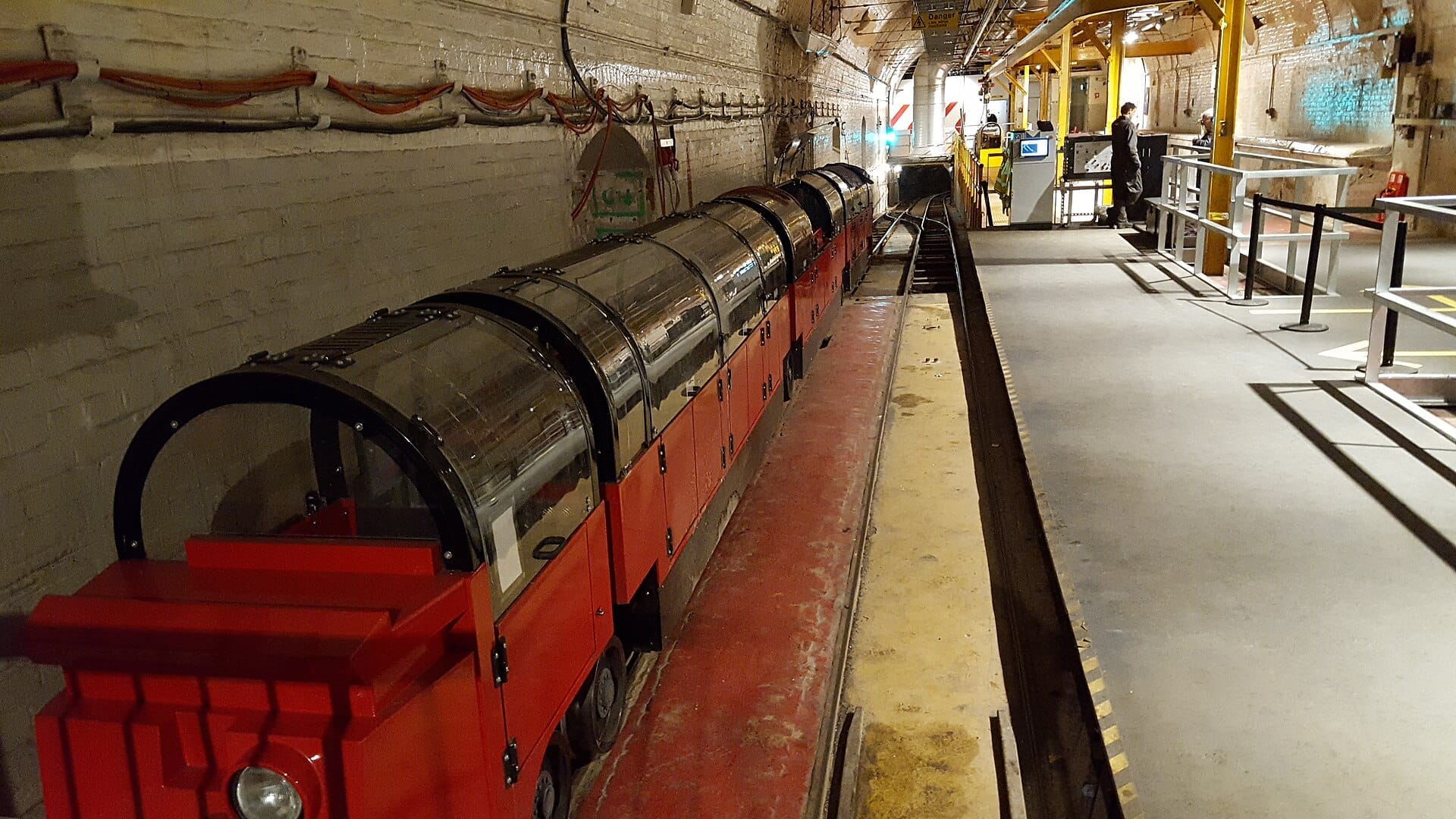
The museum has restored part of the eastern section and converted the original platform at Mount Pleasant into a boarding area. The ride itself takes about 15 minutes in total, traveling at low speed through the tight Victorian tunnels while light projections and audio explain what different sections of the route were used for. The carriages are open and narrow, accommodating roughly eight to ten people per train. It is not a fairground ride and there are no sharp drops or sudden movements, but the combination of enclosed tunnel, atmospheric lighting, and the genuine age of the infrastructure around you creates a quietly memorable experience.
Children tend to be excited by it. Adults often find it unexpectedly moving — partly because the tunnels are real working infrastructure, not a reconstruction, and partly because the scale of the original operation (thousands of tons of mail moved invisibly beneath the city every week for 76 years) is easy to underestimate. The ride ends back at the platform, where a small exhibition area allows you to walk among restored Mail Rail trains and read more about how the system worked.
⚠️ What to skip
The Mail Rail carriages have a low ceiling and open sides. Visitors with claustrophobia, or who require step-free boarding, should check accessibility details directly with the museum before booking. Children must meet a minimum age or height requirement — confirm current requirements on the official website.
Tickets & tours
Hand-picked options from our booking partner. Prices are indicative; availability and final rates are confirmed when you complete your booking.
Soho Instagram a self-guided walking tour to top photo spots
From 6 €Instant confirmationFree cancellationTootbus London by Night: Bus tour
From 32 €Instant confirmationFree cancellationIFS Cloud Cable Car Ride and Uber Boat Hop-on Hop-off 1 Day Ticket
From 38 €Instant confirmationFree cancellationThe Making of Harry Potter Guided Tour of London Warner Bros. Studio
From 201 €Instant confirmationFree cancellation
The Museum Galleries: More Than Stamps
The galleries occupy the main building and cover the full arc of British postal history with more range than most visitors expect. The early sections deal with the political and social mechanics of establishing a national postal network — a surprisingly contested process involving private carriers, state control, and the gradual standardisation of rates. The introduction of the Penny Black in 1840, which standardised low pre-paid postage by the sender rather than the recipient, was a radical democratic reform. The original examples on display are small objects with enormous implications.
Later galleries cover the design and manufacture of pillar boxes (the distinctive red post boxes introduced in the 1850s, with various prototype shapes on display), the role of the Post Office in running the UK's telephone and telegraph networks, and the social history of letter-writing during wartime. There is a dedicated children's play area called The Works, designed for younger visitors to engage with sorting, delivery, and the mechanics of how mail actually moves.
Photography throughout the galleries is generally permitted. The collection is strong on printed ephemera, envelopes, and archival design, making this a rewarding stop for anyone interested in graphic history or typography. Visitors interested in other specialist London collections might also enjoy the Sir John Soane's Museum in nearby Lincoln's Inn Fields, or the London Transport Museum in Covent Garden, which takes a similar approach to London's hidden infrastructure history.
How the Experience Changes Through the Day
Opening time (10:00 on public days) is consistently the quietest period. The museum attracts a mix of families, school groups, and independent visitors, with the heaviest crowds arriving mid-morning on weekends and during school holidays. If you arrive at opening and head directly to the Mail Rail platform for your timed slot, you will have the galleries to yourself for the first 45 minutes or so.
By midday the children's area becomes lively and the queuing zone for Mail Rail fills up. Early afternoon sees the highest footfall. The last Mail Rail departures are in the late afternoon — check the current schedule on the official site, as final slots can be earlier than the museum closing time of 17:00. If you can only visit in the afternoon, arriving around 14:30 on a weekday outside school holidays still gives a comfortable experience.
The museum is closed on Mondays and Tuesdays in term time, opening on these days only during school holiday periods; always check the latest timetable before visiting. Tuesday is often noticeably quieter than the rest of the week. The Clerkenwell neighbourhood around Phoenix Place is a working area rather than a tourist corridor, so there is no particular crowd dynamic spilling in from outside.
Getting There and the Surrounding Area
The museum sits on Phoenix Place in Clerkenwell, a short street connecting Rosebery Avenue to the south with the Mount Pleasant complex to the north. The nearest Tube stations are Chancery Lane on the Central line (about 10 minutes on foot) and Farringdon on the Circle, Hammersmith & City, Metropolitan, and Elizabeth lines (about 12 minutes on foot) through quiet residential and commercial streets. The walk from either station passes through Bloomsbury or Holborn, both pleasant on foot.
Several buses serve the Rosebery Avenue/Gray's Inn Road corridor nearby. If you are combining this visit with the British Museum in Bloomsbury (about 15 minutes' walk southwest) or the British Library near King's Cross (around 20 minutes on foot), The Postal Museum fits naturally into a full day in this part of central London.
The immediate area around the museum is not a restaurant hub. There are a handful of cafes on Exmouth Market, about five minutes' walk south, which is a pleasant pedestrianised food street with independent operators at lunch. The museum itself has a small cafe on site.
Practical Notes: What to Know Before You Go
Opening hours are generally Wednesday to Sunday, 10:00 to 17:00, with additional days sometimes added in school holidays. The museum opens on Mondays during school holiday periods. Standard adult admission is £18.50 at time of writing, with a reduced rate of £9.25 for Art Fund members and concessions. These prices are subject to change — verify current rates and any online booking discounts at postalmuseum.org before purchasing.
The museum is compact enough that two to three hours is sufficient for most visitors to see everything at a comfortable pace, including the Mail Rail ride. There is no particular need to bring anything beyond comfortable shoes. The underground sections are cool year-round, so a light layer is worth having if you run cold. The building itself is step-free at street level, but specific accessibility details for the Mail Rail platform should be confirmed directly with the museum, as the carriages are narrow and boarding involves some physical navigation.
If you are planning a broader day of London sightseeing, this museum pairs well with the Somerset House to the south, or you can extend your day toward the West End. For visitors building a multi-day itinerary, a three-day London itinerary can help prioritise which clusters of attractions work best together geographically.
Is It Worth the Ticket Price?
At around £18.50 for an adult ticket, The Postal Museum sits at the mid-range of London's paid attractions. It is not the Tower of London or the Natural History Museum in terms of scale, and visitors expecting a vast institution will find it more intimate than expected. But the quality of interpretation is high, Mail Rail is unlike anything else in London, and the collection has real depth for anyone with an interest in social history, design, or infrastructure.
It is fair to say that visitors who have no particular interest in postal or communications history and are primarily seeking spectacle may find the galleries slow. The museum rewards curiosity rather than passive observation. If you are a traveler who reads exhibit text, asks questions, and enjoys finding out how everyday systems actually worked, this is a well-above-average afternoon. If you are chasing landmark sights and have limited days, it may not make the cut on a first visit to London.
Budget-conscious visitors should note that many of London's major national museums are free to enter. For a full overview of what you can see without paying admission, the guide to free things to do in London is worth consulting before committing to paid entry anywhere.
Insider Tips
- Book the Mail Rail slot for your first available time after arrival — sell-out slots are common on weekends. Arriving at 10:00 and boarding the first or second departure means you have the galleries quieter for browsing afterward.
- The museum's permanent collection includes an extensive archive of stamp design and postal graphic history that is not all on permanent display. If you have a specialist interest, contact the museum in advance about access to the research collection.
- Exmouth Market, about a five- to ten-minute walk south down Farringdon Road, is one of central London's better lunch streets, with a range of independent food stalls and sit-down restaurants open at midday on weekdays.
- If you are an Art Fund member, your card gets you 50% off entry. The Art Fund also allows discounts at hundreds of other UK museums and galleries, so if you plan on visiting multiple paid museums during a London trip, membership can pay for itself quickly.
- The museum shop stocks a well-curated range of design-led products, including reproduction prints of iconic stamp artwork and postal design history books. It is one of the better museum shops in this part of London for design gifts.
Who Is The Postal Museum For?
- Families with children aged 4–12 who will respond well to the Mail Rail ride and the hands-on children's area
- History and social history enthusiasts interested in how everyday institutions shaped British life
- Design, typography, and graphic arts visitors drawn to the stamp and printed ephemera collections
- Travelers who enjoy London's less-visited infrastructure stories, alongside places like the London Transport Museum
- Visitors with a half-day to fill in Bloomsbury or Clerkenwell who want something substantive beyond the standard circuit
Nearby Attractions
Other things to see while in West End:
- British Library
The British Library holds over 170 million items spanning thousands of years of human thought, from the Magna Carta to Beatles lyrics. Entry to the building and permanent collection galleries is free, making it one of the most rewarding stops in central London for curious travellers.
- British Museum
The British Museum holds one of the world's great collections of human history and culture, spanning two million years across more than 60 free galleries. Entry to the permanent collection is free, but knowing how to navigate the scale of it makes the difference between a rewarding visit and an overwhelming one.
- Carnaby Street
Carnaby Street is the pedestrianised shopping district in Soho that defined the look of 1960s London and continues to draw fashion lovers, food hunters, and curious walkers today. Free to explore and five minutes from Oxford Circus, it rewards those who slow down and wander its connecting lanes.
- Coal Drops Yard
Coal Drops Yard is a redeveloped Victorian industrial estate in King's Cross, now home to independent retailers, restaurants, and bars set beneath strikingly restored brick vaults. The public outdoor spaces are free to enter and a short walk from King's Cross St Pancras station.