London Transport Museum: The Complete Visitor Guide
Housed in a cast-iron Victorian flower market on the edge of Covent Garden Piazza, the London Transport Museum tells the story of the city through the vehicles and infrastructure that shaped it. Far more engaging than the name suggests, it draws families, design fans, and history enthusiasts in equal measure.
Quick Facts
- Location
- 39 Wellington Street, Covent Garden Piazza, London WC2E 7BB
- Getting There
- Covent Garden (Piccadilly line), a 2-minute walk; Charing Cross rail station, about 10 minutes on foot
- Time Needed
- 2 to 3 hours for a thorough visit; 90 minutes if you move at pace
- Cost
- Adult Annual Pass £24.50 | Concession £23.50 | Under-18s free | Universal/Pension Credit holders £1
- Best for
- Families with children, design and graphic-arts fans, transport history enthusiasts, rainy-day visits
- Official website
- www.ltmuseum.co.uk
What the London Transport Museum Actually Is
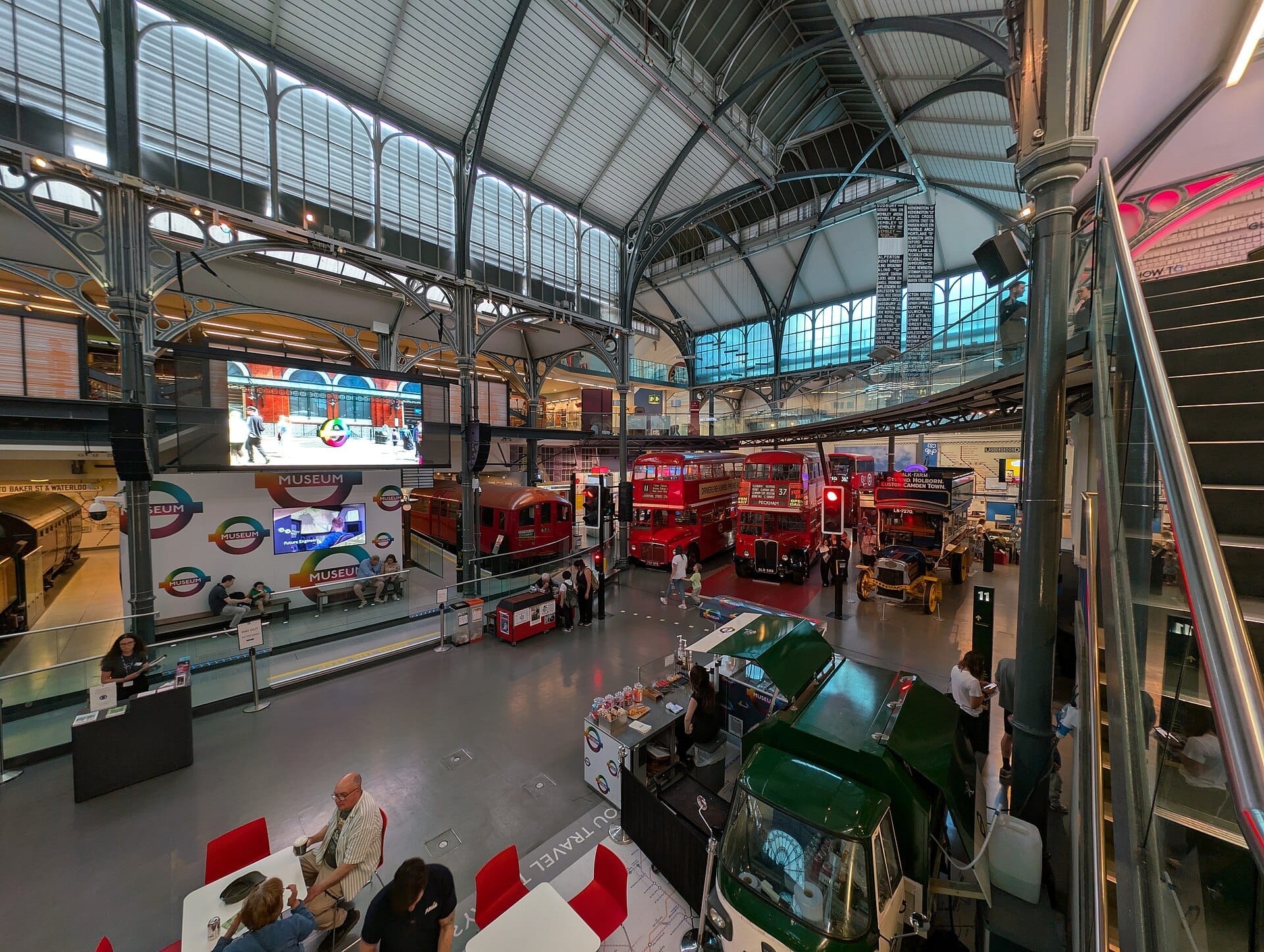
The London Transport Museum occupies the restored Victorian flower market at the southeastern corner of Covent Garden Piazza, a cast-iron and glass structure built in 1871 to a design by William Rogers. Since the museum moved here in 1980 and completed a major refurbishment in 2007, the building has become part of the appeal: the original iron columns, soaring roof glazing, and industrial-era proportions make a fitting stage for double-decker buses and early Underground carriages.
Do not let the institutional name put you off. This is not a dry archive of timetables and maintenance schedules. The collection spans roughly 200 years of London movement, from horse-drawn omnibuses of the 1820s and 1830s through the electrification of the Tube, the wartime role of transport workers, and the celebrated graphic design tradition that gave the world the Harry Beck Tube map and the roundel logo still in use today. The museum makes a persuasive case that public transport shaped London's geography, culture, and social identity more than almost any other force.
ℹ️ Good to know
Admission works on an Annual Pass model, which means your ticket covers unlimited return visits for 12 months. If you enjoy the museum once, you effectively get every subsequent visit free. Children 18 and under always enter free.
The Building and the Approach
Arriving at the museum from the Piazza side, you are already inside one of London's most familiar tourist environments. Street performers occupy the cobbled square, cafes spill onto the pavement, and the noise carries through the open arcade. The museum entrance sits quietly at the corner, easy to miss if you are not looking for it. The shop on the ground floor is accessible without paying admission, a useful detail if you want to pick up a gift or browse the collection of facsimile Tube posters without committing to the full visit.
Once inside the main hall, the scale of the Victorian structure becomes apparent. Buses and trams are parked at ground level, their full height reaching toward the glazed roof. The smell is faintly metallic and slightly dusty, the way well-maintained old vehicles tend to smell, and the light on clear days filters through the roof in broad shafts that give the interior an almost theatrical quality. On overcast days the atmosphere is cooler and more industrial, which actually suits the collection rather well.
Tickets & tours
Hand-picked options from our booking partner. Prices are indicative; availability and final rates are confirmed when you complete your booking.
LEGOLAND Windsor tickets with roundtrip transport
From 84 €Instant confirmationFree cancellationWarner Bros. Studio Tour London - The Making of Harry Potter tickets with transport
From 137 €Instant confirmationFree cancellationTootbus London by Night: Bus tour
From 32 €Instant confirmationFree cancellationThe Making of Harry Potter Guided Tour of London Warner Bros. Studio
From 201 €Instant confirmationFree cancellation
What You Will See: The Collection Floor by Floor
The permanent collection is arranged broadly chronologically across multiple levels connected by stairs and a lift. Ground level is dominated by full-size vehicles, including horse-drawn omnibuses, early motor buses, and tram cars that you can board and examine at close range. Climbing onto the platform of a 1930s bus and sitting in the worn wooden seats is a tactile experience that no display case can replicate. Children, predictably, make straight for these.
Upper levels move into the Tube's own history: the carriages, signalling equipment, station furniture, and the engineering challenges of driving tunnels beneath a city already dense with sewers, foundations, and gas mains. A section dedicated to the wartime use of Underground stations as shelters is sobering and well-researched, with photographs, personal accounts, and original objects. The acoustic design here is notably quieter than the rest of the museum, which reinforces the gravity of the subject.
The graphic design collection deserves its own mention because it is exceptional. London Transport has commissioned consistently outstanding poster art since the early twentieth century, working with artists including Man Ray, Edward McKnight Kauffer, and Paul Nash. The originals and facsimiles on display represent a century of visual communication, and the section explaining the evolution of the Harry Beck Tube map from 1931 onward is one of the most engaging pieces of design history you will find in any London museum. For anyone interested in typography, wayfinding, or modernist graphic art, this alone justifies the visit.
If the museum's graphic heritage interests you, it connects naturally to a broader exploration of London's creative districts. The West End immediately surrounding Covent Garden has its own design and cultural density, from theatres to galleries within easy walking distance.
How the Experience Changes by Time of Day
Weekday mornings, particularly before noon, are consistently the quietest period. School groups do visit during term time, but they tend to cluster in specific sections and move through on timed schedules, so the congestion is usually predictable. If you arrive at opening (10:00, daily) on a Tuesday or Wednesday, you can move through the ground-floor vehicles with almost no competition for space or sight lines.
Weekend afternoons between 12:00 and 16:00 are the busiest periods. Families with young children fill the ground floor, and the interactive elements attract queues. The upper floors, particularly the design and social history sections, tend to stay calmer because they hold less immediate appeal for under-tens. If you are visiting primarily for the graphic design and historical content rather than the vehicles, a weekend afternoon is more tolerable than the ground-floor experience might suggest.
💡 Local tip
Book a timed entry slot in advance on the museum website. Walk-in availability is often limited on weekends and school holidays. Booking takes two minutes and costs nothing extra on top of the Annual Pass price.
Historical and Cultural Context
The museum's subject matter is the London Underground, but its real theme is how a city moves and how movement determines everything else: where people can afford to live, which areas grow, which communities form, and which remain isolated. The Tube's northward expansion in the 1930s created the suburban phenomenon of Metroland, an entire commuter geography that did not exist before the railway arrived. The museum documents this with maps, photographs, and estate agents' advertisements from the period that read as remarkable social documents.
The story of London's bus network is similarly embedded in labour history. The 1958 bus strike, led largely by West Indian workers protesting discriminatory employment practices at London Transport, is given clear and honest treatment. The museum does not shy away from the role public transport institutions played in structural discrimination, which makes the collection more credible and more interesting than a straightforwardly celebratory approach would.
Understanding London's transport heritage adds depth to a visit to the operational network itself. The getting around London guide covers the current Tube, bus, and rail options in practical detail, and reading it alongside a visit to the museum gives both layers more meaning.
Practical Walkthrough: Getting There and Getting In
The nearest Underground station is Covent Garden on the Piccadilly line, which is essentially on the museum's doorstep. The station is known for its deep-level platforms and reliance on lifts and stairs rather than escalators, but the walk from the exit to the museum entrance takes under two minutes. Charing Cross station on National Rail serves the area from south London and is about a 10-minute walk along the Strand. Leicester Square station (Northern and Piccadilly lines) is about a seven-minute walk and useful if Covent Garden station has a queue, which it sometimes does on busy afternoons.
Admission uses the Annual Pass model rather than a standard day ticket, meaning your first purchase covers every return visit for 12 months. An adult pass costs £24.50; a concession pass (for students, over-60s, and certain other qualifying groups) costs £23.50. Local residents can, at times, access reduced-rate offers (check current pricing). Universal Credit and Pension Credit holders pay £1. Carers and companions of visitors who need assistance enter free, as do children 18 and under. TfL staff with a valid staff card may be eligible for free entry; check current staff benefits.
The museum is open daily from 10:00 to 18:00 (last entry 17:15), closing only over Christmas. There is a lift connecting all floors, and the main exhibit spaces are accessible to wheelchair users, though some of the vehicle interiors have steps that are inherent to the original design. Prams and pushchairs are welcome throughout the building.
⚠️ What to skip
The Covent Garden Tube station has no step-free access. Wheelchair users and those with buggies should alight at Leicester Square and walk, or approach via Charing Cross station which offers step-free access from street to mainline platforms and to the Underground via some routes; check current accessibility details. Verify current conditions with TfL before travel.
Photography, the Shop, and What Else Is Nearby
Photography is permitted throughout the museum without flash. The vehicles on the ground floor photograph well in the diffused roof light, particularly in the morning when the sun angle is lower. The upper galleries, with their poster displays and smaller artefacts, benefit from the museum's relatively low ambient lighting, so a camera with good low-light performance makes a difference. The Tube carriage interiors are popular subjects for photography precisely because they look so different from the current rolling stock.
The museum shop is one of the better ones in London. It sells facsimile Tube posters, original-design homeware, books on transport history and graphic design, and an extensive range of gifts using the roundel motif. It is accessible from the street without a museum ticket, which keeps it busy even on days when museum footfall is lower.
After leaving the museum, the surrounding area offers easy onward options. Covent Garden itself has markets, street food, and theatre-district energy. Somerset House is a ten-minute walk east along the Strand, with free courtyard access and regular exhibitions. For those building a full day around the area, a three-day London itinerary can help structure the wider West End into a manageable sequence.
Insider Tips
- The Annual Pass model makes a second visit effectively free. If you have children who want longer with the vehicles than your schedule allows the first time, plan to return: it costs nothing extra and the queue for re-entry is usually shorter than for first-time visitors.
- The gift shop sells a small selection of authentic London Transport poster prints at reasonable prices. These are not cheap reproductions but properly reproduced archive editions. They make considerably more interesting souvenirs than anything available in most tourist shops nearby.
- If you want a quieter experience of the design and social history galleries, let families with young children disperse to the ground-floor vehicles first, then work the upper levels. The contrast in noise levels between floors is significant.
- The museum runs a regular programme of events, talks, and themed evenings for adults, some of which include after-hours access to the collection. Check the events calendar on the museum website when planning your trip, as these sell out quickly.
- The Depot at Acton Town, the museum's main storage and conservation facility, opens for public open days several times a year. It holds far more vehicles and artefacts than the Covent Garden site can display, and the behind-the-scenes format is different from the main museum experience. Dates are announced on the museum website.
Who Is London Transport Museum For?
- Families with children aged 5 to 14, who can board and explore full-size vehicles
- Graphic designers and visual arts enthusiasts drawn to the poster collection and the Harry Beck Tube map story
- Anyone interested in London's social history, particularly the relationship between infrastructure and urban development
- Rainy-day visitors needing a full half-day of covered, indoor activity in the heart of the West End
- Travellers on repeat London visits looking for a substantial museum experience that does not require a full day
Nearby Attractions
Other things to see while in West End:
- British Library
The British Library holds over 170 million items spanning thousands of years of human thought, from the Magna Carta to Beatles lyrics. Entry to the building and permanent collection galleries is free, making it one of the most rewarding stops in central London for curious travellers.
- British Museum
The British Museum holds one of the world's great collections of human history and culture, spanning two million years across more than 60 free galleries. Entry to the permanent collection is free, but knowing how to navigate the scale of it makes the difference between a rewarding visit and an overwhelming one.
- Carnaby Street
Carnaby Street is the pedestrianised shopping district in Soho that defined the look of 1960s London and continues to draw fashion lovers, food hunters, and curious walkers today. Free to explore and five minutes from Oxford Circus, it rewards those who slow down and wander its connecting lanes.
- Coal Drops Yard
Coal Drops Yard is a redeveloped Victorian industrial estate in King's Cross, now home to independent retailers, restaurants, and bars set beneath strikingly restored brick vaults. The public outdoor spaces are free to enter and a short walk from King's Cross St Pancras station.