The Brazen Head: Inside Dublin's Most Historic Pub
Set on Lower Bridge Street near the River Liffey, The Brazen Head draws visitors with a claim to being Ireland's oldest pub, a site with documented records from the 17th century and licensed to sell ale since 1661. Expect low ceilings, live traditional music seven nights a week, and a courtyard that feels genuinely old rather than manufactured.
Quick Facts
- Location
- 20 Lower Bridge St., Usher's Quay, Dublin D08 WC64
- Getting There
- Dublin Bus routes to Merchant's Quay or Four Courts; short walk from the Luas Red Line (Four Courts stop)
- Time Needed
- 1–3 hours depending on whether you stay for food and music
- Cost
- Free entry; drinks and food priced at standard Dublin pub rates
- Best for
- Traditional Irish music, history enthusiasts, first-time Dublin visitors
- Official website
- brazenhead.com
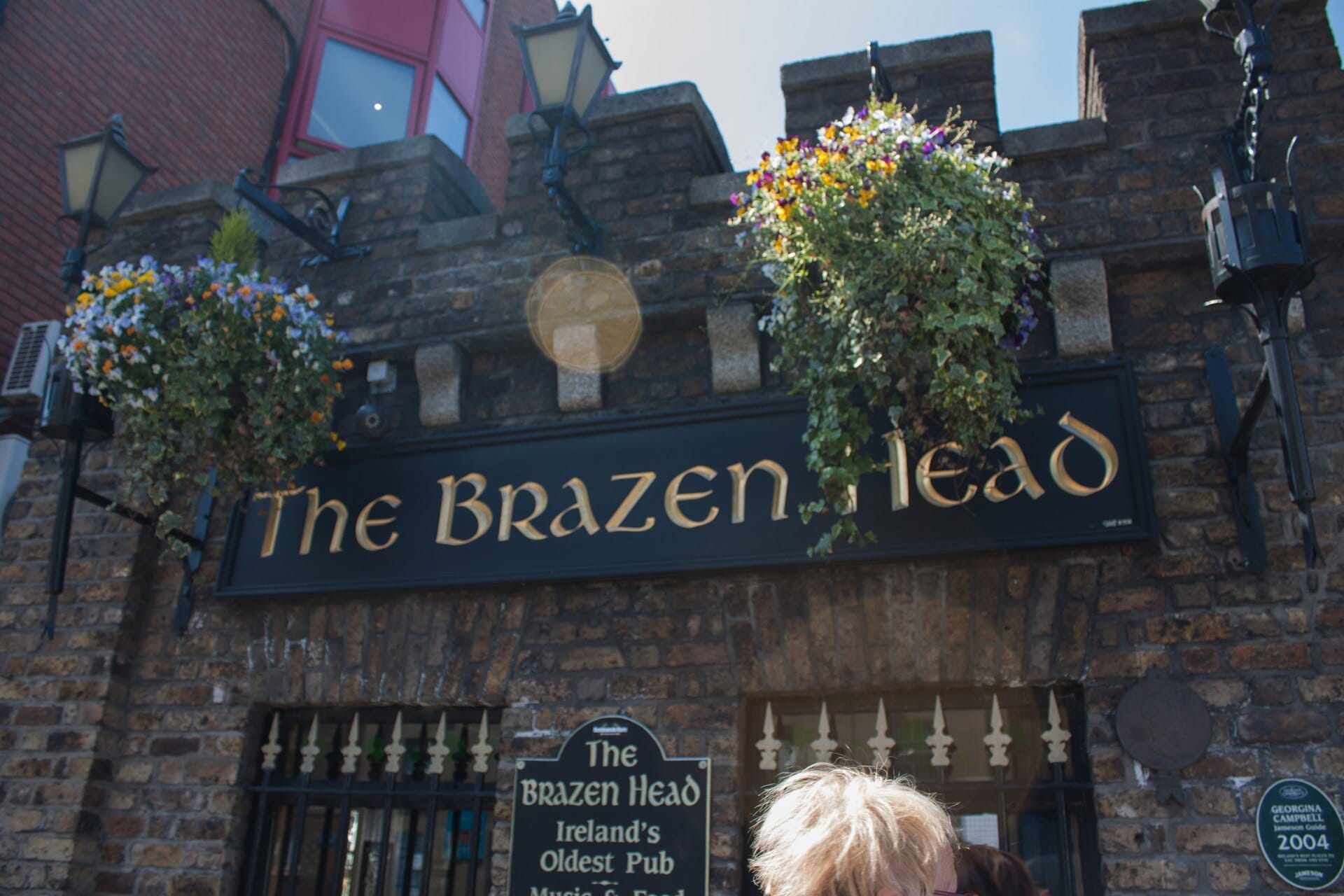
What Is The Brazen Head?
The Brazen Head is a pub and restaurant at 20 Lower Bridge Street, on the south bank of the River Liffey in the Merchant's Quay area of Dublin. The site appears in records as far back as the early 17th century, received a licence to sell ale in 1661, and was first noted formally as an inn in 1668. The current building dates to 1754, constructed as a coaching inn at a time when this stretch of the quays was a hub of trade and cross-city movement.
What that means in practice: the physical fabric of the pub, the low archway entrance off Bridge Street, the cobbled courtyard, the timber beams and partitioned rooms inside, carries genuine age rather than the theme-pub approximation of it. That said, The Brazen Head is well known to tourists and trades partly on its historical reputation, so anyone expecting a quiet, undiscovered local should calibrate their expectations accordingly.
ℹ️ Good to know
Opening hours: daily from 12:00 to late. Food served 12:00–21:00. Live music seven nights a week from 21:00 (9pm), and Sunday sessions from 15:00–18:00 (3pm–6pm). No admission charge.
How the Pub Changes Through the Day
Arrive at lunchtime and the mood is calm by evening standards. The courtyard gets afternoon light on clear days, and the inner rooms are quiet enough to notice the details: the framed photographs of Irish historical figures, the hand-written notes pinned to walls and beams, the low doorframes that remind you this building predates modern ergonomics. Food service runs until 21:00 and covers Irish pub staples, hearty and filling rather than refined.
By early evening, particularly after 18:00, the population shifts. Groups on walking tours arrive, tourists from the surrounding area fill the bar, and the noise levels rise considerably. The pub becomes genuinely crowded on Friday and Saturday evenings, with limited standing room in the front bar. If you are coming for atmosphere rather than music specifically, the window between 17:00 and 19:30 is often the most comfortable.
The live traditional music sessions start at 21:00 (9pm) nightly, with Sunday afternoon sessions from around 15:00 to 18:00 (3pm–6pm). The Sunday session tends to attract a more local crowd alongside visitors, which changes the feel noticeably. The music is performed in a dedicated area, and the acoustics in the low-ceilinged rooms mean the sound carries throughout, not just to those seated nearest the musicians.
💡 Local tip
For the Sunday afternoon session (15:00–18:00), arrive 20–30 minutes early to secure a seat. This session has a noticeably different atmosphere from the weeknight sessions and is worth the slight effort.
Tickets & tours
Hand-picked options from our booking partner. Prices are indicative; availability and final rates are confirmed when you complete your booking.
Giant's Causeway, Dark Hedges, and Belfast Tour from Dublin
From 85 €Instant confirmationFree cancellationDublin self-guided audio tour
From 10 €Instant confirmationBird of Prey, Cliffs of Moher and Aillwee Cave from Dublin
From 201 €Instant confirmationFree cancellationGame of Thrones Studio tour with return transfer from Dublin
From 63 €Instant confirmationFree cancellation
Historical and Cultural Context
The location of The Brazen Head on Bridge Street is not incidental. Father Mathew Bridge, immediately adjacent, marks a long-used crossing point of the Liffey in Dublin, linking the north and south of the city near a historically important fordable point. This is where the Viking settlement of Dublin, Dyflin, grew from around the 9th century, and the area remained central to the city's commercial and civic life through the medieval and early modern periods.
The pub's walls are hung with references to figures from Irish nationalist history, including the United Irishmen of the 1798 rebellion. Robert Emmet, the Irish rebel leader executed in 1803, is among the names associated with the pub in historical accounts. Whether these associations are thoroughly documented or partly myth is part of the texture of visiting a place with this kind of layered, sometimes romanticised past. For a more rigorous approach to Dublin's political and revolutionary history, Kilmainham Gaol offers a more structured account.
The Smithfield-Liberties area surrounding the pub has its own significant history as a zone outside the jurisdiction of Dublin's medieval guilds, which allowed craft industries to operate freely. Today the neighbourhood contains Jameson Distillery Bow St. and several other heritage-related attractions within a short walk.
The Physical Experience: What You Actually See and Feel
The entrance is easy to miss on first approach. A narrow archway off Lower Bridge Street opens into a cobbled courtyard with outdoor seating. In good weather this courtyard is pleasant; in rain, which Dublin produces reliably across all seasons, it becomes less appealing and most people move inside. The courtyard connects to the main bar and several internal rooms, each slightly different in character.
Inside, the dominant sensory note is wood. Darkened timber on the ceilings, walls, and furniture absorbs light and creates an evening-like quality even at midday. The smell is the familiar layering of an old working pub: stale beer absorbed into surfaces over decades, food from the kitchen, and on music nights, a crowd-warmth that quickly fills the space. The floors are uneven in places, the furniture is worn, and none of this feels staged.
Accessibility is worth noting: the building's age and courtyard entrance mean level access may be limited in certain areas. No explicit accessibility statement is published on the official website, and visitors with mobility requirements should contact the pub directly before visiting to confirm what areas are reachable.
Getting There and Practical Navigation
The pub sits on Lower Bridge Street at Usher's Quay, roughly a 12–15 minute walk from Trinity College Dublin or Dublin Castle. Dublin Bus serves Merchant's Quay and the Four Courts area with several routes from the city centre. The Luas Red Line's Four Courts stop is also walkable, placing the pub within comfortable reach of Heuston Station and the broader Red Line network.
If you are combining the visit with nearby attractions, The Four Courts is a short walk north along the quays, and the Smithfield Square area is within ten minutes on foot, giving you options for extending an afternoon or evening in this part of the city.
⚠️ What to skip
Lower Bridge Street is not always clearly signposted from the main quays. Look for Father Matthew Bridge and the archway entrance is immediately beside it on the south bank side. Google Maps gets you within metres but the arch entrance can read as a passage rather than a pub entrance.
Is The Brazen Head Worth Your Time?
The honest answer depends entirely on what you are looking for. If you want to stand in a building that has been serving drinks since the 17th century, in a neighbourhood that has been continuously inhabited for over a thousand years, then The Brazen Head delivers that in a way few pubs anywhere can. The building is real, the history is documented, and the music sessions are not performance events for tourists but practising musicians playing traditional Irish music.
If, however, you are looking for a pub with minimal tourist traffic and an organic local atmosphere, this is not the right choice on a Friday or Saturday evening. The pub's reputation means it draws significant visitor numbers, particularly from tour groups and travellers following standard Dublin itineraries. For a more local-leaning experience of Irish pub culture, The Cobblestone in nearby Smithfield offers traditional music in a setting that skews more toward local musicians and regular patrons.
Those travelling on a budget will find no entry charge and standard Dublin pub pricing. For context on planning a broader Dublin visit without overspending, the Dublin on a budget guide covers practical options across food, transport, and attractions.
Insider Tips
- The Sunday afternoon session (15:00–18:00) is consistently cited as the most authentic music experience at The Brazen Head. It draws more local musicians and a mixed crowd, unlike the heavier tourist presence at evening sessions.
- Book a table for dinner if you plan to eat and stay for the 21:00 music. Walk-in space fills quickly after 19:30 on weekends, and standing in the music room is uncomfortable for extended periods in a full house.
- The courtyard is the best spot in good weather. It is also the quietest corner of the pub during busier evenings, since most visitors move inside for the music. If you want conversation rather than performance, stay outside.
- The wall and ceiling decorations, notes, newspaper clippings, and photographs, reward slow reading. Many are genuine historical documents or reproductions of letters and proclamations from the 1798 and 1803 periods of Irish history.
- Arrive from the Father Matthew Bridge side and look for the archway rather than a conventional pub frontage. First-time visitors occasionally walk past it on the quays because the entrance faces Bridge Street rather than the river.
Who Is The Brazen Head For?
- First-time visitors to Dublin wanting a single pub that combines genuine historical fabric with live traditional music
- History and heritage travellers interested in the physical layers of Dublin from the 17th and 18th centuries
- Anyone specifically seeking a live Irish music session without a formal concert-style ticket or stage setup
- Groups looking for a pub with enough space and varied rooms to accommodate different energy levels in the same visit
- Travellers pairing a visit with nearby Smithfield and Liberties attractions who want a natural endpoint for an afternoon walk
Nearby Attractions
Other things to see while in Smithfield & The Liberties:
- Christ Church Cathedral
Christ Church Cathedral has anchored Dublin's skyline for nearly a thousand years, predating the city's most famous landmarks by centuries. This guide covers what you actually see inside, when to go, how to get there, and whether the admission fee is worth it.
- Dublinia Viking and Medieval Museum
Dublinia brings over a thousand years of Dublin's earliest history to life through immersive reconstructions of Viking longships, medieval streetscapes, and hands-on archaeology exhibits. Housed in the 19th-century Gothic Revival Synod Hall beside Christ Church Cathedral, it rewards curious visitors of almost any age.
- Guinness Open Gate Brewery
Tucked inside the St. James's Gate complex on James's Street, the Guinness Open Gate Brewery is a working experimental taproom where Guinness brewers test recipes that never make it to supermarket shelves. No queues, no theatrics, just serious beer in a real brewery setting.
- Guinness Storehouse
The Guinness Storehouse takes you through seven floors of brewing history at St James's Gate, the birthplace of one of the world's most recognisable drinks. The experience ends at the rooftop Gravity Bar with a complimentary pint and views across the Dublin skyline. It draws more visitors than any other paid attraction in Ireland, and whether that's a recommendation or a caution depends entirely on what you're after.