Four Courts Dublin: Inside Ireland's Most Dramatic Civic Building
The Four Courts is Ireland's principal courts complex, set in a monumental Georgian building on the north bank of the River Liffey. Designed by James Gandon and completed in 1796, it carries the scars of the 1922 Civil War and remains a working legal institution open to the public for free.
Quick Facts
- Location
- Inns Quay, Dublin 7 — north bank of the River Liffey
- Getting There
- Four Courts Luas stop (Red Line), direct access from city centre
- Time Needed
- 45 minutes to 1.5 hours depending on interest
- Cost
- Free — no tickets required
- Best for
- Architecture enthusiasts, history visitors, legal proceedings observers
- Official website
- www.courts.ie/four-courts
What the Four Courts Actually Is
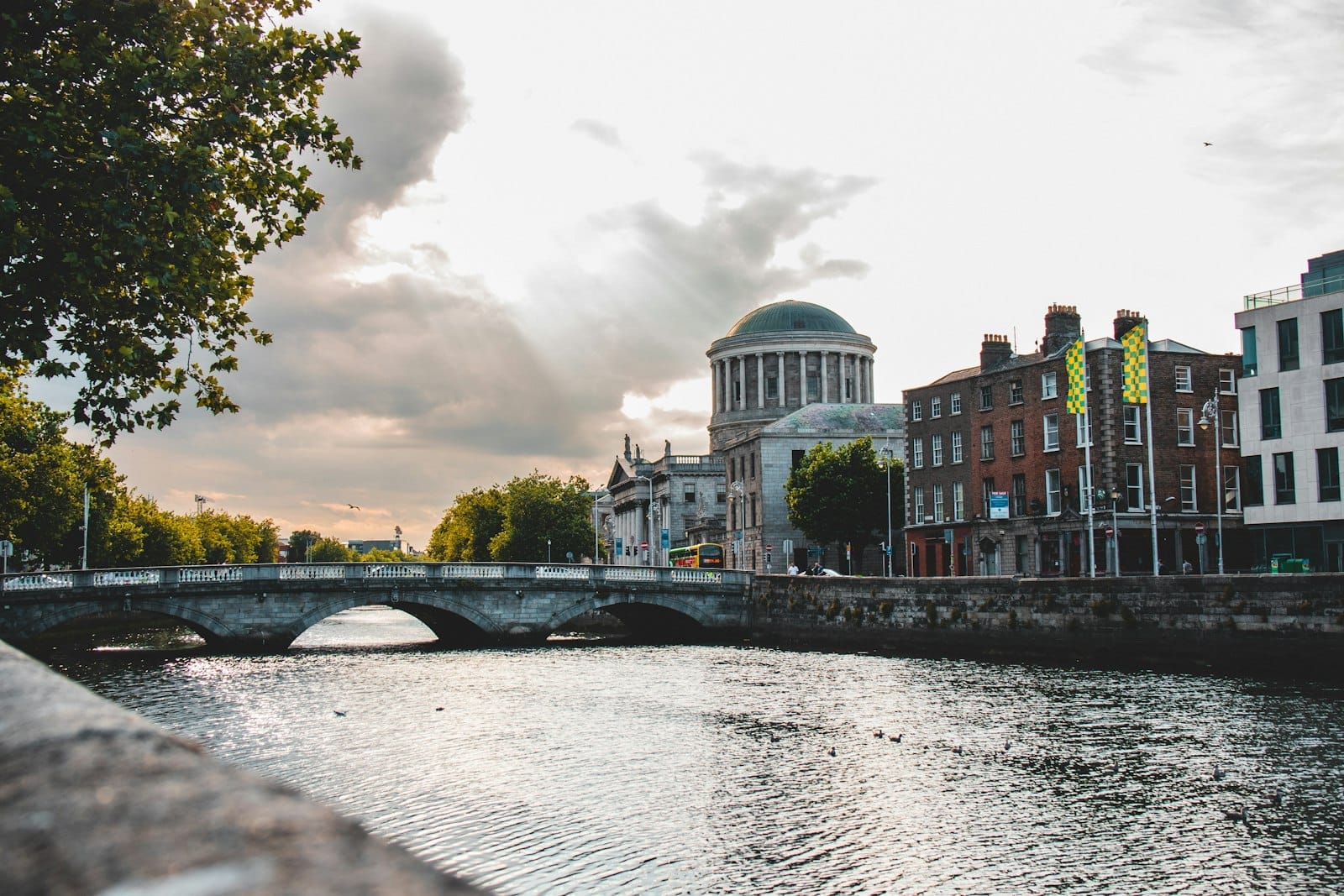
The Four Courts (Irish: Na Ceithre Cúirteanna) is Ireland's principal courts complex and one of the most architecturally significant buildings in Dublin. It stands on Inns Quay on the north bank of the River Liffey, its grey limestone facade and copper-green dome forming one of the most recognisable profiles on the city skyline. This is not a museum or a heritage site dressed up to look important. It is an active courthouse where some of Ireland's most consequential legal proceedings take place, and visitors are genuinely welcome to observe.
The building is generally open to visitors Monday to Friday, 10:00 to 16:00. Courts are closed on weekends. There is no ticket, no booking system, and no entrance fee. Visitors enter via the public entrance on the quays, pass through a security screening point, and can then walk through the building's public areas and sit in on court hearings.
💡 Local tip
Large groups should contact the Courts Service in advance before visiting. An information desk is located inside the Round Hall and staff can direct you to which courts are sitting on a given day.
The Architecture: Gandon's Masterpiece on the Liffey
Construction on the Four Courts began in 1776 under architect Thomas Cooley. When Cooley died in 1784, the project passed to James Gandon, the Anglo-Irish architect who also designed the nearby Custom House downstream. Gandon substantially reworked the plans, and the foundation stone for the enlarged design was laid in 1786. The first court sat inside the building in November 1796, making it one of the defining civic buildings of late 18th-century Ireland.
The most striking element is the Round Hall: a circular, colonnaded space topped by a dome measuring 64 feet in diameter, with both inner and outer shells and a ring of Corinthian columns at the base. Standing directly beneath it, the geometry is almost disorienting. The acoustics amplify footsteps and voices into a low, continuous echo. Light filters through the lantern above in thin diagonal shafts on clear mornings, catching the dust in the air.
The exterior is best viewed from the opposite bank of the Liffey, particularly from the southern quays west of the Ha'penny Bridge. From there, the full sweep of the building becomes clear: the central block with its portico of six Corinthian columns, the flanking wings, and the drum-and-dome that dominates the roofline. Photographers working in the early morning get clean reflections on the river surface and softer light on the limestone.
If the architecture of Georgian Dublin interests you, the Four Courts sits naturally alongside a broader walk taking in the Custom House to the east and the wider context covered in a Georgian Dublin architecture guide. Both buildings are Gandon's work and represent the high point of neoclassical civic design in Ireland.
Tickets & tours
Hand-picked options from our booking partner. Prices are indicative; availability and final rates are confirmed when you complete your booking.
Wicklow and Glendalough day trip from Dublin with Powerscourt Gardens
From 65 €Instant confirmationFree cancellationGiant's Causeway, Dark Hedges, and Belfast Tour from Dublin
From 85 €Instant confirmationFree cancellationDublin self-guided audio tour
From 10 €Instant confirmationBird of Prey, Cliffs of Moher and Aillwee Cave from Dublin
From 201 €Instant confirmationFree cancellation
The 1922 Civil War and the Catastrophic Loss of Irish Archives
The Four Courts carries a wound that goes deeper than architecture. In April 1922, anti-Treaty IRA forces occupied the building during the opening months of the Irish Civil War. When Free State forces shelled the building in June 1922 under pressure from the British government, the resulting fire and explosion destroyed the Irish Public Record Office, which was housed in an adjacent wing within the complex.
The loss was irreversible. Centuries of census records, parish registers, wills, and legal documents going back nearly a thousand years were destroyed in the blaze. For anyone researching Irish genealogy or pre-20th-century Irish history, this event created gaps that can never be fully closed. It ranks among the most significant archival disasters in European history. The walls of the Round Hall still bear evidence of patching and repair from this period, a physical record that restoration work deliberately left visible in places.
The building was subsequently restored and remodelled, reopening in 1932. The rebuilt structure preserved Gandon's exterior form while significantly reorganising the interior. What visitors walk through today is partly 18th century and partly a 1930s reconstruction working carefully within the original envelope.
What Visiting Actually Looks Like
Security screening at the entrance is standard: bags go through an X-ray scanner, and there are airport-style body checks. The process is quick on most weekday mornings. Once through, you enter the Round Hall, which functions as the building's central hub. Barristers in black gowns and wigs cross the space at pace. The administrative rhythm of a busy court building is immediately tangible: files being carried, court clerks moving between offices, solicitors conferring in low voices near the pillars.
The public are permitted to enter individual courtrooms and observe proceedings from the public gallery, provided the hearing is not restricted. Most civil and criminal cases are heard in open court. Etiquette is straightforward: enter quietly when court is sitting, do not use your phone, and do not photograph inside courtrooms. The information desk in the Round Hall can tell you which courts are in session and where.
The experience shifts considerably depending on time of day. Mornings, particularly between 10:00 and 12:00, are the most active. Judges take the bench, lists are called, and the building operates at full capacity. In the early afternoon the pace slows, some courtrooms rise early, and the Round Hall becomes quieter. Visitors who want to observe proceedings should arrive before midday.
⚠️ What to skip
Court is not in session on weekends, bank holidays, or during court vacation periods. Visiting outside of sitting hours means access to the public areas only, with no court proceedings to observe. Check the Courts Service website before planning a specific visit.
Getting There and Practical Notes
The Four Courts Luas stop on the Red Line sits directly outside the building, making it one of the easiest major landmarks in Dublin to reach by public transport. The Red Line runs from Tallaght and Saggart in the southwest through the city centre and on to The Point and Connolly in the Docklands. From central stops like Jervis or Abbey Street, it is one or two stops. Buses along the northern quays also stop nearby.
On foot from the city centre, the walk along the north quays from O'Connell Bridge takes around 15 minutes. The route passes several notable civic buildings and gives a useful sense of the quayside before you arrive. There is no dedicated visitor car park at the Four Courts, and parking on the quays is restricted, so public transport or walking is the practical choice for most visitors.
Accessibility details for step-free routes and accessible facilities within the building are not comprehensively documented in public sources. Visitors with specific accessibility requirements should contact the Courts Service office directly before visiting to confirm arrangements.
Who Will Get the Most from This Visit
People with a serious interest in Georgian architecture, Irish history around the 1916 to 1923 period, or the workings of the Irish legal system will find the Four Courts genuinely worthwhile. It pairs well with a walk across to the Dublin Castle complex or a visit to the Kilmainham Gaol, both of which cover connected chapters of Irish political and legal history.
Visitors looking for interactive exhibits, audio guides, or a structured tourist experience will find this harder to navigate. There are no interpretive displays explaining the building's history, no gift shop, and no café on site. The building is a working courthouse first and an attraction incidentally. That authenticity is part of its appeal, but it means the experience requires more self-direction than most heritage sites.
Travellers with children may find the visit short on obvious engagement, though older children studying Irish history may be interested in the Civil War context. For families looking for more interactive options nearby, the Dublinia experience or the Dublin with kids guide covers more age-appropriate alternatives.
Insider Tips
- The best exterior photographs of the Four Courts are taken from the south quays, early morning, with the dome reflected in the Liffey. The light is at its most useful between 8:00 and 10:00 before river traffic disturbs the water.
- Check the Courts Service website before visiting if you want to observe a specific type of proceeding. High Court sittings, Court of Appeal cases, and Supreme Court hearings are listed online with room numbers.
- The Round Hall itself is worth 10 minutes of unhurried observation even if you have no interest in legal proceedings. Stand at the centre and look directly up at the dome. The scale only becomes clear from that position.
- The east wing of the complex, closer to the river, shows the most visible evidence of 1922 reconstruction work on the exterior stonework. Compare the texture and colour of the stone on different sections for a direct physical record of the damage and repair.
- Avoid visiting during court vacation periods (usually August, Christmas, and Easter) if observing proceedings is part of your interest. The building is largely empty during these weeks and much of the interior atmosphere disappears with it.
Who Is Four Courts For?
- Architecture enthusiasts with an interest in Georgian neoclassicism and James Gandon's civic designs
- History visitors focused on the Irish Civil War, the 1916 to 1923 period, or the loss of the Public Record Office
- Anyone curious about the Irish legal system who wants to observe real court proceedings
- Photographers working along the Liffey quays who want a strong subject for riverfront compositions
- Budget travellers: this is one of the few major architectural landmarks in Dublin with completely free access
Nearby Attractions
Combine your visit with:
- Abbey Theatre
Founded in 1904 by W.B. Yeats and Lady Gregory, the Abbey Theatre is Ireland's National Theatre and one of the most historically significant stages in the English-speaking world. Sitting on Lower Abbey Street in the heart of Dublin city centre, it continues to produce new Irish work alongside classic plays that shaped a nation's identity.
- Blessington Street Basin
Once the Royal George Reservoir supplying water to Dublin's north side, Blessington Street Basin is now a free public park in Phibsborough. The central lake, Tudor gate lodge, and resident wildfowl make it one of the most quietly rewarding green spaces within walking distance of Dublin city centre.
- Casino Marino
Casino Marino is an 18th-century Neo-Classical pleasure house in north Dublin, designed by Sir William Chambers for the Earl of Charlemont. Despite its compact exterior, the building conceals 16 rooms across three floors — a feat of architectural illusion that continues to astonish visitors. Access is by guided tour only, with admission from €3 for children and students and €5 for adults.
- Clontarf Promenade
Clontarf Promenade stretches 4.5 kilometres along Dublin Bay from Fairview to the Bull Wall at Dollymount, offering open sea views, public art, and a marked cycle route along much of its length. It costs nothing to visit, runs along a flat sea wall path, and delivers some of the most expansive coastal scenery accessible from Dublin city centre.