Templo de San Francisco de Asís: One of Guadalajara's Oldest Standing Churches
Rising from the corner of Av. 16 de Septiembre and Avenida Revolución, the Templo de San Francisco de Asís is one of the oldest religious buildings in Guadalajara, with roots going back to 1580. Free to enter and located in the heart of the Centro Histórico, it rewards visitors who look beyond the cathedral circuit with carved stone facades, a tranquil interior, and a notable double-church arrangement that stands out in the downtown area.
Quick Facts
- Location
- Av. 16 de Septiembre y Avenida Revolución, Centro Histórico, Guadalajara, Jalisco
- Getting There
- Walk from San Juan de Dios (Line 2) or Plaza Universidad (Line 2) light rail stops; also reachable on foot from Plaza de Armas in about 10 minutes
- Time Needed
- 20–40 minutes for the church itself; pair with Aranzazú next door for a full hour
- Cost
- Free admission; parish office hours Mon–Fri 09:00–13:00 and 16:00–18:00, Sat 09:00–13:00 (office only; the temple itself has been reported closed pending reopening)
- Best for
- Colonial architecture, religious heritage, quiet contemplation, photography
What Is the Templo de San Francisco de Asís?
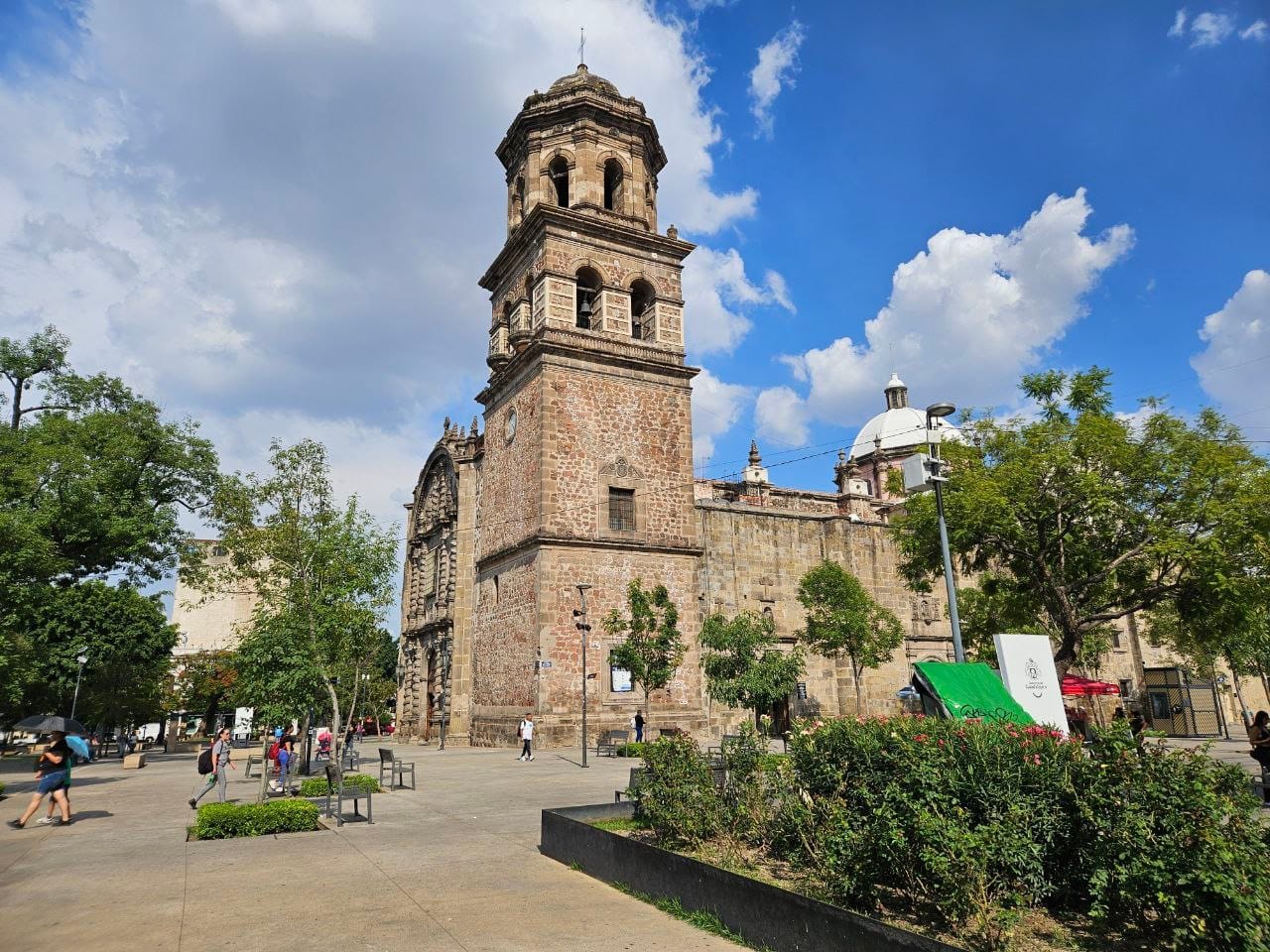
The Templo de San Francisco de Asís is a Catholic church at the corner of Avenida 16 de Septiembre and Avenida Revolución, in the southern edge of Guadalajara's Centro Histórico. Construction of the first church began around 1580, making it one of the oldest surviving religious structures in the city. The building was substantially rebuilt and expanded starting in 1668, and the layered result of those two building campaigns is visible in the facade today: older stonework meets later Baroque detailing in a way that tells the church's history without a single word.
The temple sits in what locals and guides call 'Los Dos Templos,' a compact zone where the Templo de San Francisco de Asís stands directly alongside the Templo de Nuestra Señora de Aranzazú. Two colonial churches, two distinct facades, one small urban block. The pairing is architecturally unusual and relatively undervisited compared to the cathedral complex about ten minutes north on foot.
💡 Local tip
Arrive on a weekday morning when natural light hits the carved stone facade from the east. The interior is quiet at that hour, and the ornamental details on the doorway are much easier to photograph without afternoon shade or weekend foot traffic.
The Architecture: What to Look For
The exterior facade of the Templo de San Francisco de Asís is the main reason architectural visitors make the detour. Carved in the regional volcanic stone called cantera rosa, the ornamental work around the main entrance combines Baroque motifs with elements common to 17th-century New Spain religious architecture. Look at the layering of niches and pilasters flanking the doorway: each tier introduces slightly different decorative vocabulary, a record of the different hands and periods involved in construction.
The bell tower is proportionally narrow compared to the width of the nave, which gives the building a vertical emphasis that stands out against the low streetline of Prisciliano Sánchez. From across the street, you get the cleanest read of the full composition. Inside, the space is calmer than the exterior suggests: a single nave with side altars, painted surfaces in muted tones, and natural light filtering through relatively modest windows. It is not a baroque interior in the grand sense, but it has a measured, devotional quality that makes it worth spending time in.
The adjacent Templo de Aranzazú has a more dramatically ornamented interior and is worth entering immediately after. Together, the two buildings make the 'Los Dos Templos' area a worthwhile stop on any architectural walking tour of Guadalajara.
Tickets & tours
Hand-picked options from our booking partner. Prices are indicative; availability and final rates are confirmed when you complete your booking.
Lake Chapala and Ajijic guided tour from Guadalajara
From 68 €Instant confirmationFree cancellationGuadalajara and Tlaquepaque guided tour
From 73 €Instant confirmationFree cancellation
Historical Context: Four Centuries in the Centro Histórico
When the Franciscan order began construction here in 1580, Guadalajara had been a Spanish colonial city for just a few decades. The site reflects the early mission-oriented urban planning of New Spain, in which religious orders claimed key blocks near the city center and built complexes that included the church, a convent, and open atrium space. Much of what surrounded the original complex has since been absorbed by the urban fabric, but the church itself survived.
The 1668 expansion corresponded with a period of increasing investment in Guadalajara's religious infrastructure as the city grew into its role as the administrative capital of the New Galicia region. The Franciscan presence here was part of a broader network of colonial-era churches across the Centro Histórico, several of which still stand within walking distance.
Understanding the Templo de San Francisco de Asís is easier if you already have a sense of the broader historic center layout. The Centro Histórico contains more than a dozen colonial-era churches and civic buildings within a walkable radius, and San Francisco anchors the southern portion of that cluster.
Visiting: Time of Day and Atmosphere
Early mornings between 8:00 and 10:00 are the most atmospheric time to visit. The church is active as a parish, meaning there are local worshippers present rather than just tourists, which gives the space an unperformative quality that the more famous cathedral sometimes lacks. The sound inside is hushed: occasional footsteps on stone, the low hum of traffic filtering in from 16 de Septiembre, sometimes the distant echo of vendors setting up on the street outside.
By midday on weekends, the surrounding streets are considerably busier, and the area around 'Los Dos Templos' fills with families and street food vendors. The churches themselves remain calm inside, but the exterior photos become harder to take cleanly. Late afternoon, as light warms the cantera stone facade to a deeper gold tone, is a good second option for photography.
Guadalajara's rainy season runs roughly June through September, with afternoon downpours common in July and August. The covered doorways of both temples offer decent shelter, but plan outdoor photography for morning hours during that period. The dry season months from November through April are generally the most comfortable for spending time walking the historic center.
Getting There and Getting Around
The temple is in the southern part of the Centro Histórico, roughly a 10-minute walk from the Plaza de Armas and the main cathedral cluster. The SITEUR light rail system serves the area: the closest stops are on Line 2, and the walk from either nearby Line 2 station (such as San Juan de Dios or Plaza Universidad) takes under 15 minutes through the historic streets. Uber and DiDi both operate in central Guadalajara and can drop you directly on Avenida 16 de Septiembre.
The temple is conveniently positioned for combining with other nearby sites. The Mercado San Juan de Dios is a short walk to the east, and the Parque Agua Azul is a few blocks south, making a logical half-day route through this part of the center.
ℹ️ Good to know
The area around 16 de Septiembre is pedestrian-friendly but can be congested with street vendors and foot traffic near Mercado San Juan de Dios, especially on weekend afternoons. Wear comfortable walking shoes and keep bags closed in crowded sections.
Practical Notes and Who Might Skip This
Admission is free. The parish office operates during specific hours (Monday to Friday 09:00 to 13:00 and 16:00 to 18:00; Saturday 09:00 to 13:00), but current reports indicate the church building itself has been closed pending reopening, so access for worship and visits may be restricted. No specific accessibility information was available at time of writing; the entrance involves stone steps typical of colonial-era construction, and the interior floor is uneven in places.
Dress modestly when visiting, as this is an active parish. Covered shoulders are appropriate, and avoiding beachwear or very short clothing is a reasonable baseline for any of Guadalajara's historic churches.
Travelers who have already visited the Hospicio Cabañas, the cathedral, and the Templo Expiatorio and are running short on time may find San Francisco more modest by comparison. It does not have the scale of the cathedral or the dramatic murals of the Hospicio. Its value is in its age, its quiet character, and the double-church pairing with Aranzazú next door. If colonial churches in general do not interest you, this stop is easily skipped.
For those building a thorough itinerary of the city's historic center, this temple fits naturally into a walking tour of Guadalajara's Centro Histórico. It also appears on routes connecting the cathedral area southward toward the Parque Agua Azul corridor.
Insider Tips
- Stand on the opposite sidewalk on Prisciliano Sánchez, not directly in front of the entrance, to capture both the San Francisco facade and the Aranzazú tower in a single frame. It's the most efficient composition in the block.
- If you visit during a weekday morning Mass, wait near the back of the nave. The acoustic quality of the stone interior during sung prayer is unusually good for a building this size.
- The carved cantera stone around the main doorway shows different weathering patterns on each tier, a direct result of the 1668 expansion using slightly different stone cuts than the original 1580 structure. It's a small detail that becomes clear once you know to look for it.
- Combine San Francisco and Aranzazú in one stop rather than treating them as separate visits. Entering both churches back to back, you notice the contrast in interior treatment immediately: San Francisco is more austere, Aranzazú more ornate.
- Street food vendors near the 16 de Septiembre and Calzada Independencia intersection, a few blocks east, are most active from midday onward. After your temple visit, it's a natural stop for a quick torta ahogada or tamale before continuing the route.
Who Is Templo de San Francisco de Asís For?
- Colonial architecture enthusiasts wanting to see 16th and 17th-century Franciscan construction up close
- Photographers looking for carved cantera stone facades with good morning light
- Travelers building a comprehensive walking route through the Centro Histórico
- Anyone interested in the religious urban history of New Spain beyond the main cathedral
- Visitors who prefer quiet, active-parish atmospheres over high-traffic tourist interiors
Nearby Attractions
Other things to see while in Centro Histórico:
- Calandrias (Horse-Drawn Carriage Rides)
Calandrias are Guadalajara's traditional horse-drawn carriages, operating through the colonial streets of the Centro Histórico since the early 20th century. A slow, unhurried circuit past cathedral facades, plazas, and pedestrian corridors, they offer a different pace from the city's foot traffic. This guide covers what to expect, when to go, and whether it's worth your time.
- Guadalajara Cathedral (Catedral de Guadalajara)
The Catedral Basílica de la Asunción de María Santísima anchors Guadalajara's historic center, surrounded by four plazas and centuries of layered history. Its twin neo-Gothic spires are the city's most recognized silhouette, and entry is free. Here is everything you need to know before you go.
- Instituto Cultural Cabañas (Hospicio Cabañas)
A UNESCO World Heritage Site at the heart of Guadalajara's Centro Histórico, Hospicio Cabañas houses José Clemente Orozco's most celebrated murals inside a neoclassical complex of staggering scale. This is the single most significant cultural site in western Mexico, and one of the most important in all of Latin America.
- Lienzo Charro de Jalisco
The Lienzo Charro Charros de Jalisco, on Av. R. Michel near Parque Agua Azul, is one of Mexico's most storied charro arenas. Home to one of Mexico's oldest charro associations, this is where Jalisco's equestrian traditions are kept alive through competitive charreadas, pageantry, and music.