Mercado San Juan de Dios (Mercado Libertad): The Real Guadalajara Market Experience
Mercado San Juan de Dios, officially known as Mercado Libertad, is the largest covered market in Latin America. Spread across three floors and roughly 40,000 square meters in Guadalajara's historic center, this 1958 market packs nearly 3,000 stalls selling everything from birria and fresh juice to leather boots, electronics, and Jalisco handicrafts. Entry is free and the market is open every day, generally from 8 AM to 8 PM.
Quick Facts
- Location
- Calle Dionisio Rodríguez 52, Col. San Juan de Dios, Centro Histórico, Guadalajara, Jalisco
- Getting There
- Line 2 light rail (San Juan de Dios station); Mi Macro Calzada BRT stops nearby on Calzada Independencia
- Time Needed
- 1.5 to 3 hours depending on pace; longer if you eat and browse seriously
- Cost
- Free entry. Budget MXN 80–200 for a full comida corrida lunch; stall prices vary widely
- Best for
- Street food lovers, budget shoppers, people-watchers, and anyone curious about everyday Guadalajara life
What Mercado San Juan de Dios Actually Is
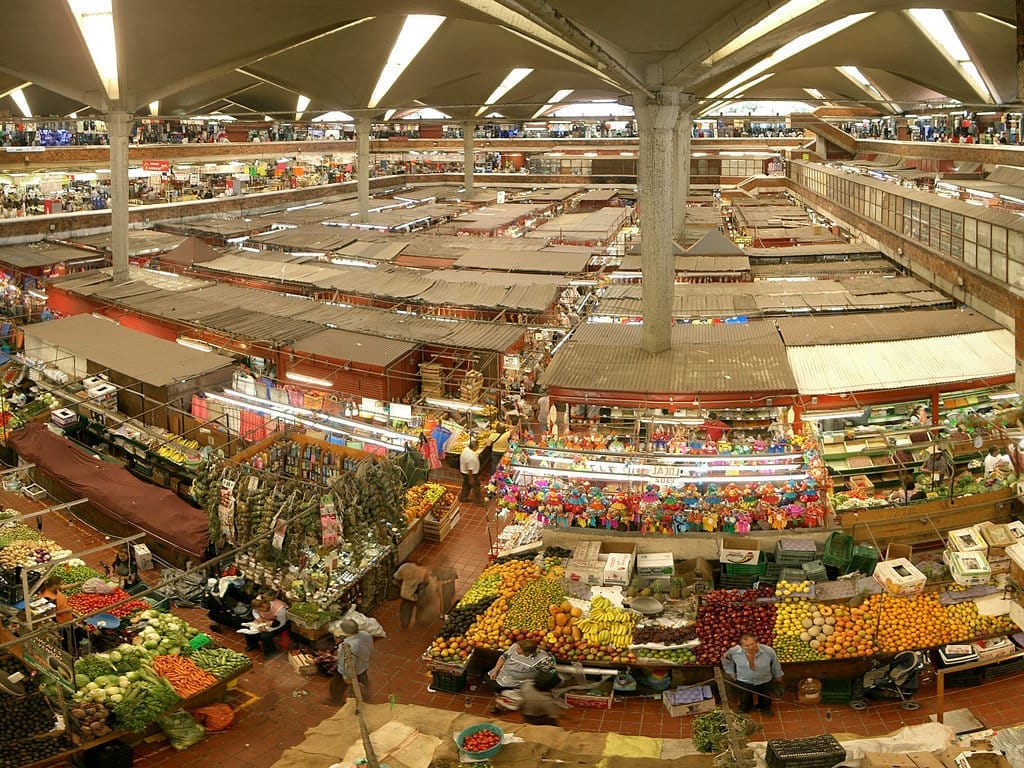
Mercado San Juan de Dios, also called Mercado Libertad by the city's tourism offices, is not a quaint artisan bazaar or a sanitized food hall for visitors. It is a working, breathing commercial infrastructure used daily by tens of thousands of tapatíos for groceries, clothing, hardware, herbs, and lunch. Inaugurated on December 30, 1958 and designed to replace a sprawling outdoor market that had occupied the same district for generations, the building spans approximately 40,000 square meters and contains about 3,000 stalls across three floors.
The scale is the first thing that hits you. The ground floor opens into a vast hall where natural light filters through concrete skylights onto rows of produce vendors, butchers, and spice sellers. The smell shifts every few meters: roasting corn, raw meat, dried chiles, fresh-cut flowers, and somewhere in the background, the faint sweetness of candy stalls. By mid-morning the corridors are shoulder-to-shoulder with shoppers pulling carts, vendors calling out prices, and delivery workers weaving through on hand trucks.
💡 Local tip
The market is at its most photogenic and atmospheric between 9 AM and 11 AM on weekdays. Weekends bring larger crowds but also more activity in the food sections. Avoid arriving after 6 PM when many stalls begin packing up.
Three Floors, Three Different Experiences
Each floor of Mercado Libertad has its own distinct character, and understanding the layout saves you considerable wandering. The ground level is the most chaotic and the most rewarding for food. This is where the market's famous food stalls cluster: long counters serving birria (the local slow-cooked goat or beef stew), tortas ahogadas drowned in spicy tomato sauce, pozole, and fresh-squeezed juices. Plastic stools line the counters and vendors compete for your attention, gesturing at steaming pots. The food here is priced for local workers, not tourists, which means a full lunch rarely costs more than a few hundred pesos.
The upper floors shift toward dry goods and clothing. You will find leather goods, including belts, wallets, and boots made in Jalisco, alongside stalls selling synthetic fabrics, quinceañera dresses, school uniforms, electronics, and household items. The quality and pricing are inconsistent: some leather work is genuinely skilled craft at honest prices, while other stalls sell cheap imports at inflated tourist rates. The third floor has a reputation for electronics and novelty goods and tends to be quieter, with more negotiating room.
For context on where this market fits into the city's shopping landscape, it helps to compare it to the calmer craft markets in the metro area. If you are specifically looking for ceramics, glass, and fine textiles, the markets in Tlaquepaque and Tonalá will serve you better. Mercado San Juan de Dios is better understood as an immersion in ordinary commercial life rather than a curated souvenir experience.
Tickets & tours
Hand-picked options from our booking partner. Prices are indicative; availability and final rates are confirmed when you complete your booking.
Lake Chapala and Ajijic guided tour from Guadalajara
From 68 €Instant confirmationFree cancellationGuadalajara and Tlaquepaque guided tour
From 73 €Instant confirmationFree cancellation
The Food Section: Where the Market Earns Its Reputation
The ground-floor food corridor is the single most compelling reason for most visitors to come here. The birria in particular is worth planning around. You will see vendors ladling deep-red broth into wide clay bowls, piling shredded meat on top, and handing across fresh tortillas with diced onion and dried oregano on the side. Tapatíos dip the tortilla into the consommé before eating, and the flavor is concentrated and smoky in a way that packaged versions never replicate. Several stalls have operated in the same spots for decades and their reputations are maintained by word of mouth within the neighborhood.
Beyond birria, the produce section reveals the agricultural richness of Jalisco: stacks of different chile varieties, fresh nopales already sliced, deep-purple tamarinds, and seasonal fruits from the Atemajac Valley. Herb vendors sell bundles of epazote, hierba santa, and other cooking plants that rarely appear in formal restaurants. Watching a local grandmother negotiate the price of a kilo of tomatillos while vendors around her shout competing offers is as informative about Guadalajara's food culture as any cookbook.
ℹ️ Good to know
Birria is deeply embedded in Jalisco's culinary identity and Mercado San Juan de Dios is one of the most reliable places in the city to eat it at working-class prices in a genuine setting. Budget around MXN 80–150 for a full bowl with broth and tortillas, though prices should be verified at the stall.
For broader context on what to eat and where across the city, the Guadalajara food guide covers the full range from street tacos to upscale regional dining.
Historical and Architectural Context
The land around what is now Mercado Libertad has served as a trading place since the colonial era. The San Juan de Dios district took its name from the hospital built there by the Order of Saint John of God, which dates back to the colonial era, and informal markets operated in the surrounding streets for centuries. By the mid-20th century the open-air market had grown to the point that city authorities commissioned a purpose-built structure to consolidate it. The building that opened in 1958 represents a particular strain of mid-century Mexican public architecture: functional concrete construction with modernist details, built on a scale intended to project civic confidence.
The building is not a showcase of architectural refinement in the way that other downtown structures are, but it has a certain honest brutalism. The concrete overhead channels and diffuses light in ways that change noticeably across the day. Early morning light is direct and warm through the upper vents; by afternoon it flattens and the interior takes on a more uniform gray. The overall structure has been maintained and modified over the decades without significant restoration, so what you see is an accumulation of practical adaptation rather than preservation.
The market sits within walking distance of several of Guadalajara's most architecturally significant landmarks. The Hospicio Cabañas, a UNESCO World Heritage Site housing José Clemente Orozco's celebrated murals, is roughly 600–700 meters to the northwest. The contrast between the two buildings, one a refined neoclassical institution and the other a concrete commercial engine, says something about how the historic center has accumulated its layers.
Navigating the Market: Practical Walkthrough
Enter from Calle Dionisio Rodríguez on the eastern side to arrive directly at the ground-floor food stalls. This is the most immediate and rewarding entry point for first-time visitors. If you enter from the Calzada Independencia side you will find yourself among clothing and general merchandise, which requires more deliberate navigation to reach the food section. There are no printed maps distributed at the entrance, and stall numbering, while it exists, is not intuitive for navigation.
Wear shoes you do not mind getting wet or marked. The floor near the produce and meat sections is routinely wet, and the market does not use non-slip mats uniformly. Bring small bills: many stall vendors do not carry change for large denominations and some decline card payments. Pickpocketing is a reported concern in dense markets throughout Mexico, so keep bags worn in front and avoid displaying high-value electronics while browsing.
⚠️ What to skip
Keep bags secured and phone use discreet, particularly in the more crowded ground-floor corridors during peak hours. Petty theft is an acknowledged risk in busy markets in Mexico's urban centers.
Photography is generally tolerated in the public corridors and food sections, though it is courteous to ask vendors before pointing a camera directly at their stall or at individuals. Some vendors welcome it; others find it intrusive. Natural light is better in the morning, and the produce section offers the most compelling visual variety. The upper floors are poorly lit and not well-suited for photography without additional equipment.
Getting There and Getting Around the Neighborhood
The most convenient public transport option is the Line 2 light rail, with San Juan de Dios station placing you within a short walk of the market's eastern entrance. The Mi Macro Calzada BRT runs along Calzada Independencia just to the west of the building, offering connections to the north and south of the city. Taxis and ride-hailing apps including Uber and DiDi are reliable drop-off options; confirm the exact address as Mercado Libertad to avoid confusion.
The market is a natural anchor for a broader walk through the historic center. From here you can walk west toward the Plaza Tapatía and the cathedral quarter in under fifteen minutes on foot. The surrounding streets in the San Juan de Dios neighborhood have their own informal vendors and small eateries worth exploring as you approach or leave the main building. For a full walking itinerary connecting the market with the city's other downtown landmarks, the Guadalajara walking tour guide covers the logical sequence.
Who Should Manage Their Expectations
Visitors expecting an organized, easy-to-navigate artisan market will find Mercado San Juan de Dios overwhelming and possibly disappointing. The market is loud, dense, and primarily designed for locals on practical errands. The language of commerce here is Spanish, prices are rarely displayed, and haggling is expected for anything other than food. Travelers with mobility limitations should know that the building involves ramps and stairs between floors, and the floor surfaces are uneven in sections.
Those looking for high-quality regional crafts specifically will be better served in Tlaquepaque or Tonalá, where the selection is curated and the provenance of handmade goods is easier to verify. What the market does offer instead is an unfiltered view of how a large Mexican city actually trades and eats, and that has its own kind of value.
Insider Tips
- The food stalls with the longest queue of workers and locals during the 12:00–2:00 PM lunch window are almost always the ones worth eating at. A full queue is a better quality signal than any sign or recommendation.
- If you want to buy leather goods, compare prices across at least three stalls before committing. The same style of belt or wallet can have a price range of 50% or more between different vendors on the same floor.
- The produce section in the early morning (before 9:30 AM) is calmer and vendors are more likely to explain what an unfamiliar ingredient is and how it is used. Later in the day they are too busy to engage.
- There is a small section near the food corridor where vendors sell pre-made salsas and mole pastes packaged to travel. These make practical edible souvenirs and are often made by the same families cooking at the adjacent food stalls.
- The market exterior along Calzada Independencia has informal street food carts that are worth checking on your way in or out, particularly for fresh fruit cups with chile and lime, which are often better value than similar offerings inside.
Who Is Mercado San Juan de Dios (Mercado Libertad) For?
- Food travelers who want to eat birria and tortas ahogadas in a working-class setting at honest prices
- Budget-conscious visitors looking for everyday Mexican goods, clothing, and leather at local prices
- Urban explorers interested in mid-20th century Mexican public architecture and market culture
- Photographers interested in documentary-style street and market photography in natural light
- Travelers wanting to understand Guadalajara beyond its tourist landmarks and museum circuit
Nearby Attractions
Other things to see while in Centro Histórico:
- Calandrias (Horse-Drawn Carriage Rides)
Calandrias are Guadalajara's traditional horse-drawn carriages, operating through the colonial streets of the Centro Histórico since the early 20th century. A slow, unhurried circuit past cathedral facades, plazas, and pedestrian corridors, they offer a different pace from the city's foot traffic. This guide covers what to expect, when to go, and whether it's worth your time.
- Guadalajara Cathedral (Catedral de Guadalajara)
The Catedral Basílica de la Asunción de María Santísima anchors Guadalajara's historic center, surrounded by four plazas and centuries of layered history. Its twin neo-Gothic spires are the city's most recognized silhouette, and entry is free. Here is everything you need to know before you go.
- Instituto Cultural Cabañas (Hospicio Cabañas)
A UNESCO World Heritage Site at the heart of Guadalajara's Centro Histórico, Hospicio Cabañas houses José Clemente Orozco's most celebrated murals inside a neoclassical complex of staggering scale. This is the single most significant cultural site in western Mexico, and one of the most important in all of Latin America.
- Lienzo Charro de Jalisco
The Lienzo Charro Charros de Jalisco, on Av. R. Michel near Parque Agua Azul, is one of Mexico's most storied charro arenas. Home to one of Mexico's oldest charro associations, this is where Jalisco's equestrian traditions are kept alive through competitive charreadas, pageantry, and music.